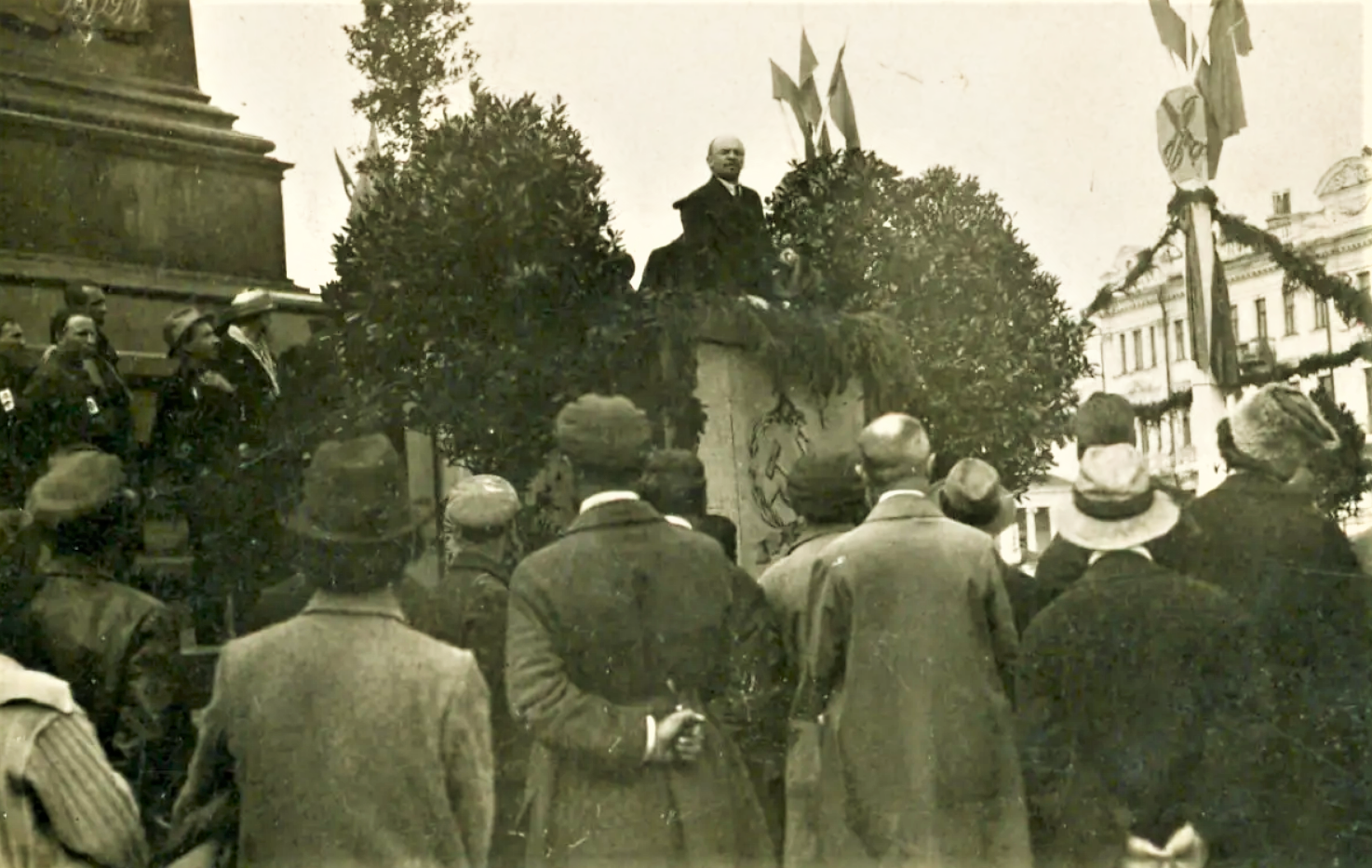
Written in late September, 1917 as a letter to the Bolshevik Central Committee, Lenin says it is not Blanquism to make plans for revolution, while at the same time stressing that insurrections were acts of revolutionary art and not of social science.
‘Marxism and Uprising’ (1917) by V.I. Lenin from On the Eve of October. Little Lenin Library, Vol. 13. International Publishers, New York. 1932.
AMONG the most vicious and perhaps most widespread distortion of Marxism practiced by the prevailing “Socialist” parties, is to be found the opportunist lie which says that preparations for an uprising, and generally the treatment of an uprising as an art, is “Blaquism.”1
Bernstein, the leader of opportunism, long since gained sad notoriety by accusing Marxism of Blanquism and our present opportunists, by shouting about Blanquism, in reality do not in any way improve or “enrich” the meagre “ideas” of Bernstein.
To accuse Marxists of Blanquism for treating uprising as an art! Can there be a more flagrant distortion of the truth, when there is not a single Marxist who denies that it was Marx who expressed himself in the most definite, precise and categorical manner on this score; that it was Marx who called uprising nothing but an art, who said that uprising must be treated as an art, that one must gain the first success and then proceed from success to success without stopping the offensive against the enemy and making use of his confusion, etc., etc.
To be successful, the uprising must be based, not on a conspiracy, not on a party, but on the advanced class. This is the first point. The uprising must be based on the revolutionary upsurge of the people. This is the second point. The uprising must be based on the crucial point in the history of the maturing revolution, when the activity of the vanguard of the people is at its height, when the vacillations in the ranks of the enemies, and in the ranks of the weak, half-hearted, undecided friends of the revolution are at their highest point. This is the third point. It is in pointing out these three conditions as the way of approaching the question of an uprising, that Marxism differs from Blanquism.
But once these conditions exist, then to refuse to treat the uprising as an art means to betray Marxism and the revolution.
To show why this very moment must be recognised as the one when it is obligatory for the party to recognise the uprising as placed on the order of the day by the course of objective events, and to treat uprising as an art–to show this, it will perhaps he best to use the method of comparison and to draw a parallel between July 16-17 and the September days.2
On July 16·17 it was possible, without trespassing against the truth, to put the question thus: it would have been more proper to take power, since our enemies would anyway accuse us of revolt and treat us as rebels. This, however, did not warrant a decision to take power at that time, because there were still lacking the objective conditions for a victorious uprising.
1. We did not yet have behind us the class that is the vanguard of the revolution. We did not yet have a majority among the workers and soldiers of the capitals. Now we have a majority in both Soviets. It was created only by the history of July and August, by the experience of ruthless punishment meted out to the Bolsheviks, and by the experience of the Kornilov affair.
2. At that time there was no general revolutionary upsurge of the people. Now there is, after the Kornilov affair. This is proven by the situation in the provinces and by the seizure of power by the Soviets in many localities.
3. At that time there were no vacillations on a serious, general, political scale among our enemies and among the undecided petty bourgeoisie. Now the vacillations are enormous; our main enemy, the imperialism of the Allies and of the world (for the “Allies” are at the head of world imperialism), has begun to vacillate between war to a victory and a separate peace against Russia. Our petty bourgeois democrats, having obviously lost their majority among the people, have begun to vacillate enormously, rejecting a bloc, i.e., a coalition with the Cadets.
4. This is why an uprising on July 16-17 would have been an error: we would not have retained power either physically or politically. Not physically, in spite of the fact that at certain moments Petrograd was in our hands, because our workers and soldiers would not have fought and died at that time for the sake of holding Petrograd; at that time people had not yet become so “brutalised”; there was not in existence such a burning hatred both towards the Kerenskys and towards the Tseretelis and Chernovs; and our own people were not yet hardened by the experience of the Bolsheviks being persecuted, while the Socialist-Revolutionaries and Mensheviks took part in the persecuting.
We could not have retained power July 16·17 politically, for, before the Kornilov affair, the army and the provinces could and would have marched against Petrograd.
Now the picture is entirely different.
We have back of us the majority of a class that is the vanguard of the revolution, the vanguard of the people, and is capable of drawing the masses along.
We have back of us a majority of the people, for Chernov’s resignation, far from being the only sign, is only the most striking, the most outstanding sign showing that the peasantry will not receive land from a bloc with the S.-R.’s, or from the S.-R.’s themselves. And in this lies the essence of the popular character of the revolution.
We are in the advantageous position of a party which knows its road perfectly well, while imperialism as a whole, as well as the entire bloc of the Mensheviks and the S.-R.’s, is vacillating in an extraordinary manner.
Victory is assured to us, for the people are now very close to desperation, and we are showing the whole people a sure way out, having demonstrated to the whole people the significance of our leadership during the “Kornilov days,” and then having offered the bloc politicians a compromise which they rejected at a time when their vacillations continued uninterruptedly.
It would be a very great error to think that our compromise offer has not yet been rejected, that the “Democratic Conference“3 still may accept it. The compromise was offered from party to parties. It could not have been offered otherwise. The parties have rejected it. The Democratic Conference is nothing but a conference. One must not forget one thing, namely, that this conference does not represent the majority of the revolutionary people, the poorest and most embittered peasantry. One must not forget the self-evident truth that this conference represents a minority of the people. It would be a very great error, a very great parliamentary idiocy on our part, if we were to treat the Democratic Conference as a parliament, for even if it were to proclaim itself a parliament, the sovereign parliament of the revolution, it would not be able to decide anything. The decision lies outside of it, in the workers’ sections of Petrograd and Moscow.
We have before us all the objective prerequisites for a successful uprising. We have the advantages of a situation where only our victory in an uprising will put an end to the most painful thing on earth, the vacillations that have sickened the people; a situation where only our victory in an uprising will put an end to the game of a separate peace against the revolution by openly offering a more complete, more just, more immediate peace in favour of the revolution.
Only our party, having won a victory in an uprising, can save Petrograd, for if our offer of peace is rejected, and we obtain not even a truce, then we shall become “defensists,” then we shall place ourselves at the head of the war parties, we shall be the most “warring” party, and we shall carryon a war in a truly revolutionary manner. We shall take away from the capitalists all the bread and all the shoes. We shall leave them crumbs. We shall dress them in bast shoes. We shall send all the bread and all the shoes to the front.
And then we shall save Petrograd.
The resources, both material and spiritual, of a truly revolutionary war are still immense in Russia; there are ninety-nine chances in a hundred that the Germans will at least grant us a truce. And to secure a truce at present means to conquer the whole world.
Having recognised the absolute necessity of an uprising of the workers of Petrograd and Moscow for the sake of saving the revolution and of saving Russia from being “separately” divided among the imperialists of both coalitions, we must first adapt our political tactics at the conference to the conditions of the maturing uprising; secondly, we must prove that we accept, and not only in words, the idea of Marx about the necessity of treating uprising as an art.
At the conference, we must immediately consolidate the Bolshevik fraction without worrying about numbers, without being afraid of leaving the vacillators in the camp of the vacillating: they are more useful there to the cause of revolution than in the camp of the resolute and courageous fighters.
We must compose a brief declaration in the name of the Bolsheviks in which we sharply emphasise the irrelevance of long speeches, the irrelevance of “speeches” generally, the necessity of quick action to save the revolution, the absolute necessity of breaking completely with the bourgeoisie, of completely ousting the whole present government, of completely severing relations with the Anglo-French imperialists who are preparing a “separate” partition of Russia, the necessity of all power immediately passing into the hands of revolutionary democracy headed by the revolutionary proletariat.
Our declaration must be the briefest and sharpest formulation of this conclusion; it must connect up with the points in the programme of peace to the people, land to the peasants, confiscation of scandalous profits, and a halt to the scandalous damage to production done by the capitalists.
The briefer, the sharper the declaration, the better. Only two more important points must be clearly indicated in it, namely, that the people are tired of vacillations, that they are tortured by the lack of decisiveness on the part of the S.-R.’s and Mensheviks; and that we are definitely severing relations with these parties because they have betrayed the revolution.
The other point. In offering an immediate peace without annexations, in breaking at once with the Allied imperialists and with all imperialists, we obtain either an immediate truce or a going over of the entire revolutionary proletariat to the side of defence, and a truly just, truly revolutionary war will then be waged by revolutionary democracy under the leadership of the proletariat.
Having made this declaration, having appealed for decisions and not talk; for actions, not writing resolutions, we must push our whole fraction into the factories and barracks: its place is there; the pulse of life is there; the source of saving the revolution is there; the moving force of the Democratic Conference is there.
In heated, impassioned speeches we must make our programme clear and we must put the question this way: either the conference accepts it fully, or an uprising follows. There is no middle course. Delay is impossible. The revolution is perishing.
Having put the question this way, having concentrated our entire fraction in the factories and barracks, we shall correctly estimate the best moment to begin the uprising.
And in order to treat uprising in a Marxist way, i.e., as an art, we must at the same time, without losing a single moment, organize the staff of the insurrectionary detachments; designate the forces; move the loyal regiments to the most important points; surround the Alexander theatre; occupy Peter and Paul Fortress; arrest the general staff and the government; move against the military cadets, the Wild Division,4 etc., such detachments as will die rather than allow the enemy to move to the centre of the city; we must mobilise the armed workers, call them to a last desperate battle, occupy at once the telegraph and telephone stations, place our staff of the uprising at the central telephone station, connect it by wire with all the factories, the regiments, the points of armed fighting, etc.
Of course, this is all by way of an example, to illustrate the idea that at the present moment it is impossible to remain loyal to the revolution without treating uprising as an art.
N. LENIN.
Written September 26-27, 1917. First published in 1921 in the magazine Proletarskaya Revolyutsiya. No.2.
NOTES
1. The teachings of the French revolutionist, Auguste Blanqui (l805·1881) favouring the overthrow of the ruling power through secret plots of a few revolutionists rather than through preparation and organisation of the masses led by a revolutionary party. Ed.
2. The strikes and demonstrations in July and the defeat of the Kornilov revolt in September. Ed.
3. Called by the Kerensky government in the attempt to secure a broader base among the petty bourgeoisie following the Kornilov revolt. Ed.
4. A division of Caucasian mountaineer troops. Ed.
International Publishers was formed in 1923 for the purpose of translating and disseminating international Marxist texts and headed by Alexander Trachtenberg. It quickly outgrew that mission to be the main book publisher, while Workers Library continued to be the pamphlet publisher of the Communist Party.
PDF of original book: https://fau.digital.flvc.org/islandora/object/fau%3A4365/datastream/OBJ/download/On_the_eve_of_October.pdf
 Revolution's Newsstand