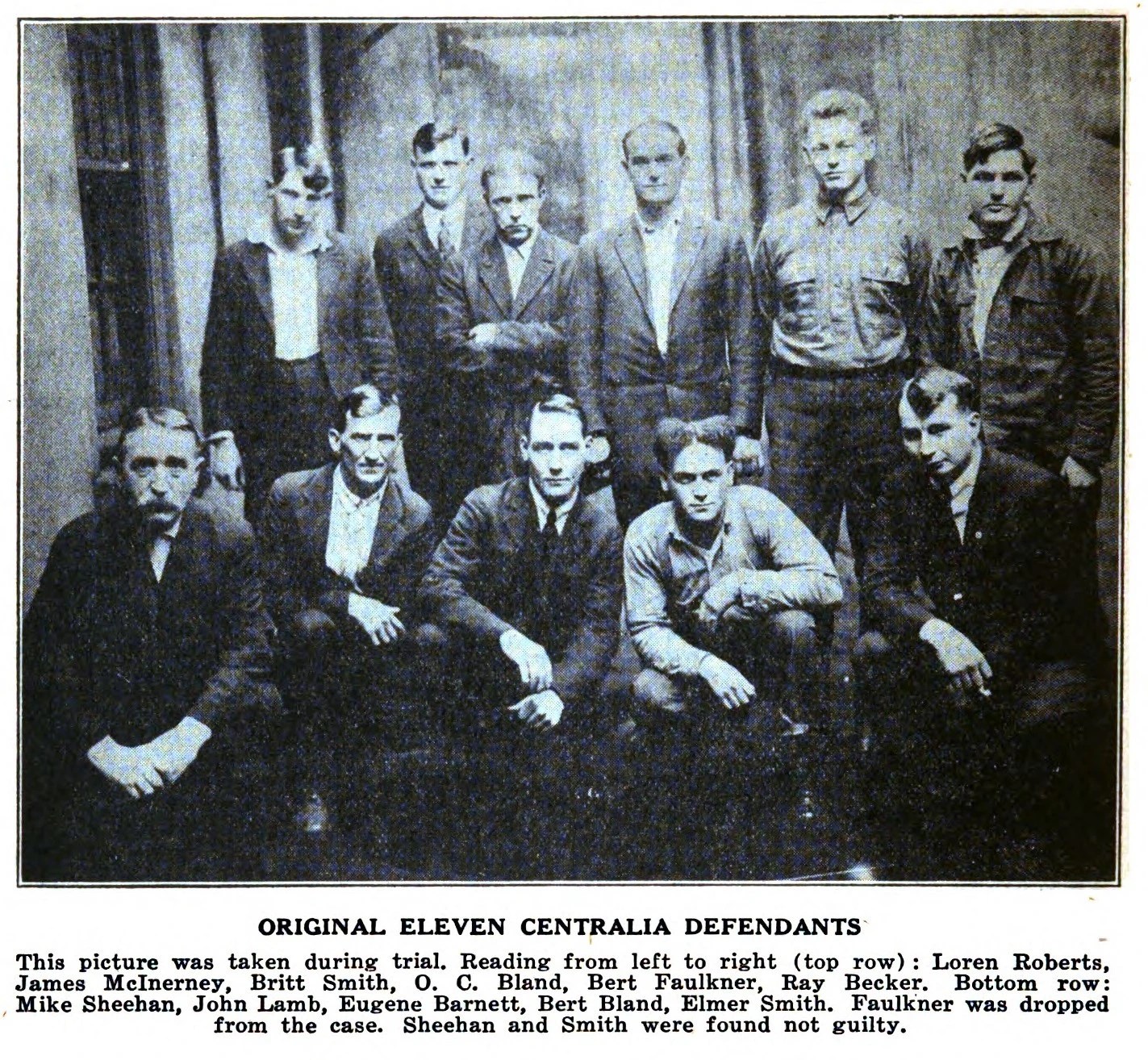
William F. Dunne remembers 1919’s so-called Centralia Massacre in which I.W.W. members defended their hall against American Legion thugs resulting in the deaths of fives reactionaries and the lynching of I.W.W. activist, and fellow veteran, Wesley Everett as well as long jail terms for heroic comrades and innocent bystanders.
‘November 11, 1919: Centralia’s Red Armistice Day’ by William F. Dunne from Labor Defender. Vol. 1 No. 11. November, 1926.
WESLEY EVEREST and his comrades, (or fellow-workers as I.W.W.’s prefer to call them) facing odds of 500 to one in Centralia on Armistice Day, November 11, 1919, put a sudden and decisive stop to the terrorist campaign waged by the American Legion against workers and workers’ meetings since its organization in 1918.
When at a pre-arranged whistle signal, armed paraders turned from the line of march and broke in the door of the I. W. W. hall, Wesley Everest and his fellow-fighters fired on the marauders and killed three of them.
Forced to retreat from the hall before the mob, Everest first tried to cross a stream, failed, returned firing, killed Warren Grimm and was captured when his revolver was empty.
He died at the hands of a white-collared, patriotic mob, under torture as devilish as that inflicted upon the Negro victims of the southern ruling class.
Heroism comes high in America.
For those who have had no firsthand experience with the lumber barons of the west coast and the tribe of retainers which compose the “law and order” element of the lumber towns, it will be hard to understand the murderous hatred with which they regarded the efforts of the Industrial Workers of the World to organize the lumberworkers.
United against the I.W.W.’s in these communities were all parasitic elements from the bootlegger to the banker. The I.W.W. not only drew the class line and antagonized the banker but it preached the virtue of sobriety and antagonized the bootlegger.
Under its tutelage, in the days of its militancy on the Pacific Coast, the lumberjacks not only organized but stayed sober.
Instead of liquor they bought literature and they made periodic distributions instead of disturbances.
The lumber boss who had voted for prohibition on the theory that his men would be more efficient, made an alliance with the bootlegger because they had become too damned efficient — in organizing for, demanding and securing higher wages, shorter hours and decent living conditions.
The gamblers and bootleggers were forced to depend for their customers on the parasites and the scissorbills.
During the heyday of Colonel Disque, the Loyal Legion of Loggers and Lumbermen was organized ostensibly to insure steady production for timber for war necessities, actually to smash all union organization in the western lumber industry.

Hand in hand with the organization of this bosses’ union went the wholesale arrests and imprisonment of I.W.W. members and officers in 1917-18 culminating in the famous Chicago trial.
Started principally by the agents of the metal mining and lumber interests it was believed that by this two-sided offensive the I.W.W. would be smashed. But it maintained its organization in the Pacific northwest lumber districts and actually penetrated and took over or destroyed units of the Four L’s as the bosses’ organization was called for short.’In Centralia the struggle was very sharp. The I.W.W. hall had been burned once before the clash on Armistice Day.
Wesley Everest and the others who remained in the hall were well aware that an attack was being planned. As a matter of fact the I.W.W.’s knew that the whole affair had been arranged at a meeting of the Chamber of Commerce in the Elk’s Club some time before and had issued a leaflet calling upon all honest citizens to see that no violence occurred.
On November 11, 1919, I was in the office of the Butte Daily Bulletin. We received a “pony” service from the United Press and got a “flash” stating that Centralia I.W.W.’s had fired on an Armistice Day parade killing a number of world war veterans.
In 1914 I had been in Centralia trying to organize electrical workers and had been told to get out of town by authorities. Knowing what the situation must be, I wrote a story of the shooting and also an editorial for the Bulletin. I never had to change a line of either from that day to this.
The moment the Bulletin appeared with the story the Butte patriots got busy. So did we. For ten days afterward an armed guard was on duty in the Bulletin plant night and day.
The Seattle Union Record was closed by the federal authorities as soon as it published its first dispatch from Centralia and an iron censorship was instituted up and down the Pacific Coast.
Twenty-four hours after we got the news I was on my way to Centralia to meet George Vanderveer, attorney for the I.W.W. We made an investigation and in four days after the murder of Wesley Everest my pamphlet called “The Truth About Centralia,” the first written on the struggle, was ready for distribution. The Bulletin gave it as its contribution to the defense and more than 75,000 copies were sold in less than two months.
During this time the sales of the Bulletin in Seattle and vicinity ran as high as 5,000 per day.
The only paper to publish the truth about Centralia at a time When the capitalist press was yelling for the blood of the heroic Centralia I.W.W.’s and picturing the murder of Wesley Everest as a glorious deed, the Bulletin can claim some credit for saving the lives of these workers.
In Butte, the American Legion had not yet passed into the control of the officer caste. A former member of the I.W.W. was chairman and he, at our request, issued a statement which we published, exonerating the Centralia I.W.W. from all blame for the shooting and upholding their right to defend themselves.

Later, while repairing a pipe in a mine tunnel, someone “accidentally” turned on the scalding steam and killed him.
The story of the bloody orgy which followed the storming of the hall by the Centralia patriots, directed by ex-army officers, the capture and torture of Wesley Everest, marched thru the streets with a rope around his neck, yelling like savages, jabbed bayonets into his quivering flesh, hung up a half-dozen times and half-strangled, his teeth knocked out by the butt of a revolver, but defying his tormenters thru it all, has been described in the pamphlet by Ralph Chaplin and by other writers.
It is a story to make the blood of workers run hot thru their veins and inspire them with the knowledge that the members of their class know how to fight and how to die: face to the foe and defiant to the last.
Still needing to screw their courage up for the dreadful deed that was to come, the maddened middle class of Centralia, having set up a censorship and smashed the cameras of newspaper men who took pictures of the sadistic orgy, threw the half-conscious Everest on the concrete floor of the jail, did a war-dance around the building to terrorize the other arrested and beaten workers, and when night came took Everest out and hung him to a bridge after castrating him.
The capitalist press of the whole nation raved and cursed the Centralia defendants and demanded a speedy trial and “justice” in the name of “the dead in Flanders Fields.”
No other workers in America have gone to trial with such prejudice against them.
George Vanderveer, skilled in the law, steeled in a hundred court combats beginning with the Everett massacre, his life in danger every moment of the trial, lean, hard, smiling, with a tongue which dripped vitriol and words which burned even the tough hides of the lumber trust stool-pigeons, fought like a lion and exposed the Centralia affair for what it was — a conspiracy of the Centralia Chamber of Commerce, the American Legion, the lumber trust and its paid agents to wreck the I.W.W. hall, kill a few wobblies if necessary and drive the rest out of town.
The trial was a farce. Only two of the defendants were acquitted. One was Mike Sheehan, over seventy years of age, the other was Elmer Smith, a young lawyer who had defended I.W.W.’s and who was arrested more than a mile from the hall by the superintendent of schools and a detachment of boy scouts.
The other defendants, in violation of all rules of evidence and legal procedure and in spite of prejudiced statements by jurors, to the accompaniment of demonstrations staged daily by the American legion, were convicted and sentenced to forty years in Walla Walla penitentiary. They are still there. The American working class owes it to the memory of Wesley Everest and to itself to get them out.
We must not let it be said that the gratitude of the working class for those who defend its elementary rights is less than the thirst of the capitalist class for revenge upon workers who sent their thugs to a deserved death.
The anger of the American working class must remain as red as that last Pacific sunset which Wesley Everest saw thru a film of his own blood until he is avenged by a victorious proletariat, and his grave must be kept as green as the Pacific forests in which he fought and died that other workers might know more of freedom than he did.
Labor Defender was published monthly from 1926 until 1937 by the International Labor Defense (ILD), a Workers Party of America, and later Communist Party-led, non-partisan defense organization founded by James Cannon and William Haywood while in Moscow, 1925 to support prisoners of the class war, victims of racism and imperialism, and the struggle against fascism. It included, poetry, letters from prisoners, and was heavily illustrated with photos, images, and cartoons. Labor Defender was the central organ of the Scottsboro and Sacco and Vanzetti defense campaigns. Not only were these among the most successful campaigns by Communists, they were among the most important of the period and the urgency and activity is duly reflected in its pages. Editors included T. J. O’ Flaherty, Max Shactman, Karl Reeve, J. Louis Engdahl, William L. Patterson, Sasha Small, and Sender Garlin.
PDF of full issue: https://www.marxists.org/history/usa/pubs/labordefender/1926/v01n11-nov-1926-LD.pdf
 Revolution's Newsstand