
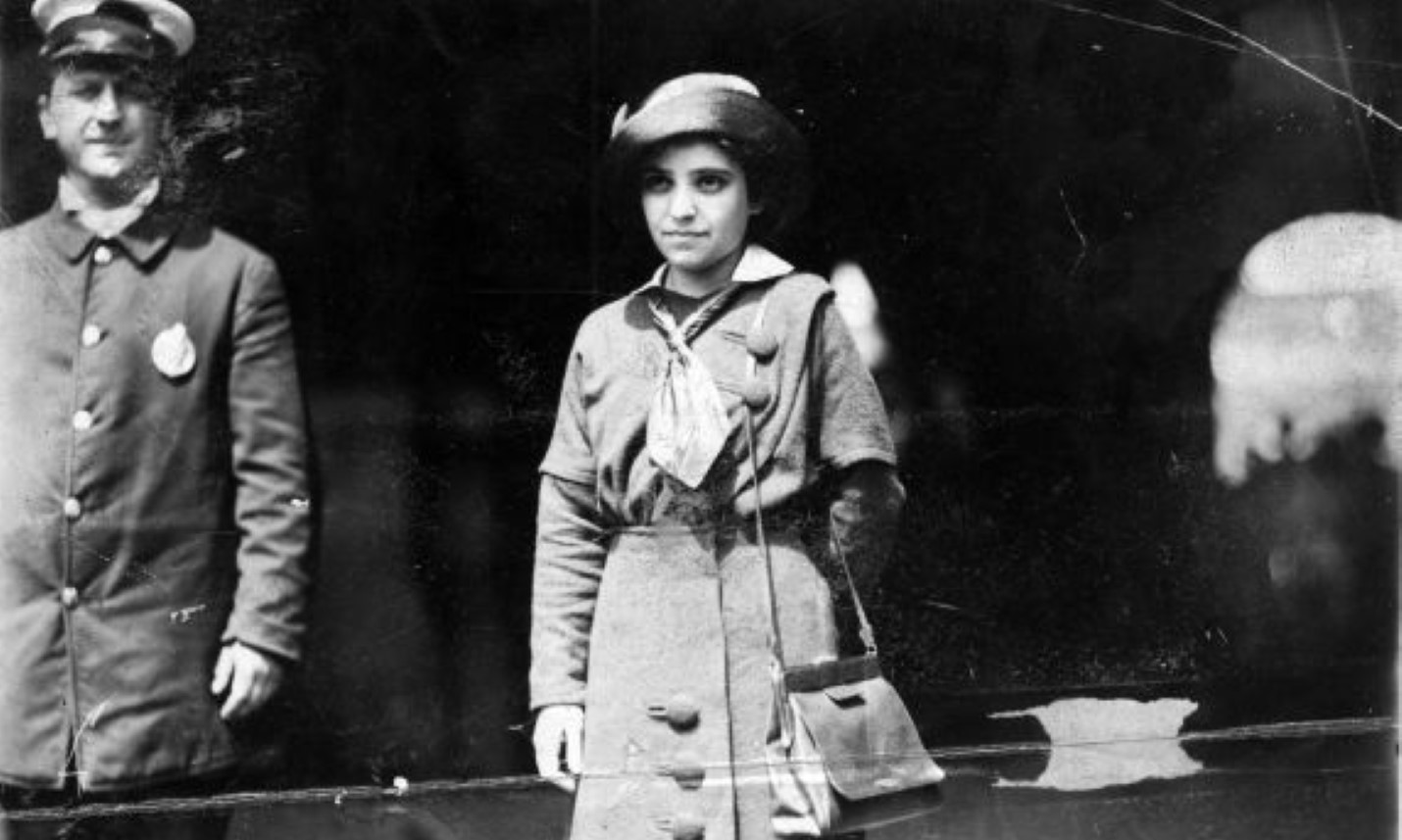
A milestone in working class history. News breaks of the very first auto strike in Detroit. On June 17, 1913, thousands of workers walked out of the Studebaker plant, joined by the Timken Axle plant workers led by Matilda Rabinowitz (Robbins), a paid I.W.W. organizer sent to Detroit to bring the One Big Union into the auto plants. Though a failure, and short-lived, and made a lie of the ‘impossibility’ of organizing Detroit’s new industry.
‘Auto Slaves Revolt’ by August Walquist from Solidarity. Vol. 4 No. 25. June 28, 1913.
Detroit Workers Begin What Promises To Be One Of The Biggest Conflicts Of The Year
(Special to Solidarity) Detroit, Mich., June 21. The unexpected has happened. Detroit, the city of “homes,” “contentment” and “prosperity” has awakened from its slumbers and the slaves in the great automobile industry are in revolt. For the past two months, Fellow Workers Matilda Rabinowitz and Jack Walsh have been carrying on continuous agitation in front of the various automobile plants of the city, and the workers were taught the slogan, “An injury to one is the concern of all.”
The Studebaker corporation decided a short time ago to install a twice a month pay day, so that they (the employers) could get more interest on the money paid in wages. A committee was elected from the employes to confer with the boss, demanding a weekly pay day. One of the committee was discharged; the workers in his department demanded his reinstatement. A meeting was held at Moose Temple on Sunday, June 14, for the purpose of discussing the weekly payday. Another committee was elected, who called on General Manager Gunn the following day and were told that the company would let them know by the end of the week as to its decision. This did not suit the employes, who demanded an immediate answer, and on Tuesday, June 16, the men employed in Plant 3, situated at Delray, walked out in a body and were addressed by I.W.W. speakers in a vacant lot adjacent to the plant.
After the meeting the workers formed in line and marched a distance of seven miles to plant No. 1, arriving at the noon hour and were there joined by about 2,000 more workers. On Wednesday they were joined by the entire force of Plant 5, making a total of about 6,000 men on strike. The Metal Polishers and Iron Moulders remained at work, but sent a committee to confer with the men on strike and informed them that they would demand a hearing for the strike committee, or they would walk out in a body.
On Thursday, June 18th, the first clash with the police occurred. A meeting was held at Plant 1, and after the meeting the men marched to the Packard automobile works. After arriving they marched peacefully around the plant and started to go around a second time, when police both on foot and on horseback charged the marchers, scattering them in all directions, and using their clubs freely. One of the marchers carried an American flag which was torn from his hands, the staff broken over his head and shoulders and the flag trampled on by these “upholders of law and order.” An attempt was made to hold a meeting on a vacant lot, which was stopped and several speakers arrested but later released. A committee called on Commissioner Gillespie and the facts were laid before him; they were told that no more parades or meetings would be tolerated around the plants, but that picketing would be allowed according to the state law which allows but 30 men to picket a plant. This was ignored, however, and on Friday another meeting was held on this lot. The police again tried to interfere, but were told by the owner of the property to keep their hands off as he had no objection to the strikers meeting there. Fellow Worker Rabinowitz having just returned from Pittsburg, addressed the men, and the police came in for a good grilling. This was the greatest demonstration held to date. The brutality of the police the day previous resulted in 1,200 men laying down their tools.
Friday night a meeting was held at Arbeiter Hall, where the workers were addressed by Jack Whyte, Matilda Rabinowitz, Jack Walsh and Frank Bohn. A set of demands were drawn up and accepted unanimously. The demands are:
Eight hour day with ten hours’ pay.
A weekly pay day.
Reinstatement of all strikers.
Better sanitary conditions.
The workers also voted unanimously to fight under the banner of the I.W.W.
The fight in Detroit has just begun. There are 60,000 automobile workers in Detroit; dissatisfaction is rampant, and the strike looms up as the greatest ever fought under our banner.
The most widely read of I.W.W. newspapers, Solidarity was published by the Industrial Workers of the World from 1909 until 1917. First produced in New Castle, Pennsylvania, and born during the McKees Rocks strike, Solidarity later moved to Cleveland, Ohio until 1917 then spent its last months in Chicago. With a circulation of around 12,000 and a readership many times that, Solidarity was instrumental in defining the Wobbly world-view at the height of their influence in the working class. It was edited over its life by A.M. Stirton, H.A. Goff, Ben H. Williams, Ralph Chaplin who also provided much of the paper’s color, and others. Like nearly all the left press it fell victim to federal repression in 1917.
PDF of full issue: https://www.marxists.org/history/usa/pubs/solidarity-iww/1913/v04n25-w181-jun-28-1913-solidarity.pdf
 Revolution's Newsstand