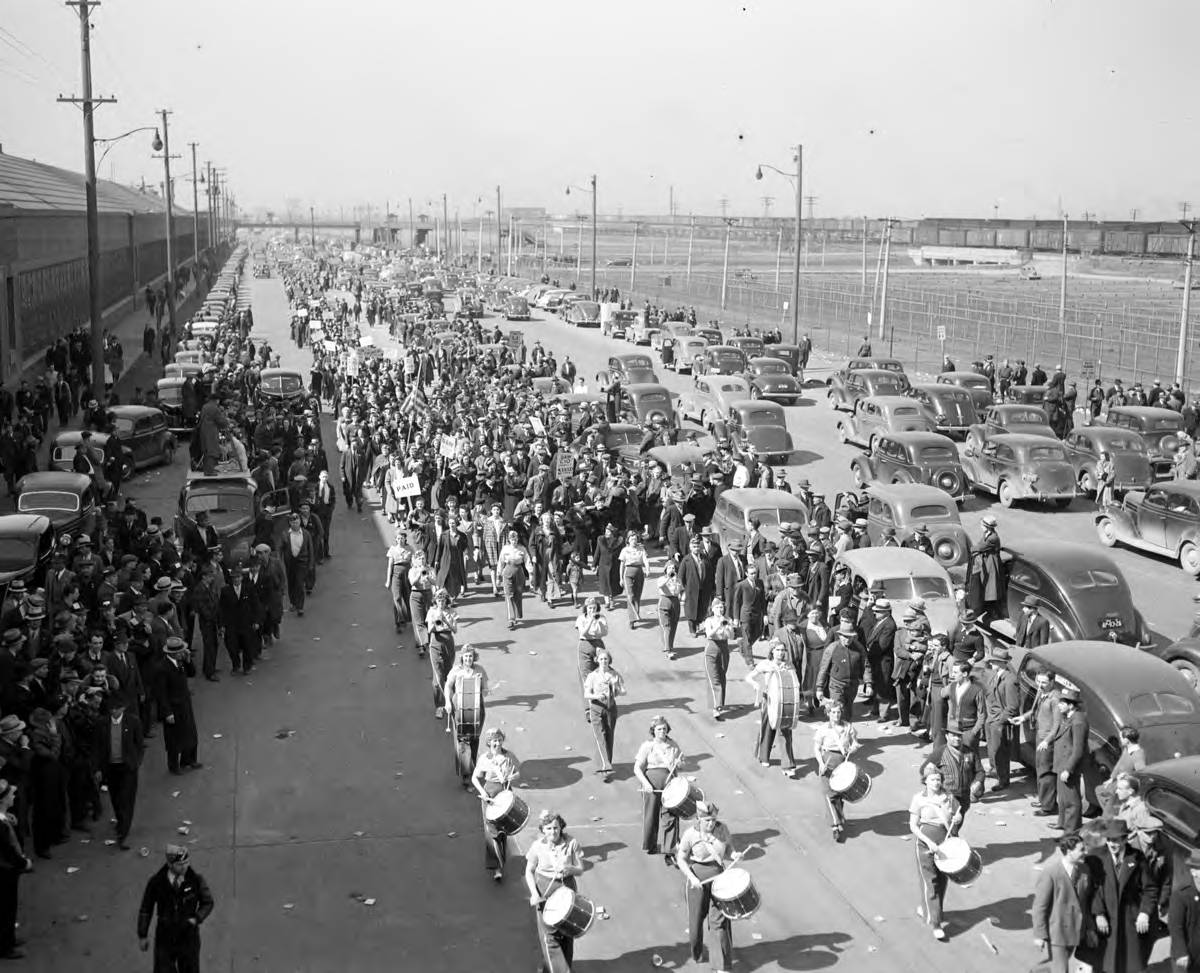
When the United Auto Workers won at Ford in April, 1941 after decades of union campaigns, it forever changed labor and the labor movement in the United States. The strike that year, though one of the most important battles in U.S. working class history, was only the culmination of years of persistent, heroic work. Ford, vehemently anti-union, was the last auto-maker to fall to the C.I.O., in part because of the racial politics employed by ‘King Henry’, which had to be overcome by an anti-racist union movement with Black leadership. Ford, one of the world’s most powerful people whose very name was synonymous with anti-union oligarchs, was challenged by a union he vowed never to recognize on his very doorstep. Here, an inside look at the military-like U.A.W.-C.I.O. plan of action implemented to shut down the 10-square-mile factory complex outside of Detroit.
‘How the Workers Shut Down Ford’s River Rouge’ from The Militant. Vol. 5. No. 15. April 12, 1941.
A Simple But Effective Strategy Closed The Plant–And Kept It Closed
DETROIT, Mich., April 7. The immediate incident which precipitated the Ford strike was the discharge of eight union committeemen in the rolling mill of the River Rouge plant. At 3 p.m. Tuesday the 6,000 men in the rolling mill stopped work to protest the discharges.
The discharges were a deliberately planned provocation by the Ford management.
In the past two weeks the UAW had won bargaining rights and shop concessions in department after department by means of its militant sit-down strikes. Thousands of Ford workers were daily joining the union.
The Ford system of slavery and naked terror was on the skids. The formerly cocky and bullying service department, Harry Bennett’s brass knuckle brigade, was being reduced to helplessness by determined committeemen backed by the solid support of their departments. The billion-dollar empire which Ford had kept hermetically sealed from unionism for 38 years, was now crumbling and toppling under the blows of the UAW- CIO.
FORD CHANGES STRATEGY
The Ford management had originally planned to stall for time indefinitely. But after the events of the last two weeks it felt it could not afford to waste a day if it was going to be able to smash the union.
The NLRB vote was due. That meant that in about 60 days the Ford workers would vote to determine a bargaining agent. Bennett himself conceded the CIO would win. Ford, judging by the rapid growth of the union during the two weeks before the strike, feared that in 60 days the union would be absolutely invincible.
If he waited for a vote, Ford would not only give the CIO time to grow more and more powerful, but would suffer the additional onus of the CIO winning a decisive majority in the vote.
Ford therefore decided on immediate desperate action to wreck the union in a showdown fight. His agents were ordered to provoke a fight. The eight committeemen were fired.
HOW FORD RECKONED
If the UWA would strike, Ford still thought his service department could wipe a strike out in blood. Or if the union didn’t fight back against the discharges, then the union was finished.
When the union committee in the rolling mill tried to negotiate the case of the eight men, the company refused to meet with it. The company would meet with no one about anything.
The rolling mill stopped waiting. The showdown fight with Ford was on its way.
Governor Van Waggoner of Michigan immediately called together his state mediation board, and rushed to Detroit in an attempt to settle the fight. James F. Dewey, “ace” mediator of the conciliation service of the Department of Labor, was rushed to Detroit.
Dewey and Van Waggoner rushed around from the company to the union in fruitless negotiations. The company was absolutely adamant. Bennett announced that the eight men would never work at Ford’s again.
THE TACTIC OF ’37
Meanwhile the union men in the River Rouge plant took hold of the situation and showed what the workers can do when the decisions are left up to them. The strike spread through the departments like a prairie fire.
The UAW workers used the tactic so skillfully applied in the 1937 sit-down strikes. They began in the best organized key department, where there was the largest number of trained and loyal union men. Gathered together and semi-armed with clubs of various kinds, they marched through the huge plants and gathered support, closing down department after department.
The best organized departments were shut down first, and as the army of union men grew bigger. and more powerful, when they were at full strength, they marched into the tool room, where some backward and timid workers were located. Here the union army forced the scabs and stoolpigeons to leave, and the department was shut down.
ALL WHEELS STOP!
Those who marched out of the plants, upon learning that there were still some departments running, marched right back in and spread the word and, incidentally. took care of any company agents who were trying to stop the walk-out by strong-arm methods.
In a few hours, this effective tactic had shut down the River Rouge plant as tight as a drum. The killing pace of the production line had been slowed to a dead stop. The murderous speed-up was ceased. The whip-hand of Harry Bennett was now feeble and powerless, and the fortress of fear and intimidation was humbled. The great myth of Ford’s invincibility was washed away in the great sea of union solidarity. Bennett now began howling for “state troopers to clear the illegally seized plants.”
Wednesday 12:15 A.M., fully nine hours after the original disturbance in the rolling mill, the top union officials, unable to get into the plants or meet with the company, confronted with the newspapers playing up the red-scare statements of Harry Bennett and storming about “illegal seizure” of the plants, were finally forced to take action. An official strike was declared at that hour and all workers ordered to leave the plants. Great parades of UAW workers marched out of the River Rouge plant singing “Solidarity.”
FORD’S PLAN
The Ford Service Department, and Ford’s equally private army, the Dearborn police, prepared their forces for a bloody settlement.
Harry Bennett confidently put. а notice in the papers calling upon workers to report for work in the morning “as usual.”
Ford’s “service” men got set to smash the union forces in a decisive battle in the morning; it. was routine to them…they would do in Ford what Girdler had accomplished in Little Steel. They were all set to wipe out the CIO in blood.
THE MILITARY PROBLEM SOLVED BY THE STRIKERS
But some of the UAW-CIO militants in Detroit had previously studied the difficult military problem presented by the peculiar geographical conditions at the sprawling Rouge plant, and by the presence of a trained army of five thousand service men and they had worked out a strategy to cope with the situation.
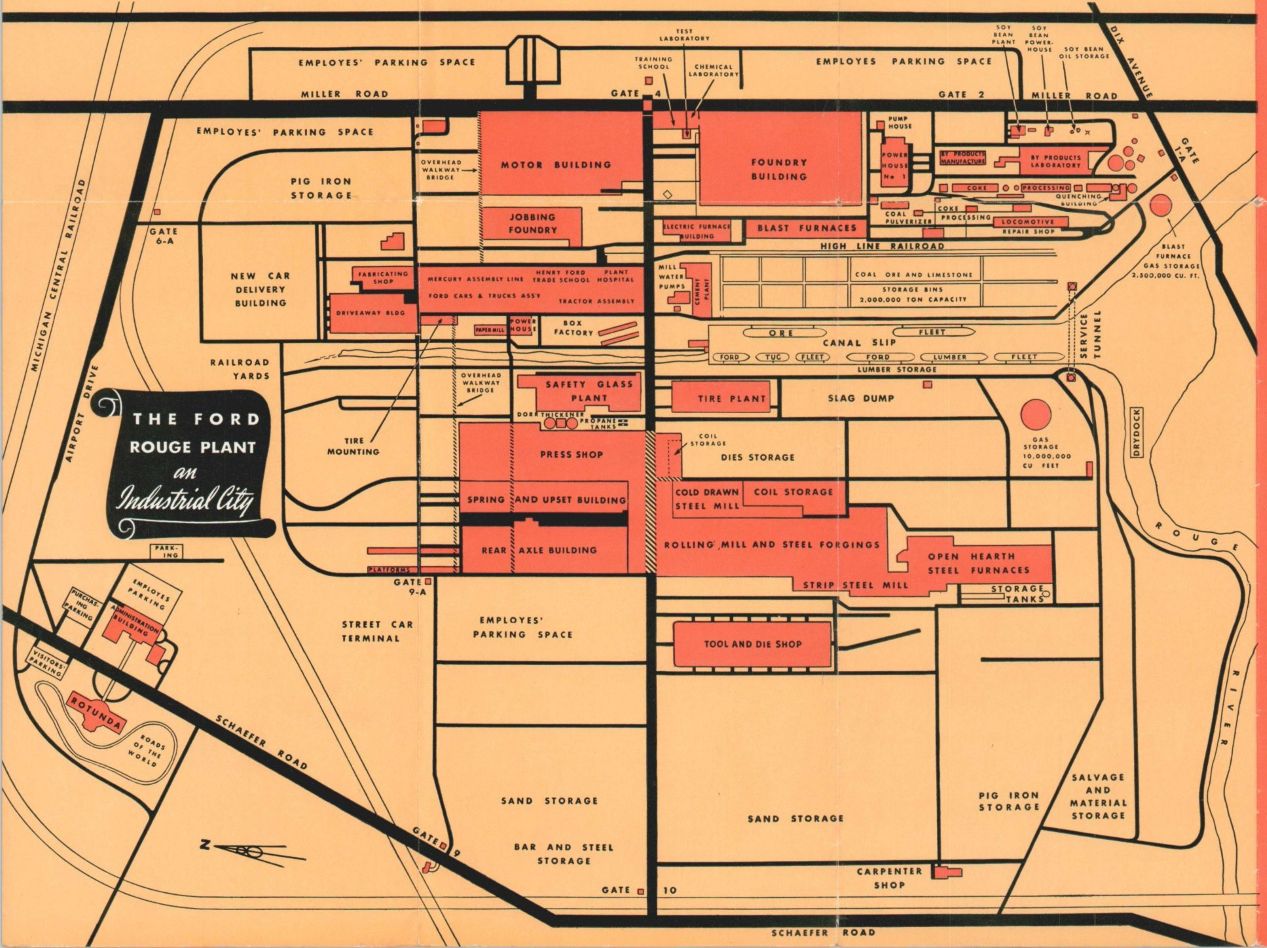
Here was their problem: The Ford plant resembles a fortress-island, surrounded by an ocean of roads. No structures of any kind surround the main portions of the huge River Rouge factory, all of which lies within Dearborn, Ford-controlled municipality.
For over a mile along Miller Road is the plant, and on the other side of the road is the big private parking lot which is the property of Henry Ford. The situation is similar on the side entrances, Schaefer Road, Dix Road and Rotunda and Airport Drives.
Half the Ford workers come to work by private autos, which are parked in the company parking lot across from Miller Road. Others use the buses and street cars which park directly next to the overpasses on Miller Road so that workers step directly from bus and street car onto the overpasses.
Obviously with 5,000 armed gunmen, prepared and trained for violence, supplemented by the Dearborn city police, and particularly in view of the lack of union preparation and organization for a strike, the union would have to pay a heavy price in wounded, and even in death, to stop the scabs, stoolpigeons and the Service Department.
Taking these facts into consideration a strategy was worked out, based on the experiences of the great General Motors strikes and the Toledo battles of previous years in the fight for auto unionism.
Experienced strike leaders knew how to defeat the movement of strikebreakers entering in cars: by the combined use of the greatest militancy and mass picketing, and a blockade of the roads with automobiles. This kind of blockade slows up the cars arriving in the vicinity of the plants, and they are at the mercy of the massed pickets. It scatters the police force, and gives strikers a command of the situation based on superior numbers.
WITH MILITARY PRECISION!
Such a plan was used at River Rouge.
The moment the Ford workers marched out of the plants, they were told to report to union headquarters. Barricades of automobiles were set up; at Eagle Pass and Wyoming Avenue, commanding entrance to the vicinity from that side; at Miller Road and Airport Drive, at Schaefer Road and at Dix Road. These barricades blocked the main arteries leading into the Ford fortress.
Later the pickets took control even of the drawbridge, owned by the county, thus preventing delivery of supplies by water on the River Rouge.
At each place from 30 to 60 cars were parked bumper to bumper, forming an impassable barricade, and supported by throngs of hundreds and thousands of pickets.
FORD’S PLAN RUINED
As 6 A.M. Wednesday approached, the hour the morning shift reports for work, the serv ice men were waiting at the gates of the plant in full force, ready for action, and bristling with arms.
They waited and waited, but nobody came.
Nobody could get through the barricades to the plant gates. The Ford Service Department, trained for a decade in the art of smashing unions, prepared for almost a lifetime just for this crisis–this most powerful strikebreaking private army in the world found itself outwitted and beaten by a simple and effective strategy.
By 6 A.M., all the entrances to the vicinity were blockaded by barricades, and the area was commanded by picket squads each numbering from several hundreds to several thousands, armed with pipes, baseball bats, clubs, and most of all armed with a grim determination to finish with Ford and to win a victory.
SOME DELUDED WORKERS
Most of those who reported for work and found the strike in progress reported for duty at the strike headquarters, others turned around and went home, others immediately joined the picket lines. But about 2,000 Negro workers, who had for months been pumped full of anti-union propaganda by Ford and his agents…and who had been threatened and intimidated into support of the Ford anti-union policy, who had gotten into the plant before the barricades were formed, charged out of Gate 4 and precipitated a battle with the pickets. These men charged three times at the pickets.
In the first charge, made from both the ground level gates and from the overpass the strikebreakers, armed with iron bolts, three foot steel bars, hammers and wrenches, started a free-for-all battle.
They were driven back by the strikers at the cost of many injured. Once again the scabs charged. And again they were driven back. After the third charge, they gave up the fight and retired inside the plant. The union suffered 36 injuries in this battle.
That was the last large scale battle. After that no one got through the now fully formed barricades.
ORGANIZING THE WAR
When the whistle blew for work to start…River Rouge, the biggest plant in the world, the hell hole of the auto industry, lay silent and lifeless as if it had been abandoned for a hundred years.
The life of the Ford workers was not inside, being sapped and sweated out of them for Henry Ford. The life of River Rouge was now centered at 9016 Michigan Avenue, the union’s strike headquarters.
With the giant now still as death, the strike began organizing itself for a long battle.
Local union leaders from dozens of the local unions poured in and offered their services. Experienced men who had captained picket lines before were sent out to organize the picketing. When they reached them, however, they found everything under control. Leaders had sprung up from the ranks. orders were given, jobs assigned, order maintained, and the Ford union was already functioning on the picket line.
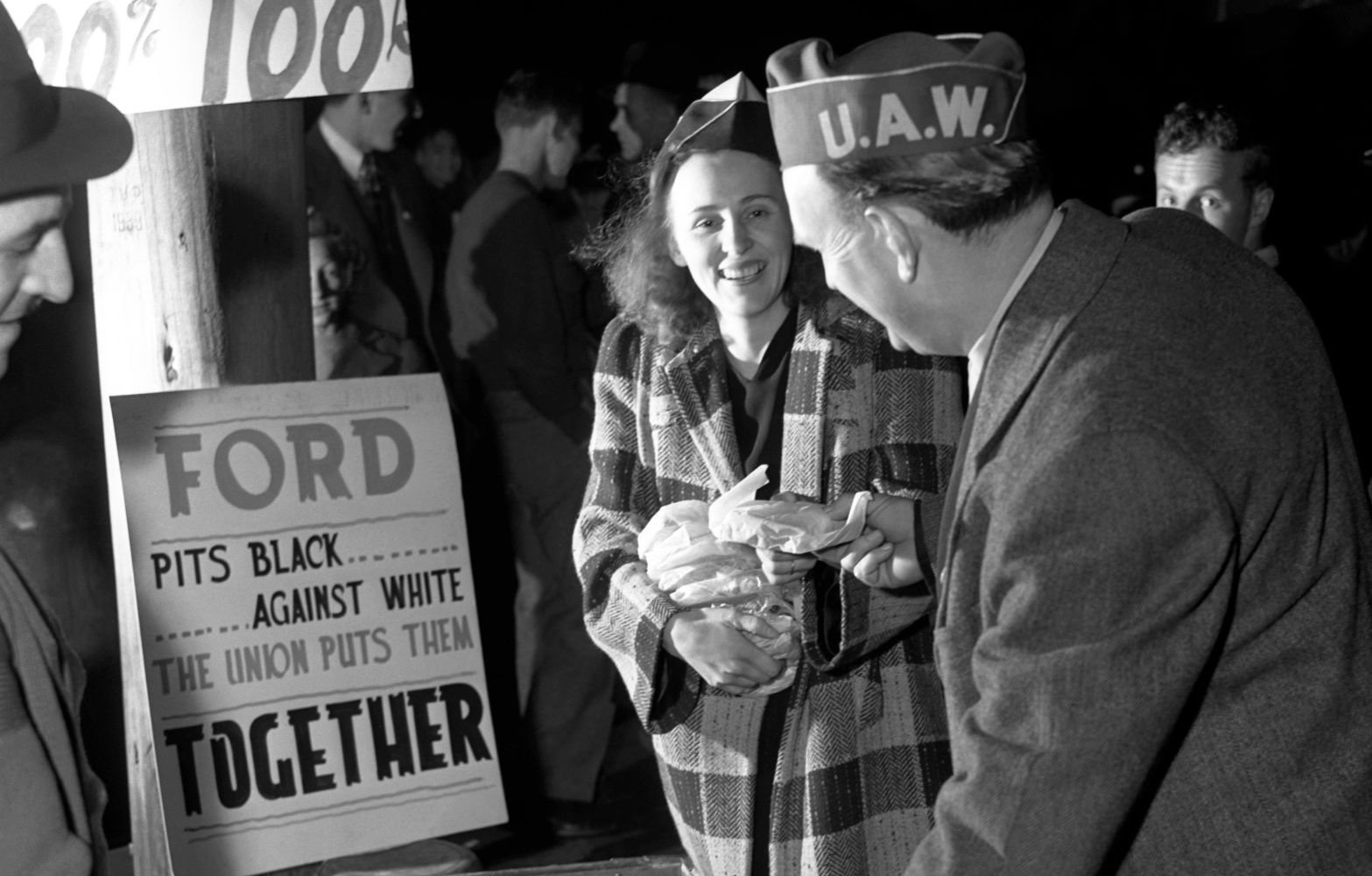
Two huge strike kitchens were set up, one on Schaefer Street and one on Fort Street, and began serving up thousands of sandwiches and hot food, delivered by truck to the strikers.
A publicity department went into action with a special Negro paper and later a daily strike bulletin. Radio broadcasts were arranged eight times a day.
A hospital was set up with a full staff of nurses and doctors, at the DeSoto local’s headquarters near the Ford strike headquarters. Special ambulances were put into service.
The local union leaders who immediately came to the aid of the Ford strike brought with them their union loudspeakers and sound cars which had not seen much use in recent times. The Briggs, Dodge, DeSoto and West Side and other locals sent their loudspeakers over, and they all blared away with up-to-the-minute news and directives.
INSIDE THE PLANT
Those inside the plant, numbering about 2,000, including many who had just been hired during the previous week for strikebreaking purposes, were now in a panicky fear. They had no food, the huge fortress was shut down…all was not as Henry had told them it would be. Now they feared the anger and hatred of the union men.
Drunk and armed to the teeth, they drove around inside the gates in Blitzbuggies intended for the army, and in new Mercury cars, with no oil in the cars, wrecking them in a drunken orgy born of panic and excitement…and being paid $8.00 a day by Bennett for this work.
By this time the UAW-CIO had complete control and was the sole policing force of a 10 mile area in Dearborn surrounding the River Rouge plant, with pickets, wearing the UAW overseas-type cap, directing traffic.
In solidarity, UAW members at the Budd Wheel and Murray Body plants, working on Ford parts. downed tools and refused to work on material for Ford.
The Teamsters Union, AFL, pledged the UAW-CIO it would not move materials to Ford for the duration of the strike.
MAYOR DEMANDS TROOPS
The Ford fortress was besieged. Dearborn was in the control of the UWA. And the bosses and their political agents began to howl.
When the capitalist police and Ford thugs had beaten up union men in Dearborn for wearing a union button, or passing out a piece of union literature…that was “law and order.”
But now, when the UAW took over control, kept order, with perfect discipline. that was “anarchy.”
“Dearborn this morning is the scene of flagrant disregard for all rights of citizens,” said Mayor John L. Carey of Dearborn, how ing for troops. What about the bloody beatings of union organizers? those were the good old days, when “good government” reigned and the mayor said nothing.
THE GOVERNOR’S DILEMMA
Governor Van Waggoner was in a tough spot. April 7, a few days away, would be election day, with many important state, county and municipal posts at stake. He was afraid of too openly taking strike-breaking action. He moved into the Statler Hotel, and conferred constantly and furiously with Dewey, who had flown to Detroit. with instructions to get the Ford workers back to work.
The mediators darted from what company officials they could contact, to the union, and back and forth again.
“TRUCE” IS CALLED
The UAW had so completely taken control, they were so obviously victorious in striking the plant, that the company agreed to a “truce.”
The agreement provided that the union clear the roads of barricades, allowing traffic to resume. while the company agreed not to operate the plant during negotiations. Picket lines of from 50 to 500 men were now stationed at every entrance to the River Rouge plant.
It was an historic sight never to be forgotten by eyewitnesses on that sunny Thursday morning. It was an inspiring and unforgettable thing to see the huge humbled giant of a plant, and the thousands of laughing, cheering victorious pickets, freed from the tyranny of Ford–the symbol of all the enemies of labor.
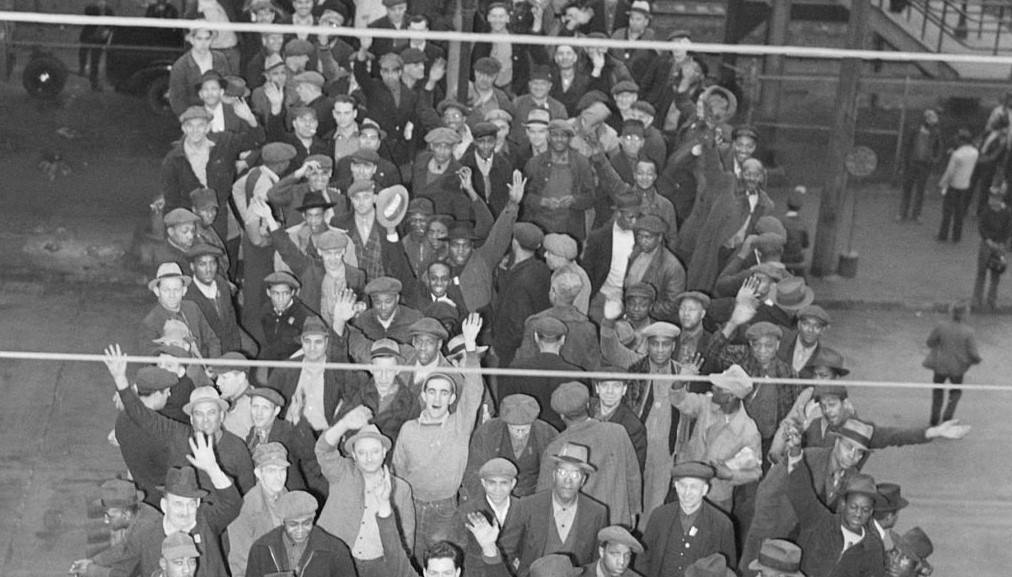
An historic sight. the long expanse of Miller Road, usually buzzing, now quiet and dead; the Ford plant like a huge monster asleep, not moving a muscle; cars parked right under the no-parking signs as though in mockery of the little pseudo-Fascist administration of Dearborn; some strikers even parking their cars in the private parking lot, Old Hank’s private reserve. The whole road with the appearance and the spirit of a Mardi-Gras, a great holiday. Thousands of cars, decorated with streamers and UAW posters and signs, slowly cruising back and forth, loaded with pickets who poke out their heads, and cheer and joke and laugh with the squads of marching pickets at the gates.
THE SPIRIT OF 37!
At the same time there is a certain grimness in the air picketing goes on despite the fact that Ford has pledged not to re-open the plant while negotiations continued. These Ford workers are smart. They do not trust the word of Ford or Harry Bennett…they know it would be kept only if they continue to show and use their organized power.
For the first time since the General Motors strike, huge picket lines appear in auto. Here again is the enthusiasm, the self-confidence, the unmatched courage of 1937.
Here, once again, is a body of tens of thousands of auto workers, unorganized yesterday…but already proving that they are going to make some of the best men in the mighty ranks of the United Automobile Workers of America.
The Militant was a weekly newspaper begun by supporters of the International Left Opposition recently expelled from the Communist Party in 1928 and published in New York City. Led by James P Cannon, Max Schacthman, Martin Abern, and others, the new organization called itself the Communist League of America (Opposition) and saw itself as an outside faction of both the Communist Party and the Comintern. After 1933, the group dropped ‘Opposition’ and advocated a new party and International. When the CLA fused with AJ Muste’s American Workers Party in late 1934, the paper became the New Militant as the organ of the newly formed Workers Party of the United States. Several papers served the Trotskyist while they were engaged in an entry into the Socialist Party, after their expulsion in 1937 and the formation of the Socialist Workers Party, the Party published Socialist Appeal until January, 1941 when the paper was again named The Militant.
PDF of full issue: https://www.marxists.org/history/etol/newspape/themilitant/1941/v5n15-apr-12-1941.pdf
 Revolution's Newsstand