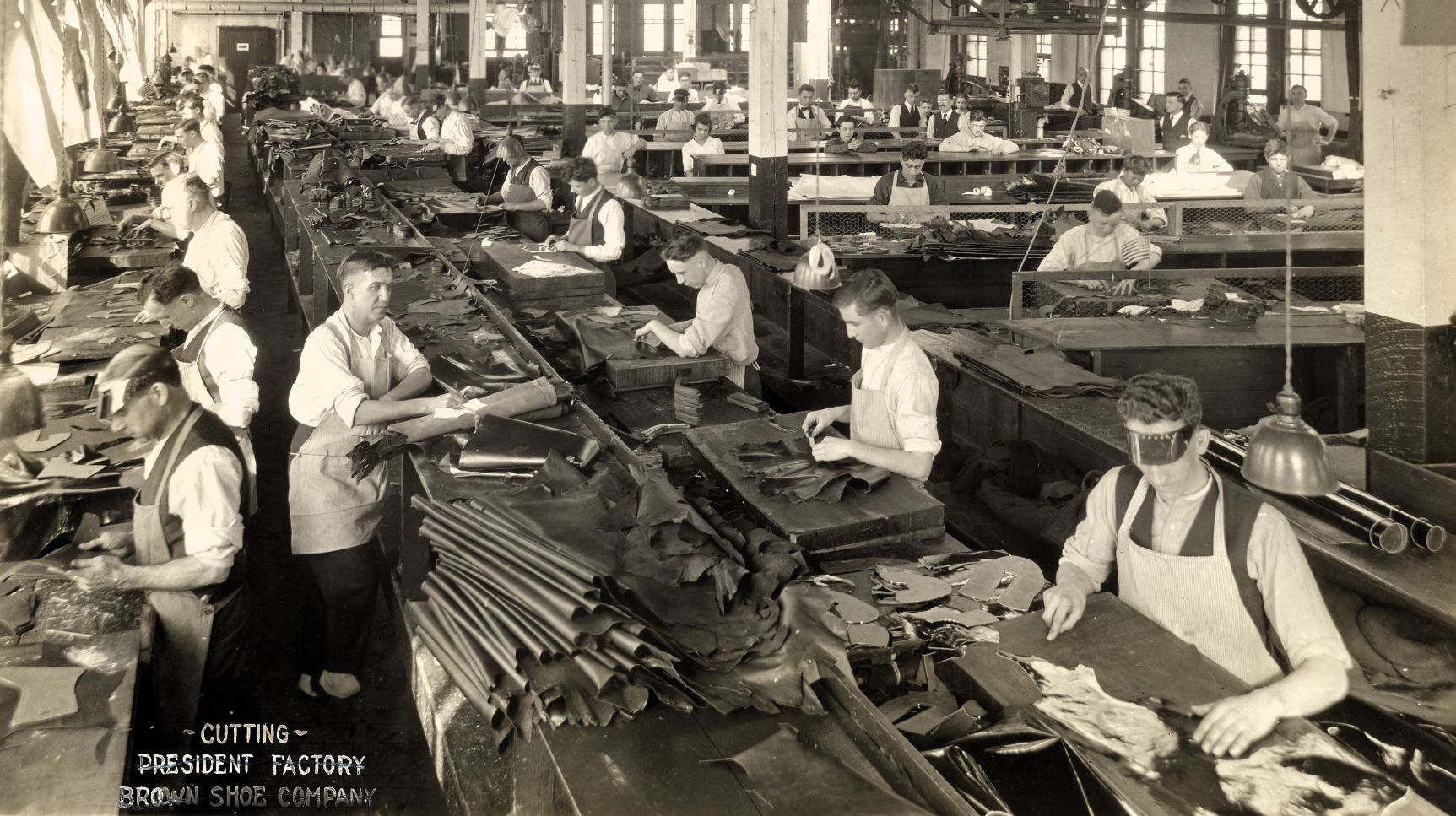
A major class battle is joined as one of the major industries of St. Louis walks out, men and women–boys and girls, for blacklist and nine hours work at ten hours pay a day. They would stay out for weeks, winning a number of demands.
‘Twenty Thousand Shoe Workers Strike For Better Conditions’ from St. Louis Labor. Vol. 4 No. 347. September 28, 1907.
The Strikers Determined to Secure Shorter Hours and Better Conditions of Work. The Blacklist System Must Go. Enthusiasm Among the Thousands of Brave Girls Who Went Out in Support of the Cutters. Nine Hour Workday With Ten Hours’ Pay is the Universal Demand of the Strikers.
Twenty thousand shoe workers are out on strike.
There is a limit to people’s endurance of inhuman conditions, and as a rule the general discontent will lead to rebellion.
The present St. Louis Shoe Workers’ strike is a rebellion against unfair and unjust conditions.
The rank and file of Organized Labor as well as the great majority of the people of St. Louis are decidedly in sympathy with the striking Shoe Workers. Never before in the history of the St. Louis labor movement has a strike of such immense proportions been more justified than the present strike of the St. Louis Shoe Workers.
For years the local Shoe Workers have been more than patient with their conditions and endured unjust and tyrannical treatment seemingly as a matter of course.
In public announcements and newspaper articles the Shoe Manufacturers heralded their unparalleled prosperity and advertised St. Louis as the center of the shoe industry of America. Profits were piled upon profits. New factories were built and the prosperity wave was visible everywhere except in the wage accounts of the many thousands of employes.
It was quite natural that the manufacturers did not expect such prompt action on the part of their employes; still less did they think of the possibility of twenty thousand people voluntarily joining the strike movement.
The strike is under the auspices and management of the Boot and Shoe Workers’ Union of Missouri. For some months the Shoe Cutters belonging to the independent Boot and Shoe Workers’ Union of Missouri were especially active in building up a good organization. That the manufacturers had been preparing for trouble was apparent from their way of giving out the work to the cutters.
Last week, shortly before our paper went to press, it was reported that final action on the strike question would be taken by Thursday evening. However, the trouble began sooner than even the most optimistic observer could think of.
In order to prevent a lockout on the part of the shoe factories, about 1,500 shoe cutters walked out of their places of employment early Thursday, badly crippling the majority of the houses in St. Louis. The factories affected were: Hamilton & Brown’s Security factory, the American Gentleman factory, the American Lady factory and the Sunlight factory; the Roberts, Johnson & Rand, Thirteenth and Mullanphy streets factory, the one at Mississippi and Hickory, also one at Twenty-third and O’Fallon streets; the Brown Shoe Co., at the White House factory and Buster Brown, the Homestake and the Blue Ribbon factory; the Peters shoe factory, Nos. 1, 2, 3 and 4; Dittman shoe factory, Courtney and Goodbar’s.
Of the factories in St. Louis, five were not affected by the strike, as they come under the jurisdiction of the International Boot and Shoe Workers’ Union, which is in no way connected with the Independent Boot and Shoe Workers’ Union of Missouri, which is conducting the strike. The factories not affected are:
Wertheimer-Swarts, at Twenty-first and Chestnut streets; John Meyer, Fourth and Morgan; Johansen Shoe Co., Eleventh street and Franklin avenue, and the Hamilton-Brown’s Randolph street factory, at Randolph street and Jefferson avenue.
The Friedman-Selby factory acceded to the demands of the union early in the week and no strike took place there.
Business Agent George C. Frank’ of the Independent Boot and Shoe Workers’ Union stated they were forced to take early action, as the bosses were preparing to lock them out, which would have been a point in favor of the forces of capital.
The factories were served with a list of the demands of the union about three weeks ago and given until Thursday to give their answers.
Wednesday they were again notified to answer the ultimatum. of the union by first mail Thursday morning, but the notice was ignored and the strike order was given by union officials. The men walked out of their places, accompanied by hosts of girls who struck in sympathy with the men.
That this strike was a general surprise can be seen by the following remarks of a local daily capitalist newspaper:
“In many respects the strike of the shoe workers is the most remarkable in the history of trades unionism. At the time of the strike not more than one-tenth of the shoe workers were members of any labor organization. Yet the strike was so complete that within 15 minutes after the shoe workers walked out not a wheel was turning in any of the mammoth factories, some of which turned out 10,000 pairs of finished shoes every day.”
The shoe cutters, the rejection of whose demands precipitated the strike, had an organization of 1,500 members. Of the other 20,000 who struck only 600 were members of the union. In one day 5,000 joined the union, and the others are being taken in as rapidly as they can be supplied with application blanks.
The cutters began forming an organization in April, and in June formulated their demands for increased wages and shorter hours. They demanded a nine-hour day instead of ten hours, a minimum wage scale of $18 a week, certain increases in the price of piece-work, and that only one apprentice be employed for each ten journeymen cutters.
These demands were presented to the superintendents of four of the Hamilton-Brown Co.’s factories, the four Brown Shoe Co.’s factories, the three factories of the Peters Shoe Co., the four factories of the Roberts, Johnson & Rand Shoe Co., and the factories of the Courtney Shoe Co., the Giesecke-D’Oench-Hayes Shoe Co., the Dittman Shoe Co., the Goodbar Shoe Co. and the Caruthers- Jones Shoe Co. The manufacturers met and decided not to yield to the demands of the Cutters’ Union,
This led to the strike of the cutters Thursday, followed by the general strike of all shoe workers in the shops owned by these manufacturers.
Business Agent George C. Frank of the Independent Boot and Shoe Cutters’ Union of Missouri, in behalf of all other striking crafts than the cutters, made a demand upon the manufacturers Saturday for a nine-hour day for the stitchers, lasters, edge-makers, bottomers. stock fitters and finishers.
It was stipulated in the demand that the rate of pay was to remain the same for the nine-hour day as for ten hours. The demands as to wage increases probably will be made more specific before the strikers ask for conferences with the manufacturers. The strikers say that they are willing to confer with the manufacturers any time relative to their demands. So far the manufacturers have ignored all demands of the strikers.
Demands of the Shoe Cutters.
There are four locals of the Independent Union, one composed of cutters, one of laborers, one of edge setters and a mixed local.
The cutters’ local is the only one that has presented formal demands on the shoe companies.
The following letter was sent to all the shoe factories affected: “In consideration of fair and deliberate action toward the she manufacturers of St. Louis, on our part, in the past, relative to conditions in the cutting departments, namely:
“Wages hours and apprenticeships.
“We desire to bring to your notice that the shoe cutters of Brockton, Lynn, Haverhill, New York, Chicago and other centers of shoemaking are already enjoying the conditions submitted on our part.
“We also desire to call your attention to the fact that the necessary living expenses in the majority of the above-mentioned cities are not as high as in St. Louis, consequently we deem it necessary to submit to you for consideration our demands as follows, your acceptance or rejection of same to be made not later than Sept. 18, 1907:
“First–Nine hours to constitute a day’s work in the cutting department.
“Second–A minimum wage of $18 for journeymen shoe cutters.
“Third–One-half cent increase per pair in piece-price shops.
“Fourth–One dollar and a half per week increase for all lining and trimming cutters, or the equivalent on piece work.
“Fifth-Time and one-half for overtime.
“Sixth-One apprentice for every 10 journeymen cutters, he to receive $15 per week the second year, $16.50 the third year, after which he is to receive the journeymen’s wage.
“INDEPENDENT BOOT AND SHOE CUTTERS’ UNION OF MISSOURI, LOCAL NO. 1.
“P.S. We are at any time prepared and willing to consult with you on these matters.”
A General Nine-Hour Workday.
One of the surprising features of the strike was the prompt action of the several thousand girls in the St. Louis shoe factories. In less than no time the girls joined the striking cutters, and their enthusiasm and determination is worthy of general praise and admiration.
It was agreed by the strikers that in addition to the cutters’ special demands a nine-hour workday with ten hours’ pay shall be the basis upon which a settlement of the strike will be possible. The demands are fair and reasonable and the prosperous employers can well afford to grant them.
Ten hours’ work in the St. Louis shoe factories at a time when the eight-hour workday is generally introduced in every important branch of industry is certainly not to the credit of the St. Louis shoe trade. If the success of the St. Louis shoe industry depends on long. hours of labor and low wages it will not have a bright future.
The Strikers Well Disciplined.
There is a commendable discipline among the strikers. Everything is proceeding in an orderly manner. Strike meetings have been held daily during the last week at Lightstone’s Hall, Eleventh and Franklin; at Walhalla Hall, Tenth and Franklin, and at the hall on Twenty-second and Franklin avenue. Addresses were delivered by a number of local labor leaders, and the enthusiasm with which the speakers were greeted speaks well for the splendid fighting spirit of the thousands of striking men, women and girls.
Joining the Union.
The officers of the Independent Shoe Workers’ Union of Missouri have been busy all week initiating thousands of recruits who applied for admission to membership. Men, women and girls realize the necessity of organization and act accordingly.
The following communication, drawn up by the board, was presented to the shoe manufacturers and their superintendents:
“The situation of the shoe workers having developed into a general strike through the refusal of the manufacturers to consider the demands of their cutters, the other crafts involved have decided to submit to your earnest consideration the following:
“A nine-hour working day to be in effect throughout the shop, and the rate of pay to remain on the basis of the ten-hour workday. We would willingly confer with you on all matters tending toward a settlement as early as possible. Respectfully,
“GENERAL EXECUTIVE BOARD.
“By GEO. C. FRANK, Business Agent.”
This action put all of the members of the allied trades who went out on a strike purely out of sympathy on the same basis as the cutters, and effectually ties up eighteen shoe factories in St. Louis. According to figures given out by the union, which are practically agreed to by the manufacturers, there are 22,150 men and women affected by the strike.
“Ten Hours Too Much for Any Girl or Woman.”
Mrs. Mary Shea of 1457 North Market street, who has worked in a shoe factory for 16 years, said that in her opinion a ten-hour day’s work is too much for the health of any girl or woman.
“The women and girls who work in shoe factories,” Mrs. Shea said, “are either self-supporting or they have others dependent upon them for support, and first of all they must not break down or they can’t make their living. It is hard work. Wages range from $3 up to the vampers, who sometimes make $25 a week.
“I know of one factory where the girls are lined up and told just how much work they must turn out. If a breaking in the machinery occurs and they are delayed they have to make up the loss by working eleven or twelve hours a day. In some of the factories they are made to work to the limit of their endurance and when they go home at night they are so tired that they can never think of going any place for amusement or recreation.
“In many of the factories conditions are good and the foremen are considerate, but a ten-hour day is too long a time to work and expenses have increased so that no one can live on any less money than is being paid for a week’s work now.
“The girls and women are loyal to the union men and will not go back to work until the differences of the men are settled.”
Employers Act in Czarish Manner.
The Missouri State Board of Arbitration and Mediation offered its services in order to bring about a settlement of the strike. We are informed, however, that the manufacturers acted very much like Mr. Pullman in 1894: “There is nothing to mediate!”
Their Blacklist System.
The shoe manufacturers have their headquarters at the Victoria building; they are a branch of the Citizens’ Industrial Alliance.
For the last two years the employers have practiced a regular blacklist system which practically makes a slave of every man and woman working in the St. Louis shoe factories.
Every employe had to give at least three days’ notice to the firm in case of a desire to change his place of employment; he could not start work at another factory unless he presented a “clearing card” from the firm where he was last employed. A man may have had a chance to get a $14 job instead of the $12 job he had with the old firm; he had to serve his three days’ notice time and when he came back the promised job was gone.
On the other hand the firm could “fire” any man or girl at any time without giving any reason. “Go to the office and get your money!”
That this penitentiary and blacklist system caused general indignation among the shoe workers is natural enough. No wonder that over 20,000 people joined the strike movement in less than three days.
The Strike Must Be Won.
It is the duty of every labor organization to support the striking shoe workers of St. Louis in this strike. It is a fight for the shorter workday, a fight against the blacklist system, a fight for better conditions. A victory of the shoe workers means a victory for every labor organization in St. Louis.
Girls Organize Local Union.
The women stitchers organized what is to be known as the Vampers’ and Stitchers’ local Monday night at a big meeting at West St. Louis Turner Hall, Beaumont and Morgan streets. These officers were elected: Miss Ollie Harrison, president; Miss Corinne Bryden, vice-president; Miss Mary Bloss, sergeant-at-arms; Miss Anna Barrett, recording secretary, and Miss Annie Crane, financial secretary. The order will be affiliated with the Independent Boot and Shoe Workers’ Union of Missouri.
A St. Charles Factory Shut Down.
The St. Charles factory of the Roberts, Johnson & Rand Co. was shut down Monday because material which comes from its St. Louis houses was not forthcoming. About 50 employes quit work there. Strikers’ Meeting Places.
The women strikers have opened permanent headquarters in the Court of Honor Hall, Twenty-second and Franklin avenue.
Headquarters for the South St. Louis shoe workers have been opened at New Club Hall, Thirteenth street and Chouteau avenue. The general headquarters will remain in Lighstone’s Hall, at Eleventh street and Franklin avenue.
A long-running socialist paper begun in 1901 as the Missouri Socialist published by the Labor Publishing Company, this was the paper of the Social Democratic Party of St. Louis and the region’s labor movement. The paper became St. Louis Labor, and the official record of the St. Louis Socialist Party, then simply Labor, running until 1925. The SP in St. Louis was particularly strong, with the socialist and working class radical tradition in the city dating to before the Civil War. The paper holds a wealth of information on the St Louis workers movement, particularly its German working class.
PDF of full issue:
 Revolution's Newsstand