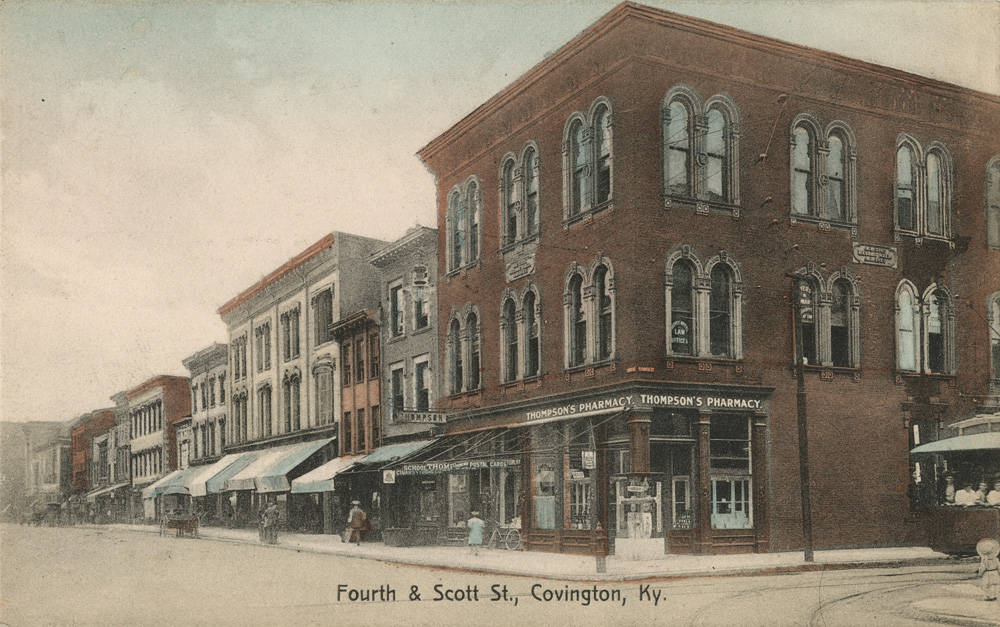
Today’s good people of Covington, Kentucky would be shocked to know how many foreign-born Marxists once called their city home. Perhaps their own great-grand parents. Remembering the comradeship and ideas found in the city’ Socialist Party headquarters across the Ohio River from Cincinnati, the cobbler shop of J.H. Dold where warmth and discussion were found by local and traveler alike. Wonderful.
‘An Historical Landmark of the Social Revolution’ by Walter Hurt from Social Revolution. Vol. 14 No. 6. June, 1917.
A community of natural comradeships, in a land of happy hospitalities, it is not surprising that in Covington, Ky., Socialism should early have found a congenial soil.
It was here the second Socialist local. in Kentucky was organized in November, 1899, the first local having been formed in Louisville; and here through the succeeding years was incubated much of the inspiration for the movement that spread throughout the state, penetrating even to the remotest mountain region.
It was here first came that splendid rebel, Father McGrady, beloved of his Bellevue flock, to let his great soul flame forth in a passion for social justice.
And here, in the quaint cobbler shop of a no less quaint character, J.H. Dold, Socialism found headquarters that were to become known to comrades all over the continent. Here for eight years–from 1902 to 1910–the movement had its abiding place, and here came for fraternal communion, not only all the Socialist speakers that were brought to Covington, but nearly all that were dated in Cincinnati. The movement now has a more pretentious home, but visiting comrades still make their pilgrimage to these quaint quarters of early days, even as the Moslem journeys unto Mecca. Here genial Joe Dold greets them from his busy bench as in years of yore, and for such time as they may they sit again beneath the drippings of his philosophic sanctuary.
Comrade Dold is well called the “Cobbler Philosopher.” He is a student and a thinker; and he studies to a purpose and thinks with accuracy, and has mastered the. philosophy of Socialism as well as any. Elihu Burritt, the “Learned Blacksmith,” may have known more languages, but he knew no more of philosophy than does this Covington cobbler, and was far less learned in the facts of life.
For twenty-three years Comrade Dold has occupied this same shop, patching the shoes and mending the economic errors of his customers. He is personally known to more people, perhaps, than any other man in Covington; and certain it is that none other has so wide an acquaintance throughout the country. Governors, senators, and cabinet officers have been his patrons; among the many famous men of the past whose footgear he repaired or whom he shod anew were John G. Carlisle and William A. Goebel.
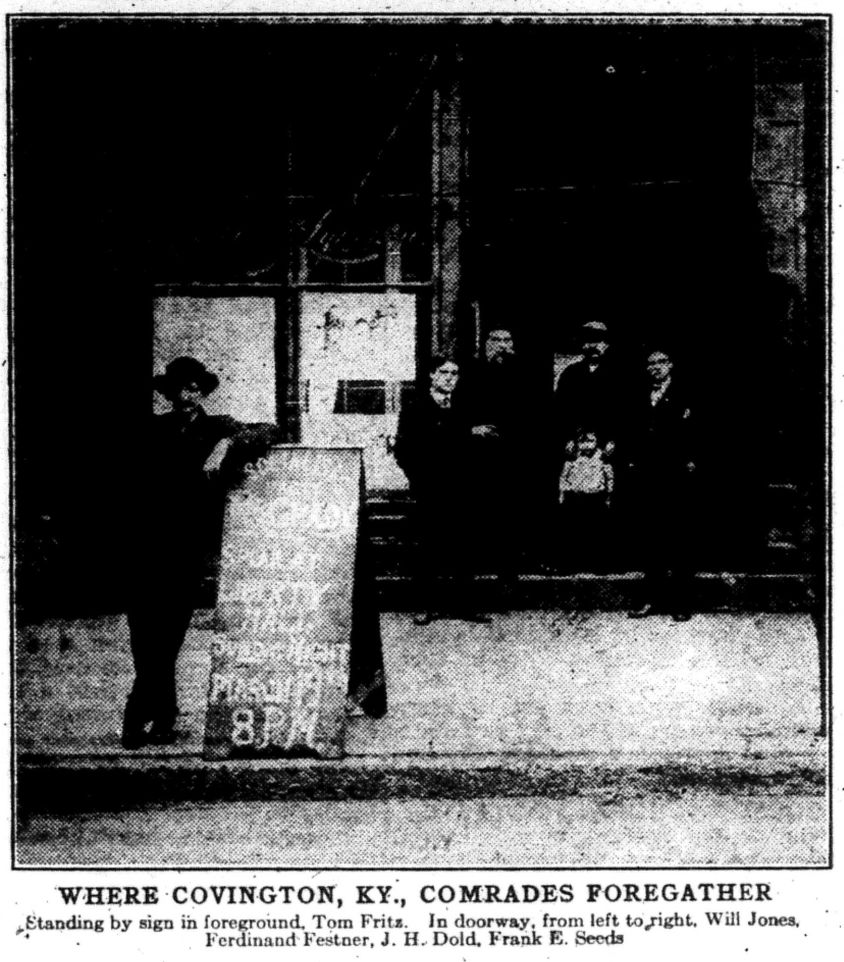
The accompanying picture of Dold’s shop was taken March 1, 1905. The signboard by the curb carries an announcement of a lecture by Father McGrady.
Comrade Dold truly has been a pioneer of progress, an intrepid scout on the frontier of freedom. Revolutionary in spirit from his earliest recollection, as soon as might be this spirit found expression in organized effort. He is a charter member of Local Covington, and previous to the formation of the Social Democratic party, as the present Socialist party first was christened, he was active in the movement known as the Co-operative Commonwealth. These old organization names, so familiar to us veterans of the movement, must sound strange to the ears of the recruits of today. To me this shop of Dold’s is the repository of rare associations, and the comrades of Local Covington hold a special place in my heart. For more than ten years I have frequented the shop during my many visits to Cincinnati and vicinage, and have warmed my hopes at the hearthstone of its welcome. Here was to be found the choicest of companionship. Here congregated rare raconteurs, who tilted humor with a nimble foil; here profound philosophy was discoursed with an amazing proficiency; and here variant wisdom was vented until each session was a large share in a liberal education. And over it all hung-clouds of fragrant smoke like incense above the altar of inspiration.
Here it was I met and learned well to know the resident live-wires, among whom, I now can recall Frank E. Seeds, the Chauncey Depew of the movement; John Thobe, the local Demosthenes of labor (in justice to Demosthenes I should explain that I never heard that gentleman declaim); Frank J. Lavanier, the irrepressible; that gentle comedian, Tom Fritz; Will Jones, the vagrom one; the scholarly A.A. Lewis; and such other congenial spirits as Randolph Winkler, Ferdinand Festner, Sam Rifkin, William H. Danks, Pete Blau, Sam Phillips, James Dial, Jr. George Riley, Frank Mills, Charles Brune, Allen Gorrell, Henry Votel, Jake Hattel, Wallace Barker, Ira Porter, Henry Giesen, and Dr. W.G. Sherrer.
Then from nearby Newport were wont to come Walter Lanfersiek, Frank Streine, George Brill, Walter Schreiver, Adam Nagel, and John Gamble.
Also, from neighboring Bellevue there often journeyed to join the circle such staunch comrades as Gus Wagenlander, Charles A. Oldendick, and M.A. Brinkman, while frequent visitors from. Cincinnati were Joseph H. Nathan and the Branstetter brothers.
In more recent days I was made happy by meeting Herman Plaggenburg, one of the most forceful factors in the local; that tireless worker in the Socialist vineyard, John S. Baird; the human dynamo, W. M Spradling; Billy Catton, Pierce Johnson, Carl Béushauser, Sam. Wetzel, George Dreier, and Lew and Gilbert Grober.
“Where are they now, these friends of mine?” Like members of a scattered family, many of them have gone forth into earth’s far places, and never again in Time shall our paths converge. But wherever they be I hope this message of remembrance may reach them, and cheer them with its spirit of unforgetting comradeship, and that soon I may have their answering hail, addressed in care of SOCIAL REVOLUTION.
The National Ripsaw, a Free-Thinking, Socialist magazine that, in the 1910s, included the O’Hare’s and Debs on its board. The paper under the O’Hare’s was a voice of the Party’s anti-war wing and became a main literary vehicle for Debs before it, like all of the anti-war Left press, was banned from the postal services. In it’s previous incarnation, The Rip-Saw was an openly racist, exclusionary “Socialist” magazine under editor Seth McCallen from 1903 until 1908 when the paper was taken over by Phil Wagner and the politics of the paper changed. Thereafter it was a leading anti-war voice, changing its name to Socialist Revolution before its banning.
PDF of full issue: https://www.marxists.org/history/usa/pubs/national-ripsaw/170800-socialrevolution-v14n06w162.pdf
 Revolution's Newsstand