
The Karelian Commune was almost entirely autonomous from Soviet Russia until 1923 when it became the Karelian Autonomous Soviet Socialist Republic of the U.S.S.R.The sparsely populated, Finnish speaking Karelian Workers Commune established in 1920 (or 1918 depending), held its first Soviet congress in 1921 as journeyed to by a Norwegian friendly delegate, below.
‘Eastern Karelia’ by Haavard Langseth from Soviet Russia (New York). Vol. 4 No. 7. February 12, 1921.
A Link Between Soviet Russia and Scandinavia. Impressions of a Voyage to Bjarmaland.
[Recent events are again bringing Russian and Scandinavian populations closer together. Already in the ninth century there was active communication between Sweden and Northern Russia. The following article deals with territory concerning which the ancient Swedes knew very little, however, and which they regarded as a land of fable and mystery.]
ALL the information we have in Scandinavia concerning the work of a number of Finnish comrades, with Edvard Gylling at the head, just beyond the Finnish boundary, is a few little items in the newspapers. Most of the Scandinavian comrades are perhaps entirely unacquainted with what the name Eastern Karelia stands for, and what the work out there is driving at. As I very recently visited Comrade Gylling in the capital of his realm, Petrozavodsk, I am very glad to comply with the request to tell something about that country.
The country and the people were already known to us Scandinavians in the Viking period, under the name of Bjarmaland. This was the country which Erik Vidfame passed on his journey to Gardarike about the year 600, and this country was the object of Tore Himd’s famous pillaging expedition to Bjarmaland in the year 1026. The Bjarmalanders, which probably meant all the Finnish tribes, were in constant feud with both the Swedes and Norwegians until far into the thirteenth century. Their neighborly relations then expressed themselves in continuous mutual attacks and punitive expeditions, which occasionally degenerated into wars of absolute extermination. Later arose the struggle for land between Sweden and Russia, which lasted for several centuries, until Sweden, at the peace of Stolbova (1617), was obliged to limit its possessions to the boundaries of present-day Finland. This divided the Finns from the Karelians, who are essentially of the same race, and the racial origin of the Karelians was forgotten by Western Europeans, who included them under the designation “Russians”. The fact that Finland in 1809 was ceded in its entirety to Russia did not produce any alteration in this condition. But the Karelians nevertheless have retained to this day their qualities as a Finnish tribe, their language, their customs and manners. The boundaries of present-day Karelia follow the language line, which in the east runs from Lake Ladoga along the Svir River to Lake Onega and thence almost straight over to Soroka on the White Sea. The Karelian language does not differ much from the Finnish, and it was in the Karelian language and in the remote forest regions of Karelia that fragments of the Finnish national epic “Kalevala” survived for centuries, until they were collected to form a single whole, in the last century.
Economically and culturally the country is far behind its western neighbor, Finland. This is due to the fact that its Russian rulers did absolutely nothing to develop or to exploit the rich natural resources hidden there.
The aspect of nature is typically Finnish, the chief impression being one of forest, moor, and water. High mountains are found only in the north and west, and the country is pretty well cut up west and north of Lake Onega; but the tract north and east of Lake Ladoga runs pretty uniformly to the Russian plains. Of lakes there are thousands, all the way from very little ones to regular “inland seas”, such as Seesjarvi, Vikujarvi, Tuopajarvi, and others. Voluminous rivers flow from these great lakes out into Lakes Ladoga and Once and the White Sea. The lake plateau is about 100 to 200 meters above sea level, and the rivers therefore form in their courses either cataracts that are miles in length, or precipitous waterfalls. An idea of the country’s wealth in water power may be gained from the fact that along the Murman railway, from Petrozavodsk to Murmansk, there are waterfalls with about one million horsepower, all very easy to harness.
The climate of course varies in the various parts of this extensive country, but the difference between the mean temperature in the south and north is less than might be expected. This is due to the equalizing influence of the White Sea and the Great Lakes, particularly Ladoga and Onega. Along the coast of the Arctic Ocean, the effect of the Gulf Stream is of decisive importance in determining the climate.
The flora is about that of Central Scandinavia. In the southern districts even wheat may be raised, and a number of cereals thrive rather well as far north as the White Sea. The chief vegetable life is the forests, in the south, pine and deciduous forests; in the north, almost exclusively fir and spruce. The total forest area is about 10,000,000 hectares, or one and one-half times that of Norway. Of the forests, many are really primeval forests, in which you may pass for forty miles without finding a trace of other men, even of hunters or fishermen. Trees of a diameter less than thirty centimeters, four feet above the ground, are never cut down. It is self-evident that there is preserved here a forest capital that should and must be utilized for the welfare both of Karelia and the rest of the world. In the forests there is an unbelievable wealth of game. The king of the forest, the bear, holds his own here, almost absolutely immolested. The rivers and lakes are rich in fish, man has not yet even taken the fresh-water fish out of the Karelian lakes. Salmon, in the many rivers that descend to the White Sea, are more abundant than anywhere else in northern Europe.
In addition to the forests, the fruitful, workable soil, the water power, the game, and the fish, Karelia has peat-bogs that are miles in width, great deposits of minerals, even veins of coal in some places. These possibilities have been but little investigated, but it may be of interest to point out the wealth in bog iron ore in a single lake, Vikujarri, where there are 11,000,000 tons of bog iron ore. This will perhaps give a slight idea of the possibilities that a systematic geological survey would reveal.
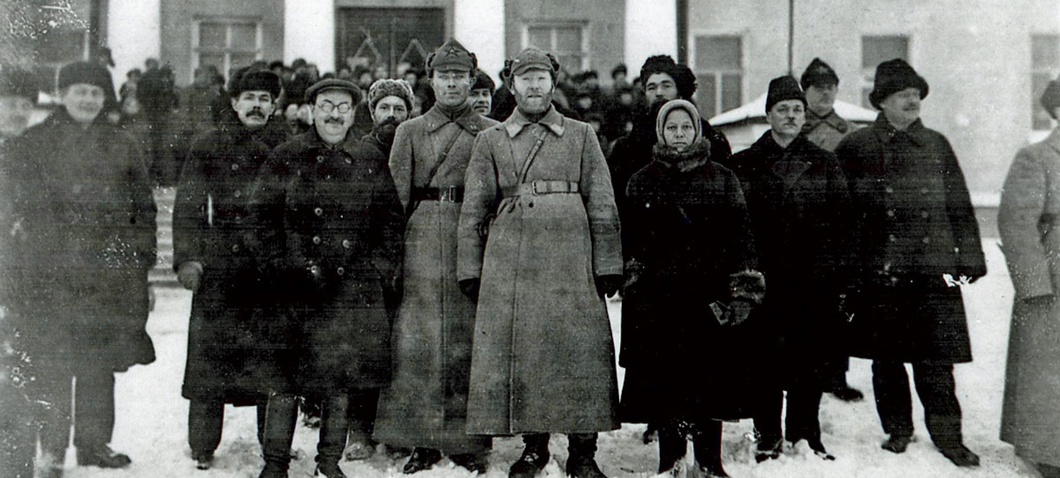
The Karelian Labor Commune
After the defeat of our Finnish comrades about ten years ago, great bodies of the revolutionists moved over toward Russia, seeking refuge and a livelihood. Many went to Norway and Sweden, many lived as fugitives in Finland. To gather these bands, to afford them economic protection, to organize them anew for continued work for Communism, this was of course a thought that many a Finnish comrade had in mind. But nothing came of these plans until Comrade Edvard Gylling, in the spring of 1920, proposed to the Russian Government to form a colony of the fugitive Finnish comrades in Eastern Karelia. His plan was approved. Karelia was separated and given the name “The Karelian Labor Commune”, constituting a partly autonomous area belonging to the Russian Federative Republic, and the Karelian Revolutionary Committee was formed on Midsummer Day, 1920.
The Revolutionary Committee consists of Finnish and Karelian Communists with Gylling as Chairman. The first task taken up was the economic reconstruction of the country, and we may say that the comrades in Karelia were not idle. In addition to keeping the most necessary branches of economic activity in operation and developing and improving them, they undertook an extensive reconstruction and reorganization in a Communist direction. In spite of the great difficulties, in spite of the almost absolute lack of usable talents, at first only a few dozen, now at most a few hundred, in spite of a very moderate degree of understanding and assistance from both the Finnish and the other Scandinavian comrades, they have already accomplished great things. The economic council, which has control of the solution of economic questions, consists of twelve persons with a Presidium of five members. On Gylling’s shoulders as Chairman of this Presidium, there rests many burdens. Among the other members are the Karelians Potoyev, Guryev, and Nikitin, as well as the Finnish Comrades Maki, Hapalainen, Makinen, and Saksmann.
Soviet Russia began in the summer of 1919, published by the Bureau of Information of Soviet Russia and replaced The Weekly Bulletin of the Bureau of Information of Soviet Russia. In lieu of an Embassy the Russian Soviet Government Bureau was the official voice of the Soviets in the US. Soviet Russia was published as the official organ of the RSGB until February 1922 when Soviet Russia became to the official organ of The Friends of Soviet Russia, becoming Soviet Russia Pictorial in 1923. There is no better US-published source for information on the Soviet state at this time, and includes official statements, articles by prominent Bolsheviks, data on the Soviet economy, weekly reports on the wars for survival the Soviets were engaged in, as well as efforts to in the US to lift the blockade and begin trade with the emerging Soviet Union.
PDF of full issue: https://www.marxists.org/history/usa/pubs/srp/v4-5-soviet-russia%20Jan-Dec%201921.pdf
 Revolution's Newsstand