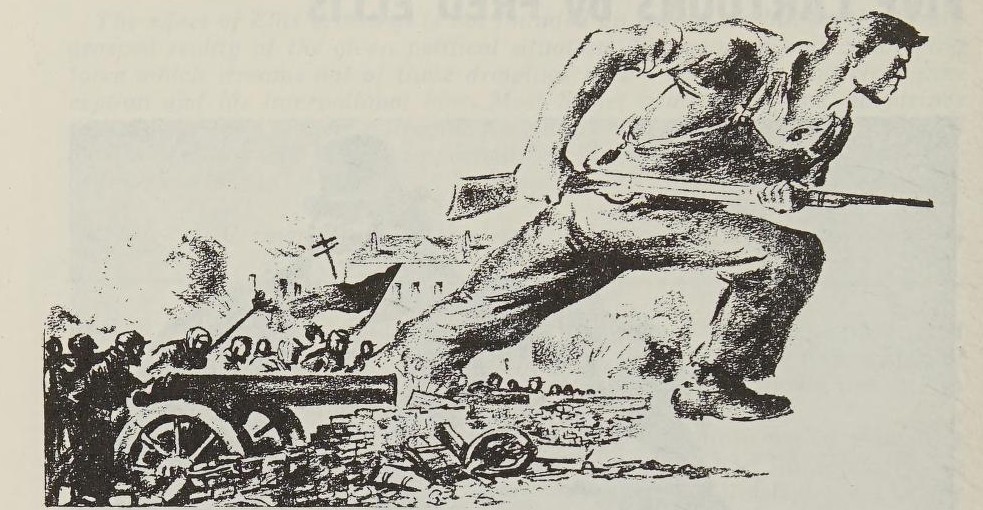
A 50th birthday celebration of an artist whose work helps to define his times, the Daily Worker cartoonist Fred Ellis.
‘Fred Ellis: Artist of the Proletariat’ by Alfred Durus from International Literature. No. 11. 1935.
ON THE FIFTIETH BIRTHDAY OF FRED ELLIS, AMERICAN ARTIST
Fred Ellis, American worker-artist, has just passed his fiftieth birthday. This event has been noted in the Soviet press, which has long been aware of his 20 years of activity in the American labor movement. Sovietskoye Iskustvo {Soviet Art), Literaturnaya Gazeta (Literary Gazette), Trud (Labor), where he is staff artist, the staff of Krokodil (Crocodile), noted satirical magazine, and others, have paid proletarian tribute to Fred Ellis, pioneer American revolutionary artist. The editors of International Literature join in the many greetings to Ellis on his fiftieth birthday, and wish him at least fifty more years of healthy activity as an artist of the proletariat. Below we present a sketch of the artist and his work by Alfred Durus, art critic and secretary of the International Union of Revolutionary Artists; Heinrich Vogeler, German revolutionary painter; and D. Moor, noted Soviet artist. These are followed by reproductions of drawings and cartoons chosen from the only few available. since hundreds of others are being shown in Soviet art galleries and are being toured in exhibits in various sections of the Soviet Union.—Editors
FRED ELLIS: Artist of the Proletariat by Alfred Durus.
The class conscious activity of the noted American political artist, Fred Ellis, began with the world war. In 1914 he bombarded imperialist war with the heavy artillery of his satirical cartoons. He started his attack in the pages of the trade union organ the New Majority and for the past 20 years he has unceasingly been sharpening his keen weapon.
Fred Ellis is a charter member of the New York John Reed Club artist’s group, which played a leading role in the organization of the present all-embracing Artists Union. He is also a member of the International Bureau of Revolutionary Artists in Moscow. A pioneer of proletarian art, he began his career at the time his American comrade Bob Minor was drawing: and abroad his German comrades, Heartfield and the early George Grosz.
It would be a mistake to think, however, that Ellis is the splendid political artist only because he is an able craftsman. His heart beats in unison with all the disinherited, exploited and oppressed of the earth; his revolutionary passion is the passion of millions; in his creative work, all the hatred of his class in embodied. A proletarian artist, Ellis knows how to clothe his passion, his revolutionary hatred in a compelling form affecting the masses. The tendaciousness of his art is integral, never artificial.
Ellis was born in Chicago in 1885. The son of a worker, he early learned the hard life of the exploited. He went to work at 14—as a clerk, then printer; as a worker in an ice cream factory, as a laborer in the Chicago packing houses (when Upton Sinclair wrote his Jungle) and finally as a sign painter. And it is significant that Ellis’ art education began during this strike. Out of seven “free” months he spent four at art school.
1919 marked a turning point in Ellis’ art life. After a fall from the sixth floor of a building while painting a sign—for which he spent six months in a hospital—he gradually drifted away from the conservative trade union press and began to contribute to the revolutionary papers. In 1923 he became staff cartoonist for the Daily Worker and in 1924, joined the Communist Party.
After recovering from his fall, Ellis returned to sign painting and up to 1927 did political cartoons for the revolutionary press in the evenings. The Sacco-Vanzetti case raised a storm over the world. It was during this period that he came to New York and did his best work for the Daily Worker. His drawings of Sacco and Vanzetti were reprinted the world over. They appeared in book form.
In 1930 Fred Ellis came to the USSR.
America has a wealth of graphic publicists. The work of most of. the artists in the American revolutionary press, artists like Bob Minor, Fred Ellis, Hugo Gellert and William Gropper, among others, belongs to the best produced by American graphic art in movement, depth and power. American revolutionary graphic art plays a leading role in the revolutionary art of the west. And the best artists in the USA are in the struggle for communism.
Bob Minor, Fred Ellis, Jacob Burck, Phil Bard, continue and develop the tradition of Daumier’s revolutionary cartoon, while French revolutionary art tied hand and foot with the fetters of formalism, is still at a loss as to what it can do with the great heritage of its countryman.


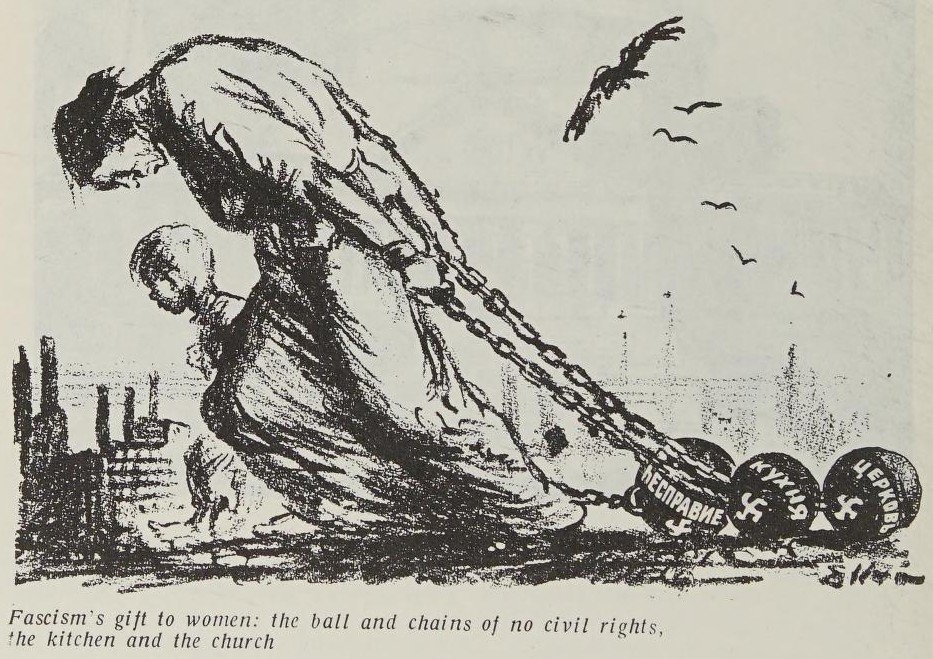

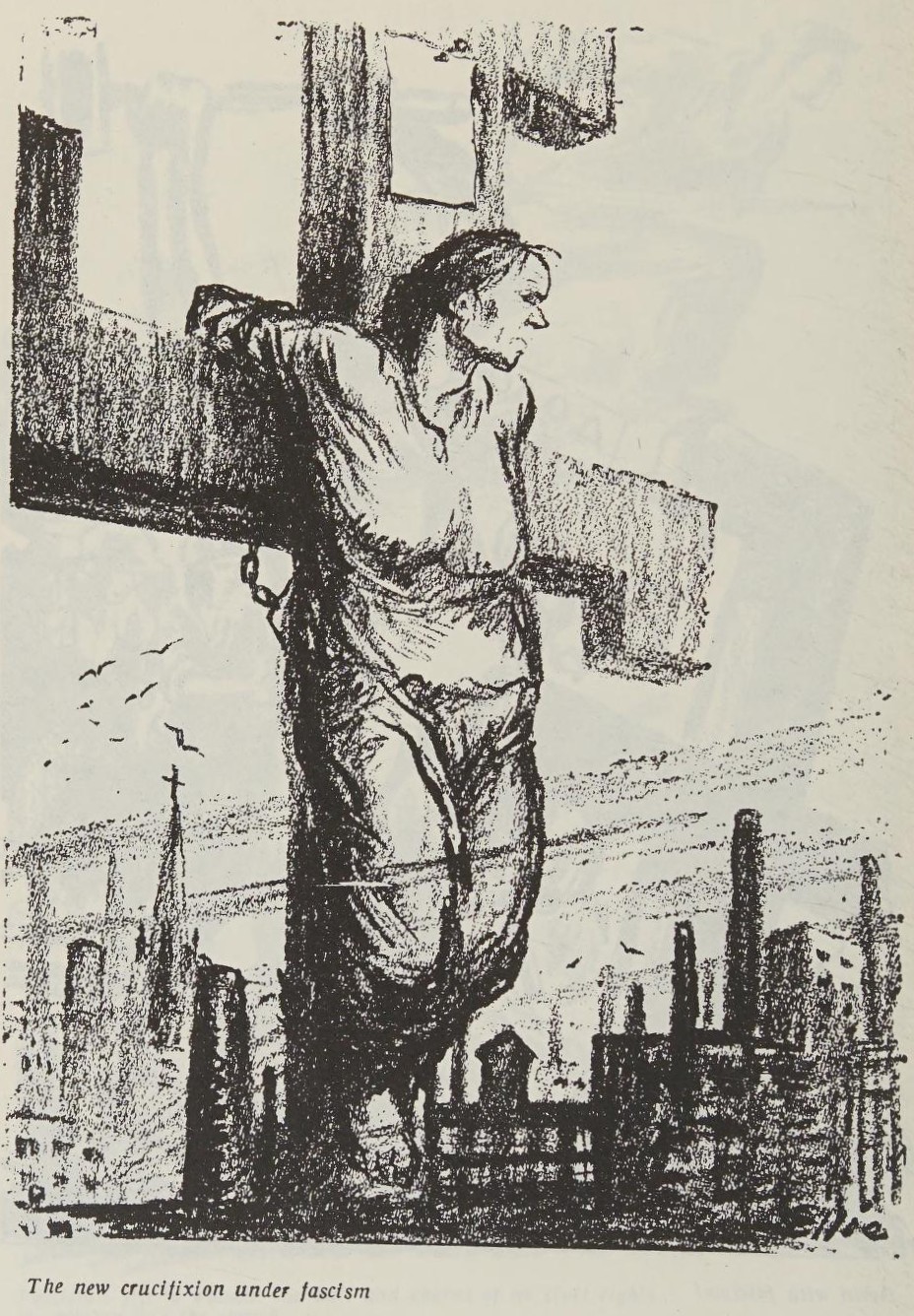
In American publicistic graphic art, the art of Fred Ellis occupies a leading place. He is today, one of the masters of American proletarian art, one of those artists in whose work expert form corresponds to its revolutionary content. He knows how to clothe current events in lasting, artistic imagery.
A feature of Ellis’ work is the fact that the artistic level of the American revolutionary proletariat is revealed by its own representative who, having become an artist, has not for a moment ceased to be a proletarian. His imagery affects the masses because the ideas, hopes and psychology of these masses are closer to him than to anyone.
Realist, graphic artist par excellence, satirist, he never copies the external world. The revolutionary artist must have recourse to exaggeration in order to penetrate the moving forces of our age. He recognizes the impossibility of separating true satire from exaggeration, that satire bars pedantry, that against the rottenness and savagery of the moribund class there is the vivifying power of the rising proletariat, that the contradictions of our age can be most vividly rendered in the light of satirical art.
The characters and symbols of Ellis’ cartoons are not always original. With a keen artistic feeling he knows how to revive old ideas and symbols. For instance, the symbol for fascism before Ellis was also: gibbets, the hangman, the skeleton—but in Ellis’ artistic rending these symbols acquire a new power and effectiveness. Ellis’ workingman as a symbol of the Hungarian Soviet Dictatorship becomes a stirring plastic work of art in monumental composition.
In Ellis’ work there is that harmonious blending of great art and living events. His work does not stand still. As a political cartoonist Ellis continues to uncover tremendous possibilities.
Ellis makes many sketches from life. These sketches are always masterly in their lifelikeness. He knows the importance of composition. He has always worked for newspapers and he knows how to take advantage of paper and ink. Ellis belongs to that noted group of American artists who have not only contributed to the world’s revolutionary art, but have also shown themselves skilled craftsmen of the reproduction technique.
Characteristic features of Ellis’ art are a joyous optimism and a healthy internationalism. This has helped him become part of Soviet life so easily. He is now staff artist of Trud in Moscow, draws posters, illustrates books for Soviet children and there is hardly a newspaper or magazine in Moscow—and in other sections of the Soviet Union—in which you cannot see the cartoons and drawings that Soviet workers love so much—draw by the American artist, Fred Ellis.
From D. Moor—Soviet artist
It was from the working class that Fred Ellis learned love, hate, struggle, his themes and his ability to generalise mordantly. He had a little art school training at the time of the big Chicago strike, when he was “free from work.” This connection between work and study penetrates his whole life.
If to the above it be added that the majority of the artists working in American revolutionary caricature were pupils of Daumier then their pupil, Fred Ellis, will stand before us at his full height, as a fiery fighter-worker, artistjournalist whose education developed under the sensitive eye and artistic hands of Daumier. In style of drawing, Ellis is close to Robert Minor (USA) on the one hand and the Soviet caricaturists, the Kukriniksi, on the other.
Already in his Daily Worker period Ellis might be summed up as an artist of big generalizations, purposefulness and emotional and journalistically clear forms. At this period his illustrative manner of drawing did not always and did not fully coincide with his tasks of big generalization and there were still gaps between the general impression and the execution.
From the time of his arrival in the USSR, a great development towards monumentalness is noticeable in his work. The drawing has become considerably simpler, more expressive and fuller in content, i.e., in the very form the actual processes of life are more fully disclosed.
His sharp observation has become still sharper. His images have widened, his symbols have become livelier and have lost a certain schematism from which they suffered earlier.
At present the artist is growing considerably, is developing all those fine qualities in which he was rich earlier. His composition is changing. It is becoming ever more efficient and mobile. The static and I would say specially “American” conventionality of drawing marked by overloading is being transformed into the movement of forms cleansed of unnecessary details. The hand has become bolder, the eye sharper and the treatment has become so much the more certain. In general one gets the impression that Ellis is a young artist who has a future. Honor and praise should be given to those who do not stand in one place content with the past but develop as Ellis does.
Moscow, USSR.
From Germany
The effect of Ellis drawings is not founded on caricature but on the firmly grasped reality of the given political situation. The rousing and convincing force which streams out of these drawings shows his simple and clear perception and his international bias. Most Soviet newspapers and magazines regard Fred Ellis as their colleague. Now Fred Ellis is turning to painting, and we are sure this will furnish important bricks for the building of revolutionary Soviet art.
HEINRICH VOGELER (German Revolutionary Artist in exile, now working in Moscow).
PDF of full issue: https://www.marxists.org/subject/art/literature/international-literature/1935-n11-IL.pdf
 Revolution's Newsstand