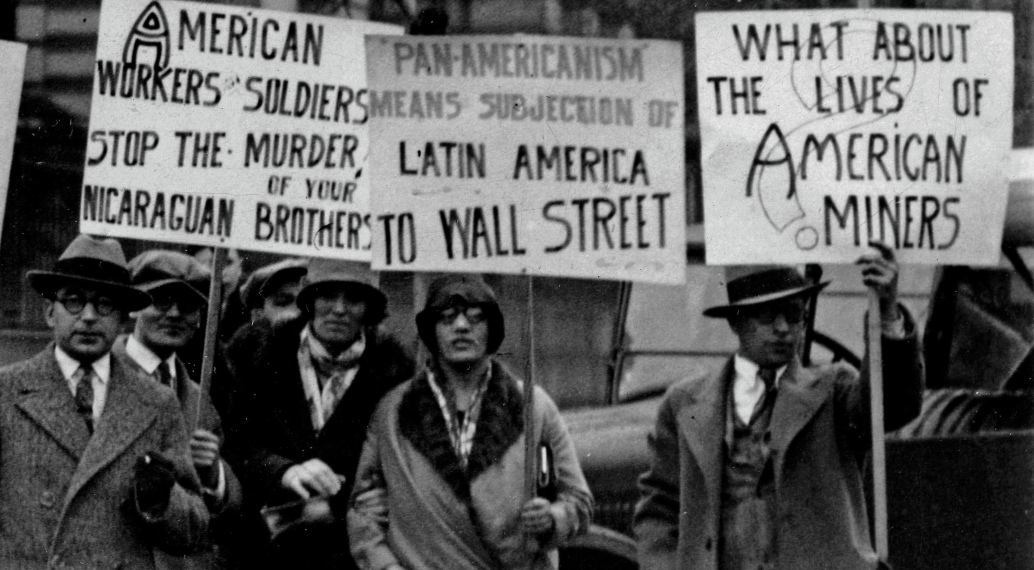
After World War One, as United States displaced all other imperialist powers to become the hegemon of the Western Hemisphere, the ambivalence of some towards the U.S. was replaced by the hostility of the many. Dunne looks at the specific events leading to that new reality, one we are still very much living in today.
‘Latin America Uniting Against American Imperialism’ by William F. Dunne from The Daily Worker. Vol. 3 No. 301. January 6, 1927.
THE revolt against American imperialism in Latin America is spreading rapidly and the struggle is becoming sharper.
A number of events in the last few weeks justify this conclusion.
They are:
1. The popular revolt in Nicaragua led by Sacasa against the Wall Street tool Diaz.
2. The recognition of the popular forces as the Nicaraguan government by Mexico in defiance of the American state department.
3. The statement of Pedro Zepeda, representative of the Sacasa government in Mexico City, in which he said:
“The intervention of the United States in favor of Diaz has fanned the patriotism of every Nicaraguan into such unquenchable fire that all are ready to fight unyieldingly against foreign invasion.”
4. The crushing defeat of the Diaz forces by the popular army AFTER the United States had instituted a blockade and landed troops in support of Diaz.
5. Open aid, by munitions and otherwise, of Mexico to the Sacasa army AFTER being “warned” by the American state department to discontinue all support.
6. Well-founded reports from Guatemala that a similar situation is developing there.
7. The unanimous condemnation of American intervention in Nicaragua by the Latin American press in a tone which shows a development of a Latin American consciousness far higher than any evidenced hitherto and which perceives American imperialism as the most dangerous foe to unity and independence of the Latin American people.
A NUMBER of occurrences combined has speeded up the tempo of the movement against American imperialism and given it a coherence which Wall Street and its state department, backed by the war department, have prevented it acquiring until now.
These occurrences can be divided into two categories–one directly affecting American and Latin American relations, the other listing events outside the western hemisphere and indirectly influencing the Latin American nations.
THE first category of occurrences can be listed as follows:
1. The continuous offensive conducted against Mexico by Secretary of State Kellogg designed to force the withdrawal of the provisions of the 1917 Mexican constitution relating to oil concessions and titles.
2. The palpable connection between the offensive of the state department and the attempt of the Roman catholic hierarchy to stir up counter-revolution in Mexico.
3. The resolute attitude taken publicly by the Calles government against a policy of an interpretation of Mexican law to suit American investors.
4. The internal strength shown by Mexico in liquidating the crisis created by the catholic clergy.
5. The interference of America in the Tacna-Arica dispute and the dispatch of a militarist (General Pershing) to supervise the negotiations and plebiscite.
6. The one-sided treaty forced on Panama which makes this republic nothing more than a military and naval base of American imperialism and is concrete proof of the intention of the imperialists to grab and use, in the struggle for world domination, such Latin American countries as it desires.
7. The ultimatum to Mexico that it stop supporting the popular government in Nicaragua, tantamount to a declaration that Mexico cannot recognize a Latin American government on which Wall Street has not put its seal.
8. Open armed intervention by America in Nicaragua in behalf of a Wall Street tool AFTER the warning to Mexico against Interference.
9. American repudiation of the pledge of Filipino freedom.
THE second category of events which by reason of the colonial and semi-colonial status of the Latin American nations in relation to America exert great influence in stimulating resentment of American domination and inspiring hope of success in the struggle against it may also be divided into two parts—one the list of events which indicate the existence of other forces hostile to American domination, the other including those struggles which show a world-wide upsurge against imperialism on the part of colonial and semi-colonial peoples and, more important, still, the evidence that such struggles are no longer forlorn hopes but that each one of them holds the prospect of victory within a measurable period.
THE first group consists of:
1. Evidences of a renewal of the rivalry between Great Britain and America in Latin America shown by the acceptance of the terms of the Mexican government by British oil companies thus placing British interests in a more favorable position.
a. The acquisition of tracts of rubber land in Panama by British interests and the consequent furore in the American press.
2. The lack of sympathy expressed in the European press for the latest adventures of American government such as the Panama treaty and the characterization of them as “imperialistic.” The comment of Pertinax, semi-official political writer for the Echo de Paris, is typical:
“The absorption of Panama proves, no matter what one says, that American imperialism exists. It differs from European efforts at hegemony only by the weakness of the obstacles it meets…After the conquest of the Spanish colonies in 1898 there came the subjugation of Panama in 1904, the Dominican Republic in 1907, Haiti in 1915, Nicaragua in 1916 and Honduras in 1924.”
BELIEF in “American idealism,” in American desire to “do good” for the Latin American peoples is fading rapidly. The complete lack of support by the leadership of the American Federation of Labor for the struggles of the Latin American masses against American imperialism, has shown to large sections of the Latin American workers the falsity of the promises that were made at the El Paso convention in return for the institution of an expulsion policy against the Communists.
THE second group consists of:
1. The growing successes of the Soviet Union at home and its appearance in all colonial struggles as a friend of the nationalist liberation movements.
a. The constant denunciation of the workers’ and peasants’ government of the Soviet Union by the imperialist powers serves only to attract the favorable attention of colonial and semi-colonial peoples to its achievements. (Accusations of “Bolshevist influence” in Mexico by the American imperialist press, etc.).
The great sweep of the Chinese national ‘liberation movement and its, defiant attitude towards the imperialist powers based on its amazingly rapid victories and internal consolidation.
a. The statement made recently by Chang Kai-shek, commander-in-chief of the people’s armies in which he announced that their victories were not for China alone but that New China would assist all colonial peoples struggling for national liberation from imperialism.
3. The great mass movement and armed uprising of the Javanese workers and peasants against British-Dutch imperialism.
THE tone of the Latin American press always leaves no doubt that the “big brother” role of American imperialism is played out so far as public opinion in Latin America is concerned and that it is now seen in its proper light as a “big bully.”
Writing from Buenos Aires, the correspondent of the Chicago Daily News says:
“A visitor from Mars getting his first earthly impressions from the Buenos Aires newspapers would be convinced that the ONE GREATEST EVIL IN THE WORLD IS THE UNITED STATES OF AMERICA.
“Two of the leading morning newspapers DEVOTE NEARLY TEN COLUMNS to cable dispatches which picture the UNITED STATES AS PLUNGING RUTHLESSLY ALONG ITS IMPERIALISTIC PATH AND TRAMPLING DOWN THE WEAKER REPUBLICS…” (Emphasis mine.)
AS in China where the weapon of the boycott has been used so successfully against British and Japanese imperialism, the Argentine press suggests this means of combatting American domination. The Dally News correspondent continues:
“The…suggested solution is to find means to stop buying in the United States.
“La Nacion declares this is the proper time to develop the coal resources of Argentine and cease buying American coal. IT SUGGESTS THAT CHILEAN COAL COULD BE USED IN THE MEANTIME.”
THE former enmity between Argentina and Chile seems to have disappeared in the face of the danger from the common enemy. The Brazilian press Is also critical. The Journal of Rio quoted in a dispatch to the New York Times, characterizes the American policy in Nicaragua as “audacious and imprudent” and says that the landing of marines “shows a spirit capable of causing consequences certain to disturb continental tranquility.”
JUST as much significance must be attached to the utterance of the press on the east coast of South America where no such open hostility to imperialism has manifested itself before, so must great importance be attached to the expression of the Mexican press, whose country would undoubtedly bear the brunt of armed intervention by the United States. El Universal, published in Mexico City, speaks plainly and uncompromisingly in an editorial published Dec. 28:
“…the motives for indignation are not less when the hypocritical lying efforts used to cover it are contemplated…No one takes the disembarking of marines in Nicaragua as anything but the culmination of the old policy of attempts against the integrity of the Latin American republics…are nothing than the consequences of that aggressive imperialism which, at times, has tried to disembark, under the mask of the Monroe Doctrine, and at other times under or with the names of the Wilson or Hughes doctrine…we hope these facts will serve to unmask before the American people the MAGNITUDE OF THE PROBLEM WHICH IS NOW OPENED FOR THE FUTURE OF PEACE IN AMERICA.” (Emphasis mine.)
THREE points are to be noted in this editorial expression:
1. The challenge is made directly to the Monroe Doctrine —hitherto considered as the whole basis of relations between the United States and Latin America.
2. Latin America is spoken of as a bloc of nations whose interests are opposed to those of American imperialism.
3. An appeal is made over the head of American government to the American people.
THE general line of development of policy indicated In the three points above is the line which the increasing sharpness of the struggle and the open aggression of American imperialism will force the anti-imperialist movement to take in Latin-America.
The entry of Latin-America, led by Mexico, into the group of nations which are part of the world struggle against imperialism is of the greatest importance for the American labor and revolutionary movement. A number of conclusions can be drawn for this which will be of value in shaping policy:
1. The conflict with Latin America, particularly its rapid development, shows the instability even of the prosperous American imperialism in a world which is becoming increasingly unstable.
2. The world situation and the growth of American penetration of Latin America while serving to industrialize these smaller nations is likewise creating a stern resistance to the increased exploitation.
3. The need of American imperialism for Latin America as a market and a source of cheap raw materials makes it especially vulnerable to forces set in motion by the rise of anti-imperialist sentiment and organization.
IT Is the duty of our party to intensify its aid to the struggles of its brother parties, the Latin American labor movements and the whole struggle against American imperialism.
The Communist parties of Latin America must be given every assistance possible so that they may be able to develop strength and influence In the labor and peasant movements sufficient to enable these to play a decisive role in the struggle.
In the United States we must, to the limit of our resources, see that the American working class and its organized section wages a struggle to prevent armed intervention and bloody suppression of the Latin American peoples.
AROUND such slogans as, “Hands Off Mexico, the leader of the Latin American peoples against Wall Street domination,” and “Hands Off Latin America, No War For Wall Street,” the fight against American imperialism can be conducted with promise of success and the Latin American peoples shown that they possess In the American working class and its advanced section powerful allies in their ever-sharpening struggle.
Not the least of these tasks at home is the systematic and untiring exposure of the present trade union leadership as dangerous allies of imperialism and deceitful foes of both the Latin American and American masses.
The Daily Worker began in 1924 and was published in New York City by the Communist Party US and its predecessor organizations. Among the most long-lasting and important left publications in US history, it had a circulation of 35,000 at its peak. The Daily Worker came from The Ohio Socialist, published by the Left Wing-dominated Socialist Party of Ohio in Cleveland from 1917 to November 1919, when it became became The Toiler, paper of the Communist Labor Party. In December 1921 the above-ground Workers Party of America merged the Toiler with the paper Workers Council to found The Worker, which became The Daily Worker beginning January 13, 1924.
PDF of full issue: https://www.marxists.org/history/usa/pubs/dailyworker/1927/1927-ny/v03-n301-NYE-jan-06-1927-DW-LOC.pdf
 Revolution's Newsstand