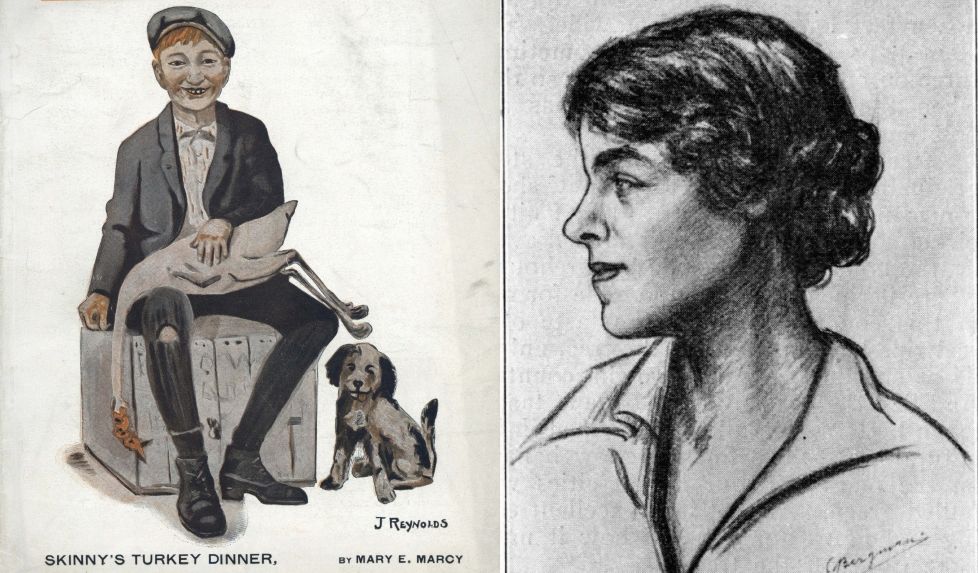
Mary E. Marcy, with her anger, empathy, and as always, a class point to make, gives us a short story on philanthropy’s spoiled Thanksgiving turkeys, and the unquestioning solidarity of neighbors.
‘Skinny’s Turkey Dinner’ by Mary E. Marcy from International Socialist Review. Vol. 10 No. 5. November, 1909.
TWO weeks before Thanksgiving Day every newspaper in Chicago began to tell about it. Mr. H. Harrison Browne, they said, President of Browne, Johnson & Company, one of the largest wholesale grocery houses in the city, would give away, on the day before Thanksgiving, a carload of choice country turkeys.
The amount of free advertising Brown, Johnson & Company, and Mr. Browne in particular, received upon the strength of this bare announcement is almost incredible. Every branch of every charity bureau in the city received requests from him for the names of families particularly “worthy” to share Mr. Browne’s bounty. Several ministers mentioned his name in writing their Thanksgiving sermons as a man of wealth for other rich men to emulate and for the poor to thank God for.
All over the city people were asking each other, how many good sized turkeys go to make up a car-load and everybody declared it was really very handsome of Browne, Johnson & Company, with turkeys at 27 cents a pound. It would be a good thing, they declared, if he could shame the Beef Trust into being reasonable for once, instead of holding everybody up during the holiday season.
The city papers gave columns lauding President Browne, and a sympathetic cub-reporter spent several evenings among the hardworking, underfed people on the West Side, gathering local color for a Thanksgiving story on Browne’s Turkey Dinners.
And fully ten thousand underfed families read about Browne’s carload of turkeys, and doubted and longed for one of them. The charity organizations were besieged with requests and pleas for notes of recommendation to the Browne Distributing Committee and the subject of universal interest in Packingtown, Bubbly Creek and all along Halsted street was Browne’s free Thanksgiving turkeys.
Now Skinny McCarty was one of the scrappiest boys for his age, in Bubbly Creek, and he made up his mind to secure one of these free turkeys for the McCarty Thanksgiving dinner. His father, Dan McCarty, had been working on half time for so many months that the family well knew it was their only chance.
Skinny read all the papers and gathered sufficient information to know that the best way to secure one of the prizes would be to have a note from the Charity People. And, as Big Dan McCarty said, “‘Skinny was a bye with a turrible nerve.” So to the Charity People he went. From past experience he realized that Miss Thompson, the investigator in whose territory he lived, would be the most likely person to approach.
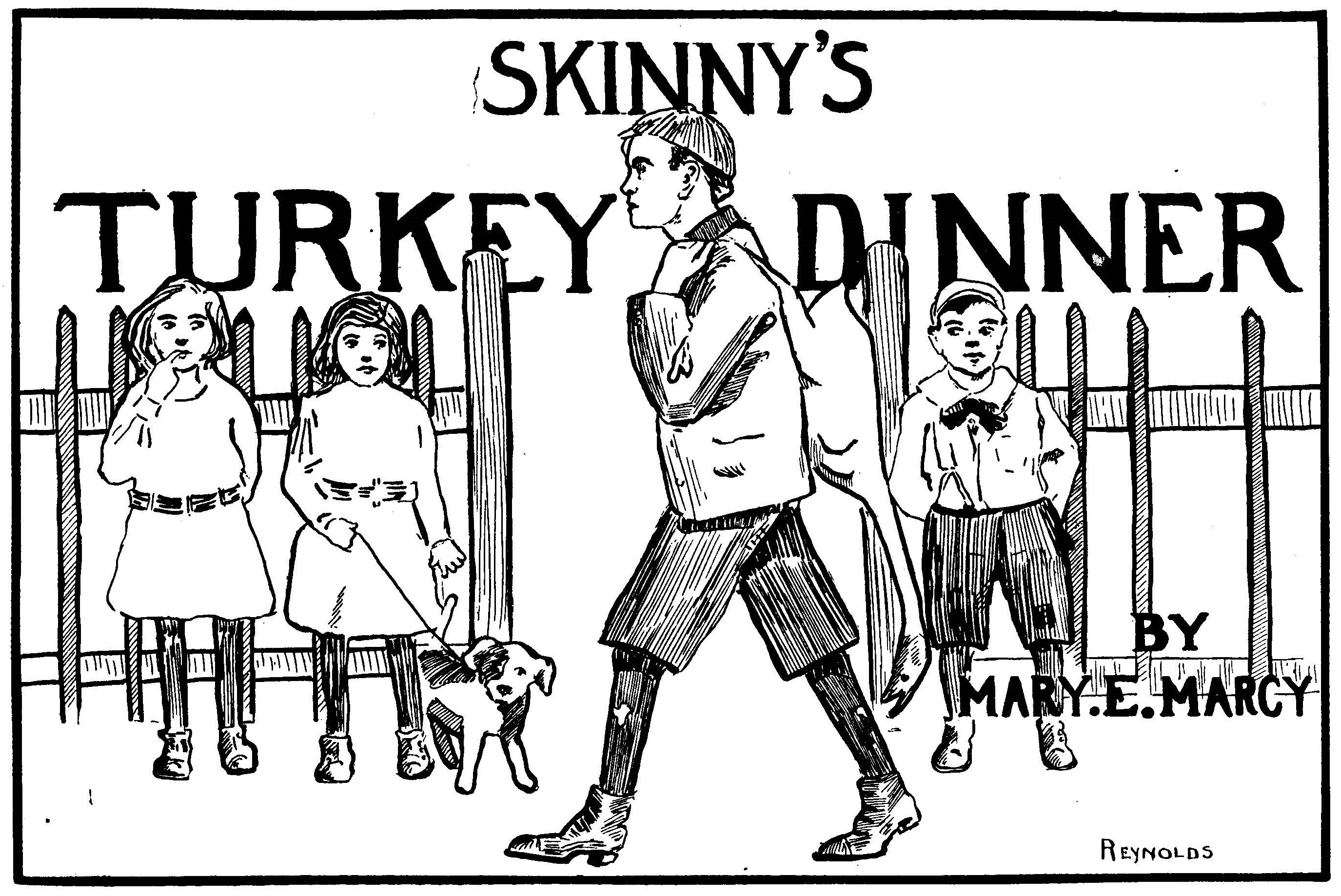
Miss Thompson had long been prejudiced in Skinny’s favor. When Dan McCarty had been laid off at the time of the advent of the last new McCarty baby she had found Skinny eager to get a paper route down town and to go into business. All the McCartys were cheerful, hard working, and, as a rule, self-supporting. She believed in encouraging them.
So when Skinny explained about the “free turkeys” and asked for a note to Browne’s Distributing Committee, he got it. Three times he was compelled to kick his feet waiting for Miss Thompson in the Bureau Investigating Room, but the morning before Thanksgiving Day his patience was rewarded and he returned to Bubbly Creek the envy of every boy and girl along the Alley.
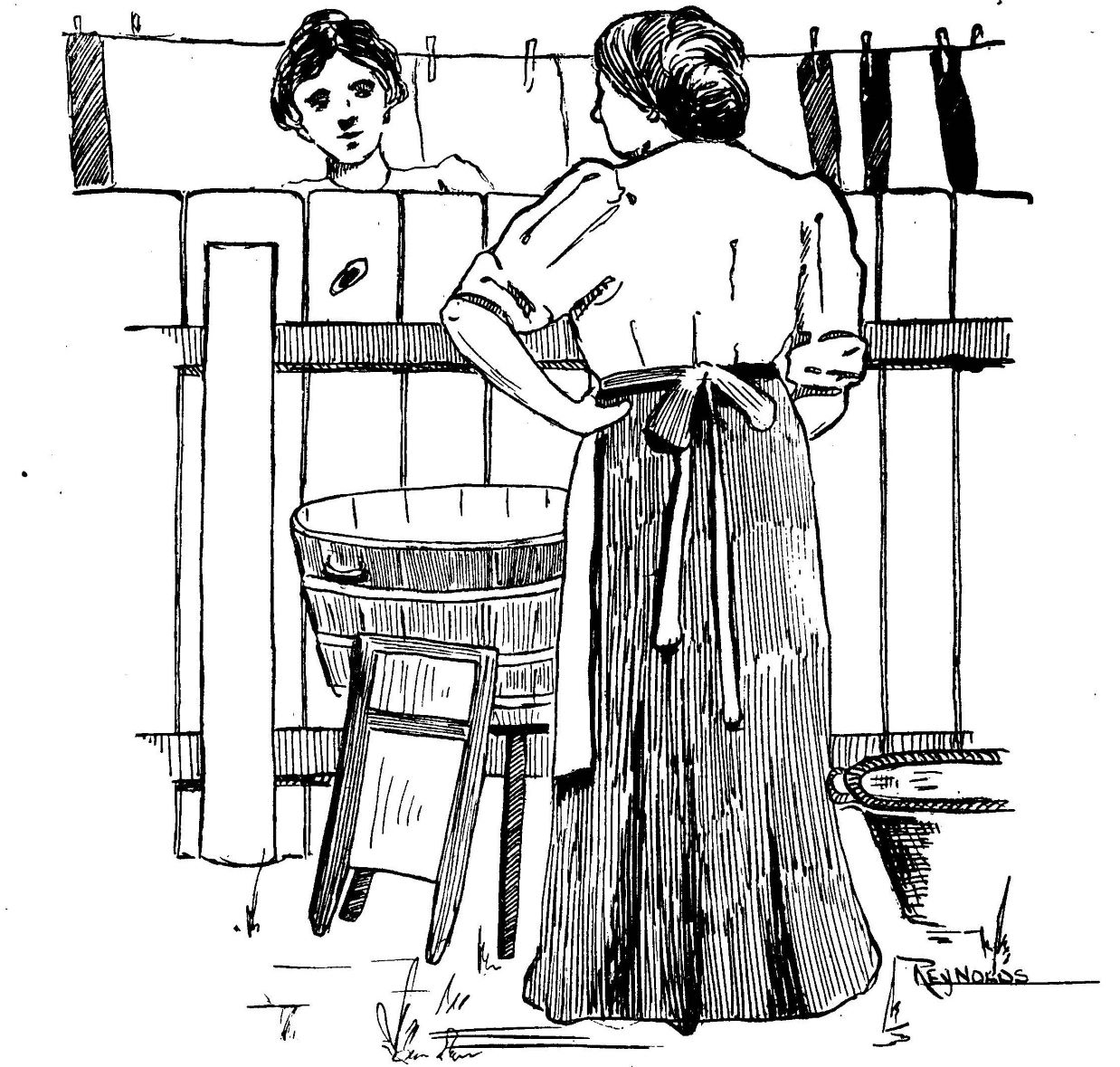
Five minutes before he reached home, Mrs. McCarty, bending over her wash-tub, heard his triumphant shrill whistle and the smaller McCartys began to expand into the largest grins of which they were capable as they flew to meet Skinny.
This was the morning before Thanksgiving Day. The turkeys were to be given away from Browne, Johnson & Company’s down town wholesale store at four o’clock in the afternoon. So Skinny assumed an air of great importance, ate a slab of bread spread with fryings, and departed for the scene of his hopes.
His mother gave him a nickel to take the car home, for it was over five miles to Browne, Johnson & Company’s store, and she hoped the turkey would be a heavy one. Besides it was not always safe for a small inhabitant of Bubbly Creek to parade his worldly wealth too freely without possessing the strength of arm necessary to protect it.
As Skinny strutted proudly down the Alley, Mrs. McCarty took her hands from the tub and stood watching him from the basement steps and bragged a little to Mrs. Smith, who lived next door, and thanked God for giving her such a smart “bye.”
It was a long and interesting walk for Skinny down to Browne’s, and he enjoyed every step of it. He reveled too in the great masses of people that packed State street for nearly a block and swelled over and blocked the cars on Randolph. All these people had come hoping to get a free turkey too, but few of them would have notes from the Charity People. And his boy heart swelled with the pride of his own cleverness,
Long before three o’clock the crowd had become an impact mass through which it refused to allow newcomers to pass. But Skinny had, long before, slowly and laboriously wormed his way near the side door, where the papers said the Browne Distributing Committee would give out the turkeys. And still the people came till the whole street looked like a hive dotted and swarming with bees. At last Browne, Johnson & Company sent a call to the Police Department and a little later a squad arrived to clear the streets and disperse the crowd.
Skinny managed to hold his position near the big doors, and when the Distributing Committee finally made its appearance he shrilled instantly,
“I’ve got a letter from the Charity People; read it. They told me to give it to you an’ you’d give me a turkey. Her name’s Miss Thompson,” and he frantically climbed over the rude platform and thrust the note into a man’s hand. So Skinny was one of the first to receive a turkey.
With a deep sigh of joy, he threw it over his shoulder, holding firmly to its legs. Then he backed cautiously against the walls of the building. The air was very cold, but Skinny heeded it not, and when a few belated policemen appeared driving the crowd before their clubs, he followed at their backs, out of the crowd, and made his way to a South Side car.
As it leaked out afterward (though it did not leak far) only five hundred turkeys were really given away, but Skinny never knew that, and if he had known, he would only have considered himself more lucky in securing one.
It was seven o’clock when he arrived home. Supper was on the table and a roaring fire in the stove, and the beaming smiles of his mother and the smaller McCartys sent Skinny’s spirits skyward in an ecstasy of pride and joy.
The turkey was hung on a nail outside the window, in the cold, but in full view from within. And Skinny persuaded Tim to sit in his place at the table so that he would not be compelled to tear his eyes from the lovely sight.
At eight o’clock came Dan McCarty home to dinner. Often it is not enough that a man shall work on “half time” but he must need work over hours to get out the job the boss wants done. So it was with Dan, but the smiling face of his wife and the grins on the faces of the children told him, at once, that Skinny had secured a turkey “Well, Bye,” he said, after he had soused his face in the tin basin at the sink, and seated himself at the table, “I’m sure glad you got it.”
“You’ll sure be a success in loife, if you kape on gittin’ things you wants, loike you do now.”
And proud and very red in the face, Skinny brought the treasure into the kitchen that the whole family, and his father in particular, might feel the heft of it and admire his smartness. Never in all his eleven years had Skinny accomplished a feat like this.
While Dan ate his supper, Mrs. McCarty sat beside him and the little McCartys chattered while Skinny walked about, alone, too big to play with the children (in the light of the day’s work) and not old enough to sit beside his father. But all the joy and pride of a first success were his.
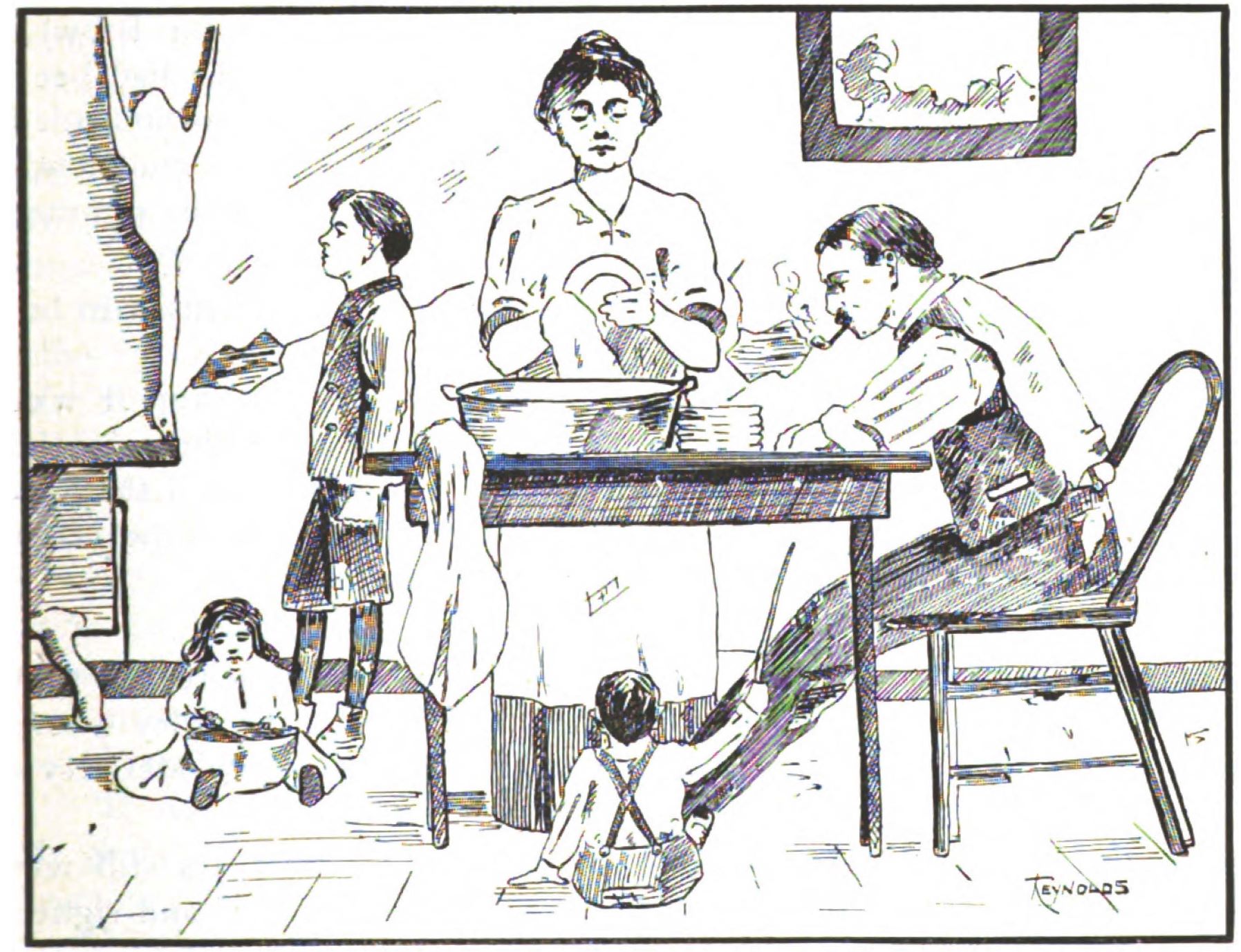
But the fire grew hot and Mrs. McCarty arose and began to clear off the dishes, as Dan wiped his mouth on the back of his hand and reached for his pipe.
“There’s a turrible smell in here, Mary,” he said, as he sniffed with his head in the air, while he filled it.
“There’s sure somethin’ dead in this kitchen, an’ be the smell of it, I’d say it’d been dead a LONG time.” “Perhaps it’s a rat,” suggested Mrs. McCarty, while the children looked under the stove and poked behind the coal box. But there was no need to search long, for the heat from the kitchen stove had thawed the frozen treasure and an unmistakable odor of decayed flesh arose from the sink. Alas for the hope and faith we may have had in the philanthropy of the large advertiser! They are on the way to a severe set-back, for the turkey—Skinny’s prize turkey—was bad beyond the hope of eating on that Thanksgiving Day.
We cannot tell the history of that fowl, whether his days had been many or whether they were few, we only know—for Browne explained to the Charity Organizations afterward, that he had been “shamelessly cheated by the packing company.” They had unloaded a lot of spoiled fowls upon him, taking advantage of his confidence and sent a number of turkeys spoiled in a wreck the previous summer on the T. and P. R. R., between Joplin, Mo., and Kansas City.
But Skinny was very young and full of hope. He refused to believe the evidence of his senses.
“All turkeys smell that way,” he declared at first, and it was only when his father had forcibly separated him from the prize he thought he had won, that the truth penetrated his brain and the iron entered his soul. His mother said the turkey was bad; the other children said it SMELLED bad; and his father insisted,
“It was turrible ROTTEN.”
So it was, that amid a storm of tears and with deep regret, that Dan McCarty deposited the turkey in that portion of the Alley where the scavengers are supposed to remove refuse, and Skinny McCarty’s first illusion was destroyed.
He went to bed crying and fell asleep with the tears still wet on his cheeks, while Big Dan and his wife talked it over, and sighed and wondered if they couldn’t afford a turkey dinner after all.
“We might,” said Mrs. McCarty in despair, at last, “we MIGHT get a RABBIT.” But just then Big Dan thought of a way.
At two o’clock on Thanksgiving Day, garbed in their very best, Dan McCarty, his wife on his arm, and all the children began their long walk to Halsted street. With their free hands, Dan and Mary clutched the fists of Mamie and little Pete and kept them from falling over themselves. Kate piloted Buddie, and Skinny marched proudly before with a wary eye on Nick. For the moment, the tragedy of yesterday was forgotten by Skinny, in the joy of a new pair of shoes.
“You shall all have TURKEY for dinner,” Big Dan had declared and Big Dan meant it. So the kiddies squirmed around and galloped along risking their own limbs and the equilibrium of their fond parents.
At Mike’s Place they all spilled noisily into the Family Entrance, and such a squeaking of chairs and pushing of tables there was that Mike himself stuck his head through the swinging doors to see what the trouble was.
“Well, well,’ he said heartily, looking from one expectant face to another, “If it ain’t Big Dan McCarty,” and he nodded to Mrs. McCarty and mussed the children’s hair.
“Mill runnin’ on full time yet?” asked Mike. Big Dan said “No, ‘bout half toime,” and ordered three beers, ‘‘an’ a little of that Free Lunch for the kids.”
“SURE!” Mike said, and disappeared through the swinging doors. He stayed so long that Dan began to fear he had forgotten the order, when the bar-keep’s helper appeared staggering beneath a load that caused the small McCartys to squirm off their seats with joy!
For the helper bore a huge tray and upon that tray were there many plates, piled high with good things. Turkey there was—a whole leg for each one of the children, and mashed potatoes, pickles, bread and butter and CRANBERRY sauce!
Then began such a clatter of knives and forks and such a smacking of lips as would drive a hungry man green with envy.
When the last crumb had been forced downward and Mrs. McCarty had straightened Tim’s tie, and washed Buddie’s face and hands and rebuttoned Katy’s dress, Dan permitted Mamie to press the button. A moment later Mike’s red face appeared.
“Won’t you come in and have a drink with us?” Big Dan asked,
“It was sure a swell feed you’re handin’ out today.” “Purty fair grub,” Mike nodded. “No,” he shook his head, and waved aside the money Big Dan had laid on the table.
“Youre money ain’t good here TO-DAY. What’ll-it-be?”
“Beer,” said Big Dan; “beer,” said Mrs. McCarty, and Mike once more disappeared behind the swinging doors.
“Gee!” said Big Dan leaning toward Mary. ‘“Mike’s a hell-of-a foine fellow!”
The International Socialist Review (ISR) was published monthly in Chicago from 1900 until 1918 by Charles H. Kerr and critically loyal to the Socialist Party of America. It is one of the essential publications in U.S. left history. During the editorship of A.M. Simons it was largely theoretical and moderate. In 1908, Charles H. Kerr took over as editor with strong influence from Mary E Marcy. The magazine became the foremost proponent of the SP’s left wing growing to tens of thousands of subscribers. It remained revolutionary in outlook and anti-militarist during World War One. It liberally used photographs and images, with news, theory, arts and organizing in its pages. It articles, reports and essays are an invaluable record of the U.S. class struggle and the development of Marxism in the decades before the Soviet experience. It was closed down in government repression in 1918.
PDF of full issue: https://www.marxists.org/history/usa/pubs/isr/v10n05-nov-1909-ISR-gog-LB-cov.pdf
 Revolution's Newsstand