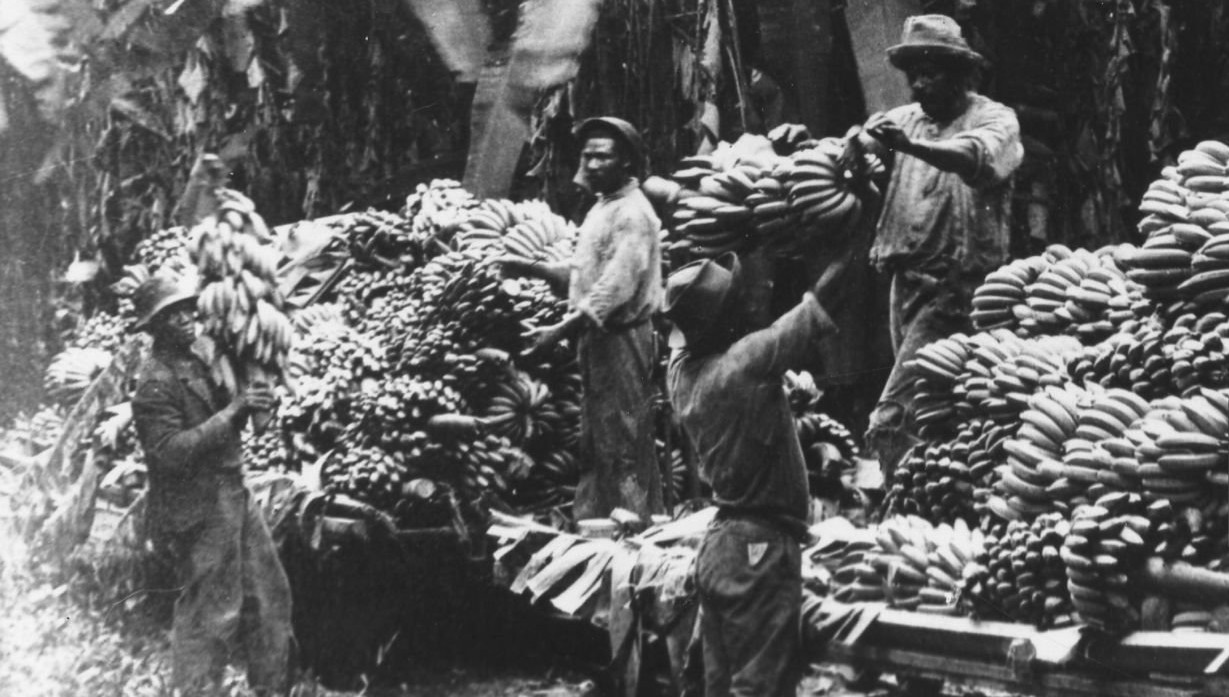
I will I confess, I had no idea Costa Rica had a Communist history. Another country beaten and robbed by that monstrous creature of U.S. imperialism, the United Fruit Company, sees mass demonstrations on May 22, 1933 led by the Communist Club in San Jose.
‘Revolutionary Spirit Rising in Costa Rica’ by Dora Zucker from The Daily Worker. Vol. 10 No. 196. August 16, 1933.
Workers, Under Lash of United Fruit, Rebel–Answer Terror With Broader Mass Struggles
The workers and peasants of Costa Rica have suffered intensified attacks on their standard of living this year. The American United Fruit Company, exercising direct control of the country economically, and indirectly politically (the present Ricardo Jimenez regime, working hand in hand with the United Fruit Company), in an attempt to get out of the crisis, has subjected the workers and peasants to the most miserable conditions.
Production has decreased by half–thousands of workers have been fired. The agricultural workers on the banana and coffee plantations receive a maximum of $6 a week, and the Negro workers, the most exploited, receive even less. The peasants are forced to live on three colones ($1.00) a week.
The attempted “back to the farm movement” which the government has been encouraging in an effort to rid the towns of the unemployed, has met the opposition of the workers since the conditions of the roads are so poor, as to make marketing profitless and the work on the farms useless. In addition, the ever decreasing purchasing ability of the workers and peasants, has greatly affected the artisans who are confronted with a situation wherein they have products but no markets.
On May 22, several hundred workers and peasants from outlying villages of Costa Rica, under the leadership of the Communist Party, held a militant demonstration in San Jose, demanding relief for the unemployed and a minimum salary for the employed.
No sooner had the workers and peasants assembled before the Communist Club in San Jose, from which they were to march to the Congressional Building, then the police, mounted and on foot, fell upon the workers and peasants, attacking them with sabers and sticks. The militancy of the demonstrators was high. They closed their ranks and in a body resisted the well-armed forces of the government. The police drew their guns and fired. Five workers were seriously Injured. The demonstrators attacked the horses of the mounted, and fought open-handed the police on foot—knocked the sabers and sticks out of their hands and kept them for their own defense. Five policemen were injured, one of whom died a few days later as a result of his wounds.
Word of this militant demonstration had spread and a seething restlessness prevailed. More and more were injured. Ambulances came on the scene to take the injured away. More police forces arrived.
Leaders Arrested, Deported
Many of the most militant fighters in the demonstration were arrested. Official orders of arrest were sent out for the leaders of the Communist Party. Some were not warned in time and were caught—the majority government utilized this moment to deport from the country one of the most militant leaders of the revolutionary movement, Adolfo Brana, a Spaniard, who had married a Costa Rican 15 years ago and ever since resided with his family in San Jose. He was not at the scene of the demonstration on May 22nd, but had gone to Turrialba, a little town of Costa Rica, to address a meeting of peasants and workers. The government officials ignored their own law which entitled Brana to remain in Costa Rica, by virtue of his having married a Costa Rican and having had children with her, and arbitrarily deported him within twenty-four hours after the demonstration. In addition, they deported Juan Palacios, not a member of the Communist Party, but a militant worker whose birthplace was Venezuela.
Terror Reign Sets In
Thereafter the terror set in. All meetings and gatherings of the Communist Party were prohibited—its publications banned. Police doubled their efforts to locate all the members of the Central Committee of the Communist Party, particularly Romulo Betancourt, a Venezuelan for whom the officials had issued an order of expulsion from the country.
Throughout the country the workers and peasants were wondering—- had the revolutionary movement been liquidated—had the Communist Party been put underground—and what of “Trabajo,” the official organ, would it appear again? The demonstration took place on Monday.
Brana and Palacios were deported on Tuesday—Thursday and Friday brought word that protest meetings against the attacks of the government and the deportations of Brana and Palacios, organized by the Communist Party, were being held in different sections of Costa Rica.
The militancy of the workers and peasants was so great that the police feared to attack them and the meetings went on. Despite the obstacles in their way and the orders of arrest over their heads, the end of the week saw the appearance of “Trabajo”—and the sales were larger than ever. And in San Jose appeared a leaflet calling to the workers and peasants to attend a meeting of the Communist Party on Saturday night.
All day Saturday, tenseness was in the air—would the workers and peasants be afraid to come? Had the government succeeded in intimidating them? They gave their own answer when hundreds of them appeared in the new headquarters of the Communist Party, singing the Internationale.
This May 22nd demonstration marks for Costa Rica the beginning of militant struggles of the masses against exploitation and colonial slavery, the beginning of the upsurge of the masses, who find leadership in the young Communist Party.
The Daily Worker began in 1924 and was published in New York City by the Communist Party US and its predecessor organizations. Among the most long-lasting and important left publications in US history, it had a circulation of 35,000 at its peak. The Daily Worker came from The Ohio Socialist, published by the Left Wing-dominated Socialist Party of Ohio in Cleveland from 1917 to November 1919, when it became became The Toiler, paper of the Communist Labor Party. In December 1921 the above-ground Workers Party of America merged the Toiler with the paper Workers Council to found The Worker, which became The Daily Worker beginning January 13, 1924.
PDF of full issue: https://www.marxists.org/history/usa/pubs/dailyworker/1933/v10-n196-aug-16-1933-DW-LOC.pdf
 Revolution's Newsstand