Rapid, an enormous, increases in the infrastructure and expenditures of empire by U.S. imperialism over the Americas in the early 1920s.
‘The Big Stick in Latin America–Its Size and Cost’ by Sam Darcy from Workers Monthly. Vol. 5 No. 5. March, 1926.
The march of American imperialism is so rapid that a survey of its extent quickly falls out of date. It used to be said that the sun never sets on the British empire; today we must change that to read that the sun never sets on American investments—yet never are lands so dark as when these same investments gain footholds in them.
The Imperialist Big Stick in Latin-America.
Let your eyes run quickly over the map of the western hemisphere—first to Cuba:
The United States has a very important naval base in Cuba. Posts of marines, however, are never confined to the coast, but are stationed at any strategic point. The Cuban government can make no loan nor dispose of any of its possessions without the consent of the U.S. Uncle Sam is nowhere so much a Shylock as here. His representative at Havana controls the execution of the political and financial policies of the land—policies which are determined by absentee landlords and bankers living in the United States.
In Haiti there are about two thousand marines who helped American bankers to supervise the “election” there. An American financial advisor exercises complete control of its finances, collects customs and makes loans which the U.S. government guarantees—thus assuring its continued occupancy. The nation’s constitution was here rewritten to permit the acquisition of land by U.S. corporations.
In Santo Domingo the United States landed an army—without any declaration of war—dismissed the president and congress and for seven years ruled by military decrees under the supervision of an American representative and two thousand five hundred marines. In 1924 a promise was extracted from Wall Street that the military governor would be retired—but his promise was not given until the Dominicans promised to allow the U.S. to collect the customs and administer the finances of the country. Though the promise was given the military governor remains.
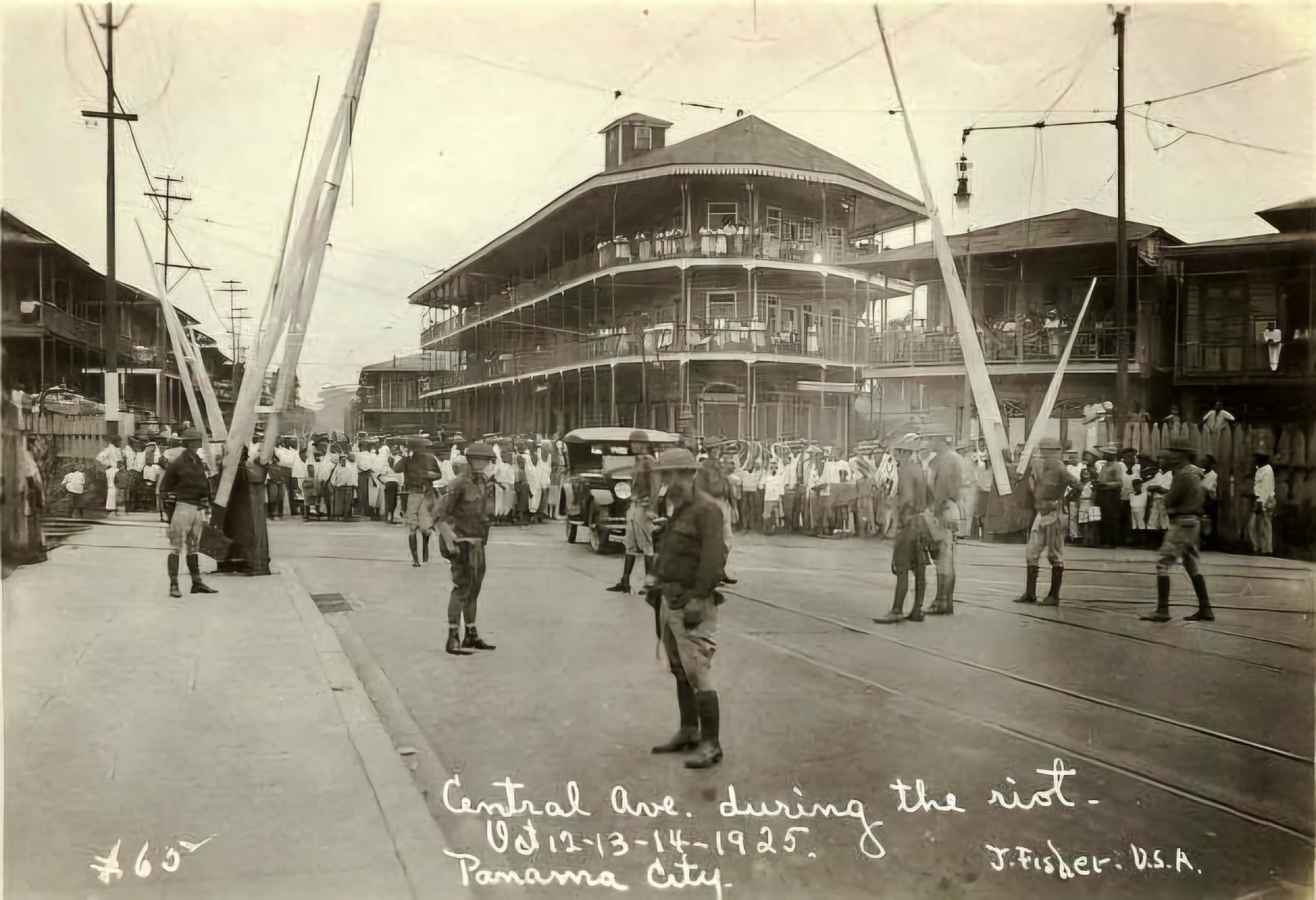
The great bourgeois hero, Theodore Roosevelt, took Panama with an “agreement” that disbanded the army of that country and provided that the U.S. could take over any additional territory it may deem fit for the protection of the canal. The cost of this alone in lives and wealth could have balanced the budgets of more than one of the hungering nations of today.
In Honduras the American minister and two U.S. corporations are ruling the country. In Nicaragua a U.S. admiral favorable as usual to American bankers has confessed that at least eighty per cent of the population are bitterly antagonistic to his rule, and are continually on the point of revolt.
In all these countries there are military forces guaranteeing the investments of American capital. In Salvador, Peru, Colombia, Ecuador, Bolivia the U.S. has official representatives directing and controlling the finances of the countries. And nowhere has it yet been recorded that from this control Wall Street has not gained in profits nor has it ever been recorded that the countries involved have not lost in lives, wealth, freedom and standard of living from such control.
Above we have listed eleven countries where the United States officially controls the governments either by direct exertion of military power or the threat of military force.
In addition to these there are the other Latin-American countries which are controlled by the United States corporations thru the use of National Governments that have become vassals of Wall Street. In Guatemala, for example, the United Fruit Company and other American financial interests have secured control of the railroads which have now become a part of the International Railways of Central America, the largest American railway enterprise outside of the United States.
In Costa Rica after thirty years of peace, American oil and fruit interests fomented a revolution and have used this as an excuse to set up a government which acts as broker for American capitalism.
In Mexico, United States capitalists own one-third of the nation’s total wealth of two-and-one-half billion dollars. They own a major portion of the land and seventy-three per cent of the oil land.
Out of twenty Latin-American republics eleven have their financial polices directed by official representatives of the American government. Six of these agents have military forces to insure the carrying out of their decrees. Those countries not yet controlled directly by official American representatives are being infiltrated by Wall Street investments. And it will not be long before these countries will have their finances controlled in the same manner as the others American Imperialism and Its European Rivals. During the last few years, the United States has been continually eliminating European capitalists from North and South American trade. This is done by various methods. The first is by a process that has become known as “funding,” that is, combining together all the international obligations of the nation after which one big loan is floated in the United States to take care of it all. The European creditors are then paid off and eliminated. The United States government, of course, must then protect the lives and property of its citizens within those countries where the loan has been floated. Since the lives are rarely in danger, despite all the propaganda about the “revolootin’” the U.S. government sends in marines to protect the dollars. This “funding” process has already been worked successfully in about half of the Latin-American states. The Department of Commerce in a bulletin issued about a year ago, makes the following very interesting comments: “Our great interest in Latin-America is largely a growth of the last ten years. Yet our investments include $610,000,000 in public securities and $3,150,000,000 in industry.”
Another method in the elimination of Europe from North and South American markets is thru arbitrations. The Swiss, British, Spanish and French governments have in the past been selected by Latin-America as arbitrators in the disputes between and among the countries involved. But the United States government is now using its great power to eliminate all this. The recent sending of military forces to insure our state department’s decision in the dispute between Panama and Costa Rica is one illustration of this. The very recent sending of the head of all our military forces, General Pershing, to settle the dispute between Peru and Chile in the Tacna and Arica affairs is another illustration of this.
This incidentally helps to explain why the U.S. government was so loath to enter the League of Nations. These small South American countries are all members of the League and if the U.S. were also a member it would become necessary for it to allow the League council to settle disputes between small South American countries. This would stop the elimination of European countries from South American affairs and would defeat the purposes of American imperialism.
The third method of capturing South America for Wall Street is that of sending naval “missions” to South American countries. The United States today has missions in Peru and Brazil. When Argentina protested against the sending of the missions, saying, in the diplomatic language of bourgeois governments, that it would create “suspicions” in South America, the state department arrogantly replied that in order to prevent this it would not play favorite with any one but would send missions to all countries thereby eliminating jealousies among them!
The World Extent of American Imperialism.
The use of the big stick is not, of course, confined to Latin America, but extends to the Philippines—the largest U.S. colony, and into Europe in the execution of the Dawes’ Plan, into Asia to insure Rockefeller’s oil interests there—into every part of the world where American investments have found their way—and this means every important section of the globe.
The Cost of Maintaining the Big Stick.
Of course, it costs much to maintain this big stick in good shape so that it is serviceable at all times. In case of war—that is the purpose of having a stick.

Karl Liebknecht in the resolution he wrote on the war says as follows: “The war is not only the result of the policy of competitive armaments which we have always opposed; it is not only the result of secret diplomacy, it is not only a Bonapartist undertaking directed against the working class movement; it is, in its very historical nature, imperialistic. It is imperialistic in its origin. It is imperalistic in its objects, i.e., it pursues capitalist aims of expansion and conquest.” This can very well be applied to what is happening today in the increase of American investments in Latin-America.
Jacques Doriot shows in an article on the effects of imperialist war on the working youth that the extraordinary increase during the war in the diseases arising from poverty (tuberculosis, etc.), was most marked among the exploited youth. A German official statement has shown that young men from 19 to 25 years suffered 44 per cent of the total sum of mortal losses of the war. In France the 1913, 1914, 1915 classes were almost without exception annihilated; in England the conscription system crushed the whole youth; in Belgium the age limit for military service (about thirty years) threw the whole burden of active service upon a small stratum of young workers; while in the United States, out of the hundred odd thousands of workers killed in the war, the bulk was largely young workers.
The toll of dead and wounded among the American young workers who are now in the army and navy and are victims of peace times preparations for war is a warning sign of what can be expected in the coming war. Senator King of Utah, in an article in Current History says in illustration of this point:
“In the last ten years the government has expended $150,000,000 for submarines. Practically the whole of this money has gone into the hands of private contractors who have delivered to the government 120 submarines. At least ten of these submarines, because of defective mechanism, have gotten beyond the control of their crews and have sunk, in most cases causing the death of members of their crews, explosions on the battleships Mississippi and the Trenton alone caused the death of 60 men.
The Extent of American Militarism.
The facts concerning the deaths of those engaged in military service are very difficult to obtain, since it is to the interest of imperialism to have the youth know of the cost they must pay to make profits for Wall Street. Yet from the one quotation above it can be seen that in the practice maneuvers of the military forces the toll of deaths run into large figures. The government well knows that another war even larger and more devastating than the World War is inevitable and it is grooming the forces of militarism very carefully for this purpose. Much ink has been spilled in the jingo press concerning the insufficiency of “our” air forces at the present time. An investigation of the budget appropriations brings some very remarkable facts to light. The increase in appropriations for the air service alone went from about one million dollars to over one billion dollars in the short space of four years, as follows:
1916: 1,300,000
1917: 26,033,000
1918: 685,000,000
1919: 1,172,343,877
The outlays authorized by Congress for increase in the navy, which cover new construction, have in the last ten years amounted to one and one-half billion dollars. The total naval appropriation for the last decade amounts to $6,980,641,947.
In dollars alone the above figures will give a slight glimpse of the gigantic cost of preparing for new wars. The United States boasts that it has a standing army only of some one hundred and forty thousand men. This, of course, does not include the navy and the marines, which are among the very largest in the world. But it also fails to include a tremendous reserve army that the U.S. is building among the civilian population through Citizens’ Military Training Camps, Reserve Officers’ Training Corps, War Colleges, etc., all of these but recent phenomena in war preparation. So that if the United States standing army itself has not increased in very great proportions the militarization of the civilian population has really increased the extent of militarism to an almost unbelievable degree.
Citizens’ Military Training Camps really began as late as 1921. Since then they have increased as follows:
1921: 10,681
1922: 22,000
1923: 25,000
1924: 34,000
The figures for 1925 are not as yet obtainable but they undoubtedly show a tremendous increase over 1924. General Pershing in an article which was syndicated throughout the bourgeoisie press wrote, “The time is not far distant when instead of training 25,000 young men we will be training 100,000 each year.”
Reserve Officers’ Training Corps were organized under what is known as the National Defense Act, according to which the president is authorized to appoint a reserve officer in any public school having over 100 students. The function of this officer to give military training to the students in the school. Under the authority of this act, 3,392 young army men were made second lieutenants at the end of 1924 for the purpose of administering this training. During the school year, 1924-1925, more than 226 educational institutions in the United States had their students receive this training. The exact number is extremely difficult to obtain. Two hundred and twenty-six institutions maintained units of the R.O.T.C. but the secretary of war reports that many schools which do not officially maintain units nevertheless give military training. Even without these the total number of students taking military training during this period runs to the number of 125,504. R.O.T.C. units were instituted as late as 1916. There are at least forty military schools alone. Every important college and almost every second rank college has an R.O.T.C. unit. The program of militarization of the young workers is carried on largely through the Citizens’ Military Training Camps, while that of the young students through the Reserve Officers’ Training Corps. Both these institutions are cheap and effective means of training armies to serve as cannon-fodder in the next war. The total number of those young men being groomed for military purposes totals to well over 500,000. This is a very conservative estimate in view of the existence, in addition to the above, of the state militia in most of the states, which can be turned into federal units on a moment’s notice.
The American government is carrying on an extensive propaganda to show that the U.S.S.R. is maintaining a large standing army, but when we take into consideration the various forms of militarization in this country and work out a proportion on the basis of population we see that the United States has approximately four men trained to bear arms to every one in the first workers’ republic. And this despite the fact that Soviet Russia has an area to defend many times that of the United States and has the bourgeois governments of the whole world plotting against it.
In 1924 and 1925 the appropriation for military purposes totaled approximately 59 per cent of the entire budget, while in 1926 the government announces that appropriations for military purposes have increased to 80 per cent of the entire budget. Simultaneously with these announcements come pious statements from the war and state departments of attempts at world disarmament and for the establishment of “eternal peace.” Military appropriations since the World War have been on the increase, clearly pointing to the fact that the government sees as clearly as the Communists that we are headed for another war.
The Youth in the Struggle Against Militarism.
It is inevitable that the youth will bear the burden of the next war, even as they have borne the burden of the last war. It therefore devolves upon the youth to take upon itself the struggle for preventing the next war, not by pacifist declarations, but by Communist deeds. Of all the existing youth organizations one only clearly points the way—THE YOUNG WORKERS (COMMUNIST) LEAGUE.
The time is rapidly approaching when the American workers will take heed and exercise the inalienable right of the masses recognized by Lincoln in his first inaugural address, 1861, wherein he says that “a people grown: weary of existing institutions may exercise their constitutional right to change or amend them or their revolutionary right to dismember and overthrow them.”
Workers Monthly began publishing in 1924 as a merger of the ‘Liberator’, the Trade Union Educational League magazine ‘Labor Herald’, and Friends of Soviet Russia’s monthly ‘Soviet Russia Pictorial’ as an explicitly Party publication. In 1927 Workers Monthly ceased and the Communist Party began publishing The Communist as its theoretical magazine. Editors included Earl Browder and Max Bedacht as the magazine continued the Liberator’s use of graphics and art.
PDF of full issue: https://www.marxists.org/history/usa/culture/pubs/wm/1926/v5n05-mar-1926-1B-WM.pdf
 Revolution's Newsstand