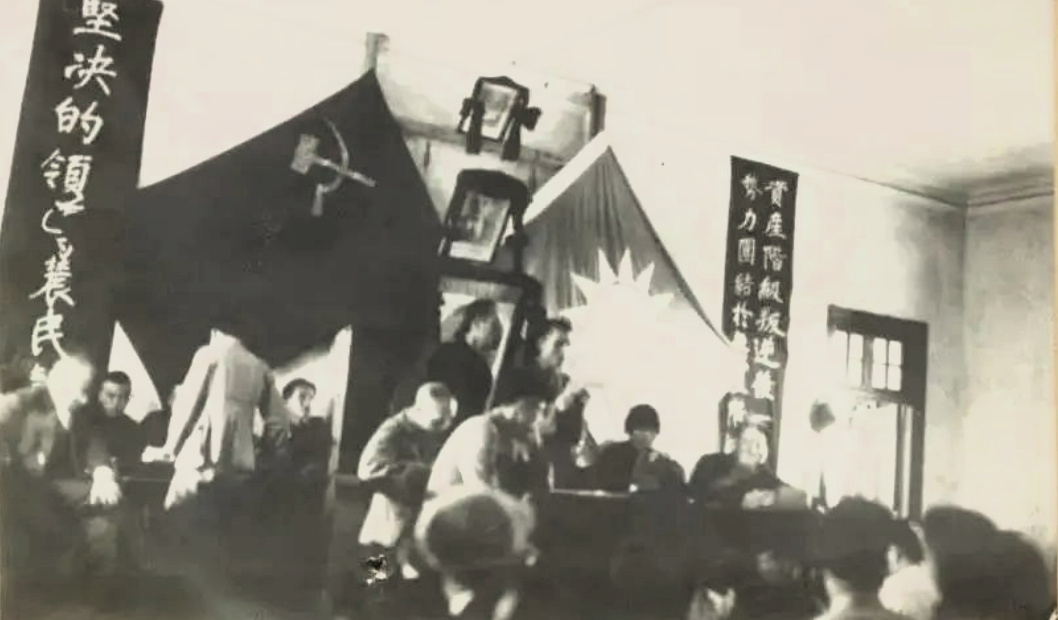
Report given by Chen Duxiu for the Central Committee to a very divided Party at the conference held in Wuhan right after the Shanghai Massacres in 1927.
‘The Fifth Party Conference of the C.P. of China’ from The Daily Worker. Vol. 4 No. 145. July 2, 1927.
Political and Organizatory Report of the Central Committee
THE first part of this report bears the heading “The Tactics of the Party in the Course of the Last Two Years.” In this respect, Comrade Chen Tu Su distinguishes four periods.
1. First Period: From the 4th Party Conference of the C.P. of China to the Rebellion of Kuo Sun Ling (in December, 1925). This stage is characterized by the rise of the Communist movement, which reached its highest point in the events of May 30th, 1925 (shootings in Shanghai). In the period in question, the proletariat was fighting for the hegemony in the revolutionary movement, a development which led to emphasizing class differences. We could then observe the beginnings of bourgeois defection, the bourgeois ideology being interpreted in Tai Tsi Tao’s book, “The Philosophical Foundations of Sunyatsenism.” In southern China it still proved possible to maintain a united front with the bourgeoisie against the two militarist leaders, Li Chen Hui and Yang Shi Min, but the Hongkong strike was already waged altogether under the slogan “The labor movement must be combined with the national movement, the dominating role of the proletariat in the latter being fully maintained.” In this first period the Communist Party of China committed no mistakes. It waged determined war against the tendencies voiced by Tai Tsi Tao and maintained the principle of a union with the left wing of the Kuomintang for the purpose of a common fight against the right wing. The same policy was observed at the Second Party Conference of the Kuomintang. The accentuation of opposition to British imperialism must be regarded as a step in n the right direction on the part of the Communist Party.
2. Second Period: From the rebellion of Kuo Sun Ling in December 1925 till the retreat of the National army from the heights of Hankow. This period. is mainly remarkable for the recession in the revolutionary movement and the strengthening of the reaction. At the commencement of the second period, southern China saw the continuation of the fight against feudalism, which found expression in the murder at Canton on August 25th, 1925, of Lao Chun Kai, minister of finance to the Canton government (killed by the accomplices of the feudal lords) and in the fights which followed it. The struggle against the bourgeoisie also grew in vehemence during this period. The bourgeoisie was engaged in organizing its political parties.
In this period Chiang Kai-shek played the part of an “armed Tai Tsi Tao.” The events of March 20th, 1926, were no mere coincidence. (We here refer to the armed demonstration organized by Chiang Kai-shek at the head of his troops against the government of which Wang Tsin Wei was at the head and against the workers’ strike committee, a development which led to dismissal of Wang Tsin Wei, to the temporary weakening of the influence of the left Kuomintang members and the Communists in the Kuomintang and in the army, and to the strengthening of the reactionary elements in the province). Chiang Kai-shek rendered apparent the tendency of the bourgeoisie to secede from the revolution, this desire being mainly promoted by the increasingly obvious divergence of class interests among the various groups engaged in the National-Revolutionary movement. The Canton conference of the Kuomintang on May 5th, 1926, was wholly under the influence of Chiang Kai-shek.
With reference to the events of March 20th, there were at that time within the Communist Party considerable differences of opinion as to the advisability of an assault or a retreat. The retreat of the Communist Party was occasioned by a lack of forces and the omission of the Party to make adequate preparations. It must be admitted that considerable mistakes were allowed to occur at Canton.
At the close of the second period the differences in the camp of the militarists were aggravated, the Mukden clique opposing the clique of Chihli. At the same time there were greater differences among the foreign imperialists, a fact which was reflected in the course of the Customs Conference.
3. Third Period: From the commencement of the Northern Expedition till the occupation of Shanghai by the National troops. This section was characterized by a renewed rise of the revolutionary movement. It saw the development of the workers’ movement and the establishment of a broad foundation for a movement among the peasantry. At the same time, the struggle against foreign imperialism increased (occupation of the British con- cessions at Hankow and Kiukiang).
The session of the Central Committee of the Communist Party at Peking in February 1926 sanctioned the project of an expedition to the north. Although there were subsequently some differences of opinion on various heads, one cannot speak of great mistakes having been committed during this period.
The expedition to the north was the result of collaboration between the proletariat and the bourgeoisie. At the close of the third period, however, the struggle of the proletariat against the bourgeoisie was aggravated, especially in connection with the attempts made by the bourgeoisie to exploit the military expedition solely for its own ends. This struggle led to the complete rupture, at Shanghai, between the proletariat and the bourgeoisie, the latter revealing pronouncedly anti-revolutionary tendencies.
4. Fourth Period: Since the coup of Chiang Kai-shek at Shanghai. This last section is altogether different from the preceding ones. The bourgeoisie has seceded from the revolutionary front. The true nature of the forces which had taken part in the national struggle has become apparent, and their attitude throughout the developments becomes increasingly obvious. The result is a consolidation of the united front of the proletariat, the peasantry, and petty bourgeoisie. The dangers lurking within the revolutionary movement itself have been greatly lessened.
The prospects for the near future figure as follows: Accentuation of class differentiation; growth of the forces of the proletariat, peasantry, and petty bourgeoisie and of the military resources of the revolution, the further development of which thus appears assured.
The second section of the report bears the title: “The Role of the Bourgeoisie in the, Revolution.” From a historical point of view, the defection of the Chinese bourgeoisie is no new departure. In history, the bourgeoisie betrayed every revolution. The Chinese bourgeoisie is opposed to the militarists but favors a compromise with the foreign imperialists, from whom it hopes to receive rewards and favors. The Chinese bourgeoisie is not only opposed to the proletarian revolution, but is not even able to carry out a bourgeois-democratic revolution. After taking part in the revolution for a short time, the Chinese bourgeoisie became counter-revolutionary. Chiang Kai-shek represents the left bourgeoisie, which turned pronouncedly counter-revolutionary after April 12th, 1927. The right wing of the Chinese bourgeoisie, the so-called “Compradores,” it is hardly worth while to mention in this connection.
The third part of the report is entitled: “The Relation of the Proletariat to the Petty Bourgeoisie.” The participation of the petty bourgeoisie in our revolution has been characterized throughout by vacillations. The proletariat must make concessions to the petty bourgeoisie for the sake of having its support. In this connection we have not been able properly to carry out the resolutions of the C.C. of the Chinese C.P. passed at the plenary session of July 1926. In the provinces many mistakes have been made in this regard. Our task now consists in drawing the petty bourgeoisie into the Kuomintang.
The fourth section of the report bears the title: “The Land Question.” The main work in this question after the fourth Party Conference of the C.P. of China held in January 1925, consisted in organizing the peasantry and in the fight for the reduction of the rent of the land. This movement is now passing over to a higher stage and is being converted into a fight for the land. The peasantry is making an elementary upheaval and wishes to solve the land question itself. The agrarian revolution is now already no longer a question of theory, but of practice. In the province of Hunan a struggle is proceeding for the equal distribution of the land: this fight is directed not only against the big land owners, but also against the small landowners and the big lessees. The struggle is proceeding in an elementary manner.
We have conducted an all too peaceful policy. The big landed estates must now be confiscated; at the same time concessions must be made to the small landowners who have to be reckoned with. At present the alliance with the small landowners is still necessary. We must not fall into ultra-left errors, but must pursue a middle course. Nevertheless, even for the confiscation of the large and middle landed estates, it is necessary to await the further development of the military actions. The only correct solution at the present moment is to deepen the revolution after it has first been spread.
The fifth section of the report bears the heading “The Hegemony of the Proletariat.” This hegemony is becoming a fact. The strike committee at Canton had governmental authority and exercised great influence among the left members of the Kuomintang. It was, as a matter of fact, a parallel government. In the province of Hunan, the influence of the proletariat is likewise strong; the petty bourgeoisie and the left Kuomintang in this province are under the leadership of the proletariat. In northern China the Communist Party also plays the leading role in the revolutionary movement. At Shanghai the proletariat was often isolated, but since May 30th the fight has been waged under the auspices of the proletariat.
The proletariat does not yet aspire to full authority; it is not yet in possession of decisive power. Nor has the Communist Party as yet sufficient armed forces at its disposal to seize the reins of government. The treachery of Chiang Kai-shek means the defection of 99 per cent of the big and middling bourgeoisie. Together with the peasantry and the petty bourgeoisie, the proletariat must create new forces.
The question of Shanghai is also a problem of the mutual relations of the bourgeoisie and the proletariat. The proletariat of Shanghai fought splendidly, but it must be borne in mind that the city is not only a centre of the proletariat but also a very important stronghold of the bourgeoisie. Even combined with the petty bourgeoisie, the proletariat of Shanghai is insufficiently strong. The opinion prevails that Shanghai cannot become the basis of the national revolution. Indeed, it is said that it will only be possible to deal imperialism at Shanghai a decisive blow when the national revolution has taken firm footing all over China. This essentially mechanical theory of determinism is not devoid of certain elements of truth. Nevertheless, I consider this argument mistaken. At Shanghai there are even some liberal bourgeois groups which are not yet wholly lost for the cause of revolution.
The sixth part of the report is entitled: “The Military Factor and the Social Basis of the Chinese Revolution.” The military forms of the national movement did not originate in the revolutionary masses themselves. The armed force of the people is not yet organized. The present armed forces of the national government have developed out of the old militarist army and consist partly of peasants and partly of the mob. The commanders of these forces are descendants of the landlords class. Therefore the army is a doubtful force. For the revolutionary army it is essential that the proportion of riff-raff in the ranks and the proportion of landlord’s sons among the commanders be materially reduced. The vacillations of the army have their social bases.
The seventh portion of the reports treats of “The Territorial Foundation and the Line of Progress of the Revolution.” The general impression is that the revolution is now progressing in a northwestern direction and not towards the southeast, which is a stronghold of imperialism. This question deserves to be elucidated from all standpoints. It is not right that we should be asked to leave it altogether to the Kuomintang. Such a policy would be tantamount to tying ourselves to the apron-strings of the Kuomintang.
The eighth part of the report refers to “The Relations of the Communist Party to the Kuomintang.” The Kuomintang is a revolutionary association, a revolutionary league of many classes. Therefore the proletarian party had likewise to enter it. At present the Kuomintang is a union of three classes, the workers, the peasants and the petty bourgeoisie. This union will be strong as long as it is in a position to satisfy the requirements of the classes it represents, and the peasant class in particular, and provided that the bourgeoisie under Chiang Kai-shek does not succeed in subordinating it to its influence.
The ninth portion of the report is called “The Reorganization of the Army.” This does not merely mean the reformation of the army or the introduction into it of new political factors. Political propaganda in the army alone is insufficient. The army must be brought nearer to the workers and especially to the peasantry. The proportionate number of members of the landowner class among its leaders must be diminished. Without a change in its social foundations there can be no reorganization of the army.
The tenth party of the report deals with “The Establishment of Revolutionary-Democratic Power.” The regime of the national government is naturally no regime of militarists. But we are still far from a revolutionary-democratic order of things. This fact must be admitted even by the left members of the Kuomintang. We are faced with the task of starting to erect a really revolutionary-democratic authority as soon as the situation in regard to the national government has changed and the threat of foreign intervention and a militarist offensive has disappeared.
The national government can look back on an eventful history. At present it is the government of an alliance of the left Kuomintang and the proletarian party, some of the ministers in the cabinet being Communist proletarians. We may, however, not cherish the illusion that this government is already a realization of the principle of revolutionary-democratic dictatorship. This would be a mistake. And wherefore is the present government not yet a realization of that principle? Because it is not yet a government of the masses of workers and peasants but only a block government of their leaders. On the other hand, the present government must by no means be under-estimated, for it undoubtedly represents a step forward on the way to a revolutionary-democratic dictatorship. This stage must be exploited if we are to arrive at a government which is controlled by the masses, i.e., at the revolutionary-democratic dictatorship of the workers, the peasantry, and the petty-bourgeoisie. The eleventh section of the report is called “The Financial and Economic Situation.” Formerly we were little interested in the problems of financial and economic construction. We had not enough determination to take part in the government. In future we must occupy ourselves more with these matters. We must pay attention not only to questions of the mass movement, but also to financial and economic factors, if we desire to consolidate the foundations of the revolution.
The Daily Worker began in 1924 and was published in New York City by the Communist Party US and its predecessor organizations. Among the most long-lasting and important left publications in US history, it had a circulation of 35,000 at its peak. The Daily Worker came from The Ohio Socialist, published by the Left Wing-dominated Socialist Party of Ohio in Cleveland from 1917 to November 1919, when it became became The Toiler, paper of the Communist Labor Party. In December 1921 the above-ground Workers Party of America merged the Toiler with the paper Workers Council to found The Worker, which became The Daily Worker beginning January 13, 1924.
PDF of full issue: https://www.marxists.org/history/usa/pubs/dailyworker/1927/1927-ny/v04-n145-new-magazine-jul-02-1927-DW-LOC.pdf
 Revolution's Newsstand