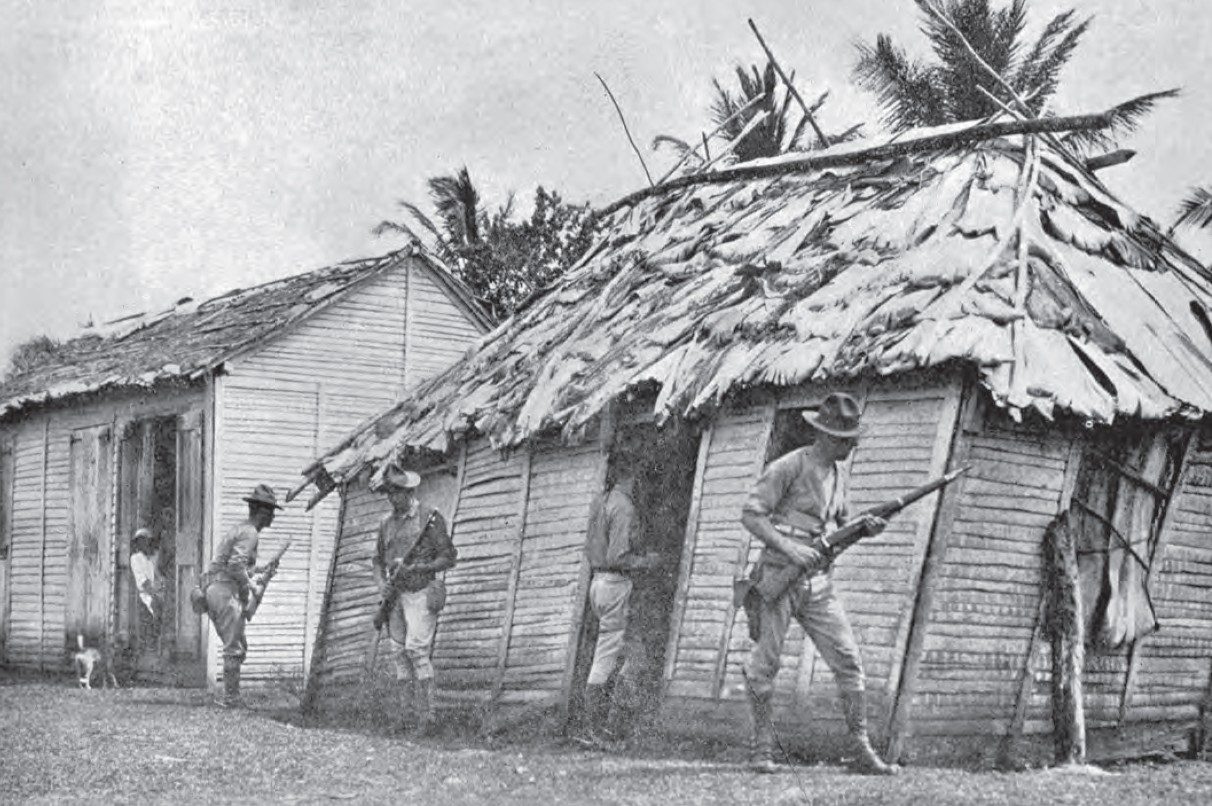
The loan as a profit-making tool of imperial control, Joseph Freeman looks at the case of the Dominican Republic.
‘Imperialism in Santo Domingo’ by Joseph Freeman from The Daily Worker. Vol. 2 No. 256. November 8, 1925.
AMERICAN control over Santo Domingo was strengthened this week by the ratification of two treaties between the United States and the Caribbean republic.
By one of these treaties Santo Domingo confirms all the acts of the American military occupation, which lasted from 1916 to 1924. Among the acts so confirmed were the levying of taxes, the granting of concessions, and the floating of loans through American bankers. The second treaty rearranges the distribution of Dominican funds, which are under American control. It also extends the treaty forced upon Santo Domingo in 1907. The extension is to run until Santo Domingo pays off its debt on the loans floated by American bankers in 1918 and 1922.
Bankers’ Scheme.
THE new treaties grant the American customs receiver general of Santo Domingo the power to apply revenues for paying interest and amortization on these loans, and in addition opens the way for a new loan of 125,000,000 to be floated in the United States. The bulk of the customs revenues collected by the American receiver general is applied to paying off the American bankers; only what is left is turned over to the Dominican government.
The purpose of these treaties was to extend American control over the Dominican republic. America’s excuse in 1904 for invading Santo Domingo was that the native government was having trouble with foreign creditors, chiefly France, which threatened to send warships to collect the debts claimed by its bondholders. In 1922, when Santo Domingo’s bonds were held by American bankers, the state department thought that the Caribbean republic was paying off its debts too rapidly, and was approaching the point where it could claim complete freedom. In June 1922 Secretary of State Hughes announced that the United States would withdraw its troops, if Santo Domingo signed treaties recognizing all the acts of the American military occupation, extending the 1907 treaty until its debts to American bankers were paid off, extending the powers of the American receiver general of customs and opening the way for a new loan by American bankers. If these treaties were ratified, Secretary Hughes declared, elections could be held for a native government and the United States troops would be withdrawn.
Resist Loan.
THE treaties were secretly negotiated in 1924, after which American troops were withdrawn and the present native government of Santo Domingo was elected. When the secrecy surrounding the treaties was lifted, nationalist Dominican leaders vigorously protested against what they considered America’s attempt further to enslave their country. Seventeen out of the thirty members of the native chamber of deputies signed a “Pact of Honor” in which they bound themselves not to vote for the treaties. They declared that these treaties involve “a serious danger for the sovereignty of the nation;” and that the contemplated $25,000,000 loan which is “the basis and the motive” of the new treaties implies “the prolongation of the state of sub-ordination to the United States for a period of time ranging from 26 years as a minimum to 100 years as a maximum.”
The deputies who signed this pact absented themselves from the chamber whenever the treaties came up. The treaties were finally ratified by a parliamentary trick, when one of the signers of the pact entered the chamber and the president quickly declared a quorum and pushed the document through.
Military Backs Loan.
THE significance of the provision in the new treaty that American control is to extend until the debt to American bankers is paid off may be seen from the circular issued by Lee, Higginson and company of Boston which participated in the floating of the 1922 loan. This circular, sent out to prospective American investors, points out that the American military authorities in Santo Domingo guaranteed “the acceptance and validation of this bond issue by any government of the Dominican republic as a legal, binding and irrevocably obligation of the Dominican republic.” The 1922 loan runs until 1942. A letter to Lee, Higginson and company from the United States naval officer in charge of the department of finance and commerce in Santo Domingo assured the bankers that Dominican customs duties “shall be collected and applied by an official appointed, by the president of the United States and that the loan now authorized shall have first lien upon such customs revenues.”
Though the American military government of Santo Domingo has given way to a native civil government, the treaties ratified this week confirm this and all other acts of the American military government.
The Daily Worker began in 1924 and was published in New York City by the Communist Party US and its predecessor organizations. Among the most long-lasting and important left publications in US history, it had a circulation of 35,000 at its peak. The Daily Worker came from The Ohio Socialist, published by the Left Wing-dominated Socialist Party of Ohio in Cleveland from 1917 to November 1919, when it became became The Toiler, paper of the Communist Labor Party. In December 1921 the above-ground Workers Party of America merged the Toiler with the paper Workers Council to found The Worker, which became The Daily Worker beginning January 13, 1924.
Access to PDF of full issue: https://www.marxists.org/history/usa/pubs/dailyworker/1925/1925-ny/v02b-n256-Chi-nov-08-1925-DW-LOC.pdf
 Revolution's Newsstand