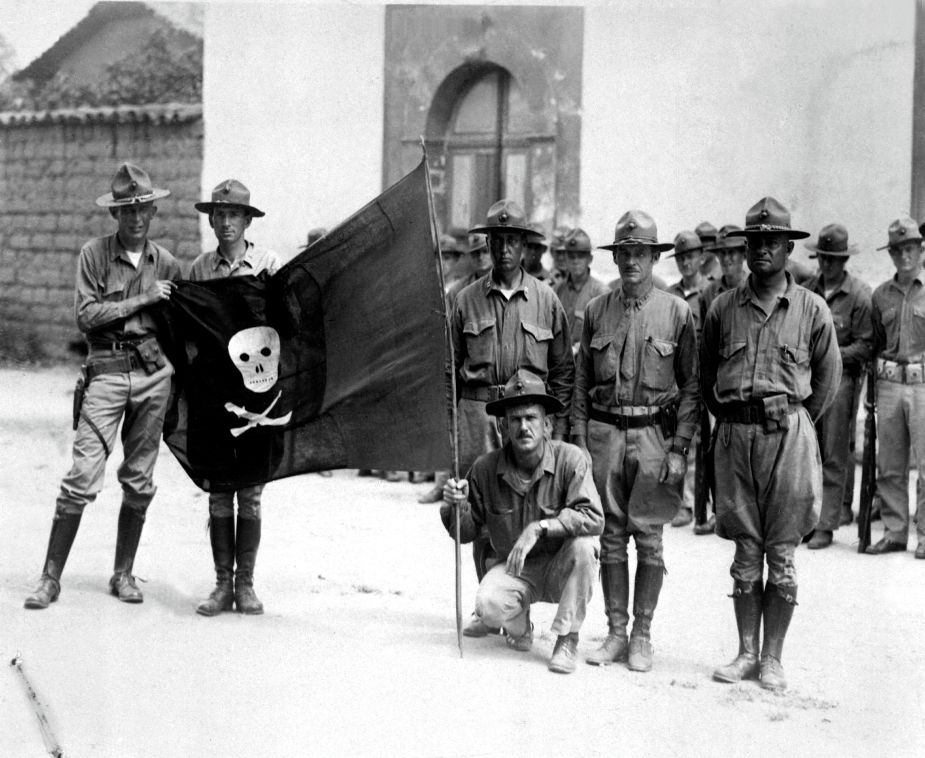
French Communist Treint on the strategy of the campaign for total dominance by the United States over the region during the 1920s.
‘The Imperialism of the United States in Central America’ by Albert Treint from International Press Correspondence. Vol. 7 No. 30. May 19, 1927.
At the Congress of the Pan-American Union, Coolidge, the President of the United States, recently made a speech in which he pointed out that Europe had completely withdrawn from Central America, that the United States were almost exclusively the country for imports and exports for the States of Central America, and that the relations between the United States and the Central American States were regulated according to the principles of “mutual support”.
What this “mutual support” is worth is shown by the armistice, brought about through the intervention of the United States, between A. Diaz, the President of Nicaragua and the Liberals who, under the leadership of Dr. Sacasa, rebelled against Diaz, the puppet of the United States. Even before the conditions of the armistice were made known, General Moncada, the military leader of the rebels declared that he was “compelled to stop fighting” by a stronger power, the United States, and that his troops must hand over their arms to the American troops. American marines, who had been landed, then disarmed the Nicaraguan soldiers. The terms of the armistice contain the following points amongst others: complete disarmament of both parties; organisation of a non-party police in Nicaragua which will be permanently officered by Americans; supervision by the United States of the elections which are to take place in 1928; the American forces to remain in Nicaragua until the police-troop is formed.
The United States have thus advanced another step towards the subjugation of Central America to their power; for this armistice makes Nicaragua almost as much a colony of the United States as are Haiti and St. Dominique.
Central America and Mexico play a leading part in the gigantic struggle which the imperialism of the United States is carrying on in a world-wide measure.
In order to get from the Atlantic to the Pacific coast, three cuttings, three waterways, come into consideration: the Panama Canal, the Nicaragua Canal, which is nearing completion and which will be the simplest waterway, and the isthmus of Tehuantepec in Mexico, which has the advantage of lying nearest to the naval base of the United States.
In this way, Central America and Mexico command the maritime ways which come into consideration for commercial traffic between the two sea coasts of North and South America as well as the direct commercial route between Europe and Far East. This explains their decisive strategical significance in a future world war. Mexico, which is rich in mineral wealth and overflowing with petroleum, is at the same time, an extremely desirable prey for the capitalists. Furthermore, it is a dangerous military land base opposite the southern frontier of the United States.
These are the most important reasons why the United States are indefatigably and with increasing success trying to lay their hand on Central America and the Antilles. They have already almost completely established their supremacy over the district known as the American Mediterranean. In the course of the last twenty years, the United States have taken possession of the most important naval base, the telegraph cables and the wireless stations in this “inland sea” which lies between Central America, Mexico and the Antilles. In this way they have the ways connecting the two oceans under their control.
They have made an economic conquest of Cuba, a political conquest of Portorico and a military conquest of St. Domingo.
The chief way by which they have insured their position is that of importing capital on a gigantic scale. In 1926 alone, they invested 115 million dollars in Central America. The total amount of capital which they have invested in the Mexican petroleum wells, amounts to more than 600 million dollars. Apart from the capital which they have invested in industry, they have used their dollars to stir up disunion and strife in the small neighbouring republics and have made the parties pliant to their wishes through bribery.
The history of the five small republics of Central America, Guatemala, Nicaragua, San Salvador, Honduras and Costa Rica, which at one time formed an independent Central American union, is the history of their subjugation to the influence of the United States after long years of struggles and intrigues.
The Central American Union, which was dissolved by the United States, was re-established under their hegemony in December 1922.
At the end of 1921, after many sanguinary fights, which they themselves had stirred up, the United States placed the power in Guatemala into the hands of their lackey, General Orellana.
The Republic of Honduras is, so to speak, a fief of the powerful “United Fruit Company” which has the monopoly of the banana export in America.
The United States, having their hand on the Panama Canal, are now exerting every effort to get the Nicaragua Canal into their possession.
Mexico, in the meantime, by its Constitution of 1917, has started out on the path of a fight for independence. The Constitution prohibits foreigners acquiring land or mineral wealth. Mexico is trying in this way to shake off the Wall Street financiers who have got hold of her petroleum wells as well as the Spanish clergy who own large domains. Since that time. the United States have contrived all kinds of intrigues and have stirred up revolts in order to compel Mexico to give way in the petroleum question.
At the same time, the United States concentrated their forces against Nicaragua, where they have placed their puppet, President A. Diaz, in power. The Liberal party, led by Dr. Sacasa, revolted against him. At the end of 1926 there was open rebellion. The insurgents were victorious. Thereupon the United States landed their marines in Nicaragua and forced the insurgents to retreat. At the same time, the United States threatened the Mexico Government which sympathised with the insurrection in Nicaragua by assembling 60 warships in the waters of Cuba, and intimidated Sacasa’s party by announcing the military occupation of Nicaragua. When the Republic of Costa Rica offered to mediate between Diaz and Sacasa, Diaz, at the advice of the White House, declined.
While this was going on, revolts against the Central Government took place in the eight Northern provinces of Mexico, led by generals who were equipped and subsidised by the United States. The revolts were suppressed, so that, for the time being, the United States are trying the method of compromise.
In Nicaragua however, the United States have not given way. They have now finally established their protectorate in Nicaragua. They have landed troops of occupation and disarmed the Nicaraguan troops. Furthermore they control the financial administration of the country.
The United States are thus, before our very eyes, continuing their policy of spoliation.
International Press Correspondence, widely known as”Inprecorr” was published by the Executive Committee of the Communist International (ECCI) regularly in German and English, occasionally in many other languages, beginning in 1921 and lasting in English until 1938. Inprecorr’s role was to supply translated articles to the English-speaking press of the International from the Comintern’s different sections, as well as news and statements from the ECCI. Many ‘Daily Worker’ and ‘Communist’ articles originated in Inprecorr, and it also published articles by American comrades for use in other countries. It was published at least weekly, and often thrice weekly.
PDF of full issue: https://www.marxists.org/history/international/comintern/inprecor/1927/v07n30-may-19-1927-Inprecor-op.pdf
 Revolution's Newsstand