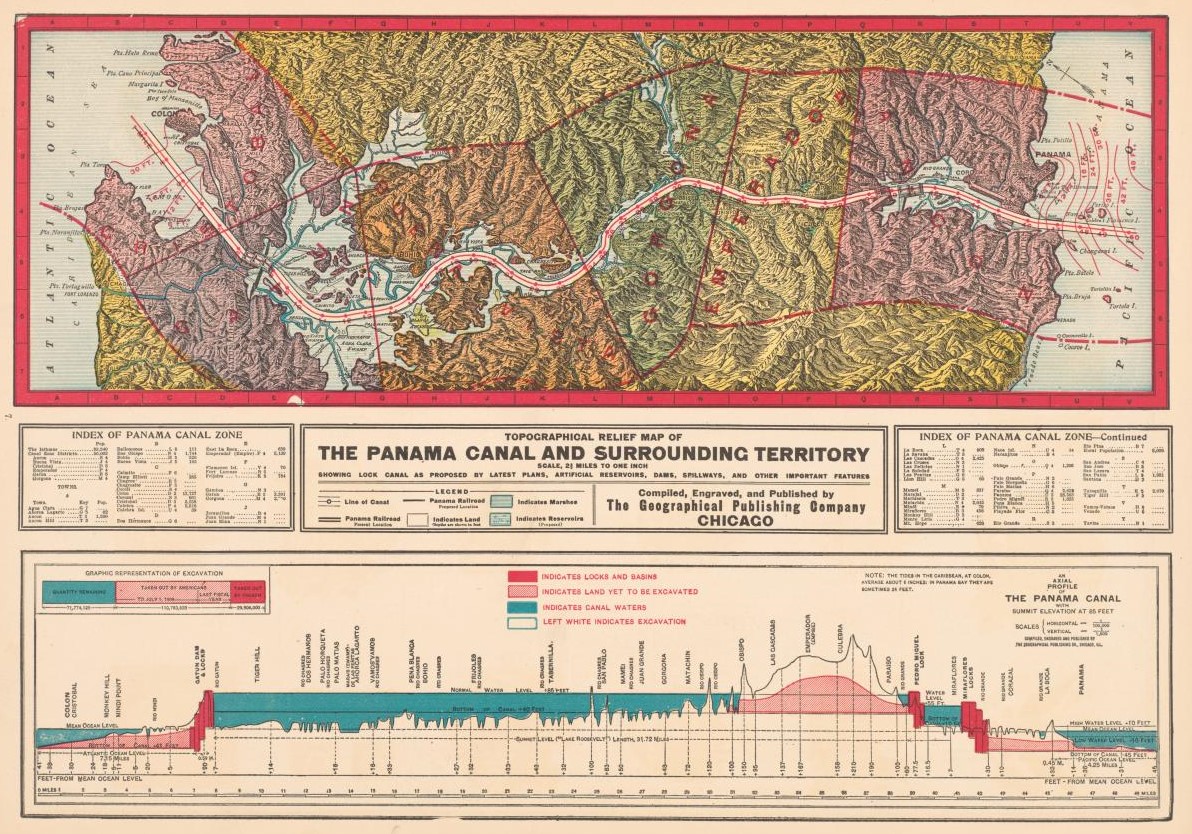
The Panama Canal is the symbiosis of commerce and war made real. A look at the centrality that the Canal became for the U.S. in beating its imperial rival and for planned war in the Pacific.
‘U.S. Speeds War Plans Through Panama Canal’ by Pedro A. Coloma from The Daily Worker. Vol. 10. No. 167. July 13, 1933.
For all the great capitalist powers, especially the United States, Great Britain and Japan, the Panama Canal is one of the most important centers for the coming imperialist war.
This means that the revolutionary movement must make Panama and the Canal a point of concentrated work in order to weaken the imperialist war preparations.
The control of the Canal, its functioning or destruction, its use by one power or another, mean much to the armed preponderance of one or the other power. With the Canal closed, the naval power, of the United States would be cut in half. The Canal is indispensable for Wall Street for transportation of troops, munitions and food from the east coast, where the most important plants are located to the west coast, Hawaii, the Philippines and Siberia.
British and United States imperialism are struggling fiercely for monopolistic control of the raw materials, markets and transportation routes of South and Central America. The main fight is between these two bandit powers; but each day Japanese imperialism, with an eye to possible war with the United States, makes further efforts to edge in and secure sources of raw material and points of support. In addition, active preparations are going on under the pressure of United States imperialism to prepare the countries of the Caribbean for war against the Soviet Union.
Looking at the map, one is struck by the strategic location of British colonies–Jamaica, Cayman Islands, British Honduras, Trinidad–as positions of attack against the Canal. The United States imperialists are not asleep to this danger. They have prepared Guantanamo Bay, the Isle of Pines and many other points in the Caribbean, as well as the increasing fortifications of the Canal itself.
No matter how strong the Canal’s protection seems, attack from within also is feared. Recently a great spy scare has been raised in Panama against Japan. The imperialist newspaper “Panama-American” said on April 21, 1933, in a boxed front-page editorial: “If someone does not soon arise officially and demand to know what in hell are so many Japanese, without visible means of support or apparent reason or legitimate occupation, doing on the Isthmus of Panama, then the Panama-American will not only ask but will answer it as well. Fishermen? Bah! Shirtmakers? Pooh! Barbers? Like hell they are!” This was followed by an even more violent editorial April 26, when this paper charged that Japanese barbers were working in U.S. army posts in order to obtain military information from the soldiers they shaved. The very next day the Port Captain, “searching for dynamite”, raided three buildings occupied by Japanese, fishermen.
But this is only a small part of it. In order to assure the Canal’s safety not only against its imperialist rivals but also against the oppressed colonial masses living around it, the toiling population of Panama, the United States government this year appointed for the first time an “adviser” to the government of Panama, selecting for the post an air corps officer! Thus, Panama is considered part of the defense area of the Canal.
Moreover, in October of 1932 U.S. Army cavalry broke up the demonstration of Panamanian tenant strikers, and on April 27, 1933 U.S. troops took part in a parade in honor of firemen killed in an explosion nineteen years ago. This had added significance since it was only four days before May 1, when a big demonstration of workers was to take place.
At the same time in Panama, in face of a rising wave of revolutionary struggles exemplified by the tenants’ strike, the San Blas Indian struggles and the Las Lomas agricultural workers’ strike, there has been organized a reactionary strong-arm corps called the Accion Comunal. This organization, supported by the ruling class, worked to smash the tenants’ strike and broke the newsboys’ strike. Its role is to prevent the Panamanian masses from carrying on anti-war struggles and struggles against the imperialists and the native bourgeois-landlord oppressors, and also to assure the “willing” participation of Panamanian toilers in the imperialist war as cannon fodder.
Finally, hundreds of British West Indian workers have been deported from the Canal Zone and Panama in recent months.
The Panamanian bourgeois-landlord lackey government is trying to convince the imperialists that the oppressed Panamanian masses are more docile and less dangerous. But the growing struggles under the leadership of the Communist Party gives the lie to these ideas.
Quantities of war material pass constantly through Panama and the Canal, for Chile, Peru, Bolivia, Colombia, Japan. Business is business for Yankee munition makers; even though the United States knows that Japan is preparing for war for domination in the Pacific, it willingly sells war material to Japan because this material is being used today against the Soviet Union. A long list could be given of such shipments through the Canal.
Grace Line boats bring munitions on each trip for Colombia, Peru and Bolivia. During the past spring it completed its two-year building program, begun and finished during the years of the crisis, having constructed four fast 17,000 ton ships. The United States government granted heavy subsidies for these in the form of mail contracts; and in return, the ships have been equipped for mounting light naval guns and machine guns, and prepared for transporting troops. Their officers are all members of the U.S. Naval Reserve.
The conclusions are clear. Panama and the Canal are among the most important war zones in the world. The revolutionary movement in the imperialist countries, as well as in the colonial and semi-colonial countries of the Caribbean. must give greater’ attention to the development of anti-war struggles in this sector.
There should be established anti-war action committees on the docks of Cristobal, Colon, Balboa and Panama City, winning especially the oppressed and exploited Negro workers. These anti-war action committees should make known to the masses every instance of war shipments. should prepare demonstrations and strike actions. Reloading of munitions offers opportunity for strike action. Passing of munitions-laden ships through the Canal must call for mass protest demonstrations.
Contact should be established between the anti-war action committees of Panama and those of the countries which ship war materials. especially of the United States, so as to co-ordinate the anti-war fight. The Accion Comunal, the press and the church, the reformists and the anarcho-syndicalist leaders of Panama are all united in their hatred for the Soviet Union. Their resistance to the revolutionary movement is a fight against the defense of the workers’ fatherland. The revolutionary movement of Panama must. undertake the task of popularizing the achievements of the Soviet Union and of winning the masses for its defense against the interventionist schemes of the imperialist powers.
The Daily Worker began in 1924 and was published in New York City by the Communist Party US and its predecessor organizations. Among the most long-lasting and important left publications in US history, it had a circulation of 35,000 at its peak. The Daily Worker came from The Ohio Socialist, published by the Left Wing-dominated Socialist Party of Ohio in Cleveland from 1917 to November 1919, when it became became The Toiler, paper of the Communist Labor Party. In December 1921 the above-ground Workers Party of America merged the Toiler with the paper Workers Council to found The Worker, which became The Daily Worker beginning January 13, 1924.
Access to PDF of full issue: https://www.marxists.org/history/usa/pubs/dailyworker/1933/v10-n167-Nat-jul-13-1933-DW-LOC.pdf
 Revolution's Newsstand