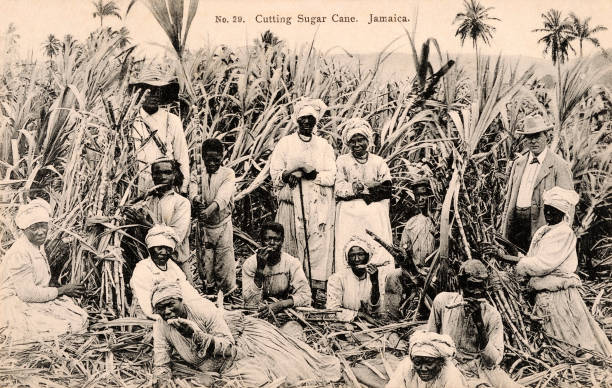
Continuing our survey of each of the countries of the imperialist feeding ground that is the Caribbean and Central America as the U.S. prepares for another major intervention into the region. A look at the specifics of the British colony in the early 1930s, not to get independence until 1962, and Garvey’s movement there.
‘Conditions of the Working Class in Jamaica’ by A. Gold from Negro Worker. Vol. 3 No. 9. June 15, 1930.
Jamaica,1 just like the whole capitalist world, is undergoing at the present time an acute economic crisis. The main wealth of Jamaica is in its banana plantations, sugar cane, coffee and other tropical products; and in view of the fact that the prices of these products greatly drop- ped, the results are clear to all. The extent of the crisis can be judged from the bourgeois paper issued in Jamaica, “The Daily Gleaner”, which wrote in its leader of April 28th:
“The general opinion of the business community is that difficult times are ahead of us. Accounts are hard to collect; the smaller traders soon, as a class, to be short of ready money…The future of sugar appears, for the present, problematical…The prices paid to growers of bananas are far from magnificent; this seems to be a year of high production and poor returns. And there is a similar story to be told of many of our so-called minor products…Indeed, we have heard, the view expressed that a slight blow2 would not be an unmitigated evil since, by restricting the supply of fruit, it might tend to improve prices.”3
Just like in all other capitalist countries, the difficulties of it are completely loaded on the backs of the toilers, and the conditions of the workers and poor peasants of Jamaica, which formerly had never been brilliant, have today become absolutely intolerable, for in addition to their old hardships unemployment has now set in.
In order to have their conditions improved, the workers who are under the influence of the reformist Marcus Garvey4 thought that the best thing to do would be to send a deputation to the Governor of Jamaica headed by Garvey. The conversation between the Governor and the Deputation is quite instructive and we consider it would not be superfluous to give here a detailed description of it.
The principal role in the deputation was played, naturally, by Garvey himself, who in a long speech described the living conditions of the workers, endeavouring to soften the Governor’s heart with his description of the workers’ miserable conditions. Garvey said that the workers’ wages in Jamaica are on the average from 1 shilling 3 pence to I shilling 6 pence (31 cents to 38 cents) per day, with 12-16 hours’ work. In Kingston, (the chief city of Jamaica), the average wage per day amounts to 3 shillings 6 pence (85 cents). In view of the fact that prices on food products are rather high, the toiling population generally lives on salted fish, eating it for breakfast, dinner and supper. Milk is too much of a luxury for the worker. Rent is quite high, and the workers are compelled to put up in small huts. The workers of the plantations live in small huts with earth floors and thatch roofs. Conditions of the plantation workers are such that their daughters go to the towns, where the majority become prostitutes. The workers are subject to heavy fines. For coming late to work by 5 minutes a whole shilling deducted from their wages, and if a worker attempts to protest he is immediately arrested for having disturbed public order.
Garvey pointed out that the exhaustive work and poor nourishment undermines the health of the workers, who very rarely reach old age, and in most cases die when 40-45 years old. On the average the workers live to about 35-40 years. Garvey, on behalf of the workers put forth rather miserable demands: to raise the highest wage-rates from 3 shillings pence to 4 shillings and the introduction of the 8-hour working day. He also brought up the plan of introducing in Jamaica the system of State capitalism, proposing that the Government take upon itself the organisation of a whole number of industries.
After Garvey, also other members of the Deputation spoke, while the Governor warned them that they should not be too long for his time was very limited and he had to leave.
After the Deputation had spoken, the Governor, first of all declared that he simply did not believe them. True, there is some unemployment; but is it possible there should not be any, once the country is undergoing economic depression? However, there is no necessity for the Government to interfere with regard to help to the unemployed, for the philanthropic societies are doing their bid and rendering help to the poor. The Cover is categorically against all plans for establishing State capitalism, in view of the fact that no good results were obtained anywhere, and the endeavour made in Australia, for instance, merely led to big losses. As regards the question of raising wages to 4 shillings and the introduction of the 8-hour working day, there can be no talk about it, for this would mean reduced output and bigger costs, and Jamaica is not rich enough to permit itself such luxuries.
In conclusion the Governor said: “I am not convinced that the position of labour at present is such as to necessitate any immediate action by the Government, nor do I at present see my way to appoint a Commission of Inquiry This is not a suitable time for the appointment of a Commission of Inquiry, because the circumstances which were bad now might easily become worse by the end of the year. And while the position of the sugar industry hangs in the balance as it does now, I think it is no use our endeavouring to arrive at any opinions on contracts which may change either for the worse or better very materially by the end of a year or 18 months”. The workers of Jamaica in, this way got their first lesson in politics. In the future they will know that a capitalist agent only judges on the bad or good state of the country not by the standards of living of the workers but by the profits of the bourgeoisie. The principal thing is to see that the dividends are good, while to the fact that the workers, exhausted by their horrible labor conditions and their semi-starvation existence, die before their time, not much attention should be paid, for so far the capitalists are not threatened with a shortage in labor power. On the contrary, higher death-rates will only rid the philanthropic societies of extra expenditure.
This lesson is not the last. The workers of Jamaica, influenced by their pseudo-leader Garvey, have decided to send a petition to the British King. So far Garvey succeeded in preserving the illusion among the workers of the possibility by means of constitutional methods to improve their conditions; these illusions, however, will soon dissipate. The toiling masses of Jamaica will convince themselves, just like the toilers of South Africa, Gambia, Nigeria, India and other colonies and possessions of “His Majesty” have already become convinced, that the King and his Ministers, Parliaments and Governors are merely executing the will of the capitalist class.
The workers of Jamaica will get the same reply from the King as they got from the Governor, and should they happen to be too obstinate in their demands, they will soon enough convince themselves that the Royal Army Service Corps in Jamaica know how to shoot down the workers not worse than their colleagues in other parts of the British Empire. The workers of Jamaica have only one road to follow for improving their conditions–that is the road of the class struggle. Only by freeing themselves from the influence of their reformist pseudo-leaders, only by organising militant trade unions, will the workers of Jamaica be able to force the exploiters to grant their demands. The experiences gained in the struggles of the working class of all countries and all nations prove that such men like Garvey bring much harm to the working class, and the sooner the workers will turn aside from them, the quicker will they be able to obtain improvements in their present conditions.
We are certain that the “Lesson in Politics” given by the Governor of Jamaica will give good results and that the workers of Jamaica will in the very near future line up with the ranks of the militant fighters for a New Society.
NOTES
1. Jamaica is one of the West Indies group of Islands, belonging to Great Britain; it has an area of 10,904 sq. miles. Seventy-five percent of its million population is comprised of Negroes, while there are even less than 2% whites. The Negroes who were brought to Jamaica from Africa to work on the plantations as slaves, remain up till now, even after their formal liberation slave-bound to their American and British fruit companies, which possess the biggest plantations and which are in actual fact the real bosses of Jamaica.
2. Jamaica suffered greatly from the hurricane in 1907.
3. This hope for a hurricane helping out in the situation did not meet with the approval of the author of the article, who writes, that although hurricanes causing much harm are very rare, yet, in view of the fact that we cannot be sure about the extent to which the hurricane will do damage, it is better if we will not have it at all. Both the hope for a hurricane as well as the arguments against it are rather characteristic for the state of mind of the bourgeoisie.
4. Marcus Garvey is a famous Negro National-Reformist. He is the organiser and leader of the international organisation of Negro workers, the so-called “World Association for Bettering the Condition of the Negroes”. This petty-bourgeois organisation at its Congress in August 1929, drew up a utopian programme for ridding the Negro race of the whites by establishing their own Negro capitalist enterprises. Recently Garvey once again appealed to the Negro bourgeoisie calling upon it to sign up to a loan essential to realise the programme, of the Association. Garvey exercises much influence among the Negro toiling masses, whom he attracts by means of his utopian plans.
First called The International Negro Workers’ Review and published in 1928, it was renamed The Negro Worker in 1931. Sponsored by the International Trade Union Committee of Negro Workers (ITUCNW), a part of the Red International of Labor Unions and of the Communist International, its first editor was American Communist James W. Ford and included writers from Africa, the Caribbean, North America, Europe, and South America. Later, Trinidadian George Padmore was editor until his expulsion from the Party in 1934. The Negro Worker ceased publication in 1938. The journal is an important record of Black and Pan-African thought and debate from the 1930s. American writers Claude McKay, Harry Haywood, Langston Hughes, and others contributed.
Link to full PDF of issue: https://www.marxists.org/history/international/comintern/negro-worker/files/1930-v3n9-june-15th.pdf
 Revolution's Newsstand