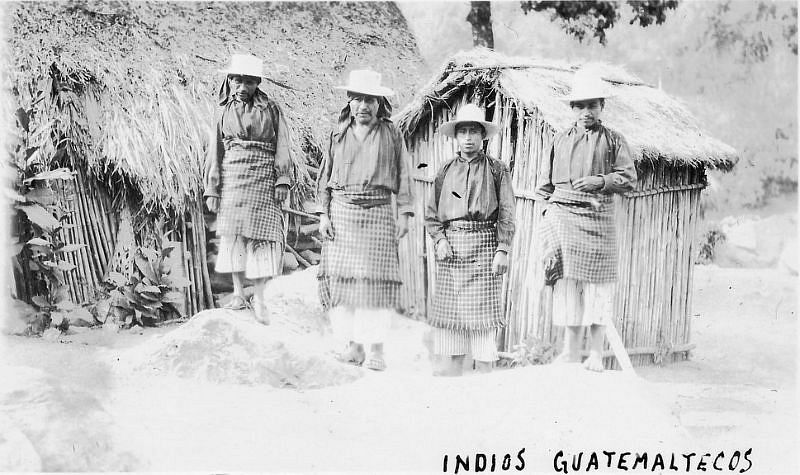
An entire nation turned into a labor camp for the profits of United Fruit, and a genocide against the Mayan people after the 1954 C.I.A. coup, in this country blighted by U.S. imperialism.
‘United Fruit Holds 1,500,000 Indians as Slaves in Guatemala’ by Harrison George from The Daily Worker. Vol. 8 No. 38. February 12, 1931.
WALL ST. PROFITS ON PEONAGE AND FORCED LABOR IN GUATEMALA
Even Children Are Forced Into Slavery to Pay “Debt” of Parents
Woll Is Silent About Convict Labor in Latin America; Wants War On Soviets
WHAT about this “forced labor,” workers? You have read that, on Tuesday, the American capitalist government has barred Soviet lumber. But it does not bar Cuban sugar, which last week the Daily Worker exposed as produced by forced labor!
Today, the Daily Worker takes up another case of “forced labor,” by American imperialist bankers and plantation owners in Guatemala.
Not a single grain of coffee enters the United States from Guatemala, but what is the product of forced labor! It is picked by the hands of Indian plantation workers, which the 1931 “World Almanac” itself on page 666 admits are “held under a system of peonage” or practical slavery.
The population of Guatemala is 2,500,000. And 60 per cent of these are pure blood native Indians. And these 60 per cent—these 1,500,000 workers—are practically the slaves, the property, of 2,700 landowners.
These feudal barons are Germans, native Guatemalans and Americans, the United Fruit Company monopolizing banana production. Every worker is held in bondage to the landowner by a devilish system of “debt.” The symbol of slavery being a little book, carried by every Indian worker in Guatemala, in which his “wages” are entered by the landowner, and the “debt” the worker owes to his master.
On the inside cover of each little book is the “contract” by which the worker is bound by the law of Guatemala to life-long servitude at forced labor. This “contract,” printed in Spanish, translated into English, reads as follows:
“Contract of work of the ‘mozocuardillero’ (agricultural worker) with the plantation (blank for the name of plantation) owned by (blank for name of plantation owner).
“I declare to owe, in account with said plantation (its name) owned by (owner’s name) for an indefinite time and at the rate of pay used in said plantation: deducting with my own personal labor the debt contracted: and resigning to look for work with any other contractor, not to leave the plantation without permission from the boss, and without having paid my debt. I agree to remain subjected to the conditions above mentioned and to fulfill the obligations contained in Articles 23, 27, 28, and 29 of Decree No. 486 and Article 1578 and 61 of the Civil Code.”
So the laws of the nation of Guatemala guarantee the feudal slave-holders the forced labor of 1,500,000 workers! And the “usual wages” of these workers for 14 hours a day is two and one-half cents!
An American worker who recently visited Guatemala examined these horrible little books. This is his story of what follows the ‘contract’ on their pages:
“The rest of the book serves to record what the Indian gets from the landowner, in goods or in cash wages. But he never gets to see a penny of cash wages. Because on the opposite page he is charged with every imaginable thing, beginning even with the fee demanded by the labor contractor who obtained the workers for the landlords. Their land has been stolen and they have no way to live unless they do “agree” to the slave contract.
“They are charged also with working instruments (machetes) or work enough to pay up.
“Each Guatemalan ‘peso’ is worth one and one-third American cents, and, examining the books of thirty Indians who had, in desperation, run away from the plantation “El Zapote,” owned by Senor Hasiastiche Plaitagen, where they had worked for nearly ten years, from October, 1920 to February, 1930, I selected one book as an average example.
“There were six entries showing the wages credited to the worker from October, 1920, to February, 1930, a total for nearly ten years work of 6,605 pesos, or what in American money would be about $88.07! No wonder, with such wages, their labor had to be obtained by force!
“This is a wage that, however miserable may be the worker s food and clothing, he can not help living up and exceeding, and thus being bound in debt for life to the plantation, and even if he dies his children are obliged to work out his debt to the plantation owner!
“He is bound to the plantation and sold with it! In fact the value of a plantation depends on the number of ‘contracted Indians.’
“Fifty million dollars of American capital are invested in Guatemala absolutely because these Indians are force to do work for 2 1-2 cents a day, and thereby produce enormous super-profits.
“Go where you will in Guatemala, you will see the branch offices of Grace and Co., and other American coffee merchants.
“In the cities you will see the branches of Morgan’s National City Bank, financing the coffee and sugar crops, half of which is imported into the United States. More, you will find there, a group of corrupt ‘labor leaders’ with a paper organization called a ‘Confederation of Labor’ which is part of Matthew Woll’s and Bill Green’s Pan-American Federation of Labor, but which prevents organization oi these Indian workers and acts as a tool of the government, just as that government acts as a tool of American imperialism.”
Workers! Matthew Woll and Congressman Fish howl for an embargo on Soviet products. They gabble about “forced labor”—in the Soviet Union—but they are silent on the real forced labor of a million and a half workers of Guatemala, here at America’s door! Why? Because American capital cannot profit from the worker in the Soviet Union where the workers have overthrown capitalism, while it does profit from the slavery of Guatemalan workers. And Woll and Fish are supporters of American capitalists!
The Daily Worker began in 1924 and was published in New York City by the Communist Party US and its predecessor organizations. Among the most long-lasting and important left publications in US history, it had a circulation of 35,000 at its peak. The Daily Worker came from The Ohio Socialist, published by the Left Wing-dominated Socialist Party of Ohio in Cleveland from 1917 to November 1919, when it became became The Toiler, paper of the Communist Labor Party. In December 1921 the above-ground Workers Party of America merged the Toiler with the paper Workers Council to found The Worker, which became The Daily Worker beginning January 13, 1924.
PDF of full issue: https://www.marxists.org/history/usa/pubs/dailyworker/1931/v08-n038-NY-feb-12-1931-DW-LOC.pdf
 Revolution's Newsstand