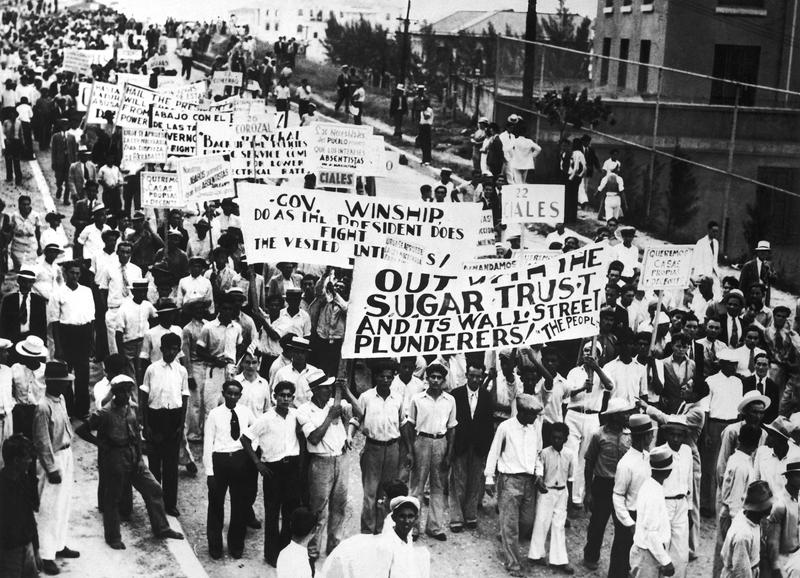
Gannes on U.S. imperialism in the Virgin Islands, and its strategic relationship with Puerto Rico, including the misleadership of long-time ‘Socialist’ grandee, Santiago Iglesias.
‘The Iron Chain of the Antilles’ by Harry Gannes from Yankee Colonies. International Pamphlets, New York. 1930.
Porto Rico and the Virgin Islands are vital links in the iron chain of the Antilles. The Caribbean area, gateway to Latin America, is a valuable source of raw material as well as a rich market for American imperialism. It is more important, however, as a war base and a wedge in the heart of Latin America. However, the great economic importance of Cuba, which has $.1,500,000,000 of U.S. capital invested in it, cannot be overlooked.
Cuba, Santo Domingo, Haiti, Porto Rico, the Virgin Islands are really a unit. Wall Street dominates throughout, and makes little distinction between actual possession, protectorate or semi-colony. Under the Platt Amendment and with the rapid penetration of U.S. capital into Cuba, that country, the largest island of the Antilles group, is in many ways more completely a colony than, for instance, Porto Rico, an outright possession. Guantanamo, Cuba, is the leading American war base in the Antilles.
Porto Rico is a comparatively small island, covering 3,435 square miles. It is about a hundred miles long and 35 miles wide. However, it is the most thickly populated of the Caribbean Islands, with over 1,500,000 people. About 73 per cent are white and the remaining 27 per cent Negro.
At precisely the time when the Porto Rican people, through repeated rebellions, had wrested a modicum of autonomy from Spain in 1898, the American fleet began to bombard San Juan, the capital and chief city. In July, 1898, an American force took possession of the island. In the customary fashion Major-General Nelson A. Miles, commander of the conquering forces, issued a proclamation asserting that the American troops had “come bearing the banner of freedom.”
The Foraker Act, passed by the United States in 1900, provided for a Porto Rican legislature, and an American dictator, to be known as the Governor. The form of government under the Foraker Act was much more reactionary than the legislative rule granted by Spain, in 1898.
An inferior sort of third-class American citizenship was conferred on the Porto Ricans by the Jones-Shaffroth Act, adopted by the U.S. Congress March 2, 1917. The Porto Rican currency had already been changed to U.S. currency, with great profit to American bankers; and in the same fashion the Porto Ricans were “transferred” into American citizens, with no added rights except to vote for 19 members of an Insular Senate which is completely under the thumb of the Governor-General, appointed by the President of the United States. Even the elections are under the scrutinizing eye of a General Superintendent of the Insular Board of Elections, chosen by the American government.
The Governor-Generalship of Porto Rico is a particularly juicy plum for the political proteges of the capitalist party that happens to be in power in Washington. In addition to a yearly salary of $10,000, paid by the U.S. Government, he receives from the Porto Rican legislature an annuity of $25,000 to cover “incidental expenses.” Besides, he is furnished, rent free, a magnificent palace and grounds; and the legislature chips in for the payment of whatever servants are needed to maintain him in his accustomed standards of luxury. An automobile is also provided for his “excellency” at the expense of the starving masses.
“The banner of freedom,” borne into Porto Rico with the support of bayonets and cannon fire has resulted in the impoverishment of the great mass of Porto Rican people. Over 80 per cent of the Porto Ricans depend on agriculture for a livelihood.
The big American sugar and tobacco corporations have dispossessed the Porto Rican peasants, grinding them down to the lowest depth of poverty and disease.
Over 95 per cent of the best lands have fallen into the hands of the Yankee invaders. The poor peasants have been expelled from their lands and are forced to go to the mountains if they want to cultivate the earth for their bread. Or they are forced to become farm laborers or factory workers.
How rapidly the Porto Rican peasants have been reduced to the starvation level can be seen from the fact that while in 1910 there were 58,371 peasant proprietors, today there are less than 25,000.
Wall Street Walks In
Instead of raising the necessary food crops to feed the people, American imperialism has transformed Porto Rico into a sugar-producing factory. Over 90 per cent of the exports go to the United States. American sugar corporations have over $54,000,000 invested in Porto Rico and own thousands of acres of the richest lands. There are outstanding over $35,000,000 in Porto Rican bonds held in the United States. Besides, all the railroads and public utilities are owned by American corporations.
The United States Army has a 999-year “lease” on a large tract of land at San Geronimo. This is a base for winter war maneuvers, as well as a station for marines who are shipped to various points in Central and Latin America whenever Wall Street interests require their presence there.
When Theodore Roosevelt, Jr., became governor of Porto Rico early in 1930, he was forced to admit in a public statement that the great majority of the people suffered from malnutrition–starvation. On September 13, 1930, he reported that conditions were worsening for the masses. In 1928, Dr. Cayetano ColI y Toste, a prominent Porto Rican, in a letter to President Coolidge spoke of the Porto Rican worker and peasant as “one of the most unfortunate beings in the world.” His food, he said, “is only putrid salt meat, codfish filled with rotten red spots and Indian rice.”
A great many are denied even these luxuries by the constant encroachments of the big sugar and tobacco corporations.
A recent statement by the American Red Cross declared that in Porto Rico 242,292 persons were in immediate need of food to keep from starving to death; 22 ,868 were practically naked; 32,526 families could not pay rent for their rotten dwellings; and 129,514 required immediate medical attention.
American imperialists like to blame the hurricane of September, 1928, for the inescapable fact that the conditions of the Porto Rican workers and peasants are constantly sinking to lower depths. This is the best excuse they can find. But no greater hurricane ever hit Porto Rico than when the imperialist forces landed, and were followed by the long reach of the big banks.
Not only does Porto Rico have to ship out most of its agrarian products, but it is forced to import a large part of its foodstuffs from the United States. These come in at tremendously high prices. Wages for farm laborers, tobacco factory and other workers in Porto Rico average from 25 to 60 cents a day. It requires at least $2.00 a day to keep above the starvation level.
Iglesias–the Socialist
Porto Rico has a Socialist Party, which is as much an aid to American imperialism as the British Labor Party is to British imperialism. Santiago Iglesias heads the Socialist Party. Among his other functions for Wall Street are Spanish-secretaryship of the Pan-American Federation of Labor, and head of the Porto Rican Federation of Labor, which is under the thumb of William Green and Matthew Woll of the American Federation of Labor.
The Socialist Party stands for closer alliance with then United States and final incorporation of Porto Rico as a state. The Socialist Party has made election alliances with the Pure Republican Party, which has in its ranks many exploiters of labor, rich farmers and even bankers.
The former Unionist Party in 1932 became the new Liberal Party. It has “independence” as one of its ultimate general aims. But its program provides that it will work with the Washington government until such time as the latter agrees to withdraw its control from the island. The same leaders who are now making loud professions for independence formerly, as members of the Unionist Party, in alliance with the Republican Party, administered the island in the interest of the Yankee exploiters and did everything possible to keep the workers passive and contented with their conditions.
There is also a Nationalist or Independence Party, which carries on a half-hearted struggle for the type of “independence” which Cuba has obtained.
A Communist Party is being formed in Porto Rico, to carry on a relentless struggle for the absolute, immediate and complete independence of Porto Rico from American imperialism.
One of the main tasks of the Communists is to fight against the traitorous role of Iglesias and the Socialist Party who, through the instrumentality of the Pan-American Federation of Labor, help American imperialism not only in Porto Rico, but throughout Latin America.
THE VIRGIN ISLANDS–A WAR BASE
The Virgin Islands, which are just to the East of Porto Rico, were purchased by the United States from Denmark in 1917 for $25,000,000. The purpose of the purchase was to add a strong link to the chain of war bases in the Caribbean. The value of these small islands to the United States is mainly military. With the purchase of the islands came the domination of 26,000 people, who are ruled by the Navy Department.
There are three main islands, St. Thomas, St. Croix and St. John. These islands were discovered by Columbus on his second voyage in 1493. They were first settled by Danes. A wide-spread slave trade was developed. The population today remains predominantly Negro. American imperialist domination has transferred to the Virgin Islands the same treatment for the Negroes that it metes out to the Negroes in the United States. They are ruled with an iron hand by a naval governor appointed by the President of the United States. All efforts by the people to attain civil government for the islands have been defeated.
After their acquisition Senator Kenyon said that the Virgin Islands were not purchased as an “investment” but as a war base. “St. Thomas,” he declared, “and its harbor is the strongest and most easily fortified spot in the West Indies. It can be made for us both an impregnable fortress and a valuable commercial and shipping station.”
A marine corps detachment is stationed permanently at St. Thomas, and the commandant of the naval station is in charge of all naval activities in the Porto Rico-Virgin Islands area.
In the Caribbeans the British have important naval bases at Jamaica, Trinidad, British Honduras and Bermuda. The island of Jamaica, commanding the approach of the Panama Canal is of greater strategic importance than the other British bases, and the British have been scouting for other important airplane bases near the Panama Canal in preparation for the fast developing war between these two imperialist powers.
Nor is American imperialism slow in constantly building up its war machine in the Canal Zone, which is an outright U.S. possession. Panama proper, which once was a part of Colombia, is the creation of an American-inspired “revolution” engineered for the sole purpose of turning over the Canal Zone to the United States. Around $25,000,000 a year is spent for military upkeep and fortification of the Canal. Over $113,127,000 had been spent by 1928 for fortifications alone.
International Pamphlets and International Publishers were a printing house of the Communist Party.
For PDF of the full pamphlet: https://www.marxists.org/history/usa/parties/cpusa/international-pamphlets/n07-1st-ed-1930-Yankee-Colonies_H-Gannes-arch-org.pdf
 Revolution's Newsstand