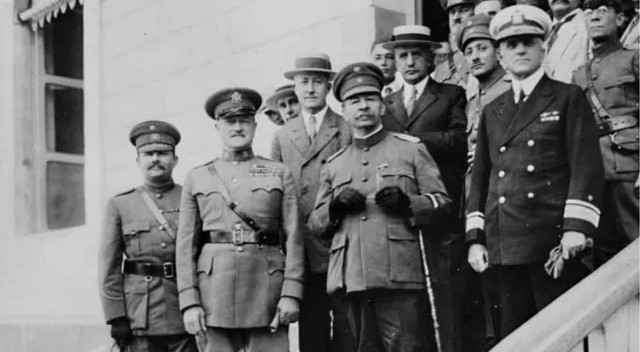
What the United States would like to return to. One of the most brutal agencies of imperialism in the Americas of the 20th century was the decades-long regime of Juan Vincente Gomez, chief torturer for Standard Oil and Royal Dutch Shell. A view of what life was like for workers and peasants in the ‘good old days.’
‘The Twenty-Fifth Year of the Dictatorship of Juan Vincente Gomez in Venezuela’ by Elisa Imar from The Daily Worker. Vol. 10 No. 130. May 31, 1933.
The 25th year of the monstrous dictatorship of Juan Vicente Gomez in Venezuela has been greeted with articles extravagantly praising the prosperity of the country in the capitalist press of the United States. In the New York Times, the Pictorial Review, the New York American, etc., articles have appeared in which Venezuela is spoken of as “A paradise on earth,” “a country governed by a noble statesman in which all the inhabitants are happy,” “a country which has escaped the convulsions of the world crisis,” etc. And as a final argument to convince the readers of the truth of their assertions these publications triumphantly bring forward the fact that Venezuela “is the only country which has no foreign debt.”
The great oil concessions granted by Gomez to the Imperialists involve not only Standard Oil and Royal Dutch Shell rights to exploit the petroleum deposits, but also to enrich themselves at the cost of the blood and sweat of the Venezuelan workers. With the coming of the crisis and the restriction of oil production, the coffers of the big operators were full with what had been squeezed out of the thousands of Venezuelan and West Indian workers employed in the oil regions. At the same time the wages of these workers, even in the famous period of prosperity, had been so meager that when many of them were discharged and had to return to the cities and haciendas from which they had come, they did not even have enough money to pay for the trip back.
Venezuela has not escaped the crisis because it has no external debt. This can be proved by glancing over the bulletin published in Caracas by the Chamber of Commerce of that country. From the end of 1929 up to the present time this Bulletin, which is interested in presenting the economic situation of the country in its most favorable aspects, cannot help declaring that month by month and year by year commerce is being crippled, that the production of oil has been restricted and continues its downward trend, that the price of coffee continues to fall, that the factories are closing, that the activity of the various enterprises and commercial houses is slackening, and the bolivar is losing in value.
This means the continuous growth of hunger and misery among the peons and all of the toiling elements of the city and the countryside. And to the common lot of all the toilers in the countries rent by the world crisis it is necessary to add the conditions of wild terror which are found in Venezuela.
The Terror of the Bourgeois Landlord Government
The main manifestations of this terror are the large number of arrests for trifling reasons, the recruitments (reclutiamentes), and forced labor on the roads. The recruitments and above all work on tbs roads (these roads which have brought so much praise to Gomez) are the horrors of the Venezuelan toilers. The roads between Caracas and Valencia, and the Caracas-La Guayra highway have cost the lives of ten of thousands of “colorados” (prisoners dressed in red who work with ball and chain).
The Trans-Andian highway in the region of Mangan alone, (State of Trujillo), has buried 1,500 workers. The Eastern Road took thousands of prisoners from all the jails of Venezuela who arrived hundreds at a time, every three months, to the deadly region of Palenque. Today this is going on in the region of Los Cocos and in the construction of the port of Turiamo.
In this road work the men succumb rapidly due to the miserable food, the brutal treatment (for political prisoners especially), the length of the working day at forced labor, as well as the deadly climatic conditions against which no precautions are taken. On holidays, when peasants enter the villages, local authorities carry out collective recruitments, capturing the peasants as if they were animals. Once recruited, the workers and peasants are forced to do military service, the term of which depends only on the caprice of the “chiefs.” The soldiers encamped in Coigne, Ocumare, Choroni, etc., eight to nine thousand of them, are forced to work in the haciendas of Gomez for two bolivars a day. (The bolivar is worth a little less than twenty cents in gold, but at present its value has dropped to from fifteen to sixteen cents.)
Political Prisoners
Right now thirty-five men are inclosed in a narrow cell of the Rotunda in Caracas, without air, without light, sleeping on the floor and weighed down with irons of as much as eighty pounds each. These thirty-five prisoners, the majority of whom have been incarcerated for more than two years, are accused of being Communists.
Among them are workers, peasants, soldiers, students and professional people. Some are not even twenty years old. They have not been granted trial, they are not permitted to have visitors or lawyers, and medical attention is not given to them even though many are suffering from serious diseases. They are now not allowed to receive food which is sent by their families and friends. This inevitably means slow death by hunger, as it is impossible to subsist long on the “rancho,” the nauseating and meager rations of the prison.
Terror In the Haciendas
Most often the owners of the haciendas or big plantations (hacendados) are at the same time civil chiefs, or political officials in their own territory and when this is not the case such functionaries are named by them. This business—political connection–helps to bring about barbarous terror in the countryside.
Bruao Sanabria, a big landlord and local government official near Santa Lucia in the State of Miranda, ordered that Cupertino Manos, a 15-year old agricultural laborer should be recruited for forced labor because the boy had tried to collect 17 bolivars which was owed to him for work he had done. Manos has already done two years of military service. Antonio Pimentel, one of the most powerful Venezuelan landlords, counsellor and intimate friend of Gomez, has a favorite diversion: raping the young peasant girls in the region of Guacara, afterwards forcing a peon to marry his victim. Many times he buys the daughters of the hungry families on his estates at the current price of 300 bolivars. The peasant Mirabel Sanchez, who was about to be married, was captured by a group of Pimentel’s foremen, while another group forced his sweetheart to the home of Pimentel. Mirabel has now been prisoner in La Victoria for 3 years.
Luis Calles, the owner of a cattle ranch near Cua ordered the imprisonment of the peon Monico, because he had hurt a cow in order to save the life of a woman who was being attacked by the animal. Monico was a prisoner for several months and was then forced into the army.
How Agricultural Workers and Tenants Are Bound to the Land
Paced with the fierce conditions in the haciendas, the agricultural workers and peasants try to emigrate to the cities, but the landlords utilize various methods to keep them tied down to the land. Most often this is done by means of debts owed in each hacienda, or estate, there is a store, or commissary, which sells on credit to the agricultural workers and tenants at exorbitant prices. As the miserable wage which they receive never enables them to pay for even the elementary necessities, they find themselves always in debt. This is easy to understand when we consider that the wages of the agricultural workers in the Colon District (State of Lara) for example, are not more than 1.50 bolivars weekly plus two cheap drill suits a year. This wage amounts to less than five cents in gold daily. Thus debts force them to remain on the estate for an indefinite time. In the State of Lara the “Habilitamiento” is used. That is the peasants are forced to sign a document before the civil chief in which they recognize the debt and pledge to pay it with work. As a rule the debt, far from decreasing, grows and the peasant upon death gives over to his children as a heritage the debts which he has contracted with the land owner and they in turn remain condemned to work on the estate. The landlords of Bebures in the State of Zulia have a firing squad shoot the indebted peasant who tries to escape. Many of the estates in this region belong to Gomez himself. In Guayana the big landowners and cattle raisers, snob as the Oaeados and dice, with indebted peons in place of money.
Another method of subjecting the laborers and tenants to the land is through the terror rule of the “Guardias de siguise” (in each hacienda there are groups of peasants bribed by the boss, who are known by the names of siguises, espalderos, caporales, etc., and who constitute small armed guards to carry out the wishes of the owner). In Yaracuy the landlords Jimenes send these “siguises” to assassinate peasants with whom they have differences. The Casados and Espanas in Guayana have armed guards with shotguns who forces the pickers of balata, sarrapia, etc., to work. The landlords Montiel, Alvarado and others in Bebures, used to arm their guards during the time of the oil boom to kill agricultural laborers and tenants who tried to escape to work in the oil region.
Semi-Slave Labor.
In the states of the Andian region of Venezuela, there abound the “Cebachados”, workers primarily of Indian origin who are not paid any wage whatsoever. They receive only a miserable portion of food, and rags to cover half their bodies in return for their work. They sleep huddled in “Caneyes” which are flimsy shelters without walls. In Guyana there are also large numbers of Indians living in such conditions. The missionary monks of Caroni ask the local landlords for Indians for the purpose of “catechizing”. They put them to work in the estates of the missions and give them only a miserable food ration. When the day’s work is done a missionary makes them kneel and pray, finally blessing them, saying: “God will pay you”.
All this is only a small part of the crimes which are committed daily in the “Venezuelan Paradise”, which the bourgeois press of the U.S.A. and other countries praises so lovingly. The actual situation in Venezuela is best characterized by the words of the Venezuelan workers themselves who have created the popular modification of Gomez’s slogan: “Peace and Work”—“Peace in the cemeteries and forced work on the roads”.
But while the powerful figures of the capitalist world, even including the Sanctity of the Pope, cover the tyrant with flowery praise, the Venezuelan people, subjugated but not defeated, fight resolutely for their emancipation. The outstanding feature of this struggle has been the establishment more than two years ago of the Communist Party which, while still in its Infancy, has succeeded in living through the onslaught of most ferocious repression. It is the duty of the workers and peasants of the whole world, and particularly the toilers of the United States to support the Venezuelan masses in their struggle for liberation.
The Daily Worker began in 1924 and was published in New York City by the Communist Party US and its predecessor organizations. Among the most long-lasting and important left publications in US history, it had a circulation of 35,000 at its peak. The Daily Worker came from The Ohio Socialist, published by the Left Wing-dominated Socialist Party of Ohio in Cleveland from 1917 to November 1919, when it became became The Toiler, paper of the Communist Labor Party. In December 1921 the above-ground Workers Party of America merged the Toiler with the paper Workers Council to found The Worker, which became The Daily Worker beginning January 13, 1924.
PDF of full issue: https://www.marxists.org/history/usa/pubs/dailyworker/1933/v010-n130-NY-may-31-1933-DW-LOC.pdf
 Revolution's Newsstand