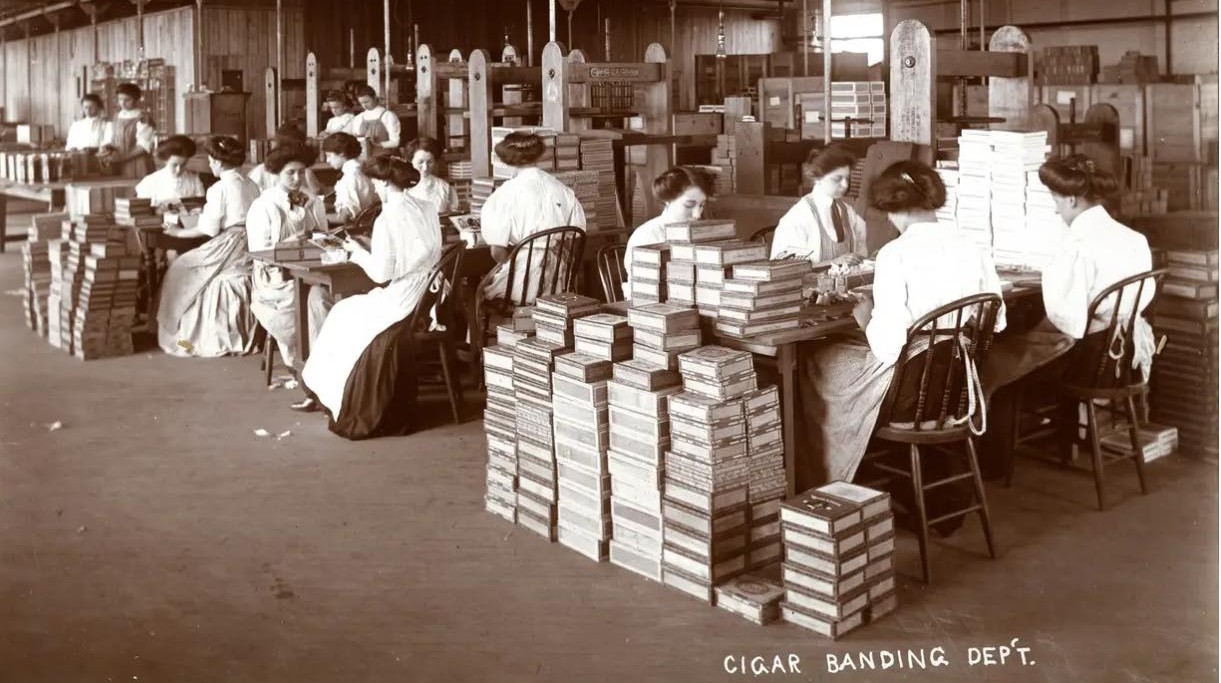
A member of the Amalgamated Clothing Workers and graduate of Brookwood Labor College ‘salts’ in one of the many cigar factories at Allentown, Pennsylvania and finds the conditions there impossible.
‘In a Pennsylvania Cigar Factory’ by Edith Kowski from Labor Age. Vol. 17 No. 9. September, 1928.
Intelligent Insistence on Rights Commands Respect
Edith Kowski, a member of the Amalgamated Clothing Workers of America, graduated from Brookwood Labor College in June, and after using up considerable shoe leather finally landed a job in an Allentown, Pa., cigar factory. Conditions of work there are described in the following extracts from one of her letters. Edith left the White Owls in July to go further south with two other Brookwood graduates, to pick up work in some southern textile mill and study its conditions. We hope to print more of her observations later.
Do you want to know something of how the rest of the world slaves? At least in that part of the commonwealth of Pennsylvania known as Allentown? Something especially of my two weeks’ experience in a cigar mill in that city?
Firstly the thing that troubled me much was that | saw so many, many young girls going to and working in the mills, and when I remarked about it to the “Y” secretary, she answered, “Yes, 40 per cent of the girls between the ages of 14 and 16 years work in the mills of Allentown”. I found through questioning them that they marry young and not because they want to get out of the mill, for, it seemed, they all expected to go back to work after they were married; they wanted either to help buy a home or a car. And some said, “What should I do home alone, when I can work in the mill and earn money?” Their last thought on earth or the thing furthest from their minds was education. They couldn’t see what use one could make of it.
Many of the mothers work until a few months before the baby is born, and when the kiddie is six months or a year old, the mother goes back to the mill, leaving her child or children, as the case may be, with some mother on the same street, who has too many kiddies of her own to leave to go to work, or with some married woman who keeps boarders. You can imagine the care these kiddies get. Many mothers, too, work in the silk mill on the 2 to 11 p.m. shift, some of them earning, and this is high, $20 a week at weaving. This shift is a straight through shift, the only stopping that is done is at quitting time; no time is taken off for meals. They eat and work at the same time. Although they are piece workers, if they stop they must work an hour later. The shift is originally a ten hour one, but doing without a meal hour, makes it only nine working hours.
Now, for the cigar mills. Brothers, when you leisurely blow the smoke from a “White Owl” cigar or any other cigar made by the General Cigar Co., into the breeze; give the girls that have made them a thought, and in the future smoke only union made cigars; at least you can hope that the conditions and hours aren’t quite so bad.
Working in a Humidor
In case there any among you who as the hot house flowers, like neither the sun, or object to getting sun-burnt, working in these mills from sunrise to sunset is a sure protection for you, and as a safe-guard against becoming shriveled up, since windows are only opened a few inches on rare occasions, (because the stock dries up and the Company loses money) the room is ventilated by a water system that keeps it like a humidor. In this atmosphere the majority of the girls work from 6:45 a.m. until 6 p.m. with a scant 45 minutes for lunch. They get 85 cents for making 1000 cigars. If they make 4000 cigars on the average every day of the week the number of the machine is hung on the honor roll. These honor roll girls earn a little over $18 per week, (some honor!) for being the best slaves, and that isn’t one half. The State Law, framed and hanging on the wall, has the inspector’s signature attesting to the fact that only 54 hours are worked in this mill. Either the inspector is one of those liberal fellows who throws in an hour or two for good luck and still calls it 54 or else the manufacturers don’t believe in signs or maybe can’t read English. Anyway I believed enough in the sign to refuse to work over 54 hours. Half the girls didn’t know what was on the posted state law and when they did, it didn’t trouble them much, they worked and would work. It meant more money, as long as the machine was kept going.
Every girl must clean her part of the machine at noon and night, and on Saturday with soap and water and Dutch cleanser wash the brass and nickel on the machine. And wash the bulbs and shades of the electric lights over her head, too, and sweep the floor. I rather naively asked the head foreman whether he didn’t think the girls ought to scrub the floors, too. This work, by the way, is all done on their own time. They get no extra pay for it. Every girl must buy an apron (it costs about 90 cents) and wear it at work, and launder it herself, of course.
This firm employs a whole floor of about 300—14 year old girls. They put the bands on the cigars for $7 or $8 per week.
I was supposed to receive $12 a week; but couldn’t stand a steady week of that grind, so I made the munificent wage of $10, having stayed out a day each week.
Presenting the Union Message
The workers are so docile. When a few saw that I gained my points by kicking they then were willing to listen when I told them they could get better conditions if they went out on strike. The boss, I said, would be forced to give in to their terms, for inexperienced workers, are all he could get to take their places and they (the inexperienced) would break enough machines in learning so that the boss would be all too willing to give in to their demands. They said “Yes, that sounds good but we could never do that here.” But I told them it could and would be done and it won’t be long either, even though they seem to love nothing better than to slave for endless hours for wretched pay and miserable conditions.
When 5:30 p.m. came and the machines were still running, I asked the foreman for an o.k. to go home, told him I was used to working a 44 hour week in a union shop and getting twice as much pay, that I was tried. “You’re tired,” he asked, and I said “Yes, I am tired.” “Well, you are supposed to work until the machine stops,” he said. “Well,” said I, “I did enough work and I am tired.” “All right,” he agreed. “Then go on home.” The second night I did work. The third night I walked out without asking and the fourth night he himself closed down the machine at 5:30 and said I could go home, and after that I left at 5:30 every night. One morning after I had been out a day, my chair had disappeared. The forelady said there were no extra chairs around; the foreman said the same, the head forelady dittoed the other two with a growl like the wolf of Red-Riding-hood fame. So I hied me to the head-foreman and told him I would not stand all day at work, that unless he saw to it that I got a chair I would report it to the office. Surely the company wasn’t so poor it couldn’t afford a few extra chairs. In an hour I got my chair, and directly after I got one of the best machines to work at, although I had only been there a week. The rule is that learners must wait their turn for machines, the time being from two weeks to three months. The girls were dumbfounded. Before that they said (of course behind my back) “What in hell is she always kicking about!” But at the last triumph, they became friendly and smiled, and that’s when I made my little union strike talk to them.
The foreman, by the way, told me he hailed from Ohio. He said they had a 50-hour law there and the state was strict in upholding it. I asked him if he knew Mr. Bigelow who was mainly responsible for putting through that law. He said he didn’t, so I advised him to look him up, that it wouldn’t do him any harm to learn more about people who are responsible for getting better working conditions for the workers, especially since he brags about coming from Ohio.
Inducements to Stay
And the funniest part of all is, when I told the foreman I was quitting he sent the forelady over to urge me to stay. “You will get used to it, and I’ll see that you get a good crew to work with,” she said. I told her I would never get used to such conditions nor to working for such miserable pay; but that I may come back some day to organize the workers into a union, so that all would have better conditions. Well, she was sorry, I was leaving, anyway. And so I bid adieu to my first job this year, having added perhaps nothing toward making the workers load a bit lighter, but experience to work with in the next cigar mill I land into.
Labor Age was a left-labor monthly magazine with origins in Socialist Review, journal of the Intercollegiate Socialist Society. Published by the Labor Publication Society from 1921-1933 aligned with the League for Industrial Democracy of left-wing trade unionists across industries. During 1929-33 the magazine was affiliated with the Conference for Progressive Labor Action (CPLA) led by A. J. Muste. James Maurer, Harry W. Laidler, and Louis Budenz were also writers. The orientation of the magazine was industrial unionism, planning, nationalization, and was illustrated with photos and cartoons. With its stress on worker education, social unionism and rank and file activism, it is one of the essential journals of the radical US labor socialist movement of its time.
PDF of full issue: https://www.marxists.org/history/usa/pubs/laborage/v17n09-sep-1928-LA.pdf
 Revolution's Newsstand