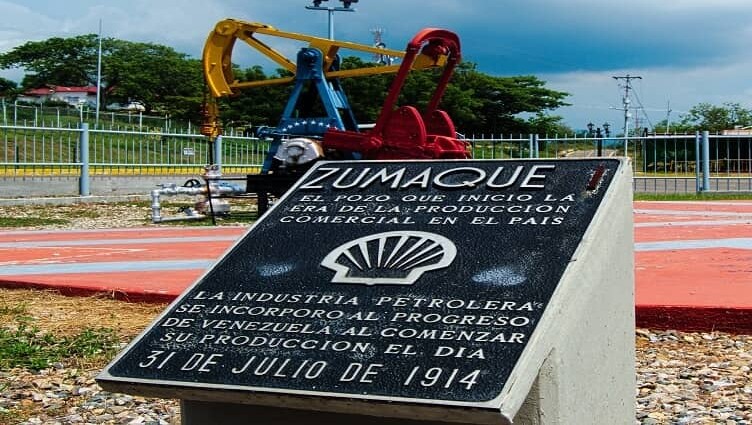
By 1928 Venezuela had quickly become the third largest oil producer in the world with British and U.S. companies leading their perspective Empires in employing every kind of intrigue imaginable to gain control over the resource.
‘Imperialists Fight for Oil in Latin America’ by Outpost from The Daily Worker. Vol. 5 No. 260. November 2, 1928.
IN the left hand top comer of South America, facing on to the Caribbean Sea, quite close to Panama and the canal, are the two states of Colombia and Venezuela.
Very little about them gets into the news columns of the newspapers. You will scarcely ever hear them mentioned in political talk. I would lay a heavy bet that quite a number of senators couldn’t spot either of them on the map first shot.
But if you get hold of the oil papers, or if you look at the city pages of the ordinary papers, or if you go where men talk of oil and oil shares, you will hear both of them talked of quite a lot.
A Rich Land.
For both of them are rich in oil or in lands which are believed to be oil-bearing. Venezuela in particular. Her oil lands are estimated at 27,000 square miles. Her output is going up by leaps and bounds. Ten years ago it was only a few hundred thousand barrels a year. Five years ago it was four million. Now it is over fifty million. Venezuela will soon rank third (after the U.S.A. and the U.S.S.R.) among the oil-producing countries of the world.
Colombia, as an oil-producer, lags far behind Venezuela, with an output of only some 15,000,000 barrels. But that 15,000,000 barrels compares with 5,000,000 only a couple of years ago; with 500,000 a couple of years before. Development in Colombia is going forward with a rush, since “Standard”—which acquired big concessions there a dozen years ago—began seriously to exploit them.
***
First Class Fight.
WHERE there is oil there is trouble. And since both in Venezuela and in Colombia the big English companies and the big American companies are rivals, there are all the elements of a first class fight, involving not only the companies but the governments.
So far it has all been very quiet and discreet and diplomatic. Every now and then a growl makes itself heard. The Americans will complain openly of British intrigues. Or an English oil magnate will indignantly declare that the Americans are “taking up an attitude based on the principles of the Monroe doctrine—namely America for the Americans, and the whole world for them.”
But these outbursts of indiscreet ill-temper are rare. For the most part the war goes on unseen by the general public. Quiet men with big check books, men who are on the closest terms with their countries’ diplomatic representatives, visit Bogota and Caracas and talk persuasively to men in high positions. Local politicians show sudden and enthusiastic interest. Strings are pulled and counter-pulled. Pressure encounters pressure. Check book meets check book. Concessions are granted and cancelled—or curious obstacles prevent their working.
A “Revolutionary.”
Take, for example, the great Barco concession in Colombia. Barco was a general who put down a “revolution” twenty years ago. He got a million odd acres of jungle as reward for services rendered. Said jungle proved to be oil land. Barco sold out to a syndicate in which Shell was heavily interested. But the Colombian courts soon decided that the syndicate’s title was invalid. The Venezuelan government (the concession is on the frontier) refused to allow a pipe-line through its territory.
The concession was pretty well valueless. Then Harry Doherty, who was also interested, arranged for the sale of the majority holding in the syndicate to the Gulf interests. “Gulf,” let me explain, is another name for the oil-interests of the Mellon family. Mr. Mellon, you will remember, is secretary of the United States Treasury.
The Mellons got control; and within a few months the magic happened. The Venezuelan government was delighted to allow a pipe-line to be made. The Colombian government gave assurances that at the first opportunity the supreme court would reverse its decision.
Then the British got busy and the Colombia government repealed the Barco concession. But Mellon’s Kellogg intervened and we are waiting.
South American Magic.
That is how magic works in South America. But it works both ways. And that is where the prospect of trouble lies. American diplomacy and British diplomacy are waging a quiet war in that unnoticed but fabulously wealthy corner of the world.
And at any moment the war may become anything but quiet. Already there are signs that the American oil lords may seek to enlist “public opinion” on their side.
The cry may go up that the British are trying to get not only an economic tout a political grip on Colombia and Venezuela. The Monroe doctrine may be noisily invoked. There may be clamor that “the security of the canal is threatened.”
There are, in short, many possibilities of big trouble down there. And next year the term of office of Juan Vicente Gomez, president and dictator of Venezuela, expires.
The Daily Worker began in 1924 and was published in New York City by the Communist Party US and its predecessor organizations. Among the most long-lasting and important left publications in US history, it had a circulation of 35,000 at its peak. The Daily Worker came from The Ohio Socialist, published by the Left Wing-dominated Socialist Party of Ohio in Cleveland from 1917 to November 1919, when it became became The Toiler, paper of the Communist Labor Party. In December 1921 the above-ground Workers Party of America merged the Toiler with the paper Workers Council to found The Worker, which became The Daily Worker beginning January 13, 1924.
PDF of full issue: https://www.marxists.org/history/usa/pubs/dailyworker/1928/1928-ny/v05-n260-NY-nov-02-1928-DW-LOC.pdf
 Revolution's Newsstand