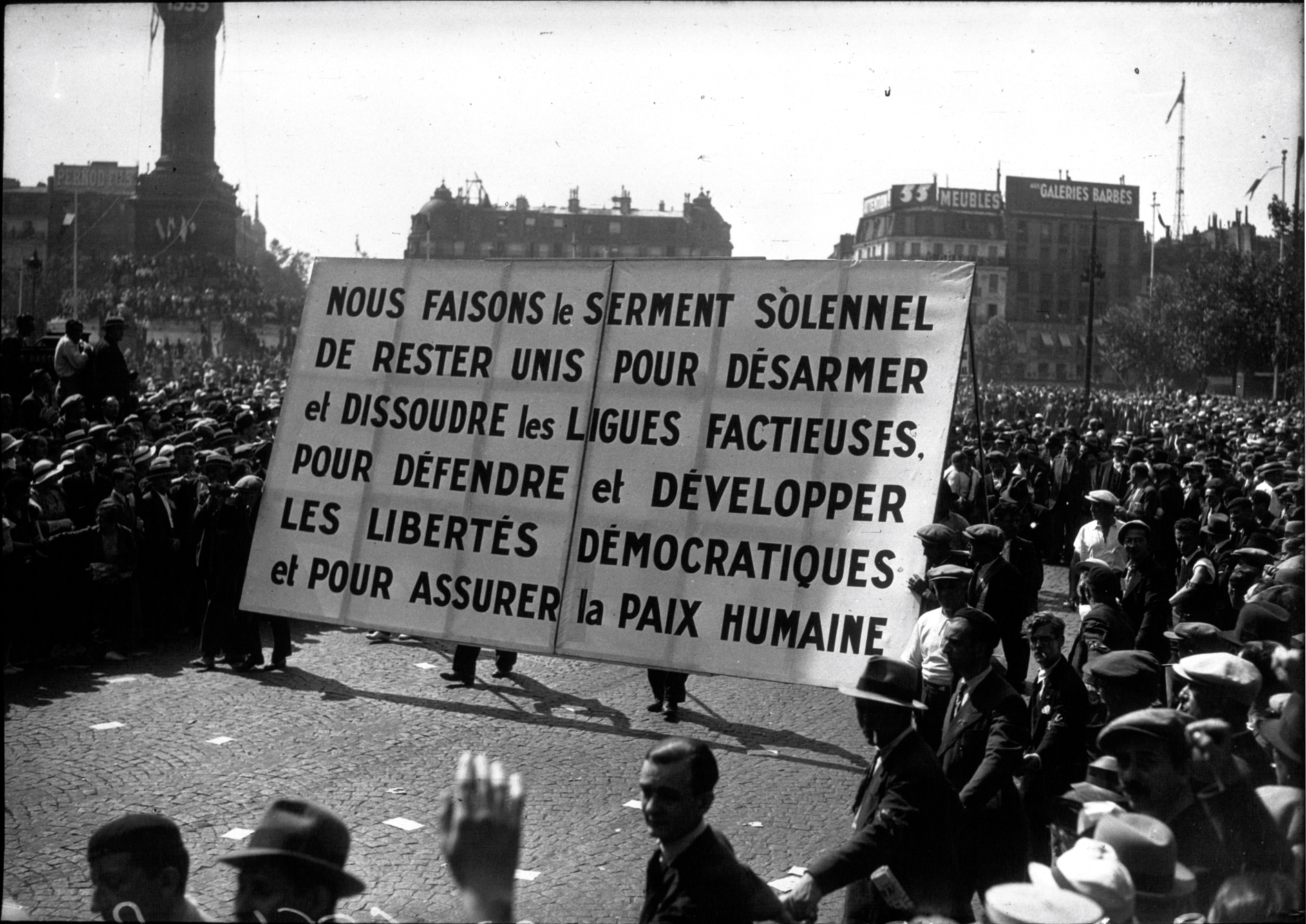
Thalheimer criticizes Dimitrov’s report and resolution on fascism and the ‘united front’ from the Seventh World Congress of the Comintern in 1935.
‘The Communist International’s Resolution on Fascism Shows Dangerous Omissions’ by August Thalheimer from Workers Age. Vol. 4 Nos. 29 & 40. October 5 & 12, 1935.
The full text of the resolution on Dimitroff’s report has now been published. In comparison with the report, the resolution is an improvement on several points though it still contains a number of serious shortcomings which may have dangerous consequences unless they are. corrected.
It recognizes the “temporary defeat of the proletariat in Central Europe.” The belated official acknowledgment of this fact is a step of progress inasmuch as it presupposes the necessity of learning from the defeat.
WHAT IS FASCISM,
Fascism is defined in two different ways: once correctly as a peculiar form of the dictatorship of finance capital as a whole. Secondly, incorrectly, as the “open terrorist dictatorship of the most chauvinist and most imperialist elements of finance capital.” The second definition leads to the conclusion that there are less chauvinist, imperialist elements of finance capital who are opposed to the fascist dictatorship. In fact, there have been various remarks in the press of the Communist Party of Germany to the effect that sections of the bourgeoisie may want to be rid of the fascist dictatorship. The German Social-Democracy is noted for its reliance upon the anti-fascist action of the Reichswehr, of the top bureaucracy and a section of the capitalist class. It is therefore necessary to meet such deviations and confusion with an unequivocal and clear definition of the fascist dictatorship.
The fact that the resolution warns “against dangerous illusions that fascism will collapse automatically” is not accidental. These illusions were very wide-spread in the Communist Parties, and they are closely related to the theory of the “third period.”
The resolution correctly states that the united front movement is still “in the very first stages of development.” It goes on to say that in France “the first advances of fascism have been defeated.” This substantiates the widespread notion among the French working class and the French C.P. that fascism in France has been decisively defeated and repelled. On the other hand, one can interpret this to mean that the present stage of the united front struggle in France is not as yet completed but merely a beginning.
THE UNITED FRONT
The resolution lacks a concrete analysis of the weaknesses and errors of the united front tactics in France. Such an analysis becomes all the more necessary in view of the fact that the united front in France has become the international model of united fronts. The warning against mechanical transference of tactics from one country to another as contained in the resolution on the report of the ECCI, was not applied as the discussions of the 7th World Congress have clearly shown. The guarantee against such mechanical transference is a thorough criticism of the experiences and practice of the united front in France by the International. Only such a thorough examination of the question will make for a non-mechanical generalization of the experiences of France to all countries. There has as yet been no adequate discussion of the French united front.
The resolution states that the establishment of the united front will be “the most important immediate task of the international working class in the present historical epoch.”
UNITED FRONT AND SEIZURE OF POWER
After seven years of the ultra-left course, after the heavy defeats of the working class in Germany and Austria which were closely tied up with the failure to apply the united front it was undoubtedly necessary to emphatically point out the fundamental significance of the united front as a turn to the reformist organizations. If, however, the tactical turn on the united front question is not to lead to serious opportunist errors, the CI must at the same time determine the limits and the aim of the united front. A Congress of the CI does not lay down directives for merely a few months but for a much longer period. “The present historical epoch” of which the resolution speaks is not very closely defined. It is to include (and it does include) the prevention of the victory of fascism in countries such as France and the overthrow of the fascist dictatorship in countries such as Germany, etc.
The application of united front tactics is the most immediate and most comprehensive task but it must reach its limit, its conclusion in this same period. The united front cannot lead up to the seizure of power. The true seizure of power by the working class is not possible through the united front. It presupposes that the Communist Party has already won the leadership over the majority of the working class; leadership for the purpose of establishing the proletarian dictatorship thru armed uprising (and not thru struggles for partial demands). The winning of the majority of the working class for the principles and aims of Communism is one of the basic aims of the united front. As soon as this has been accomplished, the united front has become superfluous. The C.I. must come out with such an explanation; of the value of the united front now, and not wait until all sorts of illusions have been created to the effect that the united front offers unlimited perspectives to the working class, or until all these illusions have led to serious errors and heavy defeats. Pointing out the limits of the united front will not weaken its power of attraction because within these limits the united front has to fulfill tremendous: positive tasks in the interest of the entire working class.
II.
Due to the fact that the limitations of the united front are not defined, they are often overstepped. An example of this is the so-called “United front government” for years referred to as the “workers government” if the possibility of Communists participating in a Social-Democratic-Communist coalition government on a bourgeois democratic parliamentary basis should arise. The report of Dimitroff as well as the resolution leave room for such a possibility. The Communist Parties are to decide whether or not they will participate in such a government on the basis of the concrete conditions of their respective country. The resolution expressly states that the “united front government” is not yet a proletarian dictatorship, in other words, that it is formed “within the framework of bourgeois democracy”. Space forbids us to deal with these questions in their full scope as far as the Russian and German experiences are concerned. We shall confine ourselves here to a few summary remarks.
EXPERIENCE OF 1923
The concept of a “united front government” with Communists participating is refuted by its own premise. One of the pre-suppositions for the formation of such a government, as laid down in the resolution, is the existence of a situation “in which the broad masses of workers revolt against fascism and reaction BUT ARE NOT YET READY TO TAKE UP THE FIGHT FOR SOVIET POWER.” If a Social-Democratic-Communist coalition government is formed on the basis of such a situation, such government will, for one thing, pass no real revolutionary measures whatsoever, and for another, the bourgeoisie will immediately begin a fight to the finish and the united front government will break down miserably since the workers are not yet ready to fight for Soviet power, which means that they are not yet ready for an armed uprising. This is the essence of the experiences of 1923 in Germany. The fact that the C.I. has until today failed to make any real criticism of the 1923 events is now having dangerous consequences. The Communist Opposition did this but instead of profiting by it the C.I. is falling into old errors under the guise of new names.
ON COALITION GOV’T
The “People’s Front government” is mentioned in the resolution but is not at all discussed. The “People’s Front government” is nothing but a coalition government with bourgeois parties. The name “People’s Front” does not change this fact. In the case of such a Peoples Front government it is out of the question that Communists participate in it or that they even demand its formation or support it.
It is necessary to add that the United Front government as well as the People’s Front government are not necessary stages but mere possibilities according to the resolution. The indication of such possibilities however leads the Communist Party to discuss the formation of parliamentary governments and to its ultimate compromise. We reject the slogans of a united front or People’s Front government in fascist countries altogether.
On the basis of past experiences and a theoretical analysis of the situation there is the following very slight possibility: under certain conditions, Communists may ask Social Democratic Parties and the reformist trade unions to take over the government on the basis of a definite program of action following a number of successful mass actions, and for Communists to pledge support of such a government inasmuch as it put its program into practise and grants the Communist party full freedom of action.
DEFENSIVE AND OFFENSIVE ACTIONS
It is correct to say that in applying united front tactics we must go from the defensive to the offensive. The following decisive points must be kept in mind, however. This transition must be prepared for by the C.P. organizationally and politically. This in turn requires the propaganda of revolutionary transition slogans: for soviets; for workers control of production; etc. not only in a period of a sharp political crisis but previous to it. This transition is impossible if the C.P. confines itself to the propaganda of partial demands only. The propaganda of revolutionary transition slogans for the preparation of the transition from the defensive to the offensive is an absolutely indispensable stage in revolutionary strategy.
PEOPLE’S FRONT
The resolution defines the “People’s Front” as a class alliance between the working class and the petty bourgeoisie. The resolution calls for the “formation of a broad anti-fascist Peoples Front on the basis of the proletarian united front in which the Communist parties come out for all those special demands of these toiling sections (toiling peasantry, urban petty bourgeoisie, toiling masses of oppressed nations) which coincide with the fundamental interests of the proletariat.”
This is correct and necessary–except that it completely contradicts the People’s Front as constituted in France which is simply a cartel with the Radical Socialist Party, a bourgeois party with a bourgeois program, bourgeois leadership and a petty bourgeois mass following. The French Peoples Front which originated in a parliamentary improvisation is nowhere rejected. Thus there arises a danger of equivocation.
TRADE UNION QUESTION
As far as the trade union question is concerned the resolution calls for the complete liquidation of the ultra-left course the inevitable result of the practical bankruptcy of a dual unionist course.
It goes without saying that this decision is yet to be applied but it does provide a basis for the fight for a correct trade union policy. Resistance to the execution of these decisions will come from two sides. For one thing, from the members of the Party who sincerely believed in the correctness of the ultra-left course, for another, from the reformist trade union leaders and also from trade union members who have learned to mistrust Communists as a result of 6 years of ultra-leftist tactics in the trade unions. It is evident that correct trade union tactics can be applied only with the aid of those Communists who fought the old course and were not guilty of ultra-leftism, namely, the Communist Opposition.
ORGANIC UNITY
The resolution repeats the conditions already formulated by Dimitroff in his speech for the formation of a united revolutionary party of the proletariat.
These conditions amount to an acceptance of Communist principles and aims. This proposal is exactly the same as the one issued by the CPGO a year and a half ago under the slogan of a “United Communist Party of Germany”. This slogan had and has the purpose of eliminating those doubts which Social-Democratic workers moving towards Communism had when asked merely to enter the C.P. This process is facilitated by demanding unification with equal rights on the basis of the Communist program. This is the essence of the thing. The fact that in the proposals of the CP of France and the 7th Congress, for the new united party, the name “Communist” is left out is merely a superfluous gesture which will at most mislead a few Communists.
FASCISM OR DEMOCRACY?
The incorrect statements of Dimitroff that it is no longer a choice between bourgeois democracy and proletarian dictatorship but between bourgeois democracy and fascist dictatorship and that Communists in such a case must defend bourgeois democracy are not repeated in the resolution.
We have here the following formulation: “In its struggle for the defense of bourgeois democratic rights and gains of workers against fascism and for the overthrow of the fascist dictatorship, the proletariat develops its forces, strengthens its fighting bonds with its allies and centers its struggle on the aim of winning true democracy for the masses–on Soviet power.”
This formulation is not incorrect, but in view of the confusion which has been created on the relation of Communism to bourgeois democracy, it is inadequate.
It is necessary to state that Communists do not defend bourgeois democracy as such, not even when they defend the democratic rights of workers against the attacks of fascists and reactionaries; that in the struggle against fascism in a bourgeois democratic state democratic rules must be cast off; that the democratic rights of the workers can be defended effectively only thru the revolutionary liquidation of bourgeois democracy which is the origin of fascism; that the transition from bourgeois democracy to the proletarian dictatorship must be prepared for by broad united front organs elected by the masses which grow into soviets. Furthermore, that soviets are the indispensable organs for the preparation and leadership of the revolutionary uprisings.
INNER-PARTY DEMOCRACY
Despite all of these errors, shortcomings, gaps, etc. this resolution could form the starting point for a correct Communist policy provided inner-party democracy is established, thus making for an easy and rapid correction of errors. If, however, this condition is not fulfilled, we predict that this resolution will lead to opportunist deviations in a number of countries. Should this condition be fulfilled, thus enlisting the aid of the most mature and critical elements of the Communist movement, the Communist Opposition, the resolution can become the starting point for the complete liquidation of the ultra-left course in practice, for an effective united front and trade union policy, for the elimination of the errors contained in the resolution.
Workers Age was the continuation of Revolutionary Age, begun in 1929 and published in New York City by the Communist Party U.S.A. Majority Group, lead by Jay Lovestone and Ben Gitlow and aligned with Bukharin in the Soviet Union and the International Communist (Right) Opposition in the Communist International. Workers Age was a weekly published between 1932 and 1941. Writers and or editors for Workers Age included Lovestone, Gitlow, Will Herberg, Lyman Fraser, Geogre F. Miles, Bertram D. Wolfe, Charles S. Zimmerman, Lewis Corey (Louis Fraina), Albert Bell, William Kruse, Jack Rubenstein, Harry Winitsky, Jack MacDonald, Bert Miller, and Ben Davidson. During the run of Workers Age, the ‘Lovestonites’ name changed from Communist Party (Majority Group) (November 1929-September 1932) to the Communist Party of the USA (Opposition) (September 1932-May 1937) to the Independent Communist Labor League (May 1937-July 1938) to the Independent Labor League of America (July 1938-January 1941), and often referred to simply as ‘CPO’ (Communist Party Opposition). While those interested in the history of Lovestone and the ‘Right Opposition’ will find the paper essential, students of the labor movement of the 1930s will find a wealth of information in its pages as well. Though small in size, the CPO plaid a leading role in a number of important unions, particularly in industry dominated by Jewish and Yiddish-speaking labor, particularly with the International Ladies’ Garment Workers’ Union Local 22, the International Fur & Leather Workers Union, the Doll and Toy Workers Union, and the United Shoe and Leather Workers Union, as well as having influence in the New York Teachers, United Autoworkers, and others.
PDF of the full issue: https://www.marxists.org/history/usa/pubs/workers-age/1935/v4n39-oct-05-1935-WA.pdf
PDF of issue 2: https://www.marxists.org/history/usa/pubs/workers-age/1935/v4n40-oct-12-1935-WA.pdf
 Revolution's Newsstand