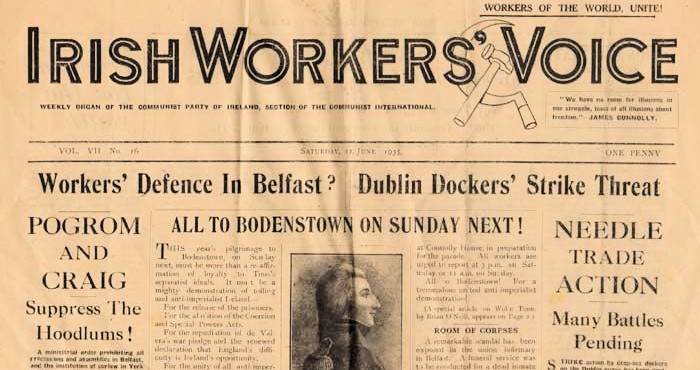
A decade of reaction and counter-revolution battered Ireland’s left wing and workers’ movement in the 1920s. Communist adherents numbered only two dozen organized in the Revolutionary Workers’ Groups in 1932, but hope to recruit hundreds in conditions of rising class struggle to constitute themselves as a bona fide party. The plan below.
‘The Formation of the Communist Party of Ireland’ by Rogen from International Press Correspondence. Vol. 12 No. 39. November 3, 1932.
Ireland has a rich history of the revolutionary national independence movement. The working masses have fought self-sacrificingly for the national liberation of Ireland from the oppression of British imperialism. However, this struggle is taking place under the leadership of the bourgeoisie and the petty bourgeois leaders and parties, and the working class of Ireland, without their own class workers’ party, have not played the leading role in this struggle.
At the present time, when there is a further sharpening of the struggle against English imperialism, the working class of Ireland is faced with a task of struggling for the leading role in the revolutionary movement of the masses of the people for complete national and social liberation. This historic task of the working class of Ireland can only be carried out by forming its own class Communist Party.
The necessary condition for the organisation of the Communist Party–the existence of cadres of advanced workers in the factories who have come forward as the leaders in the class struggle during the strike movement and the struggle of the unemployed–exists in Ireland. In addition some of these advanced revolutionary workers are already organised in the groups of Revolutionary Workers of Ireland, which have existed for several years. This organisation unites the Communist elements of the workers’ movement of Ireland. It is the basis which will make it easier to form the Communist Party of Ireland. At the present time, the group has about twenty-five members. There are local organisations in Dublin, Belfast and other towns. The group publishes a weekly paper, “The Worker’s Voice”, the circulation of which has considerably grown in recent time. The growth of the paper of the revolutionary workers is taking place simultaneously with a fall of the circulation of the paper of the Labour Party. During the last few months the group of Revolutionary workers has increased its work among the masses, especially among the unemployed.
In August in Belfast a demonstration was carried on with the active participation of the group with 10,000 workers and unemployed. At the beginning of October, 22,000 workers and unemployed took part in a demonstration and fought stubbornly against the police. The demonstrations were direct- ed against the “Means Test”. The groups carried on a great deal of work among the workers of the municipality in Belfast, organising them for a struggle against wage cuts. It is true, that the T.U. bureaucrats on this occasion succeeded in breaking up the strike, but the group succeeded in increasing its influence among the municipal workers. With the support of the leaders of the reformist trade union, the bourgeoisie are preparing an offensive against the railroad workers, the aim being to cut wages by 15%.
The group is the only force which is organising the resistance of the railroad men against this wage cut. The first and insufficient steps are being taken for the group to penetrate into new districts. For example, in August there was formed a local organisation of the group in the town of Cork, an important industrial centre. Several dozens of workers were accepted into the new group, and the wide circulation of the newspaper, “Worker’s Voice” was organised. However, the group of Revolutionary Workers is still insolated from the basic masses of workers and poor farmers in Ireland.
Among the members of the group there are still strong sectarian sentiments, in particular, there is a widespread neglect of work in the reformist trade unions and a neglect of the organisation of the struggle of the workers on the basis of their needs and partial demands.
To prepare for the organisation of a Communist Party the group will have to carry on a tremendous amount of work. It must carry on a big recruiting campaign, securing 500 to 600 workers and unemployed, more boldly and determinedly organising the struggle of the workers and the unemployed against the bourgeois offensive on the standards of life of the toiling masses, more strongly exposing the treacherous activity of the Labour Party and the leaders of the reformist trade unions and carrying on a more active struggle against the national reformist policy of the DeValera Government, striving to convert the national independence movement against English imperialism to a higher form of revolutionary struggle under the hegemony of the proletariat.
One of the chief shortcomings in the work of the group is the absence of nuclei in the factories. Therefore, the primary and most important task of the group consists of an energetic and stubborn work for the organisation of factory nuclei in the factories, railroad, shops, tram parks, docks, etc. Without factory nuclei strongly linked up with the worker’s and with authority among them, there cannot be a genuine Communist Party. It is fully possible for the group to form a number of factory nuclei within the next few months. In some factories there are one or two and even three members of the group (in Belfast there are two members in each of three factories, and in one factory three members of the group; there are individual members of the group in several factories in Dublin and other towns). The group must attach to the members working in factories two or three active members of the group to assist them and thus form a temporary concentration group, the task of which is to recruit several sympathising workers in each factory within two or three months. In factories where there are already three members of the group, there must immediately be formed a nucleus.
Experience shows that the best way to commence revolutionary work in the factories, to discover the sympathising and most advanced workers and to take the first steps for the organisation of the struggle of the workers, is the publication of a factory paper. Therefore, one of the tasks of the concentration groups is the publication of a factory paper. In order to publish the paper it is necessary to carry on preparatory work to discover the sentiments of the workers, the situation in the factory, the most burning questions which cause the discontent of the workers. During this preparatory work for the publication of the paper with the active participation of the members of the group who work at the given factory, there must be called meetings, discussions must be held with individual workers or with groups of workers during the dinner interval, when the workers are returning home after work, in short, every possibility must be utilised to make common cause with the workers. In this way the group will be able to establish contacts with some workers who will form the first activists around the factory paper.
How can we penetrate into the factories and start to organise a nucleus if there is not a single member in the factory? The group must examine the composition of the members of the trade unions and other mass organisations which are under its influence and study the list of readers of the paper, “The Workers’ Voice” and also the list of subscribers during campaigns carried on by the group, and by these measures must find out the class conscious workers, visit them at their homes and establish contacts with them in other ways, taking every possible measure to discover the conflicts which have taken place at the factory and discovering the workers who have shown themselves to be active in these conflicts, previously getting acquainted with the situation of the workers in the given factory and their demands, organising meetings for the workers where it is possible to find out those who wish to join the Party.
The task of organising a Communist Party can be carried out if the group recruits 500 or 600 workers in the next few months. The recruiting campaign will be successful in proportion as the group develops its mass work actively among the workers, mobilising them for the struggle for the improvement of their material conditions, against wage-cuts, for every-day demands and in the struggle for improving the situation of the unemployed. This every-day work in the masses of unemployed for partial demands must be closely connected with and subordinated to the political tasks of the Party and the mobilisation of the workers and toilers of Ireland for the revolutionary solution of the task of their liberation from the oppression of English imperialism and their own bourgeoisie.
An especially stubborn struggle must be carried on to attract into the Party the workers from the factories, railroads, mines, docks and especially the workers of the big factories. During the recruiting campaign the representatives and members of the group must carry on individual conversations with workers of the factories, discussions with groups of workers in their homes, while they are returning from the factory, in the places where the workers spend their dinner interval, in the existing organisations and meetings of the workers, clubs, local branches of trade unions, sections of the Irish Republican Army, etc. Every excuse must be used for Communist propaganda and the recruiting of workers into the Party.
Frequently a comradely heart-to-heart talk with a small group of workers will give much bigger results than a meeting even at the factory gates, etc. held by the Party organisations.
Every member of the group, especially the workers from factories, must take the most active part in the recruiting campaign, above all by individual propaganda, by attracting into the Party those workers whom they meet every day in the factory and the workshop.
The attention of the group must be concentrated on recruiting women workers into the Party, especially in the textile industry.
While concentrating all attention and energy on the recruiting of factory workers into the party from the factories in Belfast, Dublin, Cork, the hill district of Kilkenny, etc. it is necessary to carry on work for recruiting the unemployed, especially in such branches as Belfast shipbuilding, textile workers, etc. The work for recruiting the best elements of the unemployed into the Party must be closely connected with the organisation of the struggle of the unemployed. In view of the fact that among some representatives of the toiling masses in town and village, among the handicraft workers and also among the intelligentsia, especially the students, there are revolutionary elements whom it is advisable to secure for the Party, suitable work must be carried on among them, taking into the Party those who have been tested and have shown by their struggle their loyalty to the cause of the working class. From the very beginning steps must be taken to consolidate the new members and prevent fluctuations. The first means is to put every member onto active work in accordance with his abilities and desires, and with the special conditions, not permitting a formal approach or a mechanical application of Party discipline. A comradely and attentive approach to the new members is the best guarantee for drawing them into the active struggle in the Party ranks. Every member of the group must widely acquaint himself with the important documents on the regulation of the growth of the Party and the struggle against fluctuations, (Inprecorr. no. 22, May 19, 1932).
The group must pay great attention to Marxist-Leninist educational work, which is the first condition for the formation of an ideologically strong Communist Party, able to fight irreconcilably for the general line of the Party and the Comintern against opportunist deviations. It is specially important to have Party educational groups in the factories, bringing into them the non-Party sympathising workers. The programme of the circles must be reckoned on a short period (3 to 4 months), with a lesson once a week. The first condition for propaganda work in the circle is to link up theory with practice, with the concrete questions of the Communist Party which face the Party at the present moment and which concretely face the local organisation and the workers of the given factory.
The basis of the study in the circles must be the programme of the Comintern and the decisions of the XII. Plenum of the E.C.C.I. Special attention must be paid to the development of education among the members, the independent reading of Marxist-Leninist literature. Attention must be paid to giving assistance to comrades by recommending literature and organising small libraries in the Party committees for the Party members.
The group has only three fractions in trade unions and they work very badly. Therefore the organisation of fractions in every case when there are members of the group in the trade unions or other mass organisations is an urgent task. Special attention must be paid to the formation of fractions and the leadership and assistance of their work by the Party committees in the oppositional groups of the reformist trade unions. In realising the historic importance of the task of organising a Communist Party in Ireland, every member of the Revolutionary Workers’ Group must double his energy in Party work and assure the complete fulfilment of the tasks which face the group in the preparations for the organisation of the Communist Party.
International Press Correspondence, widely known as”Inprecorr” was published by the Executive Committee of the Communist International (ECCI) regularly in German and English, occasionally in many other languages, beginning in 1921 and lasting in English until 1938. Inprecorr’s role was to supply translated articles to the English-speaking press of the International from the Comintern’s different sections, as well as news and statements from the ECCI. Many ‘Daily Worker’ and ‘Communist’ articles originated in Inprecorr, and it also published articles by American comrades for use in other countries. It was published at least weekly, and often thrice weekly.
PDF of full issue: https://www.marxists.org/history/international/comintern/inprecor/1932/v12n22-may-19-1932-Inprecor-op.pdf
 Revolution's Newsstand