Veteran labor activist Samuel T. Hammersmark on the Trade Union Educational League’s 1922 founding convention. Born in 1872 and radicalized in the aftermath of the Haymarket episode, Hammersmark would be a founding member of the I.W.W. who became an early, and consistent, co-worker with William Z. Foster, following him into the Syndicalist League, through the 1919 Steel Strike, and later into the Communist Party and T.U.E.L.
‘The Significance of the League Conference’ by S.T. Hammersmark from Labor Herald. Vol. 1 No. 8. October, 1922.
The First National Conference of the Trade Union Educational League has come and gone. Occurring at a time of crisis in the labor movement, and crystallizing a great body of new sentiment and understanding, developed in the main within the past year and a half, it was a historic and significant gathering. It closed the door on the past generation of mistaken and disastrous tactics of the rebel trade unionists, and opened the way to the new policies of aggressive, constructive organization of the working class forces, the establishment of the militant elements within the mass unions. The Conference marked the beginning of a new period in the labor movement.
There have been other gatherings in the past, which have wielded a large influence upon the revolutionary unionists, and which, therefore, have been freighted with destiny for the labor movement generally. Unfortunately for America, however, these past conferences have been dominated by utopian and preconceived tactics, which have worked nothing but disaster, both for the revolutionists and for the trade unions. Such, for example, was the Convention of 1905, which launched the I.W.W. That gathering, on the vital question of its relation to the mass organizations, did not even discuss the question of whether the revolutionists should work within the existing unions or whether they should separate themselves–that issue was predetermined before the Convention came together. At that time the whole ideology of the American rebel turned in the direction of a utopian, dual unionism. Its classic crystallization in the I.W.W. has worked untold mischief, dominating the rebel elements, and cutting them off from the body of the working class.
The outstanding fact of historical significance in the National Conference just ended, is that it marks the passing, once for all, of the dual union and secessionist philosophy. The Conference mercilessly analyzed the mistaken tactics of the past, and definitely repudiated them. In their place it adopted a comprehensive, detailed, scientific, and revolutionary program, based upon the realities of the conditions and of the struggle. No issue was shirked, and no question soft-pedalled. The program of the Trade Union Educational League was made clear and definite, for the guidance of all revolutionary trade unionists.
The Program of the League
The general program of the League, as worked out by the Conference, covers a wide scope of theory and practice. Clear-cut and constructive stands were taken on many subjects, including industrial unionism, amalgamation, secession, political action, Russia, the Federated Press, Shop Committees, Red Trade Union International, the Workers’ Republic, the railroad and coal strikes, the Mooney-Billings case, the Sacco-Vanzetti case, political prisoners, etc. The work of the Conference constitutes a complete revolutionary industrial program.
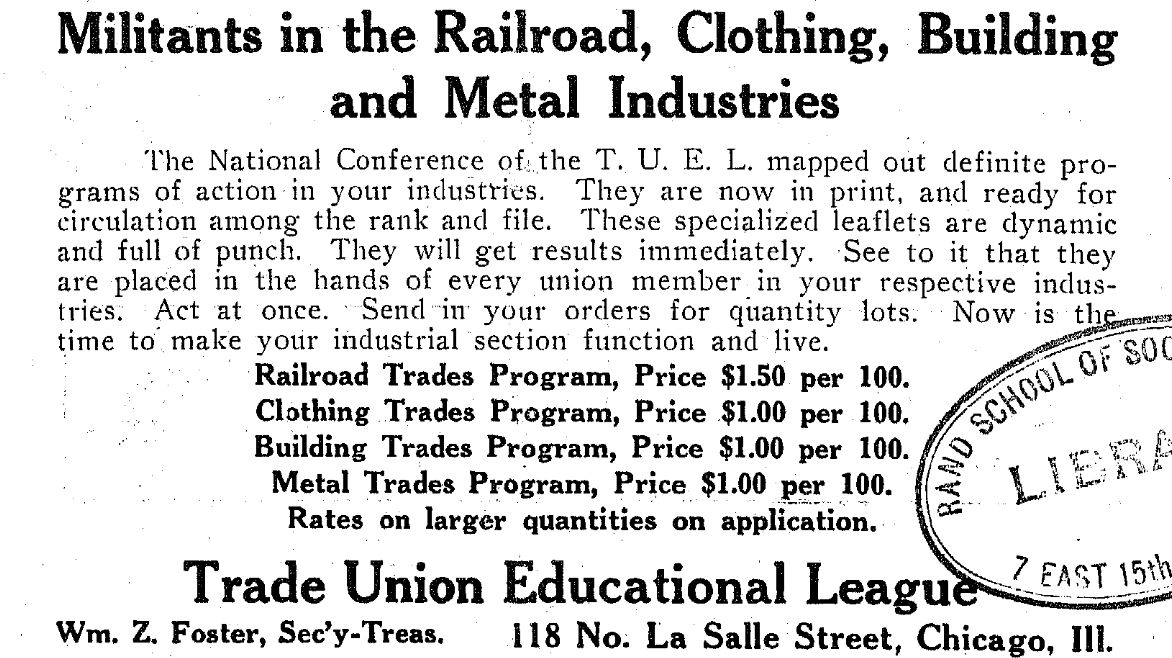
Particularly important was the Conference’s realistic manner of approach to the question of bringing about industrial unionism. The old system was to have a ready-made formula, and then in its behalf to sweep aside the whole labor movement. This method was conspicuous by its absence, in the League Conference. There, on the contrary, the manifold problems of each industry were attacked by militant unionists of experience and standing in the actual struggles of the organized workers in those industries. Thus definite, practical programs of consolidation were worked out in several of the principal industries, including Building, Clothing, Metal, Mining, and Railroad. In those industries that had no experienced militant delegates present, the Conference did not make the mistake of trying to work out programs, but took the sensible course of referring these matters to future conferences of the militants in those industries who would be competent to indicate correct lines to proceed upon. upon. Contrast this method with that of the constituent Convention of the I.W.W., for example, where the cart-wheel chart, product of some intellectual’s secluded chamber, was arbitrarily made to fit the multitudinous conditions of the many industries. The League Conference clearly marks the passage of American trade union revolutionists from Utopianism to realism.
The Sustaining Fund
From the beginning the League has been greatly handicapped by the lack of an adequate financial system. It dare not collect dues or per capita tax, because under no circumstances could it afford to lay itself open to the charge of dual unionism, which it would have done had it established a dues system. In this respect it will not make the mistake that the French revolutionists did in the campaign that led up to the recent split in their general labor movement. So far, the League has been completely successful in warding off the charge of its being a dual organization, and this has been accomplished only because it has none of the elements of dualism in it. The League has a great field before it. It must put out organizers to systematize the League’s program in all the ramifications of the labor movement; it must establish left-wing papers in the big industries and cities of the country. All this takes money, and the League has had no means of raising it. Up till the present its financial income, upon which it has done its great work, has been derived solely from the slender subscriptions to THE LABOR HERALD.
To meet this situation the League Conference has established what it calls the Sustaining Fund. The Sustaining Fund is a systematic organization of the financial support of the League’s members and sympathizers. There are many thousands of active workers in the trade union movement who will be only too glad to make yearly contributions to the work of the T.U.E.L. once an organized means to secure their donations has been developed. In addition, there are also many liberals and other forward looking people not directly in the trade unions, who may be counted upon to help in a movement of this character. The Sustaining Fund will be a national campaign to develop such support. Of the funds received, fifty per cent will go to the local Leagues directly collecting them, and fifty per cent to the National Office. Thus the League, both local and national, will be provided with the sinews of war. When the militants understand the importance of the Sustaining Fund and take hold of it in dead earnest, the League thereby will soon be able to build up such a staff of organizers and publications as to multiply its present organization and influence manyfold.
Organization of ‘Left-Bloc’ a Success
The Trade Union Educational League was founded upon the theory that it was possible to get all the revolutionary factions and the honest elements generally to work together in the trade unions on a common program of progress, as against the sterile methods of the bureaucrats now in control of the organizations. In some respects it was patterned after the Revolutionary Syndicalist Committee of France, an organization which succeeded in bringing into co-operation all the progressive and radical trade unionists of that country. This combination was able to crack the power of the social-traitors at the heads of the unions and to open the doors generally to progress. The very nature of a ‘left-bloc’ organization such as the Revolutionary Syndicalist Committee, is that the various groups hold in abeyance those questions upon which they do not agree, and concentrate upon those they hold in common. It was felt that in the United States, where the movement is in such a pitiful need of progress, that such a general agreement and combination of the radical elements could be formed. So the League was founded.
The League Conference gave a striking proof of the soundness of this theory. It brought together the trade union militants of almost every faction in the left-wing generally. There were Farmer-Labor Party men, Workers’ Partyites, Communists, Socialists, members of the Proletariat Party, Syndicalists, Anarchists, United Toilers of America, and honest trade unionists unaffiliated to any faction. The only established group that was not represented was the Socialist-Labor Party, a fact of which they will doubtless boast. The apparent medley of political groupings could have spent a month fighting each other, without result, if each had insisted on bringing forward its complete program. Instead of such a nonsensical proceeding, the Conference spent two days of hard, practical work, marked by the most complete harmony. The League also stood up under the assaults of the police in a splendid fashion, and definite bonds of solidarity were welded between all the participants. There was not a single serious difference developed throughout the wide range of the deliberations of the Conference.
Prospects of the League
Like a flame sweeping through a dry forest, the program of the League is making its way through the trade unions. All that is needed is for every militant to get busy. The workers are caught between the relentless assaults of the capitalist class, on the one side, and the treachery and stupidity of the union officialdom on the other. They have no way to turn, except the way toward which the League is directing them. And they are turning with the League, even many, indeed, who do not know that they are carrying out our program but who see its necessity. Gompers and Woll may curse, they may repeat their witch-hunt, but they will only accelerate, not hinder, the inevitable development. The future belongs to the League.
The Labor Herald was the monthly publication of the Trade Union Educational League (TUEL), in immensely important link between the IWW of the 1910s and the CIO of the 1930s. It was begun by veteran labor organizer and Communist leader William Z. Foster in 1920 as an attempt to unite militants within various unions while continuing the industrial unionism tradition of the IWW, though it was opposed to “dual unionism” and favored the formation of a Labor Party. Although it would become financially supported by the Communist International and Communist Party of America, it remained autonomous, was a network and not a membership organization, and included many radicals outside the Communist Party. In 1924 Labor Herald was folded into Workers Monthly, an explicitly Party organ and in 1927 ‘Labor Unity’ became the organ of a now CP dominated TUEL. In 1929 and the turn towards Red Unions in the Third Period, TUEL was wound up and replaced by the Trade Union Unity League, a section of the Red International of Labor Unions (Profitern) and continued to publish Labor Unity until 1935. Labor Herald remains an important labor-orientated journal by revolutionaries in US left history and would be referenced by activists, along with TUEL, along after it’s heyday.
Link to PDF of full issue: https://www.marxists.org/history/usa/pubs/laborherald/v1n08-oct-1922.pdf
 Revolution's Newsstand