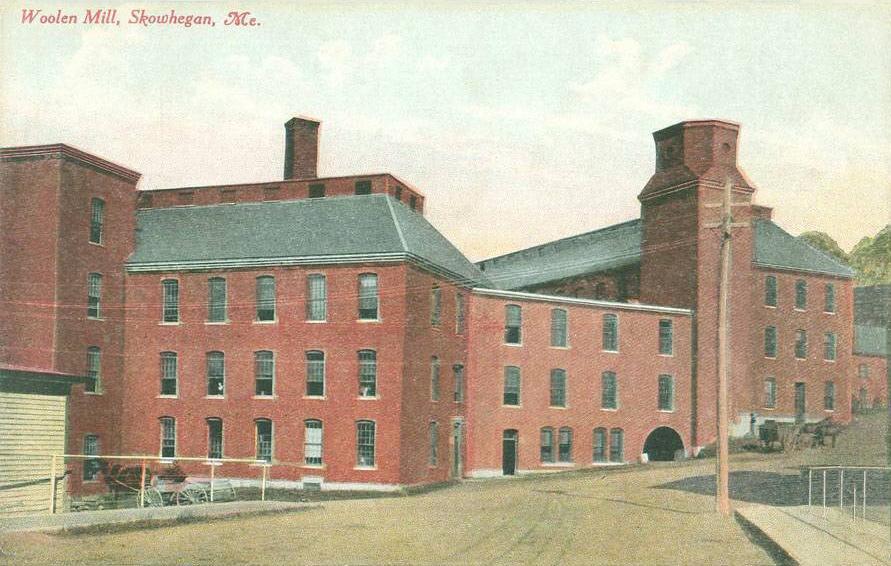
An early I.W.W. action reported in the very first issue of IUB; workers at a Maine textile mill strike against atrocious conditions, including routine sexual harassment of women and girls.
‘The Slaves of Skowhegan’ from Industrial Union Bulletin. Vol. 1 No. 1. March 7, 1907.
A more righteous battle against the outrages of capitalists was never waged than that which the I.W.W. employes of the Marston Worsted Mills, Skowhegan, Maine, have successfully carried on during the last few weeks. Some of the facts in the case are given in the following extracts from a circular issued by our organizer, Saml. J. French, who has been on the ground conducting the fight:
“Not only the textile workers of Skowhegan and other towns, but all residents, whether employed in the textile mills or in any other line of work, and those in business as well, should be interested in figuring out the correct attitude with which to regard the situation presented by the present strike of the employes of the Marston Worsted Mills at Skowhegan, Maine, heir position in the affair and that taken by the management of the mills.
“We all know that to have food, clothing and a dwelling place, and to have them in sufficient degree to enable one to LIVE rather than merely EXIST, one must receive for his or her labor a wage above the mere subsistence point. And, again, in order to retain one’s self respect and keep alive in one’s breast the spirit that an intelligent human being should possess, one must have working conditions that are Jot degrading and brutalizing and subversive of a rational standard of physical and moral development. We who work for wages also know–and any of us who don’t know should know–that it is to the material interest of our employers to keep wages as near to the subsistence point as they can work it without driving us into revolt, and to get us to become as cowardly and submissive as East Indian coolies if by any hook or crook they can bring us down to that standard; first, because it cheapens the cost of production and enables them to compete with their rivals and pocket more profits; secondly, because the workers, unable to save anything without undue stinting, are continually on the ragged edge of poverty, in debt to the landlord, the grocer, butcher, clothing dealer, instalment man and other traders, and thus, with the fear of want hanging over their heads like an economic sword of Damocles, they become more submissive, easily driven slaves who can be threatened or jollied or both into taking what comes and allowing themselves to be gradually brought down to a lower state, incidentally dragging many of the middle-class traders along with them into the mire of poverty and bankruptcy.
“But our masters sometimes against a snag in this coolieizing process; then they whine and beg us to be ‘loyal’ and try to bribe some of us to prostitute the labor power of our hands and brains for the paltry promise of a ‘steady job’ or a few extra pieces of silver in return for playing the role of Judas Iscariot and betraying the interests of our fellow-workers, or they assume a bullying, threatening attitude, and declare that they will never allow us to earn a living again where they have any say, will crush our spirit if it takes a year, will compel us to submit or starve us out, etc.–the attitude of the highwayman. The ruffian on the high-road puts a gun to your head and says, ‘Shell out and don’t try to put up any scrap over it or I’ll put you out of business for fair.’ The mill owner holds to our heads the pistol of his economic power, the possession of the machinery of production, our means of life, and says, ‘Take what I please to give you, submit to the conditions that my interests impel me to impose, let yourselves be driven and your wives and sisters and little girls be exploited and insulted by the vile-mouthed slave-drivers it suits me to place over them–if you don’t I’ll take away your means of living and make the cry of your starving babies the lever that will force you into submission.’ What is the difference? Well, there is a difference, but it is in favor of the highwayman.
“The attack of the road robber lasts but a few minutes and no further attempt is made to deprive the victim of his means of living, but the gun of economic domination wielded by the capitalist, whether it be a middle-class cockroach boss struggling to hold his own against his larger competitor or the head of a powerful trust, is held to our heads as a continuous proposition–be a good, meek, cringing slave, or face starvation and the blacklist.
“Let us see how we fare in those respects in Skowhegan, in this good old State of Maine, so many of whose sturdy sons have given up their lives to establish and maintain the integrity of our glorious “land of the free and home of the brave” in the days before the liberties they fought for could be trampled upon by a small class of stockholder parasites who through the inevitable development of the modern capitalist industrial system, have become possessed the means of life of the great mass of wealth producers who constitute the majority of the people. Is it not a fact that the Marston Mill is notorious as belonging to that class of slave pens in which the conditions under which the employes labor are mean and degrading and the wages such as one can be said to be but barely subsist upon rather than live? Is it not also a fact that it has been and is the boast of those in charge that whenever the employes unite with any intention of seeking redress of their grievances, that their organization could and would be smashed? Is it not a further fact that some of the petty bosses employed there are of that type unfortunately all too common, who are products of modern industrial life, who, while they may have acquired considerable knowledge of the mechanical end of their business, have, owing to the fact that their childhood, youth and manhood days had to be given up to the perpetual grind of the factory while becoming a mechanic, had no chance to learn anything else, to develop their minds or characters or become acquainted with the little amenities of life that go to make up civilized human beings, and are thus mere degraded and brutalized attachments to the mechanism of the mill to aid in grinding profits out of the hides of wage workers? Is it not equally a fact that the boss finisher, Charles North, is of this type of man and has been in the habit of using the vilest, most obscene and insulting epithets in the vocabulary of degeneracy, towards the women and girls in his department? And, yet I again, is it not also true that there is in vogue at the Marston a fining system elsewhere unknown, under which the girls in the finishing room are fined for an inferior job to nearly the price of it and then compelled to rip out and do the job over perfectly WITHOUT ANY PAY? In this “land of the free and home of the brave” if we don’t put up with this we face the blacklist and the risk of being up against starvation.
“Last summer some of us realizing that our conditions of labor were going backward while our cost of living was increasing, which means we must get down to a lower standard, having become acquainted with the plan of organization of the Industrial Workers of the World which is organizing the workers on the Industrial plan, taking all the employes of each plant and all the plants in each industry into one Industrial Union–plainly the most effective method of uniting, to resist the imposition of conditions such as above described–got together and formed Local Union 376, I.W.W. Upon the approach of the New Year we demanded a 10 per cent increase in wages. This, Mr. J. Wallace Blunt would not agree to, but did agree to give 5 per cent, with the promise that if the heavy weight season was profitable enough the other five would be granted in July. We willingly accepted and went along, continuing to get members into our organization. Evidently the management saw the necessity of nipping our aspirations in the bud and getting rid of the most active ones, so that by July the new courage appearing among the workers would have been crushed and the old standard of submissiveness re-established, enabling them to refuse the promised advance
“When the finishing room girls joined us it was the signal for swifter action. A pretext for a beginning of the USUAL scaring process was found. When an active girl was discharged on the claim that she had done some inferior mending, the bosses refused to discuss the matter or show the alleged spoiled cloth to our committee, who were willing to be fair in their attitude. Apparently Mr. Blunt didn’t realize that all the employes, to the number of over 200, were with us, and, when on Monday, January 21, we went to work as usual, after having discussed the state of affairs in a meeting the day previous, he put 40 weavers, two loom fixers and two dressers on their notice. This was putting the screws on with a vengeance. To throw nearly half a hundred people out of work in this part of the country in midwinter with the thermometer ranging from zero to 44 below, was too strong a display of capitalist bitterness to swallow calmly. We all struck, even the man in the boiler room, who blew off the steam and pulled his fires, shutting the plant down absolutely—and we won’t go back until we are satisfied with the conditions offered us.
“The are the facts in the case and we ask all working men and women and other honest citizens to think them over and spread them broadcast.”
The Industrial Union Bulletin, and the Industrial Worker were newspapers published by the Industrial Workers of the World (IWW) from 1907 until 1913. First printed in Joliet, Illinois, IUB incorporated The Voice of Labor, the newspaper of the American Labor Union which had joined the IWW, and another IWW affiliate, International Metal Worker.The Trautmann-DeLeon faction issued its weekly from March 1907. Soon after, De Leon would be expelled and Trautmann would continue IUB until March 1909. It was edited by A. S. Edwards. 1909, production moved to Spokane, Washington and became The Industrial Worker, “the voice of revolutionary industrial unionism.”
PDF of full issue: https://www.marxists.org/history/usa/pubs/industrialworker/iub/v1n01-mar-02-1907-iub.pdf
 Revolution's Newsstand