
Illinois has had a rich labor tradition as long as labor has had a tradition; both in its best and worst aspects. Swabeck looks at the state of unions by sector after the Chicago Federation of Labor, once in the vanguard, lurched to the right along with the rest of the mainstream labor movement in the reactionary ‘Roaring 20s’, as well as the political retreat from Third Party politics they had recently embraced. That all regions had reports as informative as this from the then Chicago-area District Organizer of the C.P.
‘Problems of Illinois Labor’ by Arne Swabeck from The Daily Worker. Vol. 3 Nos. 246 & 247. October 30 & 31, 1926.
To what degree has labor shared in the “prosperity” of the last few years and what has its leadership done to take advantage of the favorable situation presented?
These are two very pertinent questions to the workers and as far as the state of Illinois is concerned, presents an interesting picture containing valuable lessons for those willing to learn.
While the leadership of organized labor should be the first to sum up the experiences of the movement and draw the proper conclusions, the various labor gatherings held during these years show an almost persistent evasion of labor’s vital problems. The last Illinois State Federation of Labor convention was no exception. It was not only more reactionary than its predecessors, but made no attempts whatever to deal with the actual needs of labor.
The losses suffered in membership, in working conditions and in organizational positions, particularly in the basic industries, during this “prosperity” period have caused no comment from the labor leadership; not to speak of the failures to bring forward any aggressive measures to change the tide.
Survey of Conditions.
WHAT are the conditions of labor in the various industries within the state of Illinois? A brief survey without giving detailed statistics will give sufficient food for thought
The building trades workers are undoubtedly those who have been most favored by the “prosperity” period and its tremendous building boom. Their unions have gained in membership and they have gained wage increases in rapid succession. The open-shop forces, as particularly represented by the Chicago “citizens’ committee,” have been temporarily defeated. This may be said, however, to be mainly due to the great demand for skilled building mechanics created by the boom, and also due to the conditions of the industry, which despite the centralization of capital, yet leaves room for craft unions to function and to deliver the goods for their members. Nevertheless, the building corporations and bankers are merely biding their time waiting for the slack season to renew the attack. The building trades unions, meanwhile, have failed to exert the necessary effort to establish union shop conditions and to unify their ranks. Unless the necessary measures are taken, they will be in no stronger position organizationally than before the boom.
The printing trades, the clothing workers, and various other organized miscellaneous trades have been able to hold their own and in some degree strengthen their positions.
Transportation Workers.
THE workers in the transportation industry, a very important section of the labor movement in Illinois, have gained some almost invisible wage increases, but, of course, become subject to the provisions of the Watson-Parker bill with its abolishment of strikes and the established anti-labor board of mediation. The shop crafts on the other hand have been almost completely shot to pieces since the 1922 strike. They have suffered wage decreases and the remnants of their unions more or less become subject to the B. & O. plan making the workers more effective objects of exploitation.
The workers in the food industry, taking in the big packing house plants at Chicago and East St. Louis, have lost practically every vestige of organization. The union once existing, embracing all the workers, has collapsed. The company unions now rule supreme in Chicago plants. These company unions were installed to engineer wage cuts and have done so successfully. The company union in the Armour plant recently suggested the restoration of the 12- and 14-hour workday. At present the plant operates on the 10-hour basis, the average wage being $27 a week for male workers. During the last few weeks, a new method has been inaugurated of eliminating all older workers who may have any claims on the so-called compensation institutions of the company, while a new schedule of further wage cutting is starting.
In the Metal Industry.
IN the metal industry, a few of the more skilled crafts have been able to maintain a degree of organization, however, with loss of many members. Some of them have gained small wage increases; but for the big bulk of in the many great manufacturing plants, organization does not exist save for the company unions operating against the workers. For them “prosperity” has meant wage cuts in various forms, particularly in piece work rates. While these are some of the most exploited workers, it makes the situation no better to note that in the steel mills of Madison and Granite City, Ill., laborers belonging to the steel workers’ union receive only 37 cents an hour.
Many Illinois coal mines have suspended operation for long intervals, some permanently, due to the advance of the open-shop coal mining with no efforts to organize the unorganized territory. As for the union itself, its leadership has become so infested with graft and corruption that there is great danger of its complete paralysis. The sell-out of Farrington to the Peabody Coal Company is by no means accidental. The coal operators are as actively as possible pushing open-shop conditions. If a coal miner leaves his underground job a few minutes ahead of time, an investigation is made and if it is found he could do other work, he is fired. It has become an almost established system, that coal miners are always cheated on weight with the union doing little or nothing to redress the grievances of the miners.
Lately, however, a revival of the progressive movement is taking place within the union, starting throughout the state and bringing some real rays of hope for more militancy in the future. There are, of course, signs of similar activities within the unions in other industries.
Some having already brought results in a measure by increasing the ranks of the individual unions and bringing a new and better spirit to the rank and file workers, but that is entirely due to the activities of progressive elements.
II.
IN his report to the Illinois State Federation of Labor convention held at Streator, Ill. recently, President Walker painted a rather dismal picture of the future of labor while at the same time stating, which he undoubtedly thought rather gratifying, that there had been fewer labor disputes in the state during the last year than previously—only 84 strikes throughout the state, whereas in 1917 there were 282, in 1917 there were 267 and in 1920 there were 254. He said nothing of the fact that fewer labor disputes in this instance signify a failure by organized labor to utilize the favorable situation for aggressive organization activities. The losses sustained by the various unions, both in membership and organized positions, during this period were completely ignored by him. President Walker predicted a period of decline in the industrial activities for the future, but without suggesting any measures whereby labor could fortify itself or giving the slightest lead for militant fight against the open shop, which is again threatening the unions.
Injunctions.
IN this same report President Walker also claimed that there had been less injunctions during the past year because of the injunction limitation bill. Yet injunctions have been issued against the Chicago Retails Clerks’ Union by the notorious Dennis E. Sullivan, who also Imposed fines and prison penalty upon members of that union for picketing and declared the injunction limitation act unconstitutional. An injunction has been issued against the culinary crafts, covering some 150 Chicago restaurants, prohibiting any efforts of organization.
An injunction has been issued against the machinists on strike in Chicago, not to mention the fact that some fifty members of the International Ladies’ Garment Workers’ Union were thrown into prison to serve various terms for maintaining their union rights against an injunction in 1924. While many resolutions have been adopted against such usurpation of power by the courts, the labor leadership of Illinois did nothing to keep these labor prisoners out of jail save to beg the good friend of capital, Governor Small, for a pardon. Governor Small, of course, lived up to his oath and his pledge to the republican party program and this back-door politics gained nothing for the workers, while it certainly strengthened the employers.
ON the question of the injunction the Illinois State Federation of labor convention resolved, “That the campaign of education shall be continued to enlighten our membership and the decent citizens of our state I as to Its dire possibilities.” These possibilities are well recognized by the organized capitalists and their tools, the injunction judges. They are taking advantage of it, while the labor leaders completely fall to measure up to the requirements of the situation.
Free Books.
THE convention further voted for free text books for schools, better salary for factory inspectors, better and more compensation laws. It voted support for the retail clerks, attempted to terrify the employers with their unfair lists, and voted to support the new tax amendment to the constitution, which has already been adopted by both houses of the state and will be submitted to a referendum at the elections November 2. Support was expressed for these quite worthy, and quite harmless objects, while speeches were made every day for the union label.
One real issue, that of organizing unorganized workers, came up and was slightly discussed, but the net result was merely the adoption of a resolution relative to the automobile industry resolving to “look for the union garage shop card.”
In its attitude towards relations with or the sending of a labor delegation to the Soviet Republics, the reactionary leadership became particularly revealed. It attempted to place the Soviet Republic on a parallel with the fascist dictatorship, which exists by the foul murder of thousands of workers and destruction of their organizations.
Drift to Right.
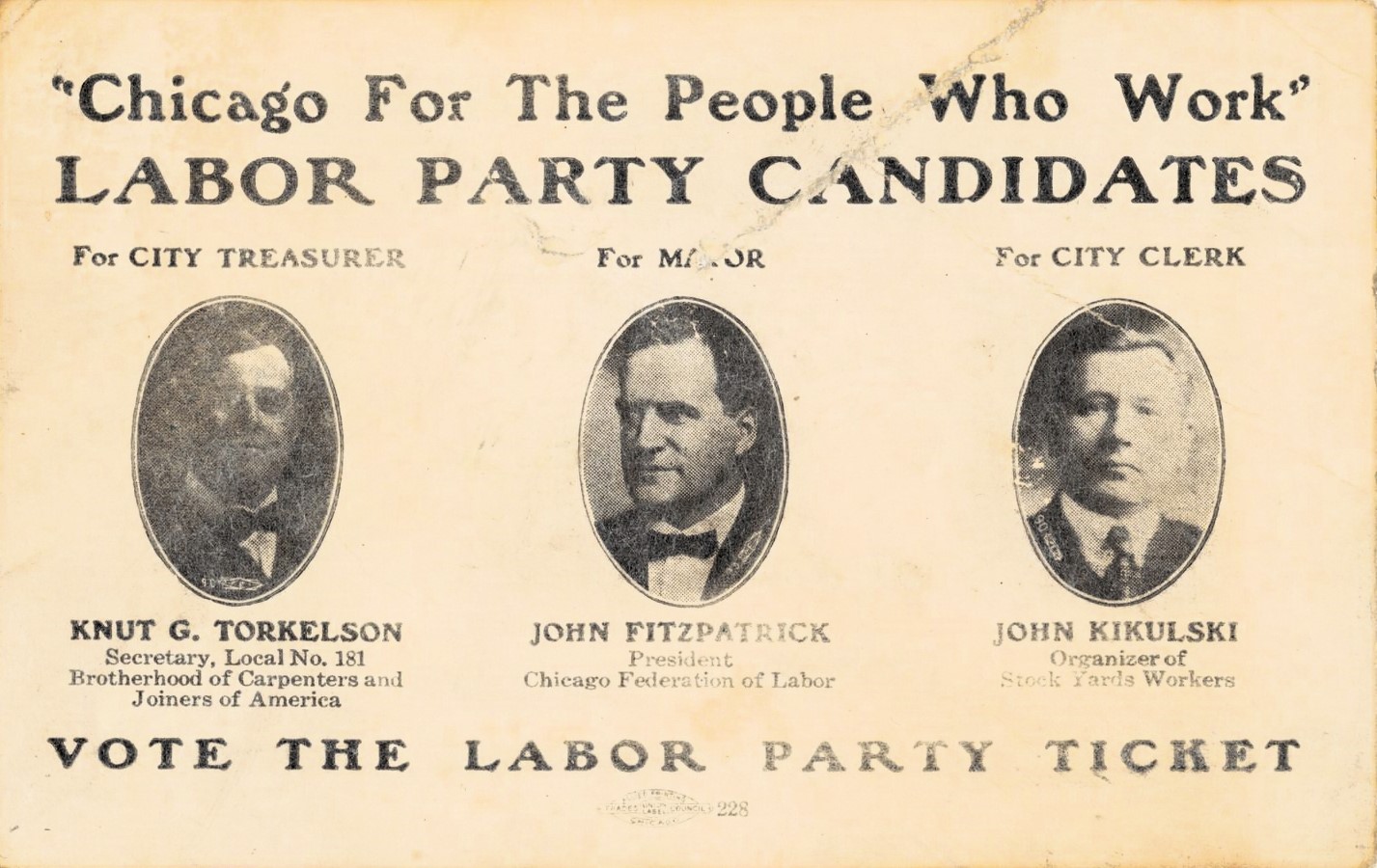
STEP by step, the Illinois Stats Federation of Labor has daring recent years gone completely to the right. It has made a considerable swing since 1919, when Duncan McDonald became its president for one year. Subsequently, John Walker stumped the state as candidate for governor on the farmer-labor party ticket at the same time that Len Small was put on the unfair list by the Central Labor Council at Kankakee. Now the turn is completed and the union leadership has formed a solid alliance with the stinking, corrupt Len Small machine.
This leadership gave full endorsement to Frank L. Smith, so-called friend of labor, prior to the exposure of the hundreds of thousands of dollars contributed for his campaign by the utilities corporations. The exposure proved a concrete example of the outright buying of political candidates of the old parties by the big capitalist corporations. Incidentally, it also laid bare one of the greatest combinations of big business, dirty politics, and crime all united to perpetuate and strengthen the capitalist system. The choice of the Illinois labor leadership was the alliance with this combination, through Frank L. Smith and Governor Small, to the Crowe-Barrett organization, notorious for its labor union busting activities, for its violent gunplay and election steals.
Maintain Alliance.
THE exposure, however, has not as yet brought the repudiation of this alliance or the endorsement made. On the contrary, several of the leaders insisted on and actually attempted to maintain their endorsement, but it met with such strong opposition from the Brennan and beer supporters who had become strengthened and encouraged by the growing dislike for the once celebrated Volstead act and wanted to promote their own choice. The situation shortly before the recent State Federation convention held possibilities of a conflict within the leadership between these two forces. But the lid was clamped on tight. A compromise had been effected based on the endorsement of candidates for the Illinois legislature only.
The Moribund Progressive Party.
The Illinois Progressive Party attempted to hold a conference simultaneously with the convention. It received little support. They are the remnants of the LaFollette movement, which once had labor endorsements galore. Parley Parker Christensen is their nominee for U.S. senator. They are now so few that they have nothing to lose, and yet they did not have enough guts to make a fight for their candidate as against the corrupt twins of “slush fund” fame. There is little hope of any political lead being given by this group for a real progressive movement, even though several of its supporters claim sympathy for the idea of a labor party.
No Signs of Progress.
THE course of the Illinois State Federation of Labor and its leadership shows no sign of learning from the experience of the movement. The period of “prosperity” has by no means been taken advantage of. Instead of strengthening the movement, it has, generally speaking, become weakened.
The policies of the state movement once going toward the progressive direction have undergone a complete turn and are now proceeding backward. The Decatur convention in 1922 was the beginning of the backward change.
The Streator convention reached the peak of reaction. Although a large delegation was present, labor from the basic industries was conspicuous by its absence. Nothing touching the vital needs of the movement was given the slightest chance to come before the gathering and only once were the delegates stirred and rose to their feet, namely, when the resolution granting a wage increase to the president and secretary-treasurer from $6,000 a year to $6,500 was carried.
Yet there is nothing dismal about the picture presented. Conditions of today are not the same tomorrow. The period of capitalist imperialist bribing of the labor bureaucracy divides the rank and file and the reactionary leadership. At any rate, the needs of the labor movement become ever more outstanding and will also become clear to the rank and file members.
THE present weakness of the trade unions just makes so much more necessary a revival of the militancy of the past, while it also holds the possibilities of the left wing movement of the future if every issue which presents itself is properly capitalized.
The Daily Worker began in 1924 and was published in New York City by the Communist Party US and its predecessor organizations. Among the most long-lasting and important left publications in US history, it had a circulation of 35,000 at its peak. The Daily Worker came from The Ohio Socialist, published by the Left Wing-dominated Socialist Party of Ohio in Cleveland from 1917 to November 1919, when it became became The Toiler, paper of the Communist Labor Party. In December 1921 the above-ground Workers Party of America merged the Toiler with the paper Workers Council to found The Worker, which became The Daily Worker beginning January 13, 1924.
PDF of full issue: https://www.marxists.org/history/usa/pubs/dailyworker/1926/1926-ny/v03-n246-NY-oct-30-1926-DW-LOC.pdf
PDF of issue 2: https://www.marxists.org/history/usa/pubs/dailyworker/1926/1926-ny/v03-n247-Chi-oct-31-1926-DW-LOC.pdf
 Revolution's Newsstand