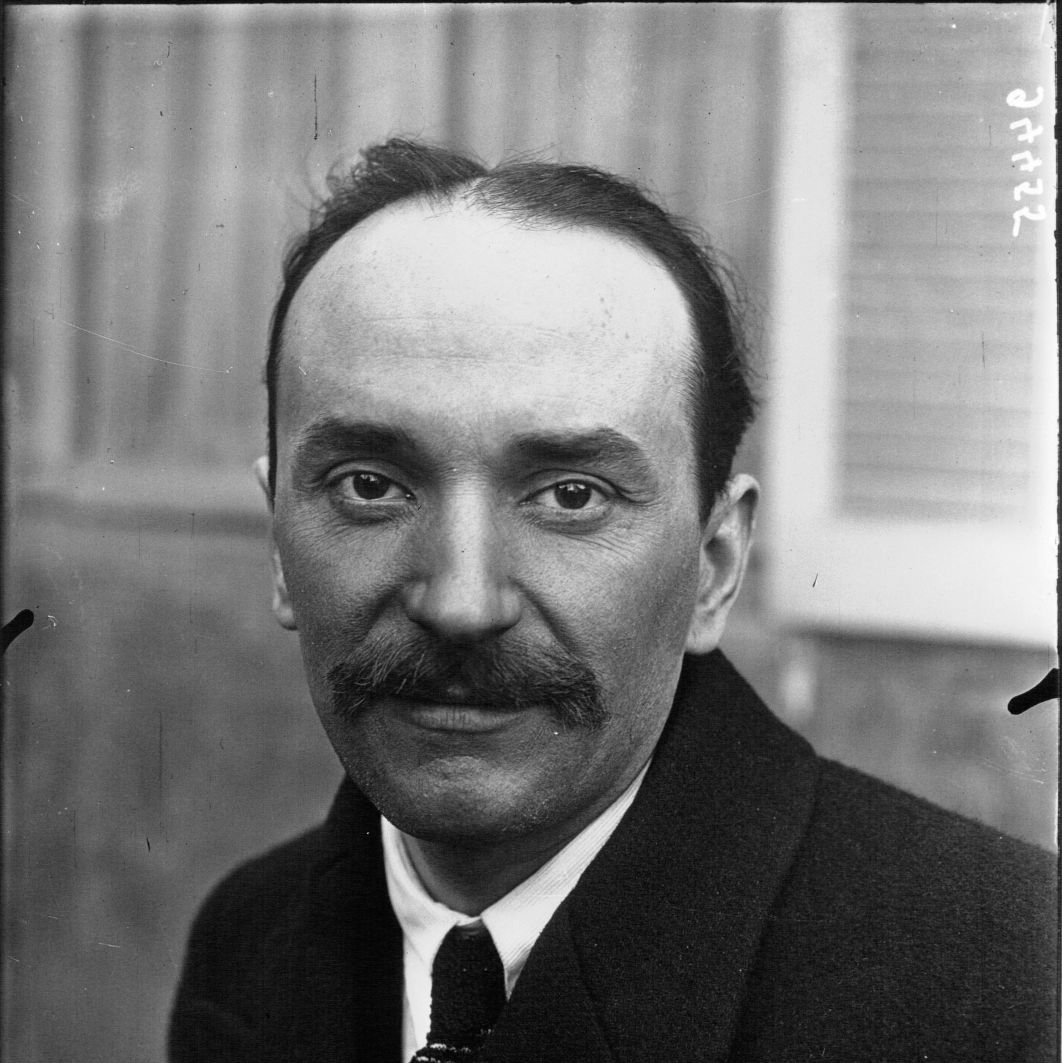
A superlative essay from the French writer on a subject he knew intimately; the real ‘invisible government,’ the Comité des Forges of iron and steel interests that determined France’s reactionary foreign policy in the years after World War One.
‘The Policy of the “Committee of Iron”’ by Antoine Ker from International Press Correspondence. Vol. 2 No. 65. August 4, 1922.
Now that the Genoa Conference is over, the nationalist war-cry, “Occupy the Ruhr”, is again resounding in France. “Let us occupy the Ruhr”, shout the oracles of the Bloc National, “it is our only salvation. Occupation alone can save us from bankruptcy and secure peace in Europe.”
Why did “France” cause the shipwreck of the Genoa Conference?
Why is the France of Poincaré considered to be the principal obstacle in the way of European peace?
Why is France heading the world-reaction today?
First of all, who is France? Who represents it? Who speaks in its name and by whom is it governed?
The real French Government does not sit in the Elysée, nor in Luxemburg, nor in the Palais Bourbon, but may be found at No. 7 Rue de Madrid, where the powerful capitalist organizations have their seats. First comes the Comité des Forges (the Iron Kings), then the aeronautic and automobile trusts, the electrical industries, the manufacturers of war-materials, etc., etc.
His Eminence, M. Robert Pinot, the pontiff of our reactionary plutocracy, is at the head of most of these organizations in the capacity of general secretary or vice-president. He is also a general delegate of the Metal and Mining Industrial Association, a huge Association of metal, mining, and electrical corporations, numbering 81 trusts, national and sectional, and having more than 60000 members who are either private capitalists or anonymous societies.
Thus we find in Rue de Madrid the organizations that Constitute the most powerful capitalist interests: coal barons, on kings, waterfall owners, owners of foundries, mills, mines, etc. Thus the national riches are monopolized by groups of powerful capitalists who are unknown to the public and at whose head we find M. Pinot.
It would be difficult to understand the various press campaigns, our reactionary policy or our international policy without understanding how the various committees in Rue de Madrid have rendered Parliament, the Press and the Government subserviant, and how the capitalist trusts directed by M. Pinot have subordinated the various state organs to their will and caprices.
The “Iron Kings” are not content with defending their interests; they are forging the doctrine that brings them in control of the state. In several statements that he made, M. Pinot has demanded that the Government machine in the economic as well as in the political field be given over to the capitalists. He places the “producers” above the governors, both in the national and international order. The necessity for the reconstruction of the world having demonstrated the powerlessness of the state, M. Pinot seeks to substitute the state by the powerful trusts and by an international entente of capitalists.
We said a moment ago that the France of Poincaré is rousing the distrust and hatred of peoples. Let us be just; it is the France of M. Pinot that menaces the world with new violence.
The Comité des Forges and the Reaction.
The invisible government of Rue de Madrid, being more powerful than any minister, (for it makes and unmakes ministers), rules the Chambre des Requins, where among 140 millionaires we find Charles Dumont, Francois and Guy de Wendel, Noblemaire, De Dion, the Rothschilds, etc. and the senators, André Berthelot, Billier, Coignet, Clémentel, Doumer, Marsal, Gérard, Raphael, Georges Lévy, etc., all of whom are directly or indirectly affiliated with the Comité des Forges.
At the service of these political pontiffs we find a prostituted press that is mostly financed by the treasury of the L’Union Des Intérêts Economiques and by the clandestine bank accounts (such as account number 11145 at the Banque des Pays du Nord). This press speaks, recriminates, and menaces in the name of public opinion and in the name of “national interests”.
We thus get a dazzling glimpse into the policy of the Bloc National:
The electoral campaign of 1919 is prepared long beforehand by the Union des Intérêts économiques in conjunction with the subsidies of the Metal and Mining Industrial Association:
The campaign against the Wiesbaden Agreement is conducted by L’Usine, the organ of the metal interests, with a view of putting through the restoration of our ruins, an act that is scandalously inhuman, but very remunerating:
The campaign against the eight hour day is conducted in support of the demands made by the Metal and Mining Trusts upon the Labor Minister.
Furthermore the press campaigns for a higher protective tariff, for reduced wages, for the “freedom” of work, against social insurance, for the abolition of the law against profiteering and against the war profiteering tax.
Finally, the campaign against the International Labor Burau in Geneva; this campaign was carried on by the entire capitalist press in support of M. Pinot at the Geneva Conference against the extension of the eight hour day to include the agricultural workers. But the vassality of the Government towards the industrial barons appears more crassly in the French foreign policy.
The Imperialism of the Iron Kings.
France is rich in iron ore, but the future of its industry depends primarily upon her coal supply. For this reason our iron manufacturers speaking through M. Robert Pinot, demanded as early as 1917 not only the reconquest of Elsass-Lothringen, but also the annexation of the Saar, whose coal surplus covers a part of the Lothringian deficit. After the War, the control of the Saar and Lothringian industries were taken over by the French iron and steel works in Pompey, Creil, Alais, St Chamont and Micheville; in the board of directors Röchling and Thyssen the powerful masters of Gelsenkirchen and the Dillingen works, were simply substituted by Schneider, Renault, Peugeot, Japy, Richemond and Theodor Laurent.
Energetic attempts are constantly being made to produce a good smelting coke from the Saar coal; but so far, it can only be obtained in England and in the Ruhr. The demand that the Ruhr region be given as security for the fulfillment of the reparation obligations is only a bait for the uninitiated. The occupation of the Ruhr (so say the spokesmen of the capitalists) is of value to us only if we are determined to make an end to German superiority in the iron industry. We thus see that the occupation of the Ruhr would only serve as a means to cripple the German industry and to put France on the iron throne.”
“Were we the masters of the Ruhr”, (so writes L’Usine,) “we could then negotiate with the English importers on a basis of equality and also force our conditions upon them”. The Westphalian expedition whose costs and risks must be shouldered by the country has for its purpose the shattering of the German iron industry for the benefit of a handful of heavy industrials; and to rob England of the last crumbs of its former monopoly on coal.
French Government circles are working diligently on the plans and methods of occupation and organization of the Ruhr District. As in 1921, a tax was decided upon, which is to be levied on all coal under our control. As regards the technical management of the “colony”, it is to be assigned to a High Commission consisting of Mssrs. Taffanel, the director of the Châtillon-Commentry Smelting Works, Dhomme, the director of the St. Chamond and Ader Steel Works–a former director of the Coal Bureau. Never before has the Comité des Forges received a more royal gift.
The demand that 85 % of the Silesian mining and iron industries be transferred to Poland, was also the handiwork of the Rue de Madrid trusts, which own two thirds of the shares. These trusts dictate to the Government its penetration and repression policies in Central and Eastern Europe: Poland, Czecho-Slovakia, Austria, Hungary, Jugoslawia and Roumania, where the mining and metal industries, the commercial and banking houses pass into their hands one after another.
Creusot alone owns a large part of the Skoda works in Austria: the Huta-Bankova Smelting Works, the Polish War Material Manufacturing Corporation, the oriental railroads, the Franco-Roumanian Railroad Company, the Reval shipyards, the Putiloff Works, etc., etc. This gigantic concern also has a foothold in Belgium, Morocco, Algeria and Chile. L’Usine tells us that this concern is also interested in the development of the colonies…
If you think that M. Charles Laurent represents the French Republic in Berlin, you are badly mistaken. He is the former president of the Metal and Mining Trust, a member of the board of trustees of the Orleans Railroad, the Banque des pays du Nord and the Suez Canal Corporation, and president of the Thomson-Houston Company (having a capital of 200 million francs). He may therefore be considered as a worthy partner of Stinnes and Rathenau, representing in Berlin the trusts of Rue de Madrid. He himself told an editor of the Matin that his main mission was to reach an agreement between the French and German industrials on the coal question.
The Iron Barons in Genoa.
In Genoa our metal industrials acting in the name of “civilization” and of thrice holy private property proclaimed the inviolability of King Private Interests. In the name of the same holy principle, they sacrificed the interests of thousands of small owners of Russian bonds, for the simple reason that the latter’s property right can never approach that of Mr. Schneider.
Rue de Madrid has not only a coal policy of its own, but also a petroleum policy. In 1919 and in the first half of 1920, the then prevalent coal shortage caused numerous metal industrials to entertain the idea of substituting coal with oil.
The Union Parisienne, which is the French bank of the Royal Dutch is partly in the hands of Schneider. The Bank of Paris and of the Netherlands also represents the interests of the Standard Oil and the Batignolles Châtillon Works which are also controlled by Mr. Schneider.
The intransigent defense of the property right aimed not only at the prevention of the former French and Belgian capitalists from being eliminated from the profit monopoly of the Royal Dutch, but also and above all, to saveguard the rights of the French iron and steel barons in Russia, where their property has been nationalized. The property thus effected s as follows: mines, iron works and oil wells in Briansk, in the Caucasus, in the Donetz Basin, in Ekaterinoslav, in the Volga Basin, in Southern Russia, in Georgia, etc., etc.
The iron magnates refuse to “give up” these far possessions, in the hope that vast profits await them as soon as a reactionary or at least a Menshevik Government comes to the rudder and denationalizes the Russian industries.
We need not investigate whether the French owners of these works acted wisely when they insisted upon the actual return of their property, instead of accepting compensation and damages for them. All we wish to point out is the fact that in 1920 these “poor” victims of the Revolution organized a trust called Commercial, Industrial and Financial Corporation for Russia, with a capital of 25 million francs. On the board of directors we find names like Grüner (of the coal trust), director of the Krivol Rog, Putiloff, the inevitable Noulens, and M. de Chevilly.
Of course, it is a pure coincidence that Count de Chevilly, whose fingers are soaked in Franco-Belgian oil, was also a member of the French delegation in Genoa…
From the above, one clearly sees the absolute dependence of the French Government upon its iron kings. Limited production for the purpose of killing competition, unlimited freedom of exploitation by the capitalists and the shameless plundering of the state, such is the policy of Rue de Madrid, and therefore of our government. And our foreign policy is completely subordinated to the coal-policy and to the expansion appetite of the iron magnates.
Behind the Bloc National is Rue de Madrid. All roads, whether in the Saar or in the Ruhr, in Poland or in Russia, lead to Rue de Madrid. Everywhere and at all times the “invisible Government” is the absolute master of our fate, of our future. With it lies the final decision of war and peace.
Everywhere we meet with the steel moloch who is still reeking with the blood of a million and a half lives!
International Press Correspondence, widely known as”Inprecorr” was published by the Executive Committee of the Communist International (ECCI) regularly in German and English, occasionally in many other languages, beginning in 1921 and lasting in English until 1938. Inprecorr’s role was to supply translated articles to the English-speaking press of the International from the Comintern’s different sections, as well as news and statements from the ECCI. Many ‘Daily Worker’ and ‘Communist’ articles originated in Inprecorr, and it also published articles by American comrades for use in other countries. It was published at least weekly, and often thrice weekly.
PDF of full issue: https://www.marxists.org/history/international/comintern/inprecor/1922/v02n065-aug-04-1922-Inprecor.pdf
 Revolution's Newsstand