
An early statement from the young, and still small, Chinese Communist Party on the resurrected parliament and ‘elections’ called by the Zhili victors after the end of the war between the Zhili and Fengtian warlord cliques for control of the Beijing government, and as the First United Front with Sun-Yat-Sen’s resurrected Koumintang Party was developing.
‘The Political Situation in China and the Communist Party’ from International Press Correspondence. Vol. 3 No. 64. October 4, 1923.
The following Statement has been issued by the Executive Committee of the Communist Party of China.
The present political crisis in China has its roots in events now long past. Li-Yuan-Hungs’s overthrow from the presidency by the Tsao clique is only one of the many crises which have followed one another in rapid and uninterrupted succession. If the people are taken by surprise by the latest events, but do not accord sufficient attention to the fundamental causes underlying them, how is it to be expected that they can find the right way of saving their country, shaken as it is by these crises?
Twelve years have passed since China was declared a republic.” And yet Pih-yang’s militarism, which is entirely inconsistent with a republic, exists now as then. First came Yuan-Schi-Kai’s coup d’état, the restoration of the monarchy by Chang-Hsun, the devastation of the country by the Anfouist club, and finally the intrigues of today, the work of Tsao Kun. This endless chain of unrest was the natural consequence of the existence of the military power of Pih-Yang, who works hand in hand with the Foreign imperialists. The longer this military power continues to exist, the greater will be China’s exploitation by foreign imperialists. Here we have the fundamental cause of the chronic crisis under which China is laboring.
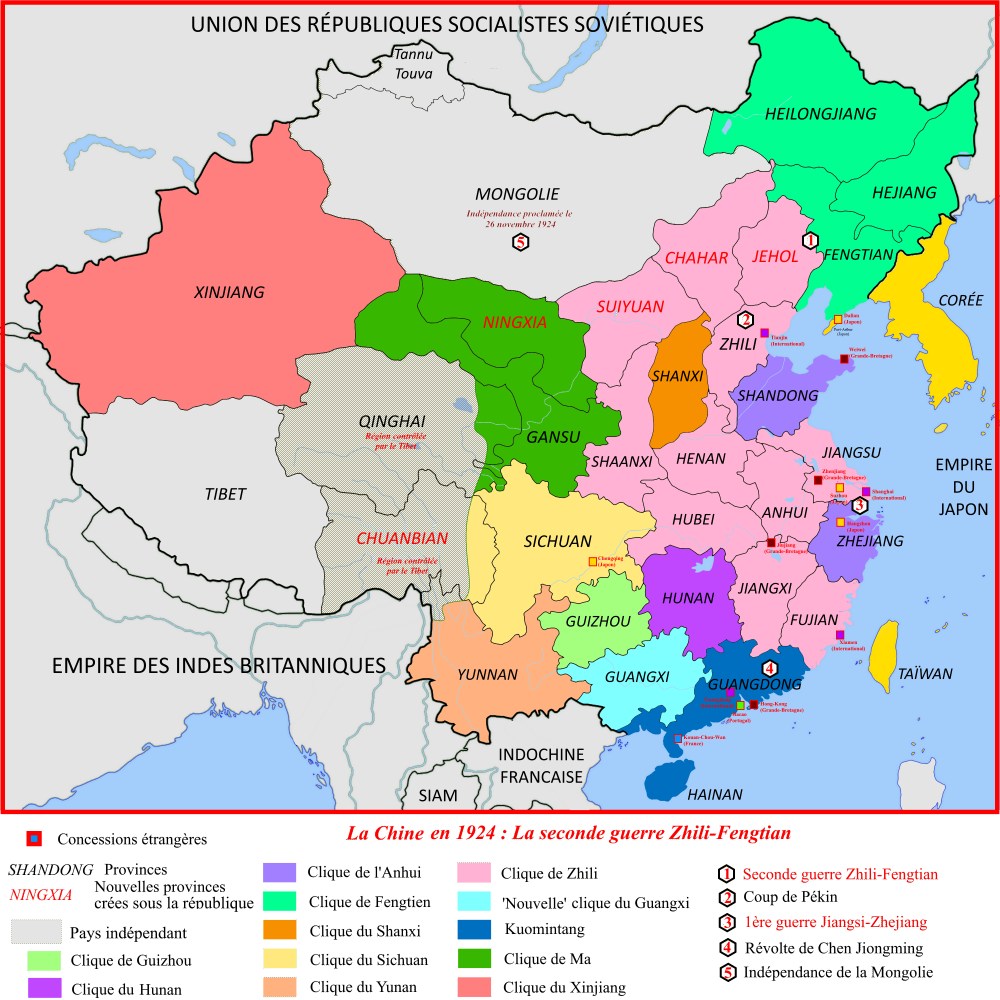
Since the civil war of last year between Tshihli and Fengtien, we know that the defeat of Chang-Tso-Lin signified defeat of Japanese imperialism, just as the victory of Wu-Pei-Fu was a victory for America imperialism. At that time the Communist Party published a report on the political situation, emphasizing that the reintroduction of a parliament, the creation of a federation of autonomous provinces, the return of Li-Yuan-Hung to the presidency of the country, and the taking over of the government by Wu-Pei-Fu, would all be without the slightest effect in altering the situation. In our opinion, the sole possibility of saving China lies in the establishment of a democratic united front, and in the continuation of the revolution until victory is gained over the native militarists and the imperialist powers backing them up.
Tsao’s coup d’état was not a sudden change of government. Since Fengtien’s defeat last year, America has almost completely supplanted Japanese imperialism in Peking. Already at that time Tsao’s followers tried to replace Hsu-Shih-Chang by Tsao. The attempt was not successful, owing to the disunitedness of the Tshihli party, which believed that it could make use of Li-Yuan-Hung as an occasional tool, and at the same time retain all practical power in its own hands. After the conquest of the South and the uniting of the whole country under military power, it intended to have Tsao Kun nominated as legal and popular president of the country, by means of election by a parliament which was to establish the constitution. It was confident of being able to secure this election by means of bribery and terrorization of the members of parliament. “Reunion of the country under military power, and the presidency of the country for the Pih-Yang party!”, these were the slogans of Wu-Pei-Fu’s policy.
The Tientsien group, Tsao-Yui, and Oy, were however anxious to make Tsao Kun president at once. But as Wu-Pei Fu’s power was still very strong, they renounced the idea at this time. Poor Li-Yuan-Hung was thus obliged to serve as a temporary cloak for the militarists of the Tschihli party. In the meanwhile, the intrigues in the Tsao party continued. As soon as it was finally realized that the establishment of the constitution was merely a pretext on Li’s part for the prolongation of his presidency, and that Wu-Pei-Fu was making no progress whatever with his conquest of the South, the Tentsien group was placed in a position to supplant Li-Yuan-Hung from the presidency. In this it was supported by the Americans, and by the pro-American Christian general Feng-Yu-Hsiang. Tsao derived support not only from the army of this general, but also from the diplomatic clique assured him by the American subsidies. His aim is to seize political power by bribing the members of parliament and the army.
Short-sighted people see the whole essence of the political crisis in the intrigues of Tsao Kun and Li. But the problem is not so simple. Tsao only ventured to overthrow Li because he felt certain of American support. This overthrow was the natural expression of the cooperation of foreign powers with the militarist, who are constantly causing unrest and provoking political crises in China. But this overthrow is not the cause of the present dangerous political situation. The cause of the innumerable political crises in China lies rather in the rule of the Pih-Yang militarists, who suppress all democracy, work hand in hand with foreign powers, and bargain away the rights of the country. If we do not find means to put an end to this essential cause, the political crises will continue in the future as in the past.
Li-Huan-Hung, who seized political power by force, subordinated himself voluntarily to the militarists. As his presidency possessed no legal foundation, he made agreements with the Chang Tschao-Tseng cabinet and with the parliament, both of which were in the service of the militarists. An actual triple alliance was brought about. Li approved of the murder of workers and students, sent agents to Kwangtung and Fukien to stir up insurrections, and only joined forces with the militarists for the sake of retaining his post as president of the Republic. His crimes are, however, by no means less numerous than those of the Pih-Yang militarists. At present he is the tool of the Tshen-Hsueh-Hwe clique, which is fighting against Tsao Kun. This clique is now improving the opportunity to return to power. All the remaining enemies of the Tschihli party, who utilize Li-Yuan-Hung as a puppet, would like to accompany him to Mukden or Hang Chow, and retain him as president. But this solution is not acceptable to the people.
The Tuan-Club-Jui clique is the deadly enemy of the Tchhli party. The crimes of the Anfuists are notorious all over the world. These are also anxious to utilize the people’s hate of Tsao for the purpose of re-establishing their own power. The subordination of Tschang-Tso-Ling and Lu-Hung-Hsiang to Tuan signifies precisely the same as the subordination of Vu-Pei-Fu, Feng-Yu-Hsiang, and Chi-Hsieh-Yuan to Tsao. Should any change take place in the future, the candidature of the Tshihl party and of the Anfuist clique still remains. Both of these groups receive support from the imperialists. The victory of Tsao-Kun or of Tuan is in no way congruous with the welfare of the country. The people will recognize neither Tsao nor Tuan should they succeed in obtaining political power for themselves and in forming their own government.
The shameless, impudent, and brutal members of the parliament have long enjoyed the support of Tsao-Kun. If there are really any honorable and straight-dealing elements among them, why do they not come forward? The organizations of craftsmen, of workers, and of students, have been solemnly deprived by parliament of the right to speak in the name of the people. What section of the population then are represented by by this parliament? The suggestion of moving the parliament to the South is entirely opposed to the views of the people. Should the parliament really draw up the constitution and elect the president, then the people will declare its decisions to be null and void.
The generals in the South West, who maintain a powerful army, violate the rights of the people, and shamelessly enrich themselves, are not one iota better than the Pih-Yang militarists. They allege their intention of creating a federation of autonomous provinces, but in reality they merely want to establish a federation of autonomous Tutschunates (Brigands). But anyone who thinks that this would signify a strengthening of the power of the southwestern provinces as opposed to the North, should learn from the experience of the past that the question here is not one of aiding democracy to make its way against feudalism, but merely of a struggle for the possession of certain territories. Those advocating this plan are would-be politicians out of a job, and these are anxious to utilize the power of the south-western provinces for their own interests, or to support Li-Yuan-Hung’s presidency.
The creation of an independent state and the appointment of a revolutionary government will be a great tax on the efforts of our suffering and much troubled people. We have no wish to imitate the example of certain Korean nationalities, who sought for recognition at the conferences of Versailles and Washington, hoping thus to attain their object, but not moving a finger to further the revolution. The militarists who join forces with foreign powers are hated by us. But many of the people who hate these militarists are nevertheless trying to gain the support of foreign powers for the purpose of crushing the militarists. But those who are incapable of comprehending the close cooperation between the militarists and the foreign capitalists are equally incapable of calling any independent and autonomous state into existence.
We, on the other hand, demand a government created by the peoples out of its own forces, a government arising out of the revolution. The people can never recognize a government appointed and controlled by any imperialist power.
The combatting of Tsao in any of the ways mentioned would not correspond with the real feeling of the people.
We hold the view that we must speedily convene a national congress in some suitable place, composed of delegates from the peasants’ associations, the trade unions, the students’ associations, and the other craft organizations of the whole country. As the parliament in Peking is a tool in the hands of the feudal militarists, and is not recognized as representing the people, the national congress, as the true representative of the whole nation, must take upon itself the task of drawing up the constitution, of bringing together and uniting he people, and of appointing the new Chinese government.
This congress alone is entitled to deny any other organ the right to rule over China in the name of the Chinese people.
The new government of really revolutionary nationalists which will be called into being by the national congress will break the power of the militarists all over China, and the power of the foreign imperialists backing up the militarists. This government will be no mere local government, but a real people’s government. And in no case will it be a government in which militarists cooperate, and which is under the supervision of foreign imperialists.
This is the sole way in which the Chinese can emancipate themselves from the double suppression of militarists and foreign powers.
International Press Correspondence, widely known as”Inprecorr” was published by the Executive Committee of the Communist International (ECCI) regularly in German and English, occasionally in many other languages, beginning in 1921 and lasting in English until 1938. Inprecorr’s role was to supply translated articles to the English-speaking press of the International from the Comintern’s different sections, as well as news and statements from the ECCI. Many ‘Daily Worker’ and ‘Communist’ articles originated in Inprecorr, and it also published articles by American comrades for use in other countries. It was published at least weekly, and often thrice weekly. The ECCI also published the magazine ‘Communist International’ edited by Zinoviev and Karl Radek from 1919 until 1926 monthly in German, French, Russian, and English. Unlike, Inprecorr, CI contained long-form articles by the leading figures of the International as well as proceedings, statements, and notices of the Comintern. No complete run of Communist International is available in English. Both were largely published outside of Soviet territory, with Communist International printed in London, to facilitate distribution and both were major contributors to the Communist press in the U.S. Communist International and Inprecorr are an invaluable English-language source on the history of the Communist International and its sections.
PDF of full issue: https://www.marxists.org/history/international/comintern/inprecor/1923/v03n64[41]-oct-04-Inprecor-loc.pdf
 Revolution's Newsstand