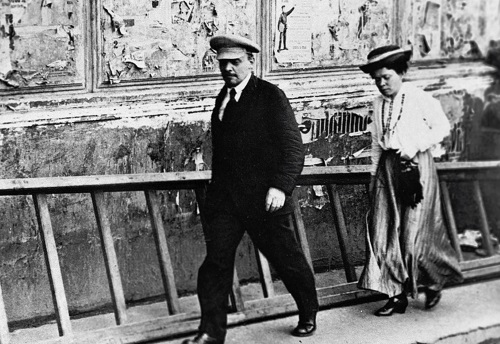
The younger sister of Lenin, Maria Ulyanova was herself an extremely active revolutionary, in exile internal and external, from 1898 on. Eventually becoming a member of the Central Committee, her most important work was on the editorial boards of Iskra and Pravda, for which she celebrates below.
‘Fifteen Years of the Pravda’ by Maria I. Ulyanova from International Press Correspondence. Vol. 7 No. 28. May 5, 1927.
This year, Press Day coincides with the fifteenth anniversary of “Pravda”, the oldest Bolshevist paper, the central organ of our Party.
The history of “Pravda” is the history of the Labour movement since 1912, when the increasing mass movement with its revolutionary wave, produced the first Labour daily paper.
In the columns of “Pravda”, the progress and the defeats of the revolutionary Labour movement have been reflected, “Pravda” has rallied round itself more and more new strata of the proletariat, has shaped and organised them and been their leader not only in their economic fight against capital, but also in their political fight. There has been no question of the day which closely concerned the working class whether it be the question of workers’ dwellings, strikes, ill-treatment by masters or questions of the general political tasks of the working class, the part it should play and its duties in the revolutionary fight which have not been dealt with in “Pravda”, which have not met with a clear and definite judgment in its columns and have not been turned to account for the support of the broad masses of workers. In the years 1912 to 1917, “Pravda” acted to the full its part as “a collective agitator and a collective organiser”, for, at that time, it was the centre of the fight for the construction of the Party as against the policy of liquidation, the fight to weld together the glorious Party of steel which, a few years later, led the proletariat and the peasantry of our country to victory.
The old “Pravda” existed for two years and was supported by the pence of the workers. It was suppressed, persecuted, prosecuted, confiscated; its editors and collaborators were arrested and banished, but it always rose again under other titles, always with the same determination and the same will to victory. It was only the dark storm of reaction, which set in at the beginning of the imperialist war, which knocked it out and drowned the resounding, unabashed voice of the “Pravda”, the darling of the working masses.
It was silent for rather more than two years. Then its voice resounded once more at the first victory over autocracy; the horny hands of the workers once again held out their pennies in its support, once again columns of workers rallied round it, once again correspondence, resolutions, letters of workers, peasants and soldiers appeared on its pages. Above all, many letters from soldiers. Of all the central newspapers which began to appear in February 1917, the “Pravda” was the only one which took up a strong, definite attitude against the war. It demanded the conclusion of the war which had been begun in the interest and for the profits of the capitalists, and the campaign of “Pravda” for a termination of the war met with the warmest approval of the working masses, but especially of the exhausted soldiers at the front. A few extracts, chosen at random from letters from the front, show with what an echo it met among the “defenders of the country”.
“Having read a few numbers of your newspaper, we are inspired with enthusiasm by the absolute truth and genuine sentiments of your articles” wrote soldiers of the 12th Siberian Regiment of Infantry.
We hear a similar tone in the voice of the soldiers of the 484th Infantry Regiment of Kirsk:
“…We are truly grateful to you for your newspaper “Pravda”. We read it with the greatest attention; it has revealed many truths to us.”
Hundreds and thousands of such letters were received. The few voices which were caught by the chaff of the bourgeois Press, in which a fight was carried on against the “Pravda” with revolting calumny and agitation, disappeared completely by their side. The soldiers quickly became aware of the reasons for this agitation and gave expression to their indignation, protesting vigorously against this campaign and assuring the “Pravda” of their support.
They supported their paper not in thought only, they sent money they had collected from their more than modest soldiers’ pay. Above all, “Pravda” received many gifts from the masses of soldiers in the form of medals and all kinds of distinctions they had received at the front. In separate numbers of “Pravda” of those times, lists of such gifts, running into hundreds, are printed. Here is an example of one of these lists:
“Pravda” has received for its “iron fund” 384 silver medals “for zealous service” and 445 bronze medals in commemoration of the 300th anniversary of the foundation of the House of Romanov from the soldiers of the Railway Regiment of the Guards.
This is only a small example, and yet of what movement in the depths of the masses it speaks, of what new forces which are prepared to support the revolution!
The first months of the February revolution formed one of the most brilliant epochs of “Pravda”. This was greatly favoured both by the spread of the revolution and by the circumstance that in the first days of April the direct lead of the revolutionary struggle and also of “Pravda” had passed into Lenin’s hands. His arrival in Russia, his significant theses which he read on April 17th in the Taurian Palace, after which they were published in “Pravda”, his clear, consistently revolutionary slogans put an end to the vacillation of some of the Bolshevist leaders with Kamenev at their head. They traced out for the Party the straight line which it should pursue, they made “Pravda” the true revolutionary banner round which the masses gathered, which in common with the Party and the workers organisations led to the conquest of the Soviet power, to the proletarian dictatorship. In that period, “Pravda” further carried on an extensive and obstinate fight against the Mensheviki and Social Revolutionaries who at that time were in the majority in the Soviets; it castigated their half-heartedness their opportunism and their betrayal of the interests of revolution mercilessly. It was an embittered fight, a mortal combat, for the fate of the whole revolution depended on the victory of the Bolshevist line.
Just through the fact however that “Pravda” rallied round itself the broad masses of workers, peasants and soldiers, who began, under its influence, to free themselves more and more from the illusions as to compromise, it roused hatred and malice among the bourgeois elements, who recognised it to be the dangerous enemy, who realised that under the influence of “Pravda”, discontent with the bourgeois coalition was steadily increasing, that opposition to “carrying on the war to the end” was always growing etc. Again “Pravda” was persecuted. Again did the accomplices of capital resort to all possible measures in order to prevent “Pravda” getting into the hands of the masses, as they feared its influence and its open, determined language. “Pravda” was kept back at the railway stations so as to prevent it getting to the front, comrades who distributed it were arrested, its shield-bearers and adherents were beaten.
This hatred grew particularly embittered at the end of April, when, after the annexation note of the Provisional Government, the Nevsky-Prospect was alive with demonstrations pro and contra Miljukov. Matters went as far as open collisions. Two essentially contrary parties were opposed to one another in acute hostility. On the banners of one party stood: “Down with Lenin!” on those of the other party: “All the power to the Soviets!” The masses tore the banner of the “enemy” demonstration to pieces and beat the partisans of one party or the other.
Only a few paces from the Nevsky-Prospect or, as it was called at that time, the Miljukov-Prospect, the editorial staff of the “Pravda” was at work in its two small rooms in the Moika Street, working feverishly. There were particularly large numbers of visitors in those days. Every now and then some “Pravdist” or other would rush into the office, bringing the most recent reports as to what was going on in the Nevsky-Prospect. Lenin himself sat in the adjoining room, quietly preparing the composition of the next number.
Fraternisation at the front, the union of the soldiers with the workers, the increasing disintegration which threatened to become a catastrophe, the land question arose–all these questions prompted increasingly wide masses of workers to collect round “Pravda”. The demonstration of June 18th was illustrative of how the illusions regarding a compromise were constantly crumbling away more and more.
The days of July. The tension reached its culminating point. The measures of the Provisional Government aiming at the removal of the revolutionary garrison from Petrograd and at disarming the workers, prompted the masses to an elementary resistance to the Provisional Government, the reactionary elements of which turned to account the open attack of the Junkers on the workers and their organisations. “Pravda” was destroyed, the leaders of the Labour movement were arrested or forced into illegality. Only a few days elapsed, and “Listok Pravdy” (“Paper of Truth”) appeared in the place of “Pravda”, for the distribution of which a worker, called Voinov, died as a hero, being tortured to death by the Junkers.
“Listok Pravdy” was replaced by the newspaper “Rabot- shij i Soldat” (“Worker and Soldier”), and when this also was forbidden, by “Proletarij” (“The Proletarian”).
Events developed with furious rapidity. Bourgeois-social compromising organs were published and failed, such as the “Democratic Conference” and the “Preliminary Parliament”, the reactionary character of which became clearer and clearer to the broad masses, thanks to the merciless criticism of our newspaper. The thunder-clouds gathered more and more threateningly, the decisive fight approached nearer and nearer. The Government still tried to struggle for its existence. Under pressure from without, our paper was again twice compelled to alter its name; it appeared as “Rabotshij” (“The Worker”) and “Rabotshij Put” (“The Worker’s Path”). Since the victory of the Soviets in October, “Pravda” has again, by the will of the victorious proletariat, borne its original name and is the banner of the October revolution.
When the first Bolshevist Labour newspaper had only existed for a little more than five years, the one hundred thousand workers who had stood by “Pravda” in the years 1912 -1914, had increased in such a way that in November the Party and “Pravda” were backed by the majority of the population of the country which had carried off victory in the revolution.
Another five years elapsed. Strenuous, feverish activity in the defence of the socialist country, for the rescue of the workers from starvation. The first stones of the socialist construction are laid. In all the difficult tasks by which our Party is faced, “Pravda” has proved to be an organiser and leader of the first Labour republic.
Severe fights, trials, the innumerable sacrifices of civil war but also joyful victories, the first steps forward, the first strengthening of the positions of the proletariat are reflected in the columns of “Pravda”. Gigantic difficulties, titanic work. Every step, every failure, every advance in this fight is described in the columns of “Pravda”.
“Pravda” was at its post. Its significance had long ago spread beyond the boundaries of our country, but the collaborators were still crowded into one or two rooms of the large premises of the editorial office of the former “Russkoje Slovo”. The closeness of these small rooms is almost unbearable. They are smoked out by the small iron stoves, but in the other rooms there are no stoves at all. All the collaborators are there, gathered round two or three tables. There sits also the editor of the. “Pravda”, Comrade Bucharin, with his leading article, crushed up against the table. There is no wood, no paper, and the central organ of the Government Party appears on two pages. Short, concise war reports, short articles in the nature of proclamations this was the “Pravda” of those times. It was not till “Pravda” had existed for twice five years, after the civil war had been brought to a successful end, that economic questions became the centre-point of attention. Construction continues; but at the same time, more and more attention is devoted to the “life of the worker”. The worker correspondent movement constantly spreads further. New blood is introduced, for those who had been trained by the old “Pravda” of the years 1912 to 1914 are already occupying important posts in the various domains of our construction.
Fresh people of this kind are however increasing in numbers. “Pravda” organises them, directs their work. They have their heroes and their victims. Some have perished, as did Comrade Spiridonov, one of our best representatives, but they are replaced by hundreds and thousands of others, for the cause they serve is an important cause, and without the wide participation of the masses themselves in all fields, it is impossible for us to build up socialism.
We are at the end of the third five years’ period of the existence of “Pravda”. Lenin, in his last greeting to it at the end of 1922, wrote that his wishes for it were that “in the peaceful struggle of the five years to come it would accomplish no less than we had achieved up to that time with arms in our hands”. This wish has been fulfilled by the progress of the economic construction which all can see with their own eyes. “Pravda” has also accomplished its share in this work.
In the future also, it shall be our banner, the protector of Lenin’s legacy, of the unity of our Party, the educator of the broad masses of the new constructors who will carry on the construction of socialism until it is perfected.
International Press Correspondence, widely known as”Inprecorr” was published by the Executive Committee of the Communist International (ECCI) regularly in German and English, occasionally in many other languages, beginning in 1921 and lasting in English until 1938. Inprecorr’s role was to supply translated articles to the English-speaking press of the International from the Comintern’s different sections, as well as news and statements from the ECCI. Many ‘Daily Worker’ and ‘Communist’ articles originated in Inprecorr, and it also published articles by American comrades for use in other countries. It was published at least weekly, and often thrice weekly.
PDF of full issue: https://www.marxists.org/history/international/comintern/inprecor/1927/v07n28-may-05-1927-inprecor-op.pdf
 Revolution's Newsstand