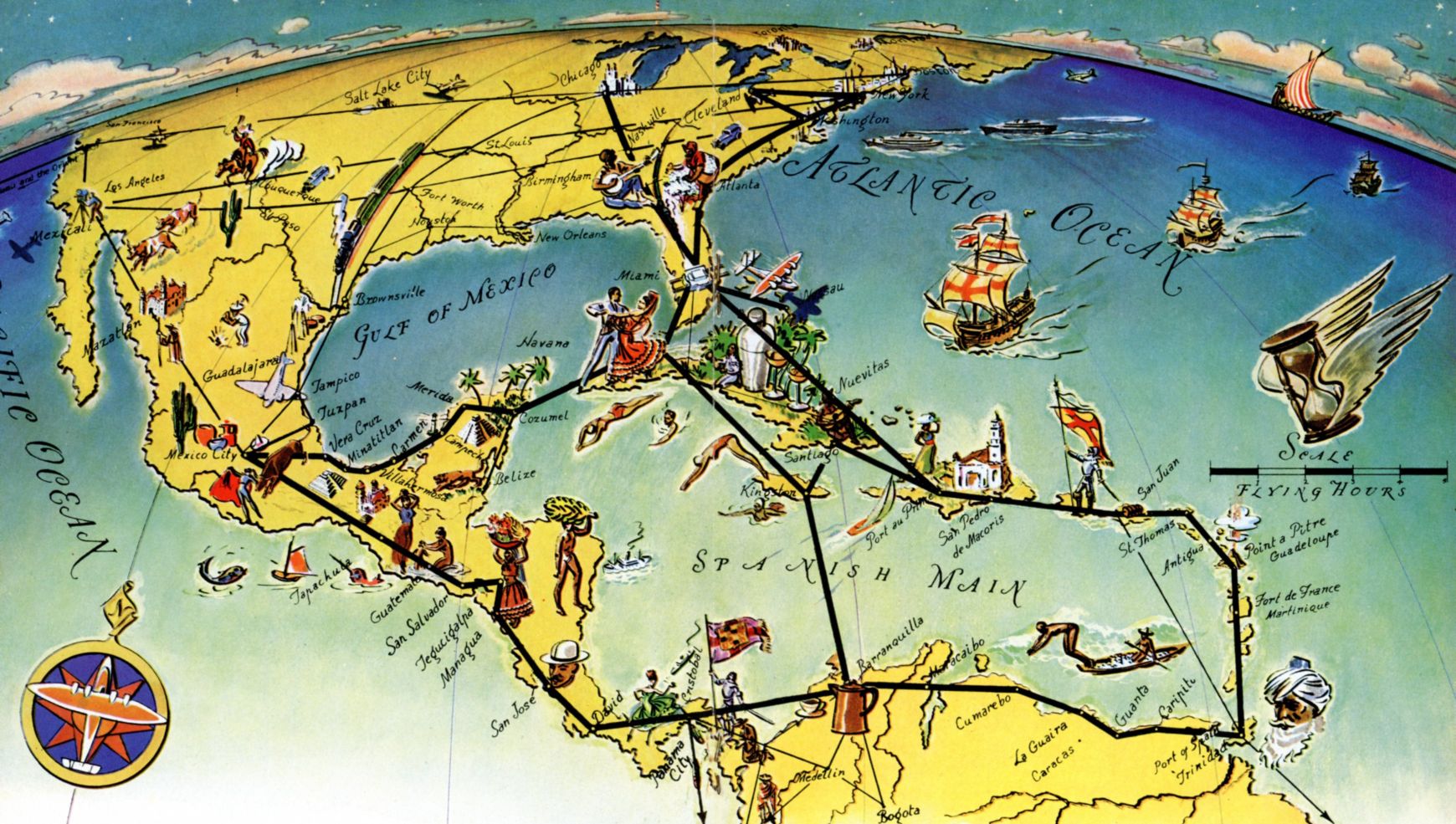
Pan-Am airways was founded by former U.S. military officers with a purpose; dominate the airlanes and displace European imperialism in Central and South America.
‘Air Imperialism of United States in Latin America’ from The Daily Worker. Vol. 6 No. 1. March 7, 1929.
THE Pan-American Airways this week obtained the contract for carrying mail by air from the United States to Mexico. Recently the same company opened an air mail service from the United States to Panama via Havana and the Central American states. Both these steps are part of the United States campaign to obtain control of commercial aviation in Latin America, a large part of which is in the hands of European companies.
The Germans Already In.
The first airline to function in Latin America was established by the Sociedad Colombo-Alemana de Transportes Aereos, a company founded in 1920 by the Kondorsyndikat of Germany. This firm, generally known as “Scadta,” operates five passenger and mail air lines in Colombia and has extended its service to Ecuador. It plans to extend its operations southward to Peru. Similarly, the German group has obtained a concession in Peru for establishing air lines with neighboring states.
A German firm, the Aero Lloyd Voliviano, also controls Bolivia’s air service; while German firms shipped 10 airplanes to Brazil in 1928 for the air service between Rio de Janeiro and Rio Grande do Sul. Plans are under way for extending the Brazilian service to Montevideo and Buenos Aires. Toward the close of 1928 the Deutsche Lufthansa announced plans for establishing regular passenger and mail service by air between Germany and Argentina.
The French, Also.
The French, also, have obtained valuable aviation concessions in Latin America. In 1925 Chile granted a French company an exclusive concession to operate air lines. The United States attempted to prevent exclusive concessions of this nature but was unsuccessful. The French have also established a mail service by ship and airplane from Paris to Buenos Aires, via Dakar in French Senegal and Pernambuco.
Alarmed at the rapid advance of European aviation in Latin America, the United States attempted to establish its own hegemony in this field at the Pan-American Commercial Aviation Conference of 1927. The attempt failed owing to the opposition of most of the Latin American countries, led by Argentina.
Trick Didn’t Work.
At that conference, the United States proposed a resolution providing that “for the purpose of engaging in international air navigation, no aircraft shall be entered on the register of any of the concerning states unless the ownership thereof is vested in a national of such contracting state, or a partnership or corporation under the laws of such contracting states.”
Since the United States is the only country in the Pan-American Union manufacturing airplanes, it would have given the United States a monopoly over Latin American aviation. This resolution would have excluded the French, British and German lines from the Americas and would have resulted in the cancellation of present air concessions to European countries. The conference, however, rejected the resolution.
Subsequently, the United States won a victory at the Havana conference which adopted a convention on commercial aviation providing that any two countries may make treaties excluding commercial aviation companies of other countries from passing over their territory.
U.S. Against Germany.
This provision was aimed primarily at Scadta. The conflict between German and American interests reached a crisis when Colombia, under Scadta’s pressure, refused to let American companies enter South America via Colombia, while the United States obstructed Scadta from extending its services northward, preventing it from securing] landing rights in Panama and Cuba. Without such landing rights Scadta was forced to restrict itself to South America; while without the right to fly over Colombia the United States could not hope to establish direct air service between North and South America. For a while there was a deadlock.
Recently, however, the State Department revealed that an agreement has been reached whereby American airlines will be permitted to enter South America via Colombia, and in exchange Scadta will be permitted to fly its airplanes over the Panama Canal. This was done only after Pan-American airways were sufficiently organized to start a fight for Latin American air control, and had already opened an air service from the United States to Cuba.
U.S. Guards Path of Empire.
The existence of such an agreement was indicated this week when President Coolidge issued an executive order outlining the rules governing the flight of foreign aircraft over the Panama Canal Zone. Under these rules, non-American aircraft must enter the Canal Zone by specified routes and must land at designated airports before leaving the zone. At these places clearance papers must be obtained and a customs inspection will be made. Forced landings at other than these specified points are forbidden unless it can be proved they were necessary. The carrying of arms, ammunition or other war material is prohibited and foreign aviators are forbidden to take photographs.
These regulations were based on recommendations of the United States State, War, Navy, Treasury, Post Office and Commerce Departments. The heads of these departments, all members of the president’s cabinet, were appointed as a sub-committee to work out aircraft regulations for the Canal Zone. The committee considers the Zone the bottle-neck of aviation routes in the western hemisphere. Through it must pass most of the north-south flights between the two continents. In its aviation program for Latin America, the Canal Zone and the Republic of Panama are an important base of operations for the United States.
Preparing For War.
The Canal Zone, which is under the jurisdiction of the United States War Department, occupies a five mile strip on each side of the Panama Canal, extends from the Atlantic to the Pacific, and bisects the Republic of Panama. The cities of Colon and Panama are within these bounds, but are excluded from American sovereignty being under the legal jurisdiction of the Republic of Panama. However, it is impossible to reach either city by land except through the American-controlled Canal Zone. Similarly in travelling between the eastern and western provinces of the Republic of Panama one must pass through the Canal Zone. In 1926 the United States attempted to control communications through this region by inserting in the Kellogg-Alfaro Commercial Treaty between the United States and Panama a clause providing for the control and operation of aircraft, radio, and wireless in case of war. The legislature of Panama rejected this treaty with a request for further negotiations. The United States Senate never acted upon it.
The Republic of Panama, however, is controlled by the United States, and two years later (1928) when President Aroaemana took office, he cooperated with the program of the United States by appointing a national aviation commission to work out plans for the construction of airports and auxiliary fields. This commission includes Americans among its members.
Importance of Aviation Control.
The future of Latin American aviation may be judged from the present state of railway communication. Few railroads connect one Central American country with another, and there are no motor highways, not even across the Isthmus of Panama. A rail line is under construction which will eventually join Zacapa in Guatemala with Santa Anna in Salvadore, but there are no other international railway lines in Central America. On the Pacific coast south of Panama the only international rail lines are Chilean, connecting Arica and Antofagasta with La Paz, Bolivia; and Valparaiso and Santiago with Mendoza in Argentina.
Air service has reduced the time of travelling between cities difficult to reach by train or boat. Thus the journey between Barranquilla and Girardot, both to Colombia, takes 14 to 18 days by train and boat but only 7 hours by air. Similarly, flying has reduced the travelling time from Havana to Panama from three days to nine hours; and from Belize (British Honduras) to Corinto (Nicaragua) from 8 days to 7 hours.
Keener Competition Ahead.
Coolidge’s order permitting foreign aircraft to land in the Canal Zone, under certain restrictions, appears to support the report that some agreement has been reached between the American and German interests. The order, by establishing landing points for foreign aircraft in the Zone, permits Scadta to extend its air service northward; presumably Colombia will not allow American aircraft to land on its territory.
With this prospect of free air passage to South America, the Pan-American Airways has already concluded an agreement with Peru for establishing air lines, and is negotiating similar agreements with Ecuador and Chile. German-Colombian capital was unable to obtain air passage to Cuba until American capital was prepared to invade
Latin America, where the sharpest competition between European and American air lines may now be expected.
The Daily Worker began in 1924 and was published in New York City by the Communist Party US and its predecessor organizations. Among the most long-lasting and important left publications in US history, it had a circulation of 35,000 at its peak. The Daily Worker came from The Ohio Socialist, published by the Left Wing-dominated Socialist Party of Ohio in Cleveland from 1917 to November 1919, when it became became The Toiler, paper of the Communist Labor Party. In December 1921 the above-ground Workers Party of America merged the Toiler with the paper Workers Council to found The Worker, which became The Daily Worker beginning January 13, 1924.
PDF of full issue: https://www.marxists.org/history/usa/pubs/dailyworker/1929/1929-ny/v06-n001-NY-mar-07-1929-DW-LOC.pdf
 Revolution's Newsstand