Manley, the Dublin-born iron molder and veteran of the Butte Western Federation of Miners, on the wildcat strikes by largely immigrant Italian miners in the immensely important anthracite coal region of Northeast Pennsylvania.
‘Anthracite’ by Joseph Manley from Workers Monthly. Vol. 4 No. 4. February, 1925.
JUST a short five hour ride from New York City lies the greatest hard coal deposit in the world—the Anthracite region of America. In this region, in dark caverns many hundreds of feet underground, is dug the hard coal that makes the bright lights of old Broadway twinkle. Here in the northeastern corner of Pennsylvania 165,000 miners members of the United Mine Workers of America, are battling for their lives against the iron heel of American capitalism—the iron heel that in Pennsylvania has more steel in it than any other state in the Union.
Two more lives, those of Samuel Pace and Steve Frely, have been added to the long list of those sacrificed in this battle of the workers against all the agents of Morgan and Rockefeller, the real owners of this vast domain.
The 480 square miles of the anthracite region is divided into three districts of the Miners Union, namely Districts 1, 7 and 9. The seat of the present: trouble is in District No. 1, of which Rinaldo Capellini is the District President. Here the 80,000 miners are seething with revolt. More than half of them are Italians. It is their fiery Latin temperament which refuses any longer to rest content under the lash of “the companies.” Next in numerical importance to the Italians, are the Poles, Lithuanians, Slovaks and Russians. Theirs is the blood and bone and sinew that digs the 70,000,000 gross tons that constitutes the annual output of anthracite from this great region.
Fighting Against Boss and Bureaucrat
The “outlaw” strike of the Pennsylvania collieries is but an indication of others that will come in the future. The present strike is caused on the one hand by the back-breaking and soul-destroying conditions under which the men are forced to toil and on the other hand by the iron suppression by “the companies” (aided and abetted as they are by the union officialdom) of the miners, long-standing grievances growing out of their miserable working conditions. This strike at the Pennsylvania collieries occurred on November 24th, almost 12,000 men from ten local unions are involved. The strike was called and is led by the Pennsylvania General Grievance Committee. The local unions involved were expelled by Lewis and the District: “because they did not keep their non-strike agreement inviolate.” The strike is in its second month. It is bigger and displays more militancy and endurance than most past strikes of like character occurring in the region. If it does not spread to the men of the six other big companies, who also have identical grievances, and if it succumbs to the combined ruthless force of the companies, the union officialdom and the state power, it will be because the present leadership of the strike has not grasped the fundamental basis of the conflict and is not willing to face the consequences of a militant struggle for the redress of the men’s grievances against “the companies.” In such an event similar strikes will again take place. No combination of force can destroy their basis. “The companies” and the District union officials cannot for any length of time successfully suppress and destroy the lives of hundreds of thousands of miners and their families. The entire Anthracite region is quivering with the class struggle—at present in suppression but ready to break forth at the first favorable opportunity.
Capellini
The Pennsylvania collieries strikers are composed mostly of Italians. It is their militant temperament and sprinkling of revolutionary ideas that gives the strike more than ordinary significance to Communists. They but a short time ago elected Rinaldo Capellini, on a progressive and nearrevolutionary program of reform. Capellini’s picturesque appearance; one arm missing; with his deep voice, his glib mouthing of progressive and revolutionary phraseology, won for him a place in the hearts of not alone the Italian miners but many of the other nationalities as well. Capellini showed skill not alone as a speaker but also as a union politician. To more effectively fight the then District organization with Brennan at its head, he helped organize the present system (which does not exist in any other District of the Miners Union) of general grievance committees. They are not authorized by the constitution and are made up of the regular mine grievance committees and the officers of the local unions of each company. For instance, the Pennsylvania General Grievance Committee is made up of the three members of the 10 “Pennsylvania” local unions and their officers. The entire committee therefore numbers about 100 members. Other general grievance committees exist for the other companies and are made up in the same manner. Both the companies and Lewis refuse to recognize these committees. In the opinion of the writer they are embryonic “shop committees.” They are very responsive to the rank and file and should by all means be retained, given additional powers and consolidated.
Capellini with the aid of this machinery of the general grievance committees and his pseudo-progressive program won the support of the miners of District No. 1; the combination enabled him to beat Brennan and have himself elected in his place. No sooner had he succeeded in licking Brennan than he fell for the scheme of the wily Lewis, who “approved” the election of Capellini and reduced him to the status of the defeated Brennan. Following which Lewis appointed his faithful henchman Brennan as International Organizer right under Capellini’s nose. Brennan serves as a watch-dog for Lewis and as a salutary warning against Cappellini’s flirting with any more progressives and Communists. Now Capellini faces a new election in a few short months. On the one
side he is faced with the rival candidacy of Brennan, whom Lewis will unquestionably support and on the other side the bitter hostility of the men who once hailed him as the champion of their grievances. We predict that he and Brennan will have to face the candidacy of a real progressive who will win on a practical militant program. It is the old story of pseudo progressives having their milk teeth pulled by the old fox bureaucrats of the International Union. It is a living proof that nothing can successfully combat the union bureaucrats and “the companies” but the Communists and their supporters.
A Fundamental Struggle
The battle of the men against “the companies” in the anthracite is a fundamental struggle. It is fraught with all the dangers of the class struggle itself. “The companies” are conscious of this. In the anthracite there is great repression of civil and other liberties. In contradistinction to the soft coal regions, general militancy amongst the rank and file of the anthracite miners is not a tradition. Working conditions are worse and wages lower than amongst the bituminous miners. Under capitalism the difficulties of mining anthracite, are greater than of mining bituminous. Consequently practically no uniformity of working conditions exist. Grievances are continually developing out of the nature of the industry, its frightful hazard, its difficulties and the lack of uniformity.
The grievances of the men should be daily readjusted through the regular adjustment machinery, the Mine Grievance Committee, the Local Union or the District Officials. In fact however, no adjustment for the many grievances takes place. The Miners Union in the anthracite is so poisoned with the policy of class collaboration amongst its higher officialdom that even its lower units cannot function. “The companies” will not give them redress because they know the higher officials will not back them up in a militant struggle. The Conciliation Board, composed of 50 per cent operators, 50 per cent Union Officials, and an Umpire, is one of the worst forms of this class collaboration system of repression. The maze of repressive machinery is so intricate, and the many grievances get lost so easily in it, that the men do not always see through the whole colossal scheme. They are however, developing more or less unconsciously the knowledge and feeling that the struggle against “the companies” for the redress of their grievances is part of the struggle against capitalism itself. The 22,000 miners of the Glen Alden; the 18,000 of the Hudson; the 14,000 of the Lehigh Valley coal companies all have the same grievances as the 12,000 striking against the Pennsylvania. A general strike of all the men of these companies has not taken place so far, simply because the so-called progressives who lead the Pennsylvania General Grievance Committee have neither the militancy nor the organizational ability to weld together the various general grievance committees and lead the men in a successful struggle. “The companies” and the District Officials have worked to scare the miners with threats of “Communism” and “Communists.” but they will not succeed. It will be shown in the anthracite that the Communists, the Workers Party, the Trade Union Educational League and the Progressive Miners Committee are the only ones who advocate a program which will help save the Miners Union and tend to solve the situation.
Morgan-Rockefeller Domination
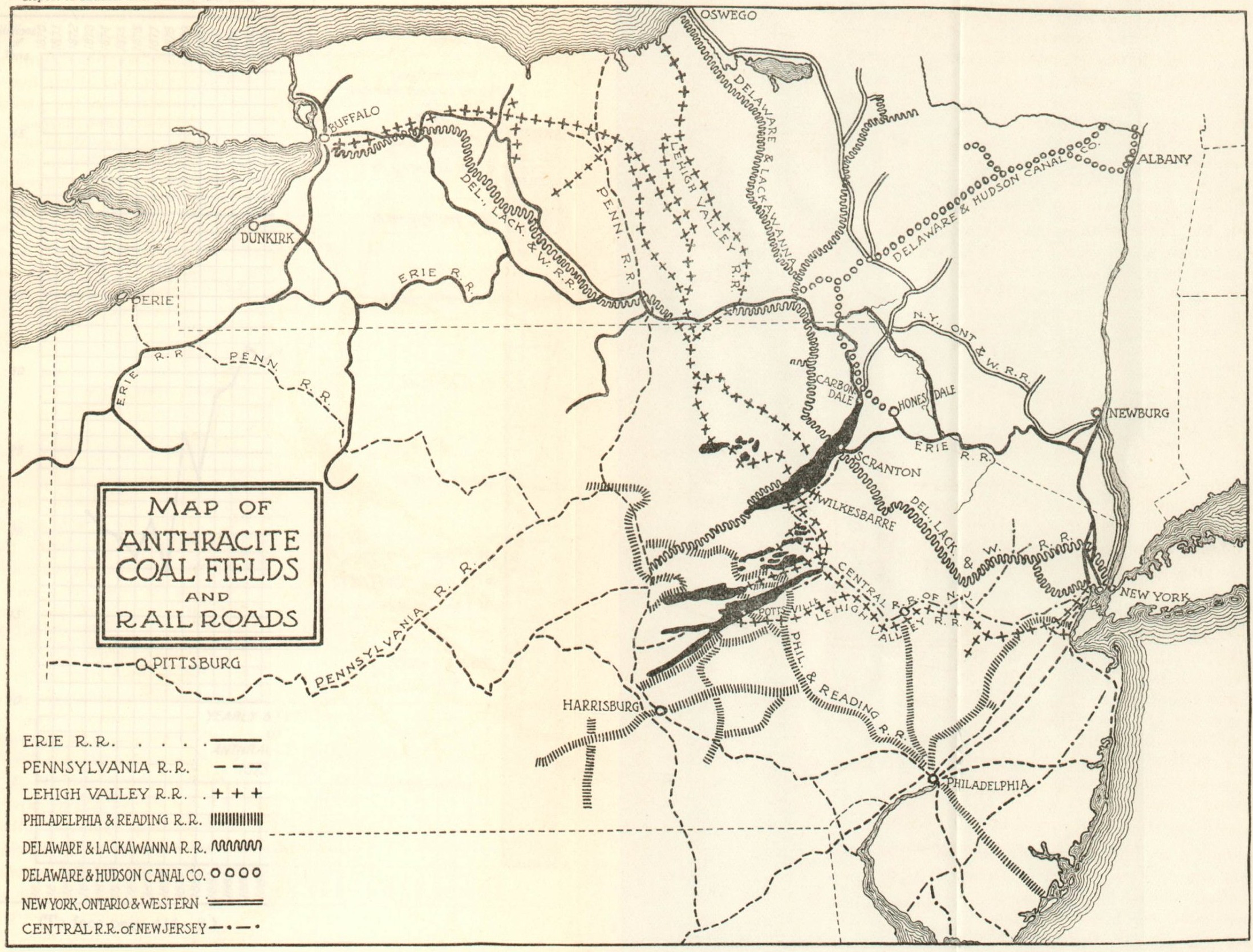
The anthracite monopoly is one of the greatest under American capitalism. Seven large coal companies own and control between 75 and 80 per cent of all the anthracite coal mined. They also own and control 90 per cent of the future supply of anthracite. These are “the companies” referred to by the men. They are owned and controlled by the anthracite railroads. For instance the Erie railroad owns or controls the Pennsylvania Coal Company where the present strike exists, the Delaware, Lackawanna and Western, the Glen Alden, etc. etc. The anthracite railroads are owned by or controlled through the Morgan and Rockefeller groups of banks. The Morgan group in 1922 had directors on the boards of practically all the large anthracite coal companies and the anthracite railroads. The National City Bank (a Rockefeller institution) in 1922 had connection with seven large producing, transporting or distributing companies.
The profits of this anthracite trust have grown to staggering proportions on the basis of figures compiled by the miners union. These profits according to the coal companies, the anthracite railroad and the distributing companies can be estimated at the huge sum total of two hundred and sixty million dollars annually.
This is the monopoly, the combination of American finance and industrial capital which has the hundreds of thousands of anthracite miners and their families in its ruthless grasp. It has its agents in their organization. Through its policy of class collaboration it is seeking to reduce a militant fighting labor organization to the status of a company union—doing the bidding of “the companies” henchmen inside and outside of the organization.
Against this mighty capitalist combination no lukewarm program or set of demands will avail. The present demands for the holding of a District convention and for the collaboration of the three District presidents are not enough. Fighting militant demands expressive of the real conditions of the miners lives and the forces with which they have to contend, must be made. ..All the general grievance committees should meet jointly and constantly. They should be welded together into a consolidated organization expressive of the rank and file. Under their auspices mass meetings of the strikers should be held, where the facts of the situation are explained. The grievances of the men should receive first consideration at these meetings and all other gatherings. The class collaboration policy of the District and International officials must be abolished. The Conciliation Board must be abolished. Complete freedom to meet and assemble at will must be established. The local unions must be reinstated by the International union with full rights.
Nationalize the Mines
These are but a few of the immediate demands that must be made if the miners organization in the anthracite is to be saved. Nothing short of a complete program to be followed by the militants of the region will put a firm ideological foundation under this at present unconscious struggle. Nothing short of the nationalization of the industry (the demand being made by the Progressive Miners Committee, the Trade Union Educational League and the Workers Party) can help solve the grievances from which the anthracite miners have now suffered for many years.
Anthracite miners do not become discouraged. Straighten your backs! Struggle against Morgan, Rockefeller and their agents in and out of your organization! Away with class collaboration and on with the class struggle! Solidarity will win.
Workers Monthly began publishing in 1924 as a merger of the ‘Liberator’, the Trade Union Educational League magazine ‘Labor Herald’, and Friends of Soviet Russia’s monthly ‘Soviet Russia Pictorial’ as an explicitly Party publication. In 1927 Workers Monthly ceased and the Communist Party began publishing The Communist as its theoretical magazine. Editors included Earl Browder and Max Bedacht as the magazine continued the Liberator’s use of graphics and art.
PDF of full issue: https://www.marxists.org/history/usa/culture/pubs/wm/1925/v4n04-feb-1925.pdf
 Revolution's Newsstand