
A valuable background to the events of 1933 and and the role of the Communist Party. Cuba’s Revolution of 1933 saw a mass student rebellion and workers’ general strike overthrow formerly U.S.-backed dictator Gerardo Machado, and the coming to power of Batista, then as U.S.-allied kingmaker, in Cuba’s military as U.S. imperialism attempted to retain control of the island.
‘The Revolutionary Events in Cuba and the Tasks of the Communist Party’ by J. Gomez from International Press Correspondence. Vol. 13 No. 41. September 15, 1933.
The revolutionary events which took place in Cuba in the middle of August, participated in by the broadest masses of the toilers of Cuba and overthrowing the actual dictator, did not come by surprise. These events were the outcome of the whole course of development of the economic crisis which has undermined the national economy of the country, reducing the toiling masses in town and country to want and misery, and aggravating class antagonisms to the utmost pitch.
Cuba, with its four million inhabitants, is a colony of U.S.A. imperialism, and one of the most important ones. It is important not only as an agrarian and raw material appendage of the United States and as a market for American products, but as a military strategic base, supplementing the system of the Panama Canal. Hence the special “attention” which the United States accord to Cuba, especially during the last few days, when American warships have been sent to “protect American subjects.”
All the leading branches of industry of Cuba are practically in the hands of U.S.A. capital. According to data published in the “New York Times” on February 5, 1933, the U.S.A. have a total of 1,750 million dollars invested in Cuba, other foreign countries a total of 1,900 millions. When it is remembered that the U.S.A. investments in South and Central America total 6,000 million dollars, in round figures, the tremendous importance of Cuba, and the role which it plays in the colonial system of the United States become apparent.
Cuba has been converted into a typical mono-culture country. Its main product and export article is sugar, more than 70 per A number of cent. of which is exported to the United States. U.S.A. companies have invested enormous sums in this branch of Cuba’s national economy (the “Daily Worker,” July 26, 1933, puts these investments at about 800 million dollars), and are at the present time the owners of tremendous sugar-cane plantations (about one-fifth of the total area of Cuba belongs to the U.S.A. companies), and of the absolute majority of the sugar boiling plants. Practically the same is the case with the tobacco plantations and factories, and with all other branches of agriculture and industry.
U.S.A. capital in Cuba is the producer, buyer, and exporter of the raw materials, and at the same time the controller of the inner trade in the industrial products of the U.S.A. and other sources. The rule of American capital prevails everywhere with the exception of the railway service, which is for the most part in the hands of British capital. British investments in Cuba are relatively small, especially if compared with U.S.A. investments.
Nevertheless, the United States has no intention of living peacefully together with British imperialism in Cuba, and is doing its utmost to dislodge Britain from its positions. With this end in view, it is promoting the building of high roads and the organisation of overland motor-coach lines. During the past year a very important high road was opened (at a cost of over 100 million dollars), crossing the whole island, and adapted for the rapid transport of troops in the event of war.
The world economic crisis, especially as it developed in the United States, has dealt a severe blow to the national economy of Cuba, the more so that this economy is mono-cultural in character and colonially dependent on the United States. The decline in the consumption of sugar in the United States, Great Britain, and other countries to which sugar is imported from Cuba, added to the increase of sugar production in a number of other colonial and semi-colonial countries (Brazil, Haiti, Santo Domingo, Java, etc.), has brought about a steady and considerable falling off of sugar export from Cuba. At the same time the sugar prices obtaining on the world’s markets, already lower in 1925 and 1926, have greatly depreciated during the period of the crisis: Whilst in 1923 the price of a pound of sugar was 5.3 cents, by 1929 it had dropped to 2 cents and by 1932 to 0.92 cents.
In consequence of the falling off of export, great stocks of sugar have accumulated. By April, 1930, there were three million tons of sugar accumulated in Cuba. In order to reduce these reserves, and to exert some influence on the raising of prices, the Machado government resolved, in agreement with the decisions of the International Conference of sugar-producing countries (held at the beginning of 1931), to reduce the production of sugar to a great extent and to exploit only a certain quantity of sugar cane. The government issued a special injunction, signed by the president, fixing the extent to which the sugar cane was to be worked up by the separate sugar boiling plants. In consequence of this injunction, the output of sugar declined from 5,136,000 tons in 1929 to two million tons in 1933.
The sharp decline in foreign trade is conspicuously apparent in the state budget, which showed a deficit of about eight million dollars (or 16 per cent. of the budget) in 1932-33. The measures taken by the Machado government for balancing the budget were directed chiefly against the toiling masses (higher duties on imports of articles of mass consumption, cuts in the salaries of civil servants, etc.).
The native bourgeoisie and the native large landowners are at one with the capitalists of the United States in seeking a way out of the crisis at the expense of the toiling masses. The restriction of sugar production has caused a number of sugar refining plants to be closed down. In 1925 there were 183 sugar refining works in operation, in 1932 only 133, and these not at full capacity. The plantations of sugar cane have also been reduced in area (in 1932-33 only 45 per cent. of the total sugar plantation area has been sown and cultivated). These circumstances have led to a considerable increase of unemployment, and at the present time there are about 500,000 unemployed in Cuba (“New York Times,” February 6, 1933). These are agricultural and industrial workers and employees, and as there is no social insurance in Cuba, they receive no relief.
The workers still in employment are not much better off than the unemployed. Wages are declining in every branch of agriculture and industry, the cuts sometimes being as much as 50 to 70 per cent. The average wage in the textile factories is scarcely 20 cents daily, and the tobacco workers are paid 30 to 40 cents; actual wages are further reduced by the fact that many branches of industry are working part time.
The situation of the sugar plantation workers is especially hard. The reduction of the area under cultivation and the restricted output of sugar have reduced the harvest season to 40 to 50 days in the year. This means fewer working days for tens of thousands of workers.
At the same time wages have dropped considerably. In 1930 a plantation worker was paid 40 cents for cutting 100 arrobas of sugar cane (1 arroba-11.5 kgs.), in 1932 only 15 to 20 cents. In a 14 hours working day 200 arrobas at most can be cut, and this requires strenuous labour. This is the reason why the “New York Times,” February 6, 1933, writes that the average wage of the sugar-cane workers on the plantations is not more than 15 to 30 cents a day. Conditions are rendered still worse in actual practice by the fact that the wages are not paid out in cash, but in scrip which can only be exchanged for goods in the shops and stores of the large landowners or the companies running the plantations. Many semi-feudal or semi-slavery customs still exist for the exploitation of the workers, not only on the plantations of the native owners, but on the plantations of the foreign companies, where these customs are closely interwoven with capitalist exploitation.
The sharp drop in wages on the one hand, and the oppressive exploitation on the other, have robbed the plantation workers of any desire or incentive to harvest the sugar cane, and they prefer to remain without work. This has become such a mass attitude on the part of the workers that in 1932 there was not enough labour to bring in the crops and the government found itself obliged to resort to the aid of the police and to send workers into the plantations with police guards.
The predominance of semi-feudal conditions, the colonial dependence on imperialism, and the mono-cultural development of the country, have plunged the farms of the middle and poor peasants of Cuba into growing poverty. This impoverishment has been further aggravated by the adoption of the “Chadbourne Plan” (in May, 1931) on the restriction of the sugar output. This restriction has almost exclusively affected the small holders and tenant farmers, for the sugar-refining undertakings have simply refused to work up the sugar cane offered by these farmers, preferring to utilise the cane from their own plantations and from the large landowners. The low purchase prices fixed by the U.S.A. companies force the farmers to abandon the planting of sugar cane. Many of these farmers leave the land which they own or have leased, and drift to the towns and plantations in search of work, thereby increasing the army of the unemployed. Other farmers grow vegetables, etc., with the “aid” of the large land-owners, thus sinking deeper into dependence, debt, and semi-slavery.
The position of the employees of the private commercial and industrial undertakings and of the civil servants has been rendered very hard by the crisis. In many cases employees’ salaries have been reduced by 30 per cent. and 40 per cent. and more. In 1931 alone the salaries of the civil servants were reduced three times, besides falling three and four months in arrears.
The petty bourgeoisie of the towns too finds its position seriously affected by the economic crisis and the measures taken by the government to balance the budget, especially the increased taxation.
The savage offensive of the ruling classes and the imperialists against the standards of living of the working classes has brought about a rapid radicalisation of the masses. Cuba’s revolutionary upsurge gives it a foremost place among the countries of South and Central America. The workers’ and peasants’ movement is assuming an increasingly militant character. The decisively important masses of the proletariat and the toiling population are joining the revolutionary struggle. In 1930 and 1931 the upsurge of the revolutionary movement had already commenced. Demands of an economic nature have been combined with and followed by demands of a political character, against the Terror exercised by the government, for the release of prisoners, against the “Chadbourne Plan,” for the resignation of Machado, demands of an anti-imperialist nature, etc.
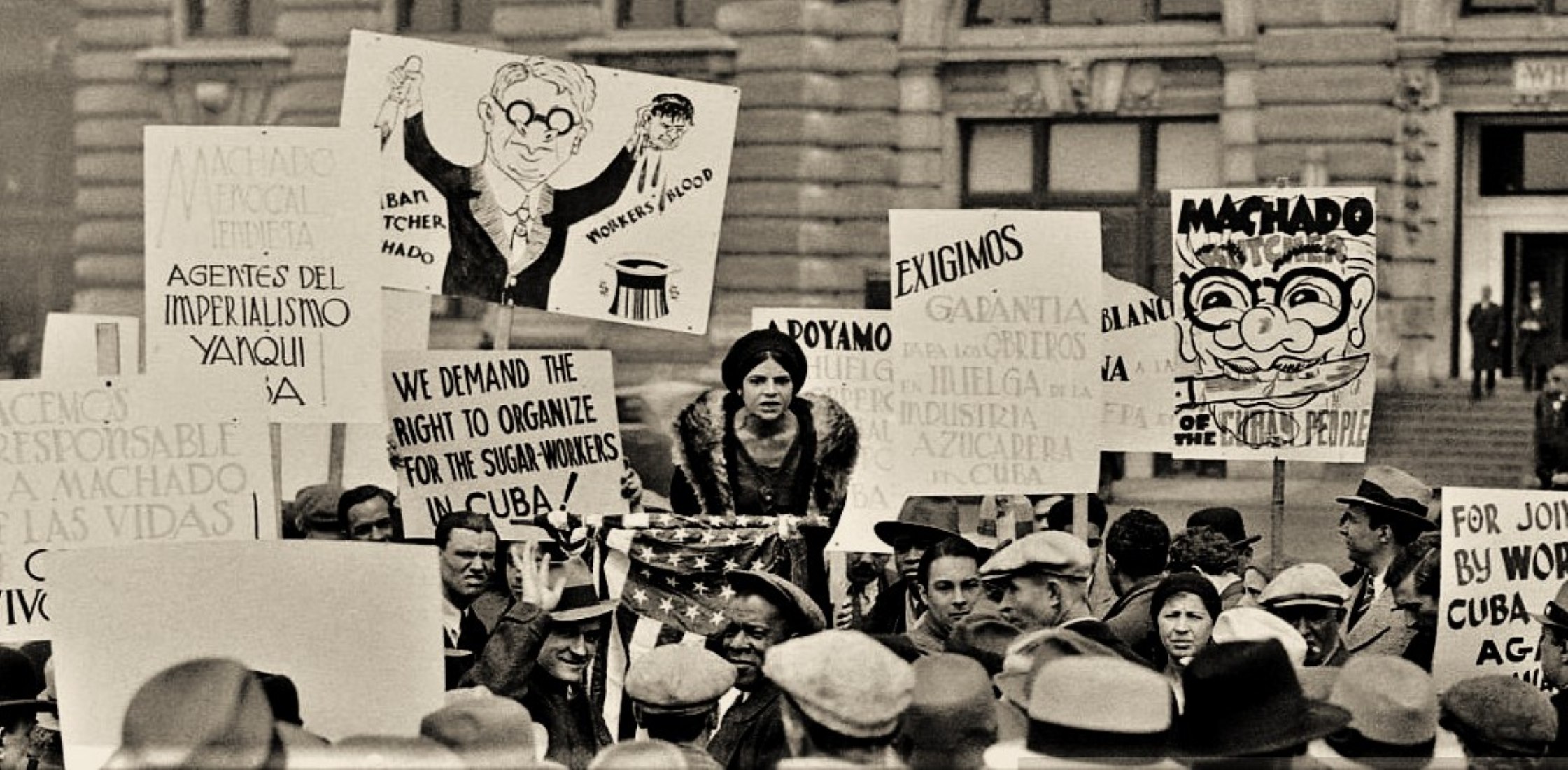
The general strike of March 20, 1930 (international fighting day against unemployment) was taken part in by 200,000 workers; the solidarity strike for the striking tramwaymen of Havanna and against police terror, in August, 1931, was participated in by 50,000 workers; the three months’ strike of the tobacco workers of Havanna, at the beginning of 1932, affected 15,000 workers; the strike wave on the plantations and in the sugar-refining factories in 1932 and 1933 has been taken part in by thousands of workers and has been accompanied by the occupation of premises and the organisation of an armed self-defence corps; there have been a number of strikes in various industrial undertakings, on the railways, and in the traffic service, chiefly in those in the hands of foreign capitalists (“Habana Electric,” railways, tramway workshops, etc.). The revolutionary mass demonstrations of thousands of unemployed in the course of the last two years, and indeed all these revolutionary struggles of the proletariat of Cuba, are evidence of the high level reached by the revolutionary upsurge which seized the masses of the toilers of Cuba. The leadership of these strikes and demonstrations has been chiefly in the hands of the Communist Party of Cuba.
The movement among the employees and office workers, and among the small citizens of the towns, is developing parallel with the movement of the proletariat. Strikes have been organised by employees against salary cuts, under the leadership of the Communist Party and the revolutionary trade unions. During the last few years employees have taken an active part in the general strikes in Havanna.
The petty bourgeoisie of the towns participates in the struggle by a mass refusal to pay taxes, high rates for electric current, etc. The sharpest expression of this struggle has been, however, the defence of the autonomy of the university by the students against Machado. Dozens of students’ leaders have been killed or imprisoned during the last few years by Machado’s agents. Terrorist groups have been formed by members of the embittered middle class, with the object of assassinating the prominent supporters of the Machado régime.
The Communist Party has placed itself at the head of the masses in their struggle for their demands, against the offensive of the large landowners and the capitalists, against oppression by U.S.A. imperialism, against the bloody dictatorship of Machado. Its prestige has increased steadily as the sole revolutionary party, as the militant vanguard of the proletariat of Cuba. During the period of the developing crisis, the period of developing revolutionary upsurge, the Communist Party has gained increasing contact with the masses whilst leading and organising them for the struggle, and has penetrated into many of the leading undertakings of the basic industries. Over the heads of the reformist leaders, the C.P. has aroused the masses to struggle for their partial demands. And over the heads and against the will of the officials, the workers organised in the reformist trade unions have followed the slogans of the Party and have joined in the general strikes, the solidarity strikes, and other revolutionary actions organised by the C.P.
During the past eighteen months, the Communist Party has commenced to penetrate into the densest masses of the proletariat of Cuba: into the masses of the agricultural workers. It was the C.P. of Cuba which organised the militant strike on the plantations and in the sugar-refining plant “Nazabal,” a strike which was supported by the peasants of the district. This was only one of a number of agricultural workers’ strikes led by the C.P. Recently the C.P. undertook the organisation of the first revolutionary trade union of the plantation and sugar workers, and this already embraces several dozens of plantations and sugar-refining works. At the same time the organisation of revolutionary leagues among the poor and middle peasants and tenant farmers was taken up for the first time. Now several of these leagues exist.
The Communist Party of Cuba has also taken up the task of work among the nationally oppressed Negroes, and advances the slogan of self-determination and independence for the Negroes, linking this up with a number of partial demands. This task is of great importance, for the national oppression of the Negroes (who form almost one-third of the total population of Cuba and the majority in a number of districts in the Oriente Province, etc.) is closely bound up with the semi-slavish character of the exploitation practised in Cuba, especially in the sugar cane plantations.
The growth of the political influence of the Communist Party is accompanied by an increase of membership. During the last two years the Communist Party has increased its membership four-fold or even five-fold. The Young Communist League of Cuba has increased in an even greater proportion.
All these successes, important as they indubitably are, are however not commensurate with the possibilities created by the objectively favourable situation. The Party has not yet penetrated sufficiently into a number of leading undertakings and has as yet struck very weak roots in some of the basic industries (among the tobacco workers for instance); the revolutionary trade unions and the Communist Party do not carry on work energetically enough inside the reformist trade unions; work in the rural districts is still the weakest link in the chain of the whole work of the Party; work among the middle classes in the towns, too, is weak.
The movement of the middle-class strata of the cities and of the peasantry is only slightly connected with the revolutionary movement of the proletariat, and is led chiefly by the bourgeois-landowning groups in opposition to Machado and forming the so-called “national opposition.” The leaders of this opposition are the great landowners of Cuba, such as Menocal, Mendieta, and others. The “struggle” which they carry on against Machado–a struggle for power, for the lion’s share of the wealth squeezed from the exploited masses–commenced immediately after the election of Machado as President of Cuba in 1925. The U.S.A. imperialists, closely bound up with the bourgeois-landowning group, since the interests of this group are interwoven with those of the U.S.A. companies, have no desire that the conflict in the ruling class in Cuba should become acute. The repeated attempts of the ambassadors of the United States (Guggenheim, for instance) towards a “reconciliation” with the opposition have, however, not been successful. The increasing aggravation of the economic crisis has continually sharpened the conflict in the ruling class in Cuba. The opposition, in its struggle against Machado, has endeavoured to exploit the growing discontent of the toiling masses in town and country, their hate against the terrorist régime of Machado. These endeavours have met with a certain amount of success, especially among the peasantry and the petty bourgeoisie of the towns (including the students), and in part among the backward strata of the workers. The original organisation of the bourgeois-landowning opposition, La Union Nacionalista,” having lost all prestige among the masses on account of its invariably conciliatory attitude towards Machado, a new organisation was founded, the “A.B.C.,” which has employed the sharpest terrorist methods in the struggle against Machado and his agents. A number of other organisations have also been founded, petty bourgeois in composition, but with leaders in direct connection with the bourgeois-landowning opposition and led by it.
The terrorist actions carried out in the towns and in the peasants’ settlements in the provinces under the leadership of leaders authorised by the bourgeois-landowning opposition–actions expressing the growing dissatisfaction of the urban middle class and of the peasantry–have been provoked by the bourgeois- landowning opposition in order to give the impression in Washington that Machado’s position was untenable and that he must be replaced. The movement thus aroused among the peasants has, however, frequently exceeded the limits set by the bourgeois-landowning opposition. The insurgent peasants attacked, for instance, the estate owned by Menocal, one of the leaders of the opposition, and set the buildings on fire.
The movement was equally out of hand on the eve of the latest revolutionary events. The opposition negotiated with Machado on an armistice, the ambassador of the U.S.A., Welles, also being present. These negotiations were completely successful. The peace was signed. But neither Machado nor the U.S.A. imperialists who invariably supported him were able to stem the revolutionary movement.
Lack of data unfortunately prevents our analysing the development of the events immediately preceding Machado’s flight in August. But the whole course of developments, and the scanty information published by the press substantiate the claim that the mass movement of the toilers, swelling to its culmination at the end of July and the beginning of August in the form of a number of partial strikes and later in the general strike in Havanna, has been participated in and led to a very considerable degree by the Communist Party of Cuba. And though the leaders of the “A.B.C.” and of the bourgeois-landowning opposition have undoubtedly played a certain role in leading the movement, yet the defeat of Machado (on August 12) was the result of the real revolutionary struggle of the broad masses of the toilers, whose chief leader was the heroic Communist Party of Cuba.
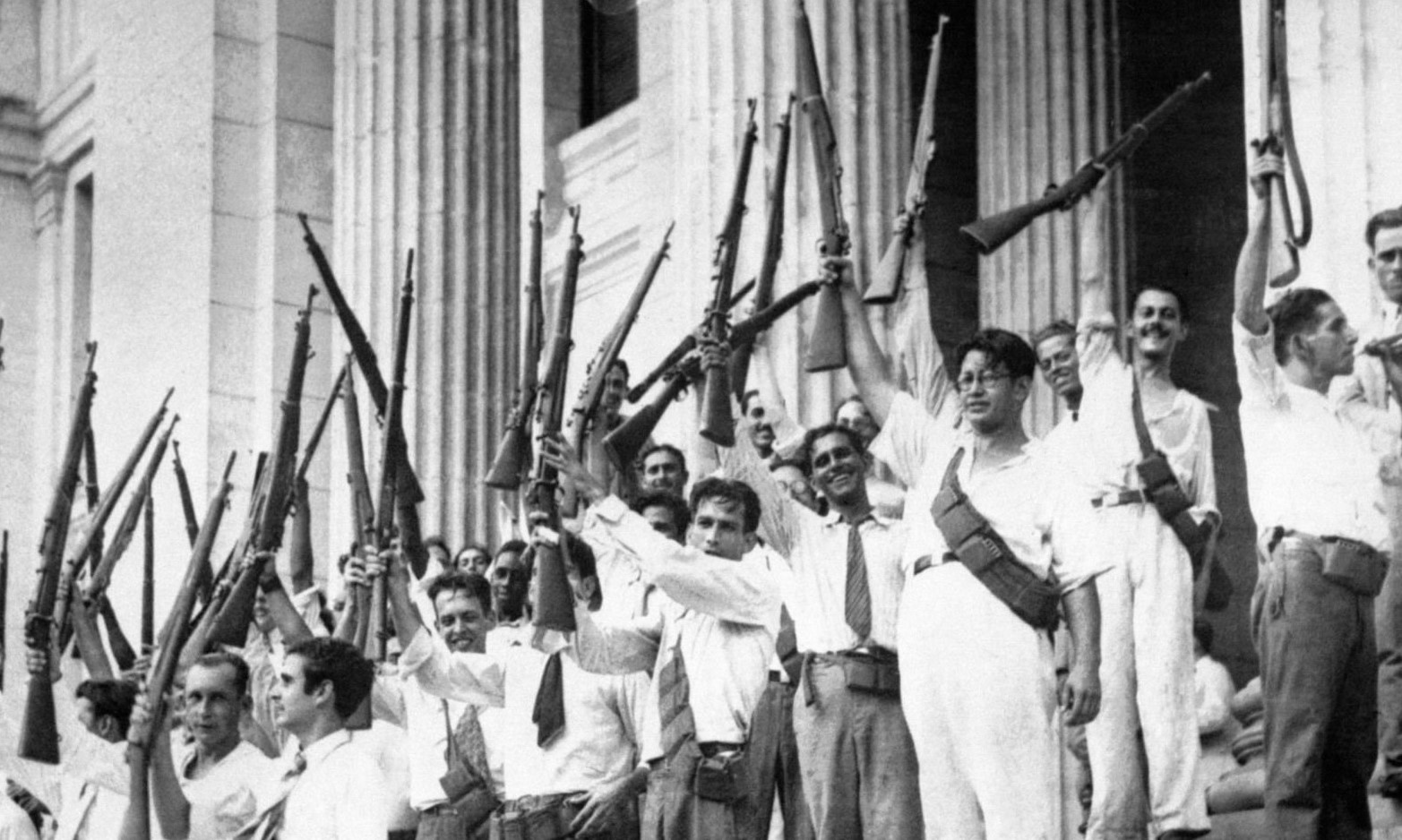
Machado’s overthrow in Cuba was as little due to a “pronunciamento” or “coup d’état,” so common in the countries of South and Central America, as was the overthrow of Ibanez in Chili in 1931. Machado was overthrown by the revolutionary pressure of the masses of the toilers. This movement had been prepared by the whole of the previous work of the Communist Party in Cuba, and was led chiefly by this Party.
The mass strikes preceding Machado’s downfall, strikes in which economic demands were accompanied by political demands (release of prisoners, resignation of Machado, etc.).; the killing of police agents (especially of Magrina, one of the murderers of the Communist Mella); the burning down of the office of the daily paper “Heraldo de Cuba,” Machado’s organ; the stormy demonstrations in the streets of Havanna and other towns–all this evidences the high level reached by the revolutionary upsurge of the toiling masses. Their demand for the legalisation of the Communist Party proves at the same time the extent of the influence gained by the Party over the masses participating in the movement.
The imperialists of the United States have now set up another puppet in place of the late dictator Machado (who fled by aeroplane from Cuba to a British island). This is Cespedes, the candidate agreed upon between the U.S.A. and the oppositional bourgeois-landowning parties. Cespedes, former ambassador at Washington, holder of a number of high offices in Machado’s cabinet, will pursue in all essentials the same policy as his “eminent ” predecessor–the policy of faithfully serving the interests of U.S.A. imperialism, of taking care of the interests of the ruling classes in Cuba and of lowering the standard of living of the toiling masses. Cespedes will follow Machado’s example in joining the imperialists of the United States and the ruling classes of Cuba in casting the whole of the burden of the crisis on to the shoulders of the toiling masses, in alleviating the situation of the bourgeoisie and land-owners of Cuba at the expense of the workers and in guaranteeing profits to the U.S.A. capitalists. It is probable that the bourgeois-landowning opposition, with whose consent Cespedes was elected” dictator, will accord him its support in these tasks.
The fact that Machado has been replaced by another puppet whose strings are pulled by the imperialists of the United States and the ruling classes of Cuba will not better the situation of the toilers in the slightest. It is a matter of indifference to the masses who forces them to starvation–Machado or Cespedes. The toiling masses of Cuba will reply to the increased attacks on their standards of living, and to the curtailment of their political rights, by even more determined revolutionary struggles. The revolutionary atmosphere of Cuba is becoming more heavily charged.
The growth of the revolutionary upsurge, and the militant actions of the toiling masses of Cuba, bear within them the germs of the elements of a revolutionary crisis. This situation must be fully and efficiently utilised by the Communist Party in the interests of the workers of every kind in Cuba.
The task of the Party, under the new conditions thus created, consists of a many-sided political and organisational preparation of the toiling masses for the decisive revolutionary struggles, for the struggle for power, for the revolutionary workers’ and peasants’ government.
The Communist Party of Cuba, whilst making every effort to develop the economic struggle of the working class, must not neglect to take into account that this struggle–under the given conditions of the maturing of the elements of the revolutionary crisis–must assume the character of a preparation of the working masses for the decisive revolutionary struggles. And therefore, parallel with the economic demands of the workers, the demands of a political character assume ever increasing importance. The struggle for these demands, combined with the main slogans of the Communist Party, thus makes the struggle of the proletariat of Cuba a political one, and raises it to a higher level.
In the present situation in Cuba, during the process of preparation for the decisive revolutionary struggles, special importance falls to the broad development of the struggle of the peasantry, the chief ally of the proletariat in its struggle against feudalism and imperialism. It is the task of the Communist Party to arouse these toiling strata for the fight for their immediate demands (cancelment of debts, non-payment of rent and taxes, etc.), to organise them at the same time for the struggle for political demands, and to popularise widely the main slogans of anti-feudal and anti-imperialist revolution.
In those districts where the peasant movement has already attained a high level, and where the volunteer movement is really developed, it is the task of the Communists to advance as a slogan of action the slogan of the revolutionary seizure of land belonging to the large landowners and foreign capitalists, to undertake the immediate leadership of this peasant action, and to organise the defence of the land thus seized. It need not be said that here the Communist Party makes no difference between the landowners of Machado’s camarilla and of Cespedes’ camarilla.
It is the further task of the Communist Party to penetrate into the army and navy, to arouse the soldiers and sailors to the struggle, and to bring their movement into harmony with that of the proletariat and the peasantry. The Communist Party of Cuba, in organising the struggle of the soldiers and seamen for their own economic and political demands, will at the same time popularise among them the main slogans of the Communist Party, the slogan of the fraternisation of the workers and peasants in the struggle, etc. At the same time, the Communists living in the districts where the war with the volunteer bands is going on, will agitate among the troops stationed here, inducing them to refuse to fight against the revolutionary peasants, and to go over to the side of the volunteers. The Communist Party, reckoning upon the fermentation in the army, will issue in the course of the struggle the slogan for the formation of soldiers’ and sailors’ councils–militant organs for putting forward the economic and political demands of the soldiers and seamen–and will not hesitate thereby to violate military discipline.
The broad masses of the proletariat of Cuba demand of the Cespedes’ government the legalisation of the Communist Party. It is possible that this government will find itself obliged to concede this under the pressure of the masses. The Communist Party must, however, not wait for this “peaceful” granting of legality, but must by its own determination win its legal existence, and the legality of other revolutionary organisations (Young Communist League, revolutionary trade unions, etc.), whilst at the same time maintaining and consolidating its illegal apparatus.
Parallel with this, it is the task of the Party to organise the struggle for such political demands as the freedom of the press, of speech, of assembly, etc., demands signifying the widest extension of “democratic” liberties.
At the suitable moment, the Communist Party will combine the struggle of the workers of Cuba with the slogan of the formation of the workers’ and peasants’ government, bringing forward and popularising the programme Nationalisation of the great industrial, banking, traffic, and other undertakings in the possession of the imperialists, expropriation without compensation of estates belonging to the large landowners of Cuba or to foreign capitalists, and free distribution of this land among the peasants; annulment of state debts; arming of the workers and peasants, formation of a revolutionary workers’ and peasants’ army for defence against the armed intervention of the imperialists, especially of the United States, etc., the toiling masses to be convinced thereby, on the basis of the programme of the workers’ and peasants’ government, that only this government is able to free them from the imperialist yoke and from exploitation by the bourgeoisie and the large landowners.
The Communist Party of Cuba, in advancing the slogan of the establishment of the workers’ and peasants’ government, and in organising the masses for the struggle for this government by forming factory committees and peasant committees supporting its influence, must at the same time include in its mass propaganda the slogan of the organisation of the Soviets of the workers, peasants, soldiers, and sailors. The Communist Party of Cuba also undertakes the task of forming these in actual practice (that is, of converting this slogan into a slogan of action) in situations in which the mass movement assumes a definitely sharp character, and of converting this movement (all over the country or in one single district) into open civil war. The Soviets created in this manner become transformed, in the organisation and leadership of the organic struggle of the masses, into organs preparing and carrying out the armed insurrection of the workers.
In combination with these slogans, and with the struggle of the toiling masses, the Communists of Cuba must advance the demand for the arming of the working class and the working peasants, especially in view of the danger of imperialist war and the preparations for intervention, and to this end they must mobilise the broad toiling masses for the struggle for the attainment of this demand through their own determination, especially in the districts where the revolutionary struggles have attained a high level.
In order that these struggles and demands of the Communist Party may be carried out, the forms of the struggle itself must alter. That is, advance must be made from the organisation of partial strikes in individual undertakings to the organisation of all-out strikes embracing whole branches of industry, towns, districts, regions, thus advancing the working class towards the political mass strike. The Communist Party, by combining the strike struggles with demonstrations, with the occupation of the factories, etc., simultaneously prepares the way for and organises the political demonstrations of the toiling masses.
The C.P. of Cuba will take up its task of extending its organisational network in the works and factories, in the sugar-refining factories, in the rural districts, and in the army and navy; further, the task of increasing its membership, especially among the workers in the large factories and the revolutionary working peasantry and among the poorest peasants, and the task of consolidating the revolutionary trade unions in the factories and on the plantations and the R.T.U.O. groups in the reformist trade unions and the revolutionary peasants’ leagues.

The Communist Party, whilst exposing the bourgeois-landowning character of the new Cespedes government, its role as agent of U.S.A. imperialism and its policy of attack on the economic and political rights of the toilers (exemplified on the very first day of the president’s taking office by the command to fire upon demonstrations, in order to “maintain order “), must not omit at the same time to unmask the “Left” demagogy of the A.B.C. and other parties, and to expose the relations existing between their leaders and the U.S.A. imperialists. Here the C.P. must win over the middle class of the towns, at present deceived by the “revolutionary programmes of these organisations and intoxicated by the success gained in defeating Machado.
In organising and leading the revolutionary movement of the toiling masses, the Communist Party of Cuba must resolutely maintain the revolutionary class line of its political, ideological and organisational independence against every bourgeois-landowning and petty bourgeois party and group hiding its actual aims behind revolutionary demagogic phrases, against every influence of outside classes endeavouring to penetrate into the ranks of the proletariat and even into the ranks of the Communist Party itself.
The Communist Party of Cuba, whilst combating the Right opportunist Junco group, and purging the ranks of the Party from its open and secret adherents, must at the same time combat that opportunist tendency still existing among some Party members, the idea that “the revolution in Cuba is impossible without the revolution in the United States–without the revolution in the other countries of Central America–without the support of the proletariat of other countries,” in a word, the theory which in actual practice serves solely to disarm the proletariat of Cuba and its vanguard, the Communist Party of Cuba. The revolutionary militancy of the proletariat and the toiling masses of Cuba, as evidenced during the last few years; the existence of a Communist Party in Cuba, self-sacrificing and ready to fight; and on the other hand the growing acuteness of the antagonisms in the ruling classes, resultant on the profound economic crisis following the partial stabilisation of capitalism–all this forms the best guarantee for the possibilities of the triumph of the revolution in Cuba.
There is no need to emphasise that the Communist Parties of the other countries, especially the Communist Parties of the United States, Mexico, and Central America, must mobilise the proletariat and the broad masses of the toilers in active support of the revolutionary movement in Cuba.
The Communist Party of Cuba is on the eve of far-reaching revolutionary struggles. The fulfilment of the revolutionary historical tasks set this Party in the present situation depends on its ability to lead and intensify the economic and political struggle of the proletariat and the toiling masses of Cuba.
International Press Correspondence, widely known as”Inprecorr” was published by the Executive Committee of the Communist International (ECCI) regularly in German and English, occasionally in many other languages, beginning in 1921 and lasting in English until 1938. Inprecorr’s role was to supply translated articles to the English-speaking press of the International from the Comintern’s different sections, as well as news and statements from the ECCI. Many ‘Daily Worker’ and ‘Communist’ articles originated in Inprecorr, and it also published articles by American comrades for use in other countries. It was published at least weekly, and often thrice weekly. Inprecorr is an invaluable English-language source on the history of the Communist International and its sections.
PDF of full issue: https://www.marxists.org/history/international/comintern/inprecor/1933/v13n41-sep-15-1933-Inprecor-op.pdf
 Revolution's Newsstand