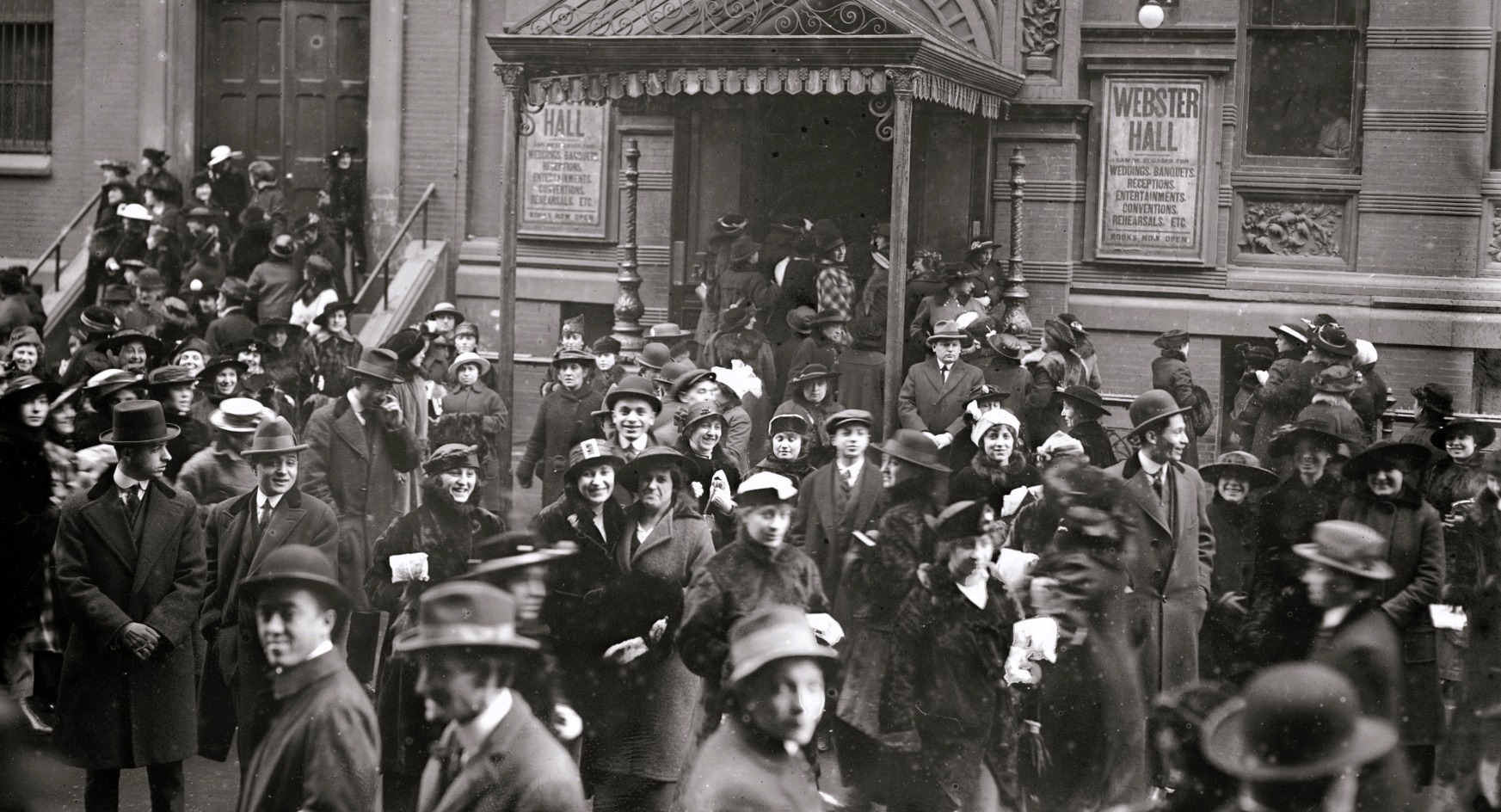
A pioneer of U.S. workers’ education, labor health, and union recreation programs, the I.L.G.W.U.’s Fannia Cohn on bringing music to every workers’ hall in New York during 1919’s general garment workers strike.
‘Concerts in Time of Strikes’ by Fannia M. Cohn from Justice (I.L.G.W.U.). Vol. 1 37. September 27, 1919.
That music is becoming an important factor in time of strikes has been shown during the recent strikes of our New York locals, particularly in the cloakmaker strike.
Already in the second week of the strike requests were made by some hall chairmen to arrange concerts in their halls, and these requests were fulfilled as promptly as it was practicable.
The first few concerts were arranged in some of the largest halls such as Webster Hall, Manhattan Lyceum, Progress Casino, etc. This was done because each of these larger halls has a stage fit for concerts and theatrical performances, and the singers and players prefer to appear on regular rather than on improvised stages.
The news that the Entertainment and Speakers’ Committee was arranging concerts for the strikers with first class talent spread with the rapidity of lightning. Since the large halls where the concerts were being arranged were few, the smaller halls serving as district strike headquarters, many “kicks” began coming in from the chairmen of the “neglected” halls. There was many a stormy conversation over the telephone between the chairman of the Entertainment and Speakers’ Committee and the indignant hall chairmen, who protested that the strikers in their halls are just as loyal to the union and pay just as large dues as those of the big concert halls, and that there is no justification for the “discrimination” against the small halls. Some went even as far as threatening that they would not be responsible for what might happen if regular concerts would not be arranged in their halls.
The Speakers and Entertainment Committee were impressed with these requests, protests and threats, and before long a concert machinery was set up and every hall reached.
The concert day was a holiday for the strikers and they came to the halls earlier than usual and in their Sunday best. The hall chairman would look and feel both proud and important, and the speakers as well as the performers would be greeted with generous applause.
There were interesting things to see as well as to hear at those concerts. A singer accompanied by a violin and piano would begin pouring forth the strains of the new Russian hymn or of the Marseillaise, and the audience. would rise to their feet and join in. Hats would be removed by all the strikers save the few old men who have religious scruples about baring their heads. These would waver a while, place their fingers on their heads, vacillating between respect to their creed and homage to the ideal of revolution, and would, as a rule, end by removing their hats. Then performers, gentiles many of them, could not help noticing the embarrassment of the older strikers: and would address them in kind words absolving them from what they considered a breach of honored tradition.
I witnessed, a concert in the Brownsville Labor Lyceum, at which the Russian hymn was played. Two old men jumped up at the first strains of the tune, removed their hat and remained in their skull caps. One of them said to me: “I love to hear Russian songs. They remind me of the old home. But we are Jews, and it would be only proper if they play something Jewish, something that grasps at your heart.” I was at a loss how to comply with his wish. The singer happened to be an American young lady who, it was natural to suppose, knew nothing of Jewish melodies that “grasp at your heart.” But to my greatest surprise she began singing the “Hatikvo,” the hymn of regenerated Zion. The audience, with the exception of a few, rose to their feet.
The programs of the concerts were generally arranged so as to meet the tastes and inclinations of the audiences. Yiddish folk songs were greatly in vogue and were greeted with bursts of applause. The Russian hymn and the Marseillaise were immensely popular.
The violin was the favorite instrument with the strikers. And the violinists could not help yielding to the insistent demands of the audience for popular encores.
Our friends among the artists had occasion in that strike to contribute their share to the cause of labor. I want to take this opportunity on behalf of the Speakers’ and Entertainment Committee, to express our thanks and appreciation to the persons who made the most valuable contribution to the strike, namely, good cheer and holiday spirits. Among the very first I wish to mention the name of Miss Temma Committa, who, as chairlady of a committee organized by the Rand School to co-operate with our Speakers’ and Entertainment Committee, helped us a great deal in arranging concerts. Also Mrs. Laura Elliot helped our committee considerably.
It is superfluous to say that Miss Vida Milholand, who sang mostly revolutionary pieces, was the pet of all our audiences. The following artists took part in our concerts:
Singers: Miss Vida Milholand, Miss Posnolsky, Miss Louise Vermont, Miss Gertrude Sipiro, Miss Roberts, Miss Bella Finkel “and” Miss Lucy Finkel. Violinists: Mr. John Gorighano, Mr. Louis Goldberg, Mr. Grainin, Mr. Emanuel Edelstein, Mr. Emanuel Berg, Mr. Lazor Elkin, Mr. Walter Cohost, Miss Goldenthau.
Pianists: Miss Heifetz, Miss Moore, Miss Midget Gould, Miss Harriet Salant, Miss Ruth Garland, Miss Berman, Mr. Jacobson and Mr. Gindin.
The appreciation shown by the cloakmakers was the best reward of the artists. But they also have the boundless gratitude of the Speakers’ and Entertainment Committee as well as of the entire union. The alliance of Art and Labor was an inspiration to us all and is, we hope, a harbinger of a better future.
The weekly newspaper of the International Ladies Garment Workers Union, Justice began in 1909 would sometimes be published in Yiddish, Spanish, Italian, and English, ran until 1995. As one of the most important unions in U.S. labor history, the paper is important. But as the I.L.G.W.U. also had a large left wing membership, and sometimes leadership, with nearly all the Socialist and Communist formations represented, the newspaper, especially in its earlier years, is also an important left paper with editors often coming straight from the ranks radical organizations. Given that the union had a large female membership, and was multi-lingual and multi-racial, the paper also addressed concerns not often raised in other parts of the labor movement, particularly in the American Federation of Labor.
PDF of full issue: https://www.marxists.org/history/usa/pubs/justice/1919/v01n37-sep-27-1919-justice.pdf
 Revolution's Newsstand