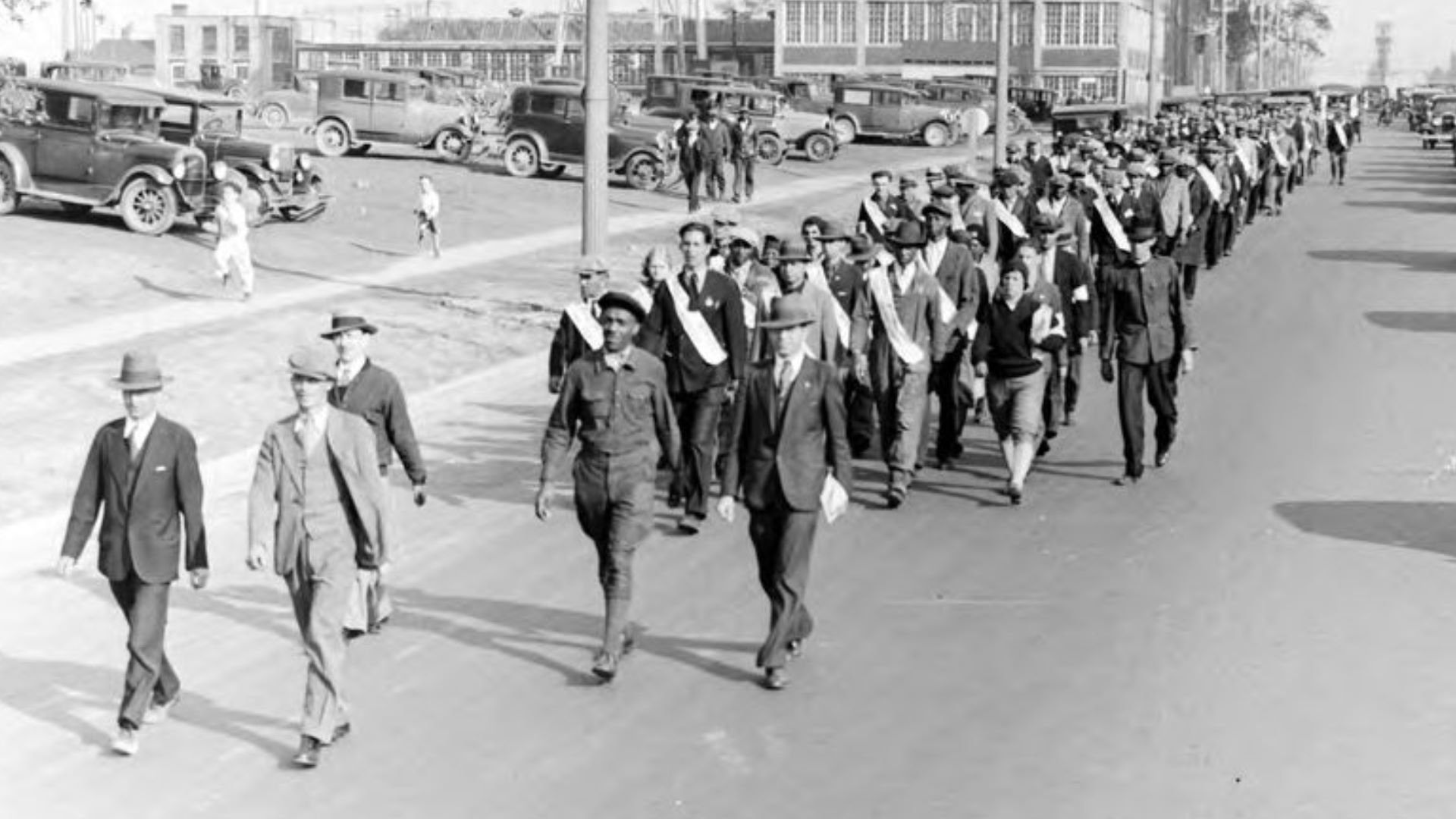
Informative internal report on the reorganization of the functioning of the Communist Party’s District 7 with 570 members, 480 of them in the city of Detroit.
‘Organization Work in Detroit’ from The Party Organizer. Vol. 2 No. 3-4. March-April, 1928.
District 7 of the Workers (Communist) Party is unique in several ways. In the first place 84 per cent of the membership is in one city which has 15 of the 22 nuclei and 480 of the 570 members of the entire district. This means that the district office can be in far closer touch with most of the nuclei than in most districts.
In the second place the membership is almost entirely proletarian. Of the 570 members in the district only about 5 per cent are non-proletarians, the rest being proletarians and their wives.
In the third place the district is predominantly a one industry district, automobile (furniture in Grand Rapids) so that the problems are relatively simplified and the membership more bound together.
Fourth, most of the members are concentrated in large factories, providing the Party with the opportunity of building shop nuclei and street nuclei that can work in the factories also. Of the 480 members of the Party in Detroit 210 it is estimated, are in shop nuclei. These shop nuclei represent the most important automobile plants in Detroit with nearly 200,000 workers. These nuclei have their five shop papers, which come out more or less regularly and are sold. The papers are Ford Worker, Packard Worker, Hudson Worker, Dodge Worker, Fisher Body Worker.
Fifth, the 16 Party Language Fractions are very well representative of the foreign speaking population. These fractions also have good contact with their respective nationalities.
Generally speaking, the Party is in a relatively healthy condition and has been making progress.
Organizational Work.
The first problem in the district was the establishment of a strong collective leadership. To accomplish this the following changes were necessary.
1. A secretariat of three full functionaries was created that considered every problem collectively and met almost every day.
2. The polcom was called to meet every week instead of once in two weeks as before and a regular night set aside for the meeting.
3. A full DEC meets once in six weeks or so. Since the Polcom (with candidates) is so large and since the cities outside Detroit are so few, there are only a few comrades outside Detroit who come to a DEC meeting. To take in comrades on the DEC who live in Detroit but who are not on the Polcom, enlarged Polcom meetings are held from time to time.
The second problem was the correct departamentalization of the work. The organization committee of the district was abolished in line with the recommendations of the CEC Organization Committee and an Org. Department established instead.
2. The Agitprop committee was entirely reorganized to meet the new functions which were placed on it. Each nucleus and section now has an agitprop director.
3. The Trade Union Committee took a new life as the auto campaign began to open up. Each nucleus and section now has an industrial organizer thus making the committee head of a department.
4. A women’s work department was established with representatives in the nuclei and sections.
5. A Negro Department was created with representatives in each nucleus and section.
6. The cooperative committee was reorganized.
7. Anti-imperialist committee was reorganized.
8. An unemployment director was established.
9. A district control commission was established.
10. A District Investigating committee was established.
Each of the various departments have already had their department conferences with representatives from the nuclei and sections. A full program of work has now been mapped out for each department.
Stabilizing the Units
The third big problem was the building up of the nuclei. The nuclei had fallen down for several reasons:
a) Unemployment.
b) Members fired from the plants for being Communists, etc.
c) Insufficient attention.
d) Previous factional situation.
e) Lack of nuclei bureaus and insufficient departamentalziation of work.
f) Creation of too weak nuclei.
g) Changing day and night shifts.
To build up the nuclei the following was done:
1) Each nucleus was assigned a leading polcom member of the district.
2) This member was to take a post in the nucleus and regularly attend.
3) Tuesday was set aside to the nucleus meetings or the nucleus bureau meetings. In case of shop nuclei where the members worked nights, Saturday afternoons and Sunday mornings were allowed. On Tuesdays no other meetings were allowed to be arranged.
4) The nuclei meet twice a month, and the nuclei bureau twice a month in between meetings of the nuclei.
5) A complete new registration is being taken. This new registration will enable us to transfer comrades to their proper shop nuclei from street nuclei, to build new shop nuclei and to place comrades in the street nuclei where they live.
6) “Floating” street nuclei have been abolished. Each nucleus now has definite boundaries in which to work.
7) Some nuclei have been dissolved and others merged.
8) Every effort has been made to build up a leadership in the nucleus thru the raising of the dignity and power of the nucleus bureau.
9) The nuclei bureaus have been entirely reorganized in conformity with the reorganization of the Party generally. The bureau consists generally only of the Organizer, who now is the only one to receive the mail in the nucleus, the industrial organizer, the agitprop director, the women’s work director, the negro work director, and in the case of shop nuclei, the shop paper editor. This is the bureau of the nucleus. made to activize the membership
10) Every effort now has been behind the various departments. Each nucleus is now to have a leaflet distribution committee, and a shop paper selling committee, besides a Daily Worker Agent, a Literature Agent, and a shop paper editorial board of the nucleus. The job of being recording secretary and financial secretary is usually combined with one of the political posts in the nucleus.
11) A Party functionary class has been established with great success.
The class is compulsory for all functionaries on the bureaus.
12) Inner agitprop work has been developed through nuclei discussion bulletins prepared by the agitprop, so as to liven up all meetings and to give the comrades a better understanding of the problems.
Another problem connected with this was the problem of handling spies.
1) The new members nucleus was abolished.
2) In its stead a district investigation committee of three has been created.
3) A new members class will be started.
4) And a district control commission has been established.
Hand in hand with the building up of the nuclei went the building up of section meetings and of section executives. The old section delegate system was abolished and section executive elected instead. While section meetings have been called the attendance is still insufficient, and the section executives still do not meet as they should. This is something which must be developed more than before.
Regular district membership meetings have been held in each case combining practical work with theoretical discussion. The first meeting Comrade Weisbord was the reporter on the meaning of the Russian Revolution. At the second meeting Comrade Bittleman was the reporter on the Build-The-Party Drive and Schmies reported on the Auto Campaign. At the third meeting Comrade Gitlow reported on the Trotzky Opposition.
Centralization
The fourth big problem was the centralization and coordination of the language fraction work. The DEC now appoints all bureaus of all fractions where necessary. The DEC has now assigned a DEC representative to each language fraction. Each language fraction now reports to the center in periodic conferences which are held and where the fractions are brought into the general line of Party activity. The rule that ten per cent of all fraction affairs go to the district is being strictly enforced.
The fifth big problem of an organizational nature was the bringing of the cities outside of Detroit, something very important, closer to the center. Each month or so now these outside cities, some of them very far from the center, receive a representative from the district. In the month of November all of the outside cities were covered by speakers on the Russian Revolution demonstrations. At the same time in membership meetings organizational questions also were taken up. In the month of December all units with the exception of Pontiac were covered on the question of protesting against the murder of the miners in Colorado. At the same time in membership meetings the Trotsky question was taken up. During the month of January all units outside of Detroit held Lenin Memorial Meetings with speakers from the center.
Besides the matter of meetings, the outside units have received help in other ways and more attention than before. In all of the campaigns of the Party the outside cities were included. When New Year’s Ball was arranged in Detroit, letters were sent out to see that a Ball for the Daily Worker was arranged also in the other cities. So far they have responded. On miners relief almost all of the outside cities are now busy with their united front conferences.
Hitherto these outside cities had received much less attention than t hey should have. It is the first time, for some of them, that they had Russian Revolution meetings. It is the first time that they have united front movements established. This policy should be continued ever more that before.
The sixth big problem was the building up of the shop papers. It was clearly established that the nucleus itself must make the paper, of course with the guidance of the district, but with its own initiative and work. The fact was that the nuclei were not participating sufficiently either in making or distributing the paper. A district editorial board has now been established composed of the editors of all of the shop papers and one from the district. In each shop nucleus now a unit editorial board has been created. In each section and in each street nucleus shop paper selling committees have been formed. However, we are only in the beginning of this work. A great deal yet has to be done.
Building the Party
The seventh organizational problem was the problem of capitalizing the sentiment for the Party by getting new members. Here too only a beginning has been made. The language fractions have been instructed to canvass carefully all clubs and other such organizations for material for the Party. Fraction and sympathizers meetings have been arranged to be addressed by the district representative to bring in those sympathizers into the Party. A good deal of attention is being paid to how to draw in the person that comes to our mass meetings into the Party. This too, has to be worked out better. And finally, through the proper distribution of leaflets, it is hoped to increase greatly our members.
The matter of leaflet distribution is no longer a haphazard matter but is receiving careful study as a method of building up our street nuclei and creating new ones. The streets of Detroit have been carefully mapped out to include proletarian centers, in each section of the city. Each nucleus, shop and street, elect leaflet distribution committees which are assigned to particular streets in territory within the jurisdiction of the street nucleus or section where the committee belongs. Each month or so from 30,000 to 50,000 leaflets on some special topic are being distributed. The same comrade going to the same streets on each successive month. At the end of five or so months, with the beginning of summer, there will be a mass distribution of the Daily Worker, and then this will be followed up with personal canvassing of those people who were found to be sympathizing and those sympathizers will be drawn into the Party.
Further advance in organizational lines have been made in a complete analysis of the finances that have been made and the drawing up, for the first time in Detroit, of a budget. The budget is still very crude and unpolitical but it is better than no budget and will be improved with time.
A further step has been the rigid enforcement of written reports from all subcommittees of the district. This rule will gradually be extended to include all language fractions and nuclei.
To conclude we see progress has been made:
1) In the building up a strong collective center theoretically developing and knowing all phases of the Party.
2) In completing the reorganization of the Party.
3) In building up the nuclei and developing functionaries.
The Party Organizer was the internal bulletin of the Communist Party published by its Central Committee beginning in 1927. First published irregularly, than bi-monthly, and then monthly, the Organizer was primarily meant for the Party’s unit, district, and shop organizers. The Organizer offers a much different view of the CP than the Daily Worker, including a much higher proportion of women writers than almost any other CP publication. Its pages are often full of the mundane problems of Party organizing, complaints about resources, debates over policy and personalities, as well as official numbers and information on Party campaigns, locals, organizations, and periodicals making the Party Organizer an important resource for the study and understanding of the Party in its most important years.
PDF of issue: https://www.marxists.org/history/usa/pubs/party-organizer/v02n03-04-mar-apr-1928-Party%20Organizer.pdf
 Revolution's Newsstand