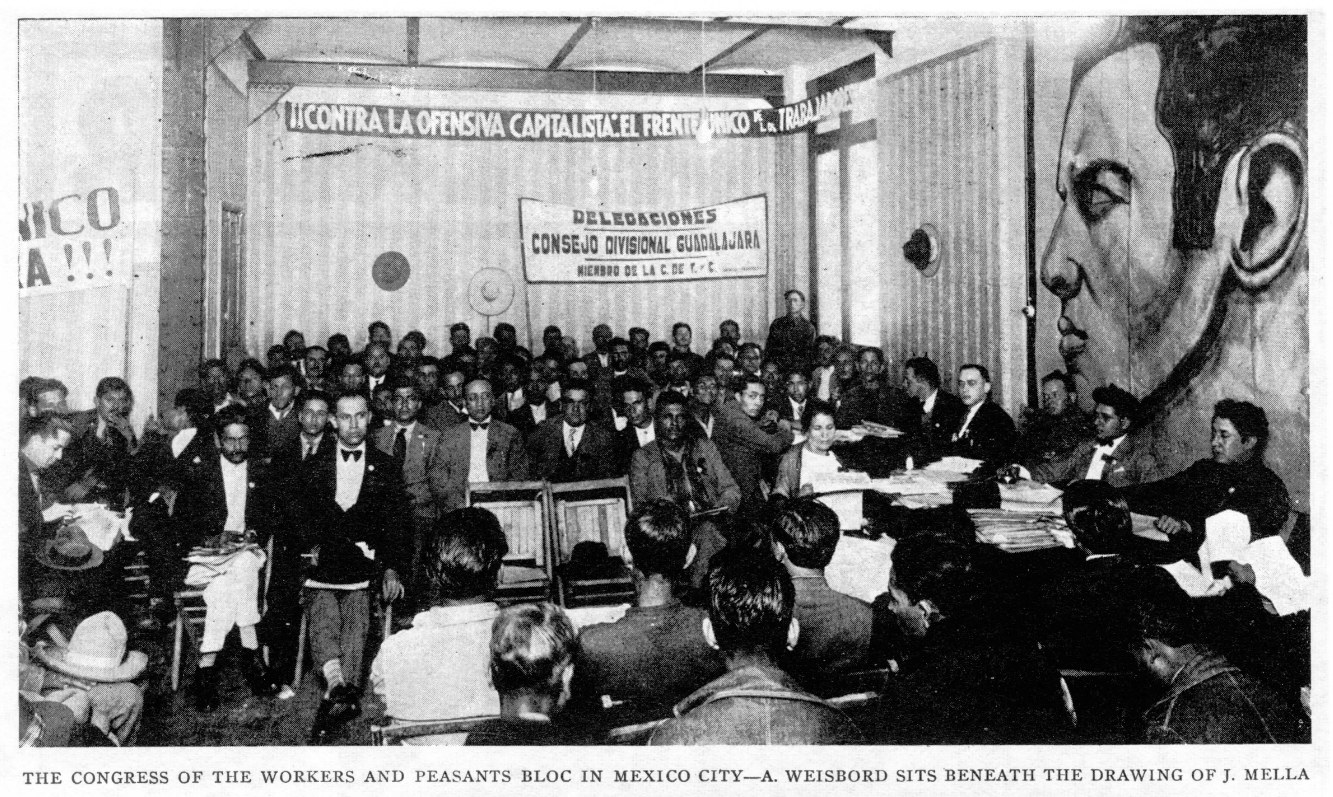
Much of interest in this sprawling Daily Worker series from Albert Weisbord reporting on his participation in the founding conference of Mexico’s short-lived Workers and Peasants Bloc as a representative of the T.U.E.L. While providing an astute outsider’s perspective on the details of the Mexican class struggle, Weisbord also places emphasis on the role of U.S. imperialism, the responsibility of U.S. Communists, and the organization of Mexican workers in the United States. Over two weeks he writes on the exploitation of Mexican labor in the U.S., political and economic conditions in Mexico, the Convention of the Bloc of Workers and Agrarians, Weisbord’s speech to the Congress, participation in a memorial for Julio Mella, and a look at the state of the Mexican Communist Party. Will be of interest to all students of the Mexican left.
‘Mexico, the Bloc of Workers and Agrarians and the Mexican Communist Party’ by Albert Weisbord from The Daily Worker. Vol. 5 Nos. 350-360. February 15-27, 1929.
(This is the first of a series of five articles on Mexico by Albert Weisbord, who has just returned from Mexico City, where he went as a delegate from the T.U.E.L. of the United States to the Unity Conference of Workers and Peasants. The second article, to be published tomorrow, will deal with political conditions in Mexico and its relations to U.S. imperialism.)
I. Mexicans in the United States
One travelling through the mid-south and Texas on the way to Mexico must be impressed with one outstanding fact–the tremendous misery of the masses. As the train whizzes by one can see the shacks, one room, one window, clap-trap boards, unpainted, open toilets, home of pig and chicken, where those who toil from morn to night must live. I was shocked oy the similarity of these conditions to those of the peasants of Poland. They looked like the same kind of shacks, only here was even more terribly severe exploitation.
I began to see more clearly than before that truly there was a sort of inner imperialism in the United States, where the agrarian masses of the mid-south had already been driven down practically to the level of the European peasant. I am sure that no one knowing this part of the mid-south can claim that conditions are better in this part of American than in Europe.
This tremendous fact has not been utilized at all by the Party. Have we not always taken for granted the fact that the agrarian toilers were better off in America than in Europe? Let us turn our spotlight on this part of the country, Texas, Mississippi, Alabama, etc., and there will be revealed conditions that will act as an electric shock to the whole labor movement and to the Party, showing to the Party more clearly than before the basic conditions of the masses and the tasks and opportunities before it. In this connection it should be said that a great deal of material was missed during the last Mississippi flood. Our Party did something to expose the conditions, but what a wealth of material could have been revealed!
Can anyone maintain that masses undergoing such terrible oppression are not objectively ready for revolution? To anyone who scoffs at this, I say to him, go down yourself and try to live under such conditions.
And I would ask him further, “What do you know about the south anyway?” The more one sees of the real situation the more one realizes that our Party has done so little in the South, so little among the agrarian toilers, so little among the Negroes, so little among the most exploited of all!
It is in the South that most of the 3,000,000 Mexicans in the United States live. These Mexicans live even worse than the whites. In all America, with the exception of the Negroes, one cannot find a section of the population more exploited. Three million Mexicans in the United States, but how many in our Party? Yet these Mexican toilers have a tremendous role to play.
In the first place, in the South and West they are concentrated in most important industries, such as oil, mines, railway, metal, and compose the bulk of the agricultural workers. The organization of the unorganized of these industries especially in this region must take in above all these Mexican masses. They are ready to organize, The A.F. of L. officialdom has ruled them out of its unions, and fights hard to prevent them from being organized.
Have Formed Own Unions.
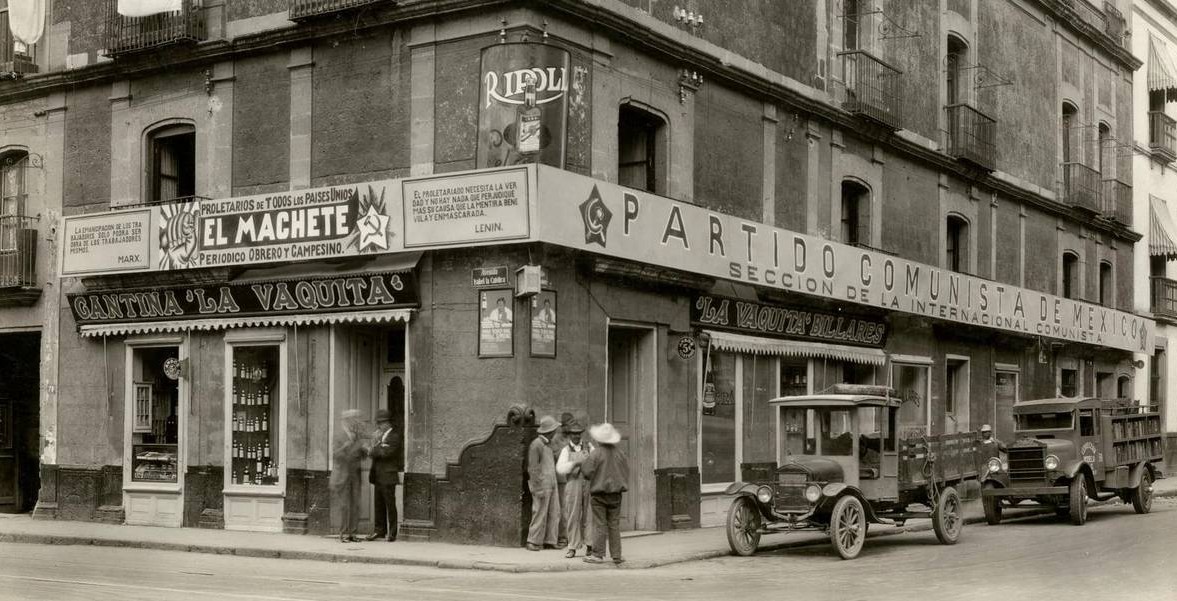
In spite of that they have formed unions of their own and almost 1,000 of them subscribe to El Machete, the organ of the Communist Party in Mexico. Unseen and neglected by the revolutionary movement, betrayed by the reactionary labor bureaucrats, yet the Mexicans in the southern part of the U.S., rightfully trusting no one, have gone ahead undaunted, in spite of their tremendous handicaps. The revolutionary movement in the U.S. has a huge sin to wipe out. The mobilization of these masses must become one of our most important tasks.
Especially must this be so when we see that the Mexicans are potentially and directly the greatest, single anti-imperialist force in the U.S. Every blow given Latin America by U.S. imperialism reacts immediately and directly on these Mexicans. They bear with them the deepest hatred to the “gringoes.” They have a double hatred, doubly expressed as workers, and despised as “greasers” as they are. Their fierce rebellious spirit has broken out again. They are a potential force to be feared in the mid-south and southwest.
Highly Strategic.
One of the best ways of attacking Wall Street is through the mobilization of the colonial, semi-colonial and anti-imperialist masses. In America the most powerful anti-imperialist force is concentrated in just those industries most necessary for U.S. imperialism (oil, railway, metal, mines, agriculture, etc.) It is this fact that makes the winning of the Mexican masses in the U.S. of the highest strategic importance for our Party. We owe this to ourselves and to the movement in Latin America.
Further it is not beyond the realms of possibility that U.S. troops will invade Mexico in a short time. Should the revolutionary movement in Mexico advance much further than it is advancing today, intervention is a surety. If in New York City we will pass resolutions against such intervention, the great mass of Mexicans concentrated along the border will be ready to carry out those resolutions. Border work, frontier work, must occupy the attention of our Party far more than before. And for this work the winning of the Mexican toilers is of paramount importance.
Finally I shall venture one further idea as to the great importance of the Mexican worker in the U.S. to us, and that is his relationship with the Negro. I would like to throw out the thought that the Mexican worker can help win the Negro masses far more easily than the white. The deep prejudices that exist between white and black, does not exist between the oppressed Mexican and Negro masses. They are bound together economically and even socially. There is no reason why the closest revolutionary alliance could not be made between Mexican and Negro. The Mexican therefore becomes a vital link in the chain of solidarity, binding the entire American proletarian and agrarian toilers together.
American imperialism is beginning to realize the menace 3,000,000 Mexicans means to its power. Upon the initiative of the A.F. of L. traitors, immigration to U.S. from Mexico has stopped. The “friendship” of the Mexicans to the U.S. means that the Mexican consuls have become the direct accomplices of U.S. imperialism in its new and further persecution of the Mexican within the U.S. Many Mexicans are being deported. The A.F. of L. is carrying on a bitter war against the Mexicans. In many cities a “Mexican Commission” of a fascist bourgeois character is being created to handle the “Mexican Problem.” All the reactionary Mexican politicians and priests, especially those expelled from Mexico for their reactionary policies, are concentrating their forces along the border. The American politicians and the American and Mexican papers aid them in every way in disintegrating the ranks of the Mexican workers and in organizing counter-revolutionary bodies.
Simultaneously with the increased oppression and terror against the Mexicans in the U.S., the Mexican government promises land to those who return to Mexico driven out of the U.S. But the land is never forthcoming and hundreds of families are now on the border in Mexico absolutely destitute, whom the Mexican government has helped the U.S. government to despoil.

Against this new persecution the Mexican masses are beginning to strike back both against U.S. imperialism and its agent the Mexican government.
II. Conditions in Mexico
U.S. Imperialism Dominates All Capitalist Groups; the Communists Fight
If the conditions of the masses in Texas and the mid-south are bad, the conditions in Mexico are much worse. If Texas resembles Europe then Mexico shows the oppression that capitalism brings to the colonial peoples. However, before going into this it is well to have clearly before us the economic, political and social situation existing in Mexico today.
Just as internationally we are in a new phase, the third phase of post-war capitalism, so we are in a new phase in the relationship between American capitalism and Mexico. Hitherto in Mexico there was among the big capitalist powers a great scramble for the huge resources of Mexico. The Mexican ruling classes could play off one set of exploiters against the other, and could take a more “independent position”, if necessary “threatening” with “mass movements,” etc. Similarly that group of capitalists not favored by the government would set up its own clique which would also “play” with the masses in order to put as much pressure on the government as possible to “bring it to reason.”
A Radical Change.
But today all this has radically changed. Today U.S. imperialism dominates all the capitalist groups. The other groups now place themselves, in a sense, under the protection of the U.S. group and form one united front in dealing with the Mexican government and the masses. In order to put pressure on the government the oil wells and mines have practically closed down. What is tantamount to a boycott has been established on Mexico. This can all the more readily be done as–
1. Oil production in U.S. exceeds the demand.
2. Huge fields and mines have been opened up in Colombia and Venezuela.
3. The resources had originally been seized by the U.S., for example, partly to be used but also partly to prevent rivals from acquiring them and this latter aim had already been accomplished.
Simultaneously the Mexican government found itself embarrassed on other fronts. More American capital was poured into Mexico than ever, so that more and more the economic life of the nation was gripped by American investors. The invasion of Nicaragua meant increased American pressure from without. Increased pressure on the Mexicans in the U.S. and the new immigration regulations threw still more burdens on the Mexican government. And finally, there were the feudal reactionaries supported by the catholic church, who were arming for fight and costing the government dearly.
This boycott and united pressure has completely driven the Mexican government and native ruling class from its “independent” position. It is no more a case like that of “buyers” competing with each other for the goods of the “seller,” but now just the reverse, “sellers” (cliques in Mexico, Venezuela, Colombia, etc.) are competing among themselves for the “buyer.” The Mexican ruling clique sees the oil and mine fields closing down in Mexico and opening up in Venezuela and Colombia, and knows that these new fields are enough to supply the world for the present and that the boycott can be continued for a long time.
The Mexican government can not take away the concessions from the American and other capitalists. Nor are there many more concessions to grant and if there were, could not be granted to other powers. The Mexican government must see a situation, where having given away the resources to be used, they are deliberately not being used so as to starve the government into submission.
Definitely Broken.
The result of this policy is that the Mexican ruling class has been definitely broken. It is now desperately trying to win the favor of the imperialist powers, above all American imperialism. It has deprived the masses of any of the benefits of the last revolution, particularly where it affected American concessions. It has retreated from Article 27 of the Constitution. It has greeted Morrow with fervor and has established a new policy of “friendship” with the American government. All this, to show American capitalists that Mexico is no longer “red,” that the Mexican government will be “good,” and submissive to American imperialism, just as good as Venezuela or Colombia, and please won’t American capitalists open the oil and minefields so that the Mexican government can get its royalties, its rake-off, its part of the plunder from the terrible exploitation of the masses. The fact is American imperialism has it in its entire power to make the Mexican government rich or poor, and so has the Mexican bourgeoisie and petty bourgeoisie in its grip.
As American imperialism rules, the Mexican government becomes more reactionary. Above all American imperialism must have stabilization. By its demonstrations in the past against the U.S., Mexico has been the anti-U.S. leader of all Latin America. It is the largest country (next to Brazil). It is nearest to U.S. It has been the traditional enemy of the U.S. since its foundation. It has fought again the U.S. These are but some of the facts that have made Mexico looked up to as the natural leader in the fight of the Latin-American peoples against American imperialism.
Makes Caribbean “Secure.”
This tradition must be definitely broken. This is part of the preparations for the next war that America is making and goes hand in hand with the slaughter of workers in Cuba, in Colombia, in Nicaragua (Bolivia and Paraguay) and elsewhere. This is how the Caribbean will be made “secure” for American imperialism.
And the government is doing everything it can to break the revolutionary tradition in Mexico, to prove Mexico will be “good” and stable. Fascism is rearing its ugly head. The murder of Mella in Mexico is but the last example. A new series of measures is being applied to workers and agrarian organizations. A new fascist labor code is being worked out which is calculated to transform the workers into company unions that will be part of the state apparatus. In the countryside armed guerillas are being controlled by the chiefs of military operations in each district. The recent verdicts of the Supreme Court on agrarian, oil and labor questions are new indications of the growth of reaction. This nascent fascism is all to enable the Mexican government to induce American imperialists to get it out of the economic crisis which it faces.
The Bloc Shattered.
Today there is no bourgeois petty-bourgeois group in Mexico that does not cater to American imperialism. On this question there is unanimity. In fact the present complicated political situation is due precisely to this unanimity. For with the desertion of the battle-fronts against American imperialists, the block of various classes which had been formed to fight imperialism is now completely shattered. Each section of the ruling class now tries to vie with each other to prove that it and it alone can stabilize the government, can control the masses, can dominate the situation and turn over the “goods” to American imperialism. Each group curries favor and the assassination of Obregon and the coming elections has greatly sharpened the antagonisms between them.
The thesis of the Mexican Communist Party reads as follows:
“8. The fight between the different bourgeois factions is presented in the following manner: Militarist groups, new great land owners, and elements of the small bourgeoisie and laborites, having for candidate Valenzuela; group of the official bureaucrats backing Ing Ortz Rubio, (group by the acting president and by the military forces on his side was an industrial group, American investors, and the group of Calles); Laborites, a group of military chiefs and small bourgeoisie support Saenz, another group of the small bourgeoisie and all reactionary elements are backing the anti-reelection candidates Vasconcelos and Villareal who maneuver in order to gain the help of the catholics. None of these groups have substantial differences one with the other. All of them are willing to reach a compromise with imperialism.
“9. Since the problem of the seizure of power is the problem of strength, and is being rooted in the country by military forces, the different groups instead of working for electoral propaganda, are preparing for an armed fight. This fight will impoverish still more the masses.”
Can U.S. Control?
But while these groups are preparing for armed struggle we must ask ourselves what are the wishes of the master, American imperialism, in this case, and can American imperialism control the situation? It is plain that American imperialism is strongly against armed struggle. No more “playing” with masses. Stability. This means: a) disarmament of masses; b) strong central authority; c) elimination of generals as decisive power; d) fascism.
The fundamental question here is how strong is American imperialism? Can it control the situation? Mexico is in a transition situation. From decentralization (then favored by American imperialism) it is moving to centralization (now favored by American imperialism.) The question is, has American imperialism, already, in this present election, been able to stabilize the situation? We turn now to the most important factor of all in this connection, the position of the masses, the revolutionary movements they have created…
III. Mexican Workers Badly Paid
2,250,000 Agricultural Peons Prove Promise to Distribute Land Was Never Carried Out
Before we go any further it might not be out of place to present some statistical data as to the working population in Mexico.
In 1921 (unfortunately no later figures are available, although in the main they hold true today), there, were from 14,000,000 to 18,000,000 in Mexico. The exact number could not be ascertained because of the large number (several million) of Indians living in the mountain wildernesses. At that time the population was divided as follows:
Indians 4,200,000—29%
Metis (mixed white and Indian) 8,500,000—59%
Creoles (slightly mixed white) 1,400,000—10%
Others 250,000–2%
Total 14,350,000
Gainfully Employed In:
Agriculture 3,500,000
Industrial (approx.) 700,000
Mines and metals 52,000
Textiles 66,500
Transport 69,000
Postal, tel. and tel. 6,000
Various industries 508,000
Domestic 240,000
Commerce, etc. 271,000
Professions 80,000
Government employes 119,000
Army and police 54,000
Artisans 94,500
Housewives 4,500,000
Children to 10 4,123,000
Not determined 439,000
Unemployed 169,500
Total 14,290,000
Agrarians.
Today we find the agrarians divided about as follows: Agricultural workers (peons), 2,250,000; semi-proletarian, 750,000; middle peasants, (Accomodado ranchero), 75,000; poor peasants (ranchero), 250,000; haciendas (40% foreign), 6,000 (of which about 2,000 are very big latefundistas).
Thus, we see, there are relatively few peasants, strictly speaking, in Mexico. It is the revolutionary semi-proletarians who have received small pieces of land through the revolution. But by these small pieces of land the land hunger of the agrarian masses was not appeased, it was only aggravated. The cry for land is the big question before the agrarian toilers at the present time.
Increased Exploitation.
With the increased invasion of American capitalism into Mexico the conditions of the masses have grown worse. The failure of the Mexican Revolution has been fully shown to the masses. The 8-hour day is on paper. The number of unemployed grows, with the continuance of the imperialist boycott. Unskilled industrial workers get, on the average, 50 cents a day, skilled, $1 and $1.50 (maximum, $2) a day. Waitresses, for example, work 14 hours a day for $4 a week! The housing and social conditions are very bad, even in Mexico City, and are much worse outside.
But it is when one deals with the agrarian masses that the full picture of slavery is seen. The 2,250,000 agricultural workers (peons) toil from mom to night for from 10 to 20 cents a day, often paid not in money but in food. Here we see most clearly how the revolution initiated against feudalism and against the control of foreign imperialist capital has not realized the smallest part of its objectives.
The large estates (latifundistas haciendas) remain intact. Of the total capacity of workable lands only 6% per cent are used and of this but 4 per cent were given to the peasants, and then only where foreign interests were not involved and where the revolutionary movement was strong. Of the 32,000 communes that had a right to receive land only 8,000 had received anything; in many cases where the agrarian masses with arms in their hands had seized the land for themselves. Today the Mexican government is trying its best to disarm the agrarian masses. This is resisted, as it is well known that when the agrarians are disarmed the land is taken away again. This has already happened in countless cases.
Strikes and Repression.
Against these unbearable conditions the masses are striking hack. The strike of 40,000 railwaymen in 1926, the constant and growing conflicts in the mines (as in Jalisco, etc.), in the textile mills and oil fields shows what is taking place. These strikes are being violently repressed by the government.
It is this mass industrial movement which is frightening the government and leading it to attack even the CROM (the A.F. of L. of Mexico). We see that although the labor movement in Mexico is very young (the CROM having been organized in part by the government itself, then calling itself revolutionary!) yet already the officials of the CROM and the Pan-American Federation of Labor have become thoroughly exposed. These officials are no longer followed by the masses. They are hated as the whole petty-bourgeoisie, which has now broken with its revolutionary traditions and now follow in the wake of American imperialism, is hated. This move to the left on the part of the masses has caused the government to attack even the CROM unions and to start a policy of open fascism. Today the CROM, hit from the top and hit from the bottom, is rapidly disintegrating and a new revolutionary trade union movement is taking its place.
Proletariat Young.
We can appreciate the difficulties the Mexican industrial proletariat has to face when we consider that the proletariat really only exists since 1914, and that 50 per cent to 75 per cent of the industrial proletariat has an agrarian character.
Finally, we must keep in mind that over 50 per cent of the proletariat is illiterate. Yet, in spite of these difficulties, under the leadership of the S.P. the industrial workers are forming a great powerful movement.
However, up to now it has been the agrarian masses who have shown the most acute revolutionary temper. Cheated in the last revolution, time after time they have seized the land with arms in their hands only to be routed by superior federal forces. Their miserable lot has made them a revolutionary group.
Different Categories.
Today we see a National Agrarian League (“Compesinos”) of almost 40,000 and under the leadership of the C.P. These agrarian toilers have united with the industrial workers in two big movements, the Workers-Agrarian Toilers Bloc (Obreros-Compesinos) and the National Assembly for the Unity of Workers and Agrarian Toilers. At the same time a new National General Confederation of Labor has been formed. This is the masses’ answer to fascism and its preparation for the coming Civil War.
(Note: I have not translated the word Compesinos literally. Literally it means those who are in the country. But that includes 5 categories—given above—and is very confusing. The National Compesinos League, for example, contains mostly semi-proletarians, few agricultural workers and very few peasants. It is therefore very necessary that the word compesinos be dropped and an accurate terminology used.)
IV. The Bloc of Workers, Agrarians
A Historic Convention Adopts a Revolutionary Program; Tirana—the Candidate
On January 24th and 25th there convened an historic convention. For the first time in the history of Mexico, the workers and agrarian toilers of Mexico united in solemn assembly to nominate a presidential candidate in the election and to form a permanent political revolutionary bloc.
To this National Conference of the Workers and Agrarian Toilers (Campesinos) Bloc there came over 300 delegates from all over the country.
There were represented: The Communist Party of Mexico (2500) The Unitary Railwaymen’s Party (7500) National Agrarian League (560,000) (Campesinos) Workers and Agrarians Confederation of Durango, Mayarite, Michuacan Federation of Labor, Regional Parties of Workers and Agrarian Toilers, etc., totalling 130,000 members more, and thus making a grand total of approximately 500,000 people behind the bloc.
Widely Supported.
Thus the conference actually represented one half a million people but there is no doubt that it had the sympathies and support of the overwhelming majority of the masses. The program that was adopted was of the most revolutionary sort.
There was no illusion in the minds of any of the delegates that the coming election might not mean civil war and from the Presidential nominee down, all were preparing for it. The goal of this conference was the democratic dictatorship of the workers and peasants and they practically said so in so many words. The program contained the following main planks:
Four Points of Program
1. Nationalization of the land. The land to the agrarian toilers.
2. Nationalization of the industries with workers control.
3. Dissolution of the State Apparatus and the formation of Workers and Agrarian Toilers Councils.
4. Free Arms to the Masses.
Such demands could receive the overwhelming and enthusiastic approbation of the widest masses, as they have done, only in an acute revolutionary situation. The fact that the agrarian toilers no longer follow their old petty-bourgeois leadership, the fact that they can unite with the trade unions of Mexico under the leadership of the Communist Party and prepare to fight for such a program speaks eloquent volumes.
Tirana—The Candidate.
The conference then nominated a staunch revolutionary fighter, Pedro IV. Rodriguez Triana as candidate for the Workers-Agrarian Toilers’ Block in the coming election. I had a long conversation with Triana before I left Mexico. He is a very simple straight-forward revolutionary with a long fighting record that dates from 1903 when he fought with Madero and later with the anarchist leader Flores Magon in the National Liberal Party and when Madero betrayed his promises, in 1910, he then fought Madero.
In 1915 Triana was one of the principal generals of Zapata’s Army, an agrarian revolutionary army which under the slogans of Land and Liberty won great renown in Mexico. When the De La Huerta reaction and later the Serrano reaction began, Triana actively took the field against them. It is such a “parliamentarian” that the conference selected to run for president. Within the past few years Triana has become an officer in the National “Campesinos” League (mostly semi-proletarian) and had already begun great work in the organization of the agricultural workers (Peons) who had been almost entirely unorganized.
About the New Step.
In very direct language Triana commissioned me to tell the great working class of the United States about the new step the masses had taken in Mexico. In the opinion of Triana, this bloc had not been created before because the militants had failed to realize the necessity and value of the bloc. Today with a revolutionary situation the reactionaries are divided and the militants have more confidence in themselves than before.
I asked Triana several questions, whether the agrarian toilers would really aid the industrial workers in seizing the factories, and mines, etc. and also whether the agricultural workers (not organized and so not represented directly at the bloc conference) would join hands with the rest. My final question was whether the masses were adequately preparing for the conflict.
To all these questions this revolutionary representative gave a direct answer all the more forceful because so calmly sure:
Tirana Speaks.
1. The masses will go with the bloc. The masses want a complete change in system.
2. The agrarian toilers will help the workers seize the factories, mines, oil fields, etc.
3. The agricultural workers (peons) will support the bloc even more than the semi-proletarians. Triana had organized and led these peons in battle also.
4. The reaction will provoke civil war and this will be the opportunity for the militants. Already in the country there is a red military corps well armed and a whole military strategy has been worked out. In this struggle the Mexicans in the United States could help greatly. Of course, if the revolution succeeded then the United States would interfere “and in that case,” Triana said, smiling at me, “our success will depend on the proletariat of the United States and throughout the world if we are to win.”
This analysis is also the analysis, in the main, of the Party in Mexico. The Party thesis reads as follows:
“10. The armed conflict between the different bourgeois groups, will launch in the fight the agrarian masses who will want to seize the land. We foresee that the conflict between those groups will conduce later on to a conflict between those groups and the agrarian masses, first, and later with the working masses. The role of the party is to unite those discontented and to unite the fight of the masses in order to reach a united front against the bourgeoisie and imperialism.
“11. The first task of the party must consist in separating the working and agrarian masses from the leadership of the bourgeoisie and the small bourgeoisie. The second to organize these masses within one organization which will unify them for action. This task the party must take in hand with all energy. The Comintern at our April Conference has fixed the method and the organization. The method is a class program which should mark clearly the difference of objectives between the bourgeoisie and the proletarian and agrarian classes. The organization is the Workers and Agrarian Block.”
Permanent Block
The conference of the Block did not break up until it had formed itself into a permanent body with permanent rules and a permanent executive of nine created, and had worked out the forms by which the state organizations could be created and individual members placed in groups for the social unification of workers and agrarian toilers before affiliation. The executive is as follows:
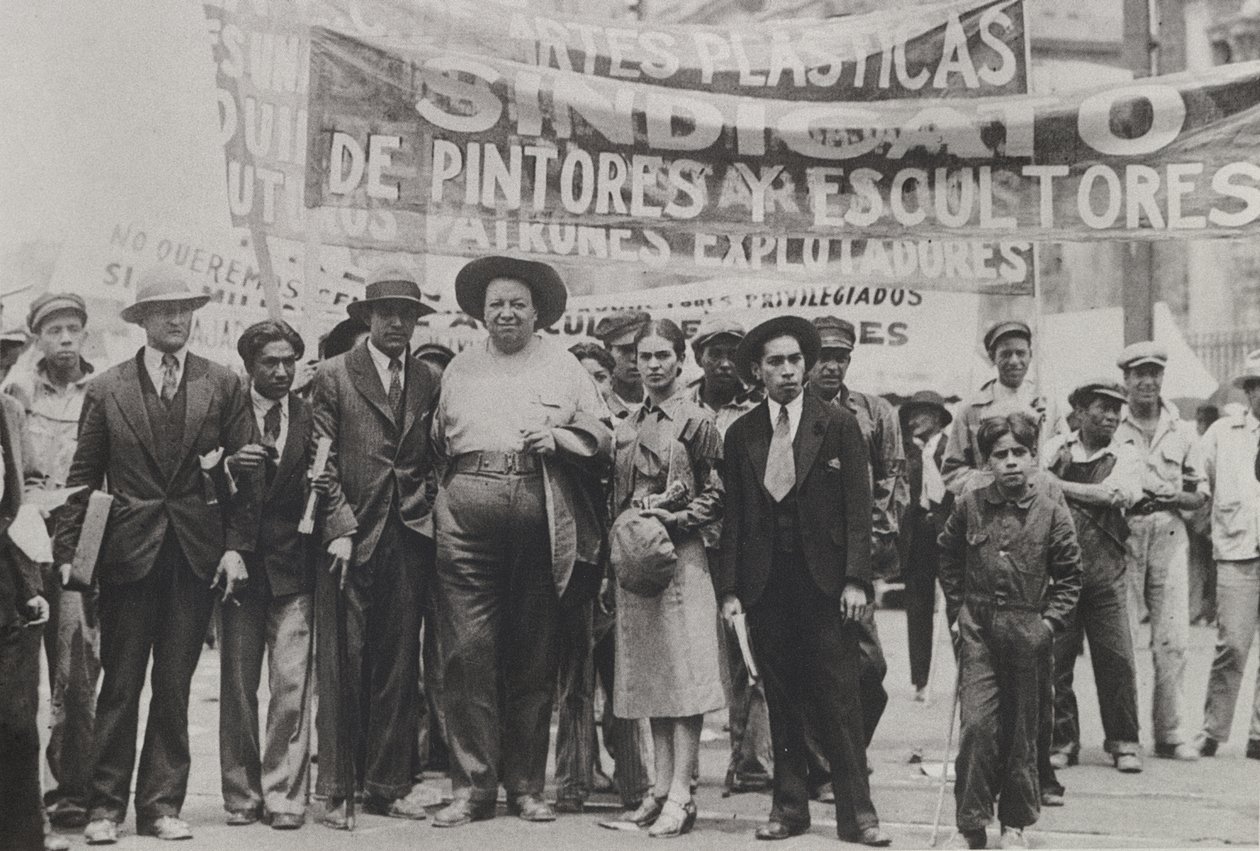
Diego Riveira, president, Communist Party; Galvin, secretary, National Camp. League; La Borde Railwaymen’s Party; Monson, Communist Party; Carillo, Communist Party; Diaz, Coahuila League; Caleros, Tuamalupas League; Silva, Chihuahua Workers Federation; Lara, Vera Cruz League.
V. The Assembly for Unification
As the economic counterpart to the Proletarian-Agrarian Toilers Bloc, the revolutionary masses in Mexico, with the Communist Party here, too, as the driving force, have just completed the National Assembly for the Unification of Workers and Agrarian Toilers. There already had existed a Committee for Proletarian Defense that had formed shop committees all over Mexico; but as it was necessary to win the agricultural workers (2 1/2 million) and connect with the rural toilers, agrarian groups were also invited to the conference, which was held under the auspices of the “National Committee for the Unification of Workers and Agrarian Toilers.”
Time Is Ripe.
The time was very ripe for such a National Assembly, the purpose of which was to form a new National Confederation of Labor affiliated to the Montevideo (Uruguay) Secretariat, against the CROM and the Pan- American Federation of Labor. I have already described the situation, which was rapidly leading to the disintegration of the CROM. It will be recalled that during the Calles government then calling itself revolutionary, that the government had actually aided the CROM which at one time claimed over a million members (although the industrial proletariat numbers but approximately 700,000 workers.)
However, due to the treachery and exposure of the CROM leaders, the move to the Left of the masses, the attack against the CROM through the new governmental policy, and mass desertions, the CROM had fallen to 150,000 members with about 150,000 other workers organized in various independent unions, some under anarchist leadership and influence. The disintegration of the CROM, coming at such a revolutionary conjuncture, offered tremendous possibilities for the new movement and from the start the movement met with great success.
T.U.E.L. Represented.
To this National Assembly for the Unification of Proletarian and Agrarian Toilers, I was sent as the fraternal delegate of the Trade Union Educational League, the American section of the R.I.L.U.
When I arrived I found that already about 450 delegates representing one half of all the organized workers in Mexico had been elected, besides about 100 agrarian delegates who came from the National Campesinos League (semi-proletarians) covering 22 of the 27 states in Mexico.
The delegate list was as follows: 100 delegates from Jalisco, representing 20,000 (mining). 20 delegates from Sunaloa, representing 5,000. 25 delegates from Nayarite, representing 5,000. 50 delegates from Tamaulipas, representing 15,000 (oil). 10 delegates from Nuevo Leon, representing 2,000 (metal Monterrey). 50 delegates from Coahuila, representing 8,000 (coal). 28 delegates from Vera Cruz, representing 4,000 (textile stronghold CROM). 15 delegates from Puella, representing 10,000 (textile stronghold CROM). 119 delegates from miscellaneous states, representing 43,000. 38 delegates from Railwaymen’s Union, representing 55,000. Total 107,000.
No Fake Delegates.
Unfortunately, due to great lack of funds, many of these delegates, although duly elected from mass organizations, could not arrive but even as it was, over 400 delegates from 315 local unions and 80 agrarian groups attended the sessions which lasted five days from January 26th to January 31st. These were no fake delegates. They were the real stuff. Straight from mine, factory and field they came, representing one-quarter of the whole industrial proletariat and one-half of those organized, and made up a most enthusiastic and earnest revolutionary gathering.
Already this body was stronger than the CROM.
1. The CROM was based on class collaboration, the now Unitarian Confederation on revolutionary struggle.
2. The CROM had organized those industries which were still Mexican owned, more or less, such as traction, taxis, public works, textile, food, some mines and government works (firearms) etc. The new confederation had, on the other hand, those industries most important to attack American imperialism in Mexico, such as oil, ports, mines, metal, railway, agricultural workers, etc. The basic heavy industries were with the new assembly.
3. During the course of the assembly the whole powerful Railwaymen’s Union became one of the leading factors in the convention. The anarchist group was practically wiped out of the leadership. Very important CROM unions’ (textile workers, printers—5,000 members, etc.) came over.
Order of Business.
An ambitious order of business was worked out. This included:
1. General report on the situation facing the working class and the struggle of the proletariat against capitalist rationalization for better social legislaion, against company unions and for the abolition of the “white guards” for protection of the unemployed, etc.
2. General program for the agrarian toilers, including fight for continuation of land grants, for the arming of the agrarian toilers, and to fight against the daily murder of agrarians by civil and military authorities.
3. Questions of organizations of the unorganized workers (in general, but particularly miners and agricultural workers) and support of strike struggles (lessons from the railway strike and the Jalisco miners’ strike, etc.)
4. Formation of a new National Unitarian Confederation of Labor (constitution, executives and questions of organization and relationship to unions not in the new Unitarian confederation.)
5. Formation of various National Industrial Unions (and problems relating thereto).
6. International Trade Union Unity (relations with the T.U.E.L., with the Montevideo Secretariat, and with the Mexican masses in the U.S.
Intense Discussion.
It is not necessary here to give in detail the reports that were given. I have given the points, roughly, that were covered in these reports. It is sufficient now merely to point out that the discussion was most intense and serious throughout, all delegates participating and speaking freely. More, the passion with which they spoke showed clearly that they were releasing all the pent up feelings and emotions which they had stored up, crushed as they had been by the government collaboration of the CROM officials. A whole decade was expressed in the torrent of words that flowed out at this assembly.
We cannot give the points that made the discussion so interesting and valuable. However, the discussion on international relations must receive brief attention. The American fraternal delegate from the T.U.E.L. was received with the greatest enthusiasm. It was the first time such a delegate had been present. Many of the workers never believed there were, any revolutionary workers in the U.S. and they did not believe me.
But when my first speech was translated, all suspicion and doubt vanished and I was taken into their arms as a true brother. Together we discussed the problems of Mexican workers in the United States, organization questions (indeed, I was commissioned to work out the organization thesis!) and international relations. The press gave big publicity to the event. A special resolution was adopted on the relations with the T.U.E.L. and amid the greatest enthusiasm a formal Solidarity Pact was signed.
“Resolution on Relations with the Revolutionary Trade Union Movement of the United States, the Trade Union Educational League.
“The National Assembly for the Unification of Workers and Agrarians views with the greatest joy I the establishment of close contact with the revolutionary trade union movement in the United States, and we greet the Trade Union Educational League as a comrade organization fighting side by side with us against our common enemy.
“We especially welcome the fact that for the first time the revolutionary trade union movements on either side of the Rio Grande have sent fraternal delegates to participate in mutual conference. We heartily trust this will be the steady procedure in the future.
“We warmly approve and adopt the proposals of the Trade Union Educational League and its representative and we fully appreciate that this means that the necessary first steps will have been taken in binding the revolutionary movements of both Americas in most intimate friendship and solidarity.”
The Solidarity Pact reads as follows:
“Solidarity Pact between the National Assembly for the Unification of the Workers and Agrarian Toilers of Mexico and the Trade Union Educational League of the United States:
“The present period of tremendous aggression of American imperialism makes imperative the closest unity of the National Assembly for the Unification of the Workers and Agrarians of Mexico with the Trade Union Educational League, the revolutionary trade union movement of the United States.
“In this joint struggle against American imperialism, the Trade Union Educational League especially pledges its utmost aid particularly in the armed struggle of Latin American peoples against United States imperialism for genuine national independence.
“We pledge ourselves to solidarity in all actions in support of the class struggle programs of the Trade Union Educational League and the National Assembly for the Unification of the Workers and Agrarians against all exploiters both native and foreign, of the proletarian and agrarian masses.
“We will mutually fight against the menacing danger of a new imperialist war and for the most energetic defense of the U.S.S.R.
“We will aid each other in opposing all capitalist rationalization of industry at the expense of the workers and will fight against the extortions of landowners upon the agrarian masses and for the vigorous defense of the organizations of agrarian toilers.
“We will oppose fascism and all forms of reaction in either country.
“A deadly war must be waged jointly by Trade Union Educational League and by the National Assembly for the Unification of the Workers and Agrarians of Mexico against the Pan-American Federation of Labor and its ‘Monroe Doctrine of Labor.’ We must wipe out completely the corrupt and class collaboration; officials from the trade unions.
“At the same time we will join hands on a basis of the class struggle, both on a national and on an international scale, in accordance with the policies and practices of the Red International of Labor Unions, to establish one single Trade Union International throughout the world.
“Long live the solidarity of the workers of the United States and Mexico.
“Long live the Trade Union Unity of the workers throughout the world. ALBERT WEISBORD, for the Trade Union Educational League of the United States. JUANA DIAZ, for the National Assembly for the Unification of the Workers and Agrarians of Mexico.”
Other Questions.
Two other questions arose which must be mentioned briefly. 1) The relation of the new Unitarian confederation to the new political workers agrarian toilers bloc came up. The committee brought in a resolution that declared that each local union could decide what working-class political candidate to support (a modest enough resolution) but the few anarchists present were able to provoke a storm and due to the strong anarcho-syndicalist traditions existing still, the resolution was withdrawn and nothing at all said on this question. The resolution was withdrawn simply because the confederation was just being created. Once created, short shrift will be made of those petty-bourgeois anarchist elements.
2) The very few anarchists (2 in particular) tried their very best to split the conference, but they could not do so. When their disruptive tactics reached so far that they denounced as a liar one of the most outstanding leaders, this was too much. Blows were struck, and the anarchists would have been thrown bodily from the window if they had not quickly apologized. The anarchists are politically dead!
What were the achievements of the National Assembly for the Unification of the Workers and Agrarian Toilers,
1. A new permanent central trade union body was formed, the Unitarian Confederation of Labor. A complete program of work, a constitution and an executive of 11 (General Secretary, Sequeros, Organization Secretary, Campa, Financial Secretary, Barrios) created,
2. The following National Industrial Federations were created: a. Miners, b. Oil workers, c. Metal workers, d. Transport workers. e. Textile workers, f. Agricultural workers, g. Food workers, h. Theatre workers.
For each national industrial federation, executives were chosen and rules worked out.
3. Preparations were made for a general strike against the new fascist labor code should the government try to put this into effect.
4. Closest relations were established with the Trade Union Educational League and the Montevideo secretariat.
What were the immediate results of this conference?
1. The masses prepared better for the coming open revolutionary period. Already there are four national bodies formed: a. National Agrarian Toilers League (Campesinos). b. National Committee for Proletarian Defence (Shop Committee). c. National Unitarian Confederation of Labor, d. Workers Agrarian Toilers Political Bloc.
2. The anarcho-syndicalists have been entirely liquidated and the CROM rapidly decomposed.

3. The Pan-American Federation of Labor is dead among the masses in Mexico and in its place stands the R.I.L.U. Special pains had been take to send organizers to Cuba, Nicaragua, Panama, Guatemala, and other plaee3 where the CROM and the Pan-American Federation of Labor claimed some influence to kill forever any illusions that the masses had concerning these organizations. The coming Caribbean Conference and the Montevideo Conference will see all these countries well represented.
VI. T.U.E.L. Report at Mexican Congress
Speech of Weisbord before the congress on Jan. 26, 1929.
Comrades, the fact that the fraternal delegate from America cannot speak Spanish shows eloquently how isolated have been the revolutionary trade union movements in the United States and in Mexico from each other. This isolation between the two revolutionary movements has cost both of them very dear. Today the closest unity between the revolutionary trade union movements in the United States and in Mexico and Latin America generally, has become of the greatest necessity.
While we have delayed our unity, based on the class struggle, Yankee imperialism has increased its oppression of the toiling masses both in the United States and in Mexico. Emerging from the last war enormously powerful, the American bosses and bankers have become the strongest in the world. At home American capitalism has driven the great mass of workers down more than ever. Repeated wage cuts, lengthened hours, most inhuman speed-up—a speed-up that saps the very life blood of the worker, and leaves him exhausted—a huge army of 4,000,000 workers out of work, these are the conditions facing the masses in America.
Hand in hand with this has gone an increasing fascination of government. A huge force of police and government officials has been created ready to throw itself against the working class. Today the strike-breaking injunction, the murderous tactics of soldiers and police, the jailing of many hundreds of workers, have become every day occurrences when workers strike for better conditions. Indeed, the very right of the workers to strike is being practically taken away. And with the right to strike goes the right to organize.
The growth of American capitalism is meaning the smash-up of the trade union movement in America. The basic mass trade unions have been and arc being destroyed. Never before has the control of the government of the United States, by the bankers and big business men, been so open and brazen as today. The victory of millionaire Herbert Hoover means that the sharpest attack yet made by American capitalism will be launched against the toiling masses with the full and most active support of the government.
Left Wing in U.S. Grows.
But do not think that the American workers have not fought back. As American capitalism grows, the revolutionary movement in the United States has grown. 1,000,000 workers quit the mines, mills and factories to demonstrate in the streets for the liberation of Sacco and Vanzetti. Long, bitter strikes have broken out in which the proletariat have given the bosses blow for blow.
Within the past two years alone we saw 200,000 miners fight for 18 months, 15,000 textile workers in Passaic struggle for over a year, tens of thousands of clothing workers in New York City fight on for many months, 30,000 textile workers in New Bedford and Fall River, Massachusetts, battle for six months, the bloody conflict in the coal fields of Colorado, etc. All these, and other long and hitter mass strikes have been under the actual leadership or strong influence of the Trade Union Educational League.
In these struggles the proletariat is becoming hardened and matured. The corrupt officials of the American Federation of Labor have become discredited. New and revolutionary unions, affiliated with the Trade Union Educational League, and internationally to the Red International of Labor Unions, such as the National Miners’ Union, the National Textile Workers’ Union, the Needle Trade Workers’ Industrial Union, have been created.
The organization of the masses of unorganized workers, of whom we have at least 25,000,000 in the United States, is proceeding. The strongest blows of the capitalists have not been able to shatter us.
The revolutionary trade union movement is emerging stronger than ever. Simultaneously with this attack on American labor, Yankee imperialism seeks to conquer the whole world. In Europe, in China, in India, in Canada, in Latin America, everywhere the increasing weight of the hand of American capitalism is seen. Today it tries to mortgage all of Germany, shoots clown the Chinese masses, attacks the Soviet Union, drives out European competition from Mexico and Latin America. Tomorrow the American guns of war will speak against England, or against Japan, or against France, or against any other force that may stand in its way.
Comrades, it is when we come to Mexico and Latin America, that we see most clearly how things are going. The Caribbean must become an American lake, all Latin America must become a huge colony for the Yankee Wall Street, a huge colony where the masses are enslaved, where the resources are seized, where foreign competition is driven out of the markets, and where American imperialism can best prepare for war. This is the open policy of Wall Street.
To this end billions of dollars in capital, in machinery, in commodities, have been poured into Mexico and Latin America. The governments of these countries have, many of them, become mere puppets, mere tools, in the hands of American capitalists to crush the masses further.
Does anyone think that the murderous governments of Cuba, of Nicaragua, or of Colombia, to mention only a few, are not only fancy names for Yankee imperialism? The murder of Julio Antonio Mella, the massacre of Cuban strikers, the slaughter of the Colombian workers, the atrocious war against the brave Nicaraguan people whose heroism, as typified by the soldiers of Sandino, will stand as a glorious monument for the toiling masses of the world—what are these things but the advancing iron heel of American imperialism?
Morrow-Gil Friendship.
In this connection we must point out clearly and unmistakably that the “friendship” recently attained between the imperialism government of the United States and the government of Mexico, is at the expense of the workers and peasants of Mexico, that Yankee imperialism is consciously end deliberately strengthening its control over Mexico by this means, as a part of its whole policy, based on the Monroe Doctrine, of driving British imperialism from its present position in Latin America, and that the hour is rapidly approaching when diplomacy ends and armed conflict begins.
In such a war the masses of Latin America will be asked, even compelled, to die for the bankers of Wall Street. When Herbert Hoover comes to Mexico, as when he toured South America, it will be as a conqueror, as a Caesar looking over his empire. In the struggle against this Caesar the proletariat and peasantry of Mexico and Latin America can rely on no other force but themselves and the support of the workers throughout the world.
Comrades, I am here to declare most solemnly to you in the name of the Trade Union Educational League, representing 250,000 revolutionary trade unionists in the United States, that we especially pledge ourselves to carry on unceasing war against this American imperialism, whose hands are bloody with the blood of the toilers of both Americas, and who stands as our common enemy, fighting both you, the toilers of Mexico and all Latin America.
Labor Imperialism.
The struggle against American imperialism must become also a deadly struggle against the Pan-American Federation of Labor, which is only the “labor” instrument of Wall Street. We must remember that the tentacles of U.S. imperialism have reached into the labor movement of both countries, corrupting their venal officials, attempting to disarm the workers of Latin America before imperialist aggression with hypocritical phrases of “good will” and fraternity, and designing to make the trade unions of the United States accessories to the imperialist subjugation of the Latin peoples and the exploitation and murder of their fellow-workers south of the Rio Bravo (Grande).
I mean that unspeakable instrument of Yankee imperialism, the Pan-American Federation of Labor, whose every act is dictated to suit the policies of the imperialist State Department of the United States government, and which is a coarse caricature of an international labor organization whose actions we revolutionary and militant trade unionists of the U.S. repudiate, and whose leaders and organizers we denounce as scoundrels and traitors to the proletariat of all America.
The actions of Green, Woll, Morcres and Iglesias, in the corruption and stifling of true proletarian internationalism, stand out for all to see. Their “Monroe Doctrine of Labor” is a reflection of the domination with armed forces by Yankee. land of the oppressed peoples of Latin America. Green, Woll and Co., who in the U.S. corrupt the trade unions with schemes of class collaboration and deliver the trade unionists of the American Federation of Labor over to the most intensive exploitation, wish to impose such policies on the Latin-American proletariat by the domination of the American Federation of Labor in the Pan-American Federation of Labor to obtain the collaboration of the Latin-American workers with their imperialist exploiters. We declare this to be international treason to the proletariat, and ask from and pledge to the proletariat and peasantry in Mexico and all Latin America, fraternal assistance in destroying such conceptions, in driving out of our trade unions such traitors and in attaining true international and proletarian solidarity in action. In the crimes of U.S. imperialism, the Pan-American Federation of Labor, like the yellow Amsterdam International of India, China, and elsewhere plays a definite role. The murders in Cuba, in Colombia, in Nicaragua, and the hundreds of other aggressions of Wall Street meet never a protest from the Pan-American Federation of Labor led by Green and Woll. To give final proof of a total lack of international proletarian solidarity, the last convention of the American Federation of Labor petitioned the imperialist U.S. government to stop Mexican workers from immigrating to the United States. We, of the Trade Union Educational League, declare to you that proletarian solidarity and interests have no boundary lines for us. We welcome our Mexican brothers as comrades and join them in the struggle for the emancipation of labor.
Comrades, your present convention is an historic one. It is a great step forward in the unity upon a basis of class struggle of the toiling masses of Mexico and Latin America. The Trade Union Educational League hails this convention with joy and through it the proletariat and peasantry of Mexico. We are aware of the difficulties you have to face in your struggle for trade union unity in Mexico, to attain the utmost struggle and to eradicate self-seeking bureaucrats whose interests incite divisions of your forces. We are aware that under the pretensions of a code of labor laws supposed to “protect” labor, the interests of the U.S. imperialists and of Mexican employers are being foisted upon the Mexican workers. We are aware that a most grave danger menaces, that fascism, new nascent in Mexico, will assume the open forms it has already taken in some other Latin-American countries and may viciously attack your organizations and attempt to destroy them by violence–having failed to corrupt them. We point to the assassination of Julio Antonio Mella as a sign of the menace of fascism on the soil of Mexico, which will, of course, be actively supported by Yankee imperialism.
With such a perspective facing the proletariat and peasantry of the Americas unity against all imperialism and all exploiters and all reaction is imperative. To organize this unity the better the Trade Union Educational League makes the following proposals to your National Assembly:
1. An exchange of delegates to the national conventions of the respective organizations.
2. Exchange of written reports on the conditions of labor and the peasant masses, actions of the enemy classes, the conditions of the organizations of workers and peasants and their defensive and offensive actions. Such reports to be exchanged each month.
3. Articles for the press, mutually exchanged, to inform the toiling masses of each country in a popular way of the struggles going on and to lay the basis for actions of solidarity.
4. A written and signed Solidarity Pact, to be written by the Mexican comrades of the Workers and Peasants Assembly of Mexico, which the T.U.E.L. suggests should deal with the following problems:
a) For a joint struggle against American imperialism, especially pledging the assistance of the T.U.E.L. to the armed struggle of Latin-American peoples against United States imperialism for genuine national independence.
b) For actions of solidarity in support of the program of demands of the signatory organizations, against the exploiters of the proletariat and peasantry, native and foreign.
c) Mutual struggle against the danger of a new imperialist war and for defense of the Soviet Republic of Workers and Peasants.
d) Against capitalist rationalization of industry at the expense of the workers; against the extortions of landowners from the peasantry and a defense of the demands of the peasant organizations.
c) Against fascism and all forms of reaction in either country.
f) Against the Pan-American Federation of Labor, its Monroe Doctrine of Labor and for expulsion from the trade unions of corrupt and class collaboration leaders.
g) For trade union unity on the basis of the class struggle, both on a national scale, and on an international scale, in accord with the policies and practices of the Red International of Labor Unions, to establish one single Trade Union International.
Tasks Before Left Wing.
Comrades, I believe that a few additional proposals are necessary in view of the situation existing within the United States and the great danger of war. In the United States we have 4,000,000 Spanish speaking and Latin-American workers, 3,000,000 of whom are Mexican.
The organization of these Mexican and Latin-American workers within the U.S. must become a basic task for us. Situated in the oil industry, the railroad industry, the mining industry and in other basic industries of America, composing a big part of the agricultural workers, the Mexican and Latin-American workers in the U.S., most bitterly exploited of any of the foreign-born groups, can strike a vital blow at Wall Street.
The organization of this great mass of workers will be a tremendous blow against Wall Street and a tremendous demonstration against American imperialism and capitalist war. The mobilization of these workers would be a distinct help in the mobilization of the agricultural workers as a whole and of the Negro masses in the South whom our Mexican comrades could most easily lead into struggle. The mobilization of these Latin-American toilers in the U.S. would be of tremendous aid to the revolutionary struggles of the Latin-American masses against American imperialism.
These great tasks before us make a few additional proposals absolutely necessary if we are to map out a program of work and carry out our tasks. A capable Mexican comrade should become part of the apparatus of the revolutionary trade union movement in the U.S., and capable Mexican organizers sent into the key cities of America where the Mexican workers predominate to organize these workers and mobilize them for struggle. Simultaneously a most capable representative of the T.U.E.L. should be stationed in Mexico to help out as much as possible and to coordinate the work in the two countries to the greatest possible extent. When this first step will have been accomplished we will be well on the road to living up to our historic duty.
Montevideo Conference.
Finally, a word as to the coming Montevideo conference. We have been informed of the coming conference at Montevideo, Uruguay, in May, at which will be organized the Confedercion Sindical Latino-Americana. We greet that movement as the most valuable means whereby the solidarity in action of the trade unions of Latin America with the revolutionary trade unions and militant minority of the U.S. can be affected. We trust that your assembly will unite with the other Latin American unions represented at the Montevideo congress. On our side, we have the duty of fighting the imperialist policy of the bureaucracy of the American Federation of Labor officialdom from within that organization and outside of it, where the 90 per cent. of the proletariat are still unorganized, of organizing new and militant unions which will function in the interests of the whole working class, both here and in foreign lands, and which will be the power within the fortress of Yankee imperialism, that will destroy it from within as our Latin American comrades attack it from without.
Forward, then to unity, nationally and internationally, of the trade unionists of all America and of the world.
Down with the yellow and class collaboration officialdom. Away with the Amsterdam and Pan-American Federation of Labor traitors and splitters.
The TUEL, United States section of the Red International of Labor Unions, through your assembly, sends to the trade unions of Mexico and of all Latin America, its fraternal greetings and earnest pledge of every support within our power. Long live the unity of the workers.
Down with imperialism, the enemy of every worker and every peasant from Behring Strait to Tierra del Fuego. Down with the agents of imperialism in the labor movement.
VII. Mexican Masses Honor Mella
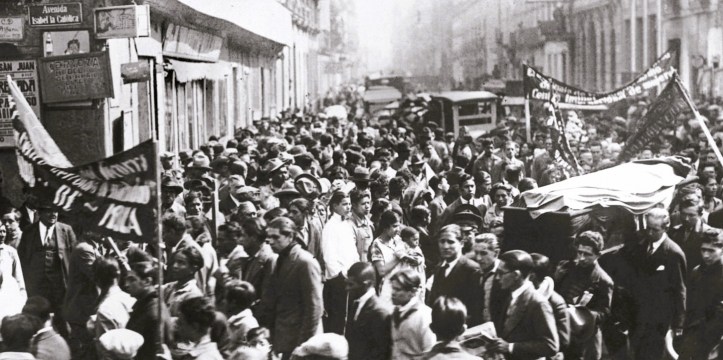
It was my honor and privilege to be present at a huge memorial meeting, on January 24th, for Julio Antonio Mella. The meeting was in one of the largest theatres in Mexico City and was packed to the doors on the call issued by the Committee of Proletarian Defense.
The death of Julio Antonio Mella has been keenly felt by the masses in Mexico. Great demonstrations have been held under the leadership of the C.P. of Mexico. His picture is to be found everywhere. At the meeting the very poorest masses were present and one could see they were deeply moved.
The speakers were, Huneo, of the Latin American Trade Union Confederation, Diego Rivera of the Anti-Imperialist League, La Farga of the Committee of Proletarian Defense, Vadillo of the Association of Proletarian Students (founded by Mella) and Penichet of the Association of Cuban Political Emigres in Mexico. The speeches, which touched on Mella’s life and work and the meaning of his murder, were received with much feeling by the audience. One could almost see them clench their fists and swear to avenge the murder of their leader.
That Mella was politically murdered is now established beyond a shadow of a doubt. The policeman testified in court that as Mella lay dying on the street, someone came up, pulled up his sweater and exclaimed, “That job is well done.” In spite of the overwhelming evidence against him and the tremendous indignation of the masses, however, the murderer has just been freed by the Mexican government. This is the answer of the fascisti to the revolutionary mass movements just generated by the C.P. More murders are expected.
The death of J.A. Mella has been a great blow to the Communist movement in Latin America. In the loss to the Parties, Mella’s death can be compared to our own Ruthenberg.
Far from desponding, however, the comrades have hut closed their ranks. Hundreds of new members have now joined the Party. The revolutionary situation is growing more acute. The Party carries on.
VIII. Communist Party of Mexico
The Communist Party of Mexico stands at the cross-roads of its history. Like the Communist Party of the United States, only more so, it is in a transition period, having shed its cloak of isolation on the one hand, and on the other hand having not yet become a truly mass organization. Yet within the past year the C.P. already has made astounding progress. Considering the membership figures alone, last year the C.P. had 1,005 members, this year the Party has 2,500 members; last year the Party had 19 districts, this year it has 61 districts. Of the membership 65 per cent are industrial workers in the basic heavy industries (railwaynen, miners, oil workers, etc.), 33 per cent are agrarian toilers, of which 5 per cent are agricultural workers. Only 2 per cent therefore are intellectual workers. From these figures we can see the basically sound composition of the Mexican Party and its great growth.
Main Campaigns of the Party.
The chief campaigns of the Party are:
(1) Political campaign.
(2) The trade union campaign. (3) Mopr (International Red Aid).
In all these campaigns the Party has been singularly successful. The fact of the matter is that the Party has taken the initiative and actually leads all mass movements which I have described in my several articles, published before, movements which have a minimum of 500,000 actual adherents. The Party not only leads the Workers and Agrarian Toilers Permanent Political Bloc, it not only leads the new trade union movements in Mexico, but when matters come to more direct and open clashes with the governmental and imperialistic forces, when the matter takes the form of a civil war, the Mexican C.P. without a doubt will be in the leadership as well.
The Mexican Party has one newspaper, El Machete, with a paid circulation of 15,000. However, this circulation by no means reflects the influence of the paper, since 5,000 papers go to 5,000 separate communes, where all the workers together chip in to subscribe to the paper (since no worker has enough money to pay for the paper himself) and where the paper is read aloud to all the people in the commune. Thus actually the circulation is closer to 175,000 than 15,000. With this paper there correspond regularly almost 400 workers and agrarian correspondents. The paper has over 400 agents, the majority of whom are not Communists. In the United States alone there are 1,000 paid subscribers to El Machete.
Simultaneously with the growth of the Party, the Young Communist League of Mexico also has grown. Last year 900 members were in the Y.C.L., this year there are 1,500 members. A monthly paper is put out with a circulation already of 5,500, and already is becoming an influential factor among the toiling youth in Mexico.
The tasks of the C.P. in the present period must be:
(1) Greatest concentration on attacking the Mexican government as agent of American imperialism.
(2) Greatest clarification of class lines so that definitely the industrial proletariat has the hegemony.
(3) A rigorous and adequate organizational preparation for the coming and open sharp struggles that face the Mexican people at the present time.
Party Perspectives.
The Party has the following perspective, as given in its thesis:
“10. The armed conflict between the different bourgeois groups will launch in the fight the agrarian masses who will want to seize the land. We foresee that the conflict between the groups will conduce later on to a conflict between these groups and the agrarian masses, first, and later with the working masses. The role of the Party is to unite those discontented and to unite the fight of the masses in order to reach a united front against the bourgeoisie and imperialism.
“11. The first task of the Party must consist in separating the working and agrarian masses from the leadership of the bourgeoisie and the small bourgeoisie. The second, to organize these masses within one organization which will unify them for action. This task the Party must take up with full energy.
“The Comintern at our April conference has fixed the method and the organization. The method is a class program which could mark clearly the difference of the objectives between the bourgeoisie and the proletariat and the agrarian masses. The organization is the Workers and Agrarian Bloc.
Agrarian Revolt.
“12. The perspective which the Party has is the following: On the initiation of the fight between the different bourgeois factions beginning with the military group in the north, to develop the agrarian rebellion. In this, whether due to the disorganization of the workers and agrarian elements, the Right wing obtains a military victory and in this case the organizations will fall into illegality with all its consequences (disorganization, terror, etc.) or whether the elements of the Left organize themselves and adopt a dear program which takes in all of the large worker and agrarian masses, in spite of momentary military victories, the rebellion of the large masses will extend.
“13. This last perspective is the one which the Mexican C.P. must see in ail its magnitude and in all its consequences. The position of Mexico permits a fight of ample historical perspectives. A revolution of a proletarian and anti-imperialist character can sustain itself victoriously in Mexico with the active collaboration of the working masses in Latin America, and with the solidarity of the American workers and agrarian toilers. Whole regions will fall into the hands of the rational bourgeoisie and of the imperialists, but the central regions, naturally protected, can grow the necessary cereals for its nourishment where they can also work the factories: They can sustain themselves under a workers’ and agrarian government.
Party Must Grow.
“14. But these fights cannot take place if the Mexican C.P. does not increase its organization and does not convert itself to a mass Party and does not fight with surety and energy on each of its two large fronts, in the workers’ movement and in the agrarian movement. In either case, with one or the other of the perspectives, the Party must take the necessary organizational steps in order to place this in a state of being able to undertake the tasks and keep contact with the masses. The Plenum instructs the C.C. of the Party to take all the necessary measures in order to look after our organization and contacts.
“15. The Plenum instructs the C.C. to give special attention to the agrarian question. Without organization of our Party from below among the agrarian masses it is impossible to have a real and effective influence among the masses of main importance to the revolution.”
In conclusion I may say that an adequate estimate of the C.P. of Mexico shows that it has made tremendous progress within the past few years. It is no longer a propaganda sect. It is now the most important factor in a big revolutionary movement. It has definitely behind it one-half million adherents. It is in control of the most important revolutionary movements in Mexico. The very ripe situation opens up gigantic opportunities to the Mexican Party. This places the Mexican Party today in a very critical situation, since it must solve problems never solved before, and lead the masses in the revolutionary movement. But there is every indication that the C.P. and the Y.C.L. of Mexico will live up to these historic tasks.
The Daily Worker began in 1924 and was published in New York City by the Communist Party US and its predecessor organizations. Among the most long-lasting and important left publications in US history, it had a circulation of 35,000 at its peak. The Daily Worker came from The Ohio Socialist, published by the Left Wing-dominated Socialist Party of Ohio in Cleveland from 1917 to November 1919, when it became became The Toiler, paper of the Communist Labor Party. In December 1921 the above-ground Workers Party of America merged the Toiler with the paper Workers Council to found The Worker, which became The Daily Worker beginning January 13, 1924.
 Revolution's Newsstand