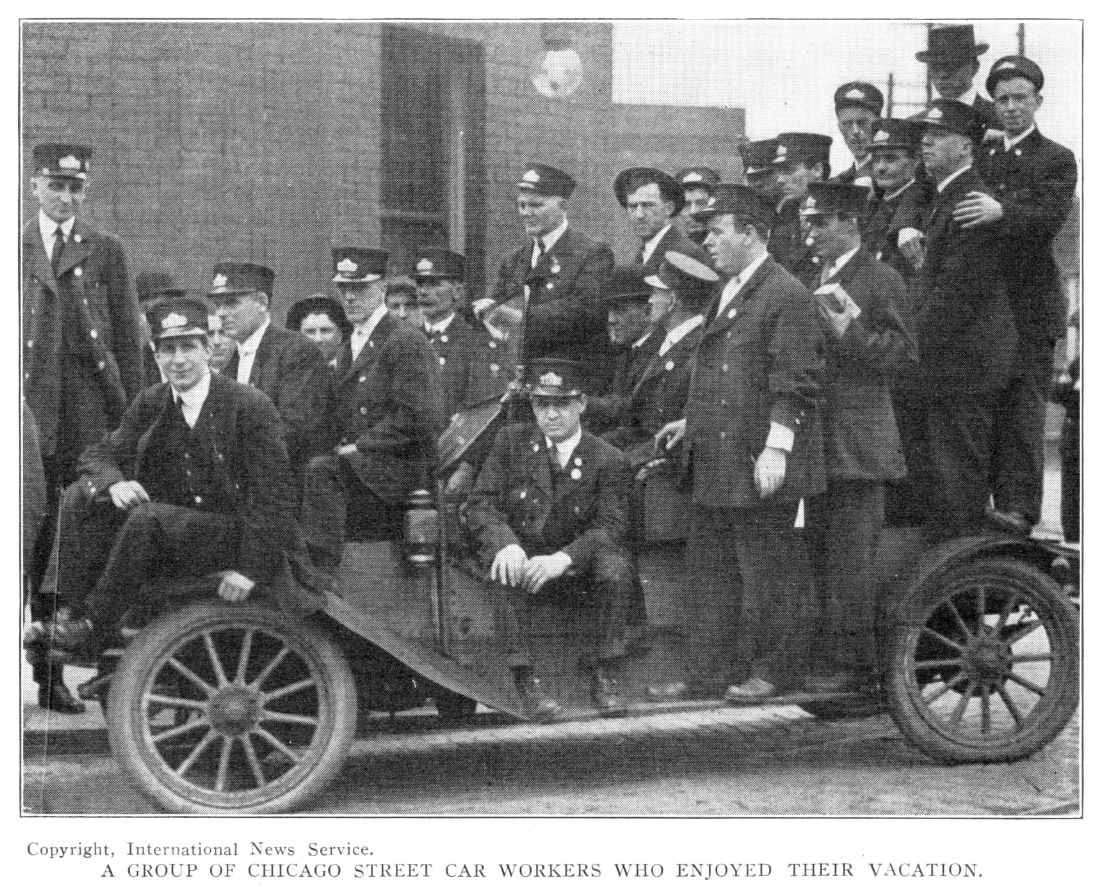
14,000 workers on Chicago’s streetcars and ‘L’ walk, and so does the city of 2.5 million. Also, we need to revive the term ‘plug-uglies.’
‘When Chicago Walked’ from The International Socialist Review. Vol. 16 No. 1. July, 1915.
ON THE morning of June 14 nobody among all the two and one-half million people who live in the city of Chicago could get a surface street car or an elevated railroad train downtown or crosstown. The carmen were on strike. The 14,000 members of Division 241 of the Amalgamated Association of Street and Electric Railway Employes of America failed to come around and work for their wages that morning.
In a polite note to the street railway presidents they said it was necessary to have “a cessation of work,” they were “sick and disgusted” of the kind of arbitration offered them, and they would keep on with the “cessation of work” until the street railway companies would agree to a real arbitration instead of a “hide-and-seek” arbitration.
Four hours after the strike order was issued Charles C. Healey, superintendent of police, told newspaper men he would go before the city council finance committee that morning and ask for money to pay 1,000 extra policemen. Not a newspaper report or a town rumor had whispered of violence. Nonetheless Chief Healey went before the finance committee and laid out these figures on what he wanted: 1,000 revolvers, 50,000 cartridges, 1,000 clubs and belts, salaries for 1,000 special policemen, money for two meals per day for 6,000 men. Total, $450,000.
Never in any American city has there been a clearer exhibition of police desire for violence, and police willingness to meet violence. All the squads of newspaper men and corporation spotters searching the city of Chicago that day were not able to cite one instance of violence. The 4,000 regular policemen and detectives were under strict orders from Chief Healey to arrest and hurry to the lock-up any union man who was apparently violating the law, but were unable to find one union man worth even trumping a charge against him. A few cars run by policemen and elevated railway officials were not touched by the strikers. And on the basis of this showing, Chicago’s police chief asked for· 1,000 clubs, 1,000 revolvers and 50,000 cartridges.
Do you wonder why the police are accused of blood-thirsty manhandling and a joy in mauling heads, laying open scalps and plugging innocent citizens with bullets during strike times? Is there some reason for the theory that the average police chief in an American city has an itch to knock heads and order cops to shoot into crowds?
One item in Chief Healey’s budget. Called for “Meals, two per day for 60 days, $252,000.” There has been no public or private explanation of what this was to be for. The only way the street car men could guess was that the city of Chicago out of public moneys was to pay for the meals of 6,000 imported gunmen and sluggers.
What did the finance committee do with this amazing request of the police chief? On a viva voce vote, they passed it. Then Alderman Charles E. Merriam demanded roll call. And it was beaten by 11 to 3, which means that in the present era of politics and American democracy, some so-called ward aldermen favor secretly slugging and shooting the working class, but hold back, if they must go on record about it before the voters.
Alderman William E. Rodriguez brought an ordinance into the city council that night. It said that no person could run as motorman on an elevated railway train unless he had twenty-one days of training under a competent instructor; nor act as motorman on a surface street car unless he had fourteen days training. Alderman De Priest, colored, protested: “I come from a peculiar people who have difficulty in obtaining employment. This ordinance is unfair to them.” Rodriguez replied: “It is intended to do just that. We want to make it impossible if we can, by city ordinance, for any person to get a job running a street car in this town while the strike is on.” The ordinance passed 57 to 10, which shows that aldermen listen to the labor vote during strike times.
Alderman John C. Kennedy discussed the ordinance and referred to Chief Healey’s call for. 1,000 revolvers and 50,000 cartridges. One Henry D. Capitain, known as a street railway alderman, said Kennedy was not “sane,” and worse yet was “hysterical.” Kennedy replied in even and positive voice: “I tell you we don’t want to see workingmen shot down in the streets of Chicago.” When Capitain started to defend himself of the implied charge that he was accessory to the intended shooting of workers, he was hissed by the galleries so that he could not be heard.
Another ordinance of Rodriguez was framed to give the mayor power to seize and operate the street railways, pay the carmen their demands on wages and working hours, and so operate till the companies should make an agreement with the striking carmen.
“You may call. this confiscation or anything else you like,” said Rodriguez, “This is a time when public convenience and necessity demand seizure and operation of these properties. If the Commonwealth Edison Company, our local lighting trust, should have a strike of its employes, what would we do? Would we go along with dark streets and no lights in our homes? No, we would take the plant and run it and light the city until the company made terms with its employes. When an ice plant in Cincinnati was tied up by a strike in the hot weather of summer and the people were suffering for want of ice, Mayor Hunt seized the ice plant and operated it with the strikers until the company made terms with the strikers.” The ordinance was beaten 62 to 4, which shows that confiscation isn’t strong with the politicians. From the galleries, however, came a straight three minutes of tumultuous applause and cheers. The “mob” was almost a unit for a forcible seizure of the street railways.
Now notice how street railway presidents “respect the law.” Though the city council went on record by 57 to 10 against importation of strikebreakers, the next day Leonard A. Busby, the $65,000-a-year president of the Chicago City Railways Company, and Henry A. Blair, the $50,000-a-year president of the Chicago Railways Co., went personally to Passenger Agent Hartigan of the Lake Shore Railway and paid $15,000 in cash for 500 tickets at $30 each for transportation of strikebreakers from New York and Philadelphia. Two trains of loads of strikebreakers were reported on the way to Chicago. At least $60,000 merely for transportation of strikebreakers was paid-even though the assembled aldermen of Chicago had voted 57 to 10 against such action. Which shows that representative government is a piece of monkey-work so far as street railway presidents are concerned.
When the strike had been on about forty-eight hours, it was called off. The companies agreed that in arbitration they would produce their inside office account books, which were withheld in the arbitration of three years ago.
This left 2,000 stranded and hungry strikebreakers in Chicago without any strike to break. What happened to them? Well, for one thing, the newspapers didn’t welcome them. The Daily News front page called them plug uglies, thieves, and thugs, and applauded the police for. Running them down to the Indiana state line. On an inside page, however, the Daily News had an editorial. It said the two Socialist aldermen in the council meeting two days before had played to the galleries, were “demagogues,” and were “preposterous” in their behavior. Yet the cold fact is that the main action of the two Socialists was aimed at keeping strikebreakers, plug uglies and thugs from coming to Chicago. Which shows that a strikebreaker is a good clean fellow until the strike is over and then he’s a plug ugly and a thug and a thief in the eyes of a capitalist newspaper playing for circulation with a public standing by the strikers.
Two points about the Chicago car strike are worth notice. Every street car motorman and conductor in Chicago was in on it. The solidarity of it amazed the city and the tie-up was complete. The elevated men’s union joined hands with the surface car men’s union. Their journal pointed to the joined capitalists who own both elevated and surface lines and said: “They are one; so are we.”
Then, too, it showed the pass to which arbitration has come. Labor now must strike in order to get a real arbitration. Corporations hide their account books, insist on dictating who shall be the umpire, the “neutral,” on arbitration boards, and by other acts make arbitration a game of bunk instead of actual judicial decision. So far have they developed the art of winning through arbitration that the Illinois Manufacturers’ Association and other business organizations are calling for a compulsory arbitration law. The street car men say they know a trick about “cessation of work” that will give them the kind of arbitration they want, even if it’s compulsory.
The International Socialist Review (ISR) was published monthly in Chicago from 1900 until 1918 by Charles H. Kerr and critically loyal to the Socialist Party of America. It is one of the essential publications in U.S. left history. During the editorship of A.M. Simons it was largely theoretical and moderate. In 1908, Charles H. Kerr took over as editor with strong influence from Mary E Marcy. The magazine became the foremost proponent of the SP’s left wing growing to tens of thousands of subscribers. It remained revolutionary in outlook and anti-militarist during World War One. It liberally used photographs and images, with news, theory, arts and organizing in its pages. It articles, reports and essays are an invaluable record of the U.S. class struggle and the development of Marxism in the decades before the Soviet experience. It was closed down in government repression in 1918.
PDF of full issue: https://www.marxists.org/history/usa/pubs/isr/v16n01-jul-1915-ISR-riaz-ocr.pdf
 Revolution's Newsstand