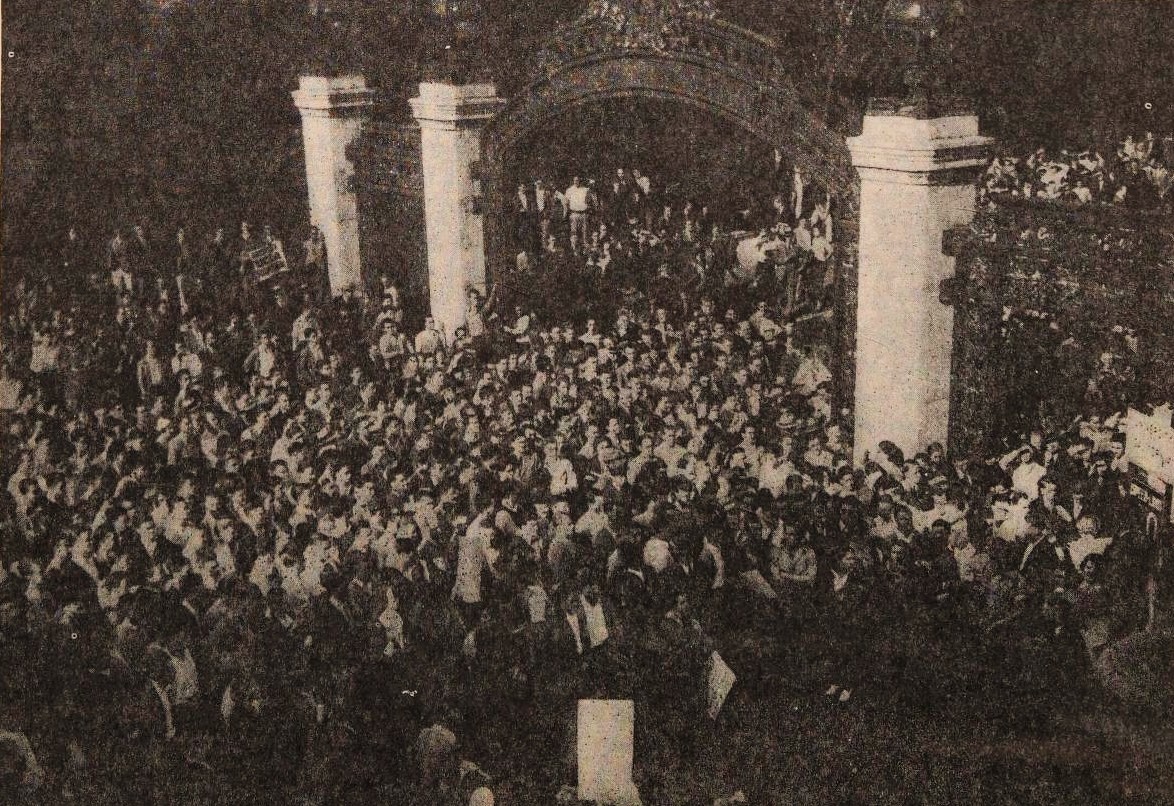
The University of California systems sees spreading student strikes as Berkeley comes out in support of suspended U.C.L.A. activists in 1934.
‘The Strike at Berkeley’ by John Rockwell from Student Outlook (S.L.I.D.). Vol. 3 No. 2-3. November-December, 1934.
The central strike committee which is a group of 16 students elected at a Convention attended by more than 200 students, makes this report on the protest strike made Monday, November 5, at the Univ. of California, Berkeley.
The purpose of the strike was to organize and solidify that student opinion which wished to protest the U.C.L.A. suspensions, the Santa Clara editor expulsion, and the sponsoring of vigilantes by Dr. McQuarry of San Jose State Teacher’s College and by Provost Moore of U.C.L.A.
Though the method of using a strike to gain this purpose was thought of as being undesirable by many students and professors, no other alternative of equal effectiveness could be found. The time element, the need for immediate action, was a decisive factor in making the decision to use the strike.
The two prime issues of the strike were: 1. Demanding the immediate and unconditional reinstatement of all five suspended students at U.C.L.A. 2. Demanding the maintenance of freedom of speech.
Throughout the action of the Central Strike Committee there were three definite policies adhered to: 1. That the strike was not a protest against the administration: nor was it to involve the personalities of President Sproul and Dean Deutsch; 2. that the strike was to be carried on in an orderly and gentlemanly fashion; 3. that the students doing the work of organizing the strike were not led by any left-wing minority group. This last was insured by the make-up of the General Strike Committee of which 12 members were unaffiliated, 2 were members of the National Students League, and 2 were of the Student L.I.D.
These policies were given in detail by a delegation sent to President Sproul and Dean Deutsch before the strike. President Sproul was non-committal, saying that he was acting as an impartial judge, hearing all sides of the case and making no statement for or against the proposed strike. In a statement in the Daily Californian the morning of the strike he belied his stand by appealing to the loyalty of the students and condemning the strike on a small technicality: The Strike Committee was informed of this latter objection the night before the strike during an interview with Dean Deutsch. An application was made at that time to comply with the technicality, i.e., permission to hold the strike on the campus, but the Dean’s hands were carefully tied in the matter, for the President had given him the order in the afternoon not to permit holding the strike on the campus and had left for Los Angeles. Gaining permission being impossible and yet desiring to comply with the administration to the fullest in their action, the strike committee agreed to hold the strike at Sather Gate, which was the expressed wish of Dean Deutsch. He also stated that the administration had no objection to a meeting held at Sather Gate and would inform the Berkeley police accordingly.
Further duplicity in the stand of the Administration are evidenced by a letter sent special delivery Saturday afternoon to all professors having classes at the time of the strike. This letter demanded that professors be at their classes at 10:00 o’clock instead of 10:10, the usual time, that they should take the roll, an unusual procedure in most classes, and that they should take the names of all those students who left classes or tried to announce the strike during the ten minute interval, which is the student’s time.
The Administration also gave the impression to prominent members in the Student Government that if the strike were not stopped there would be a curtailment of student activities. This resulted in an organized minority group, mostly athletes, trying to break up the meeting which was held at Sather Gate. Their methods were continual booing, throwing eggs and tomatoes at the speakers, and physical violence in some cases.
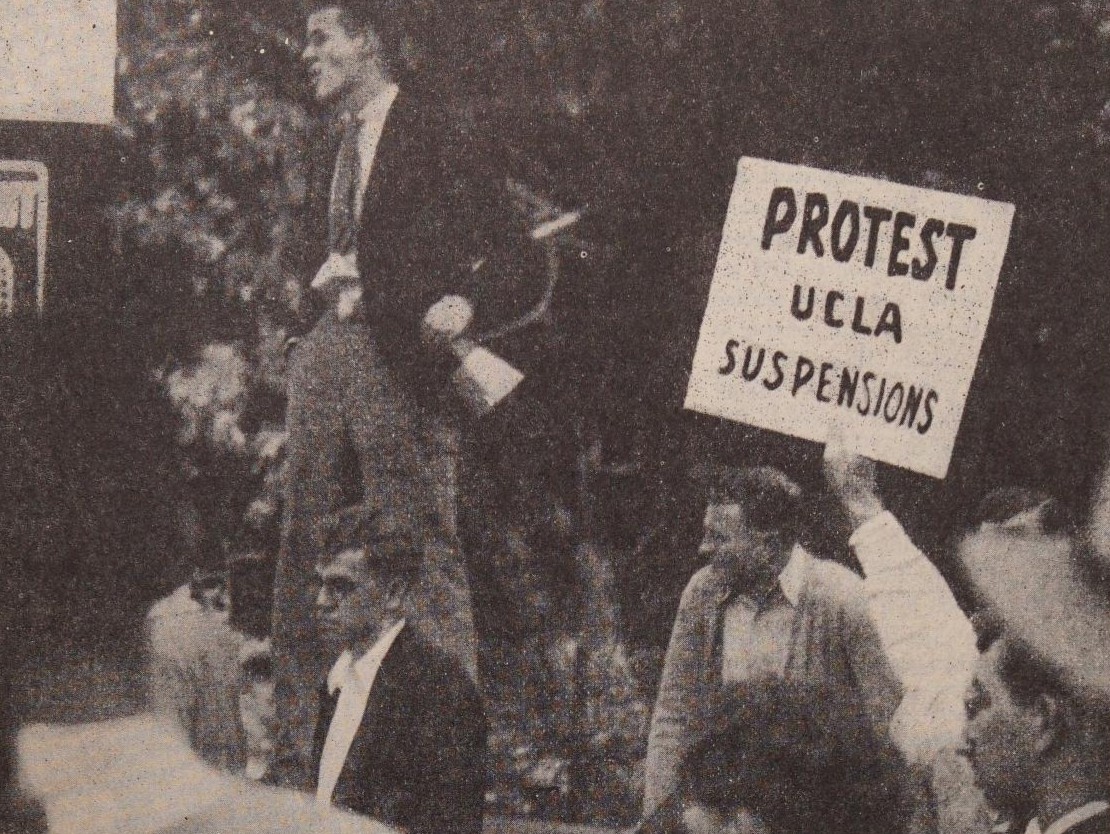
The reaction among students who did not take part in this rowdyism and of professors has been tremendous. Even those who did not favor the strike have become so incensed at the opposition’s actions that they are anxious to aid in the establishment of a permanent mass organization to carry on the forwarding of the issues of the strike.
An organizational meeting was held Wednesday, November 7 to create the Students’ Rights Association. The four points of the platform of this new organization are: 1. For the maintenance of complete freedom of speech; 2. for the permission of all minority student groups to meet on the campus; 3. for the establishment of a democratic student controlled open forum on the campus; 4. and for the stopping of all vigilantes.
Going through a series of names in the 1930s starting with Revolt, then Student Outlook, then New Frontiers, and finally Industrial Democracy these were the publications of the Socialist Party-allied National Student League for Industrial Democracy. The journal’s changes in part reflected the shifting organizations of the larger student movement.
PDF of full issue: https://www.marxists.org/history/usa/pubs/student-outlook/v03n02-03-nov-dec-1934-student-outlook.pdf
 Revolution's Newsstand