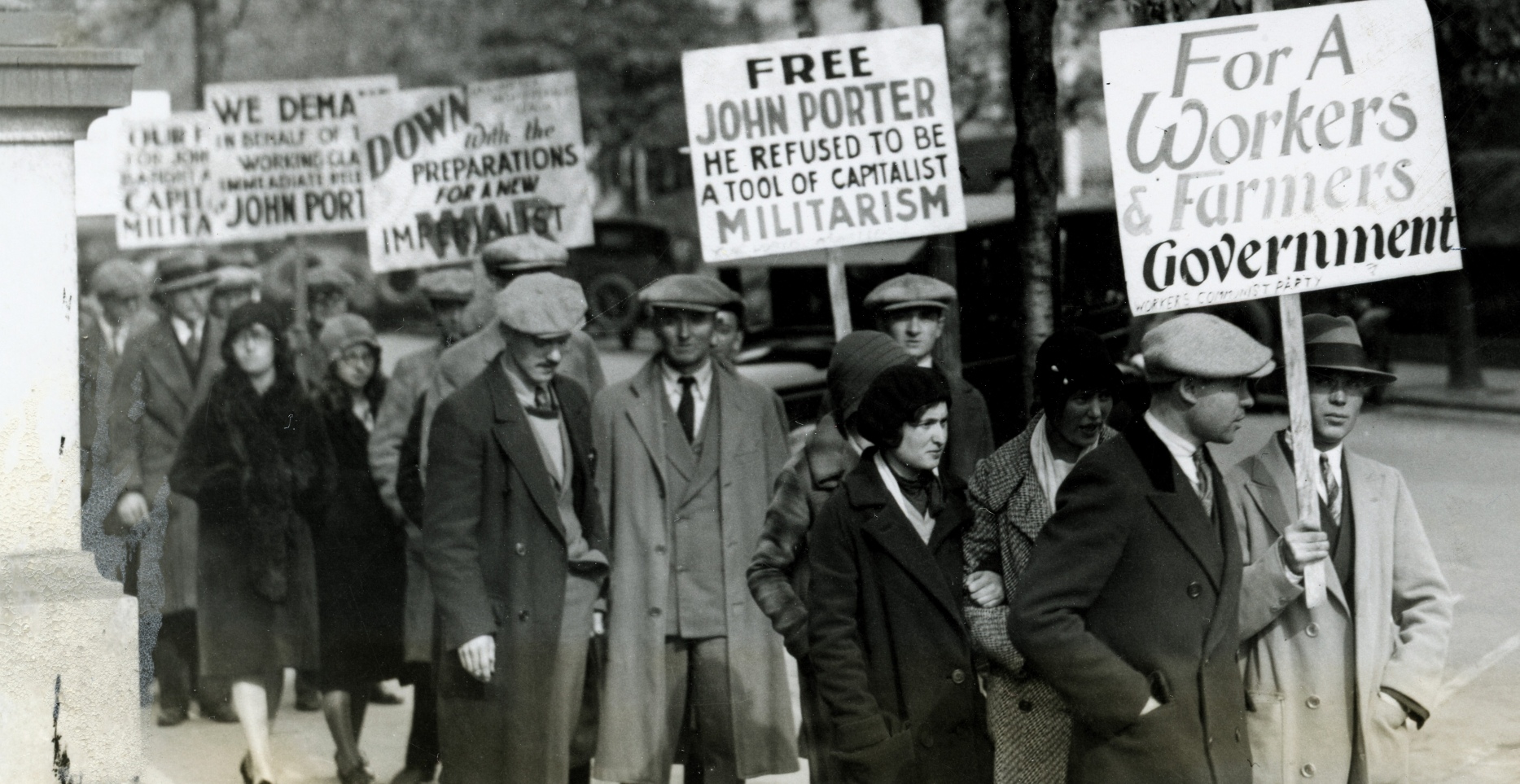
John Porter was an active-duty soldier who went AWOL. A Young Communist militant and textile union leader arrested during the Passaic strike for desertion from the U.S. Army, he would end up being jailed in Leavenworth and then Alcatraz for over two years.
‘John Porter: Working Class Fighter’ by I. Rijak from The Daily Worker. Vol. 6 No. 40. April 22, 1929.
His Example Will Inspire Others to Revolt Against Imperialist Militarism
Behind the bars of the Fort Leavenworth Military Prison today is John Porter, one who will go down in the history of the American working class as a devoted, loyal and courageous soldier of the Revolutionary Movement in this country.
The case of John Porter is unique. He is one of the first of the servicemen to realize the nature of the armed forces and to take up the struggle for the workers. As a victim of bourgeois militarism and capitalist rationalization, John Porter deserves the full support of all class conscious workers in his fight for freedom, and for return to his place in the ranks of the militant labor movement.
It is necessary to review once mere his case so that larger sections of the working class will realize the significance of Porter’s imprisonment and will fight harder for his freedom.
Early Life of Porter.
John Porter was born in a working class family in Concord, New Hampshire. As one of the millions of children of the working class he did not have the opportunity of getting “free education” and at the age of fourteen he was forced to leave school and search for work in order to live. Day in and day out, when the sun rose, he was already in line near the gates of New England textile mills searching in vain for work. After many weeks’ search he finally got a job. He immediately became acquainted with all the “glories” of a textile mill, long monotonous hours, speed up, and every day the same noise of the machines. Being young and vigorous he started to revolt against the miserable shop life and a desire for a change for the better became greater and greater.
Believed Recruiting Lies.
Walking on the streets after hard days of work, the army recruiting station became more and more attractive. Naive, he fell for the posters and beautiful slogans which trap many young workers, and John Porter also decided to “Join the Army and see the world,” to have a “free vacation” and not to “worry about a job.” At sixteen he entered the army and remained there for two years and two months, during which he felt all the burdens of capitalist militarism and gradually to realize that the capitalist army is not a place for vacation but a source of exploitation and reaction. The soldiers were used for the interests of the bosses, he had many occasions to see that soldiers, sons of workers and poor farmers were used against their brothers and fathers as strike breakers. He began to feel that his place was not on the side of the bosses and in spite of the fact that he had only ten more months to serve, he deserted. At that time, not being a Communist, John Porter did not realize that the best way to serve the working class was not by deserting but by remaining and winning over the rest of the soldiers for the cause of the working class as was done by our two Red soldiers, Crouch and Trumbull.
Textile Worker.
Porter went back to a textile mill in New Bedford. The conditions then were even worse than two years ago. The process of rationalization intrenched itself, the speed-up became worse, the hours longer and this intensification of exploitation was accompanied with wage cuts. The workers revolted against these miserable conditions, and went on strike. John Porter was in the front ranks of the struggle. He joined the National Textile Workers Union and became union organizer. Later he became the vice-president of the union. In spite of police brutality he was leading the picket line every day. His devotion and enthusiasm inspired hundreds of young textile workers and they look towards him for guidance and inspiration. At this time he also became acquainted with the organizers of the Young Workers Communist League and soon joined their ranks. He was a charter member of the New Bedford League and the first organizer of the unit.
Alarms Textile Barons.
The textile barons began to realize that John Porter was becoming more and more dangerous and they decided to get rid of him. Five times he was arrested, beaten up and tortured, but the brutality of the capitalist court and police had an opposite effect on him. He became even more determined as the struggle went on.

In the midst of the strike he was informed by the police that they knew he deserted the army but that if he would step out of the strike and leave town, they would not arrest him. John Porter gave the police a courageous answer; “I am not a quitter and will be out on strike until the struggle is ended.”
He was arrested and within two hours he was turned over to military authorities.
After three weeks at Fort Rodman where he was held incommunicado, he was sent to Fort Adams, Rhode Island. During this period he was subjected to the most brutal treatment by the military who tried to break his spirit.
The officers were unsuccessful. Porter remained true to the working class in spite of the threats of the officers to court-martial him for membership in the Young Workers Communist League and for his leadership in the New Bedford textile strike.
Nation-Wide Protest.
A nation-wide protest started by the Young Workers Communist League and the International Labor Defense Convinced the authorities that it would be unwise to give Porter a life sentence. The officers then tried to get Porter not to make a political defense and assured him that if he would follow their advice he would get away with a month or so at the most.
Knowing the consequences, Porter told the court-martial that he deserted from the army because it is used against the workers. “I would be ready to give my life for a working class army” he declared. The infuriated officers gave him the maximum, two and a half years at hard labor. Then he was sent to Ft. Leavenworth, Kansas, where the Commandant, Col. Wm. Morrow, had demonstrated his vicious hatred of Communists when Commandant at Alcatraz prison where Paul Crouch and Walter Trumbull were confined.
Only the working class can free John Porter. In fighting for his release, we will prove to the ruling class that they cannot take out of our ranks our best fighters and railroad them to prison.
More John Porters
With the sharpening of the class struggle we will have more and more John Porters. Many servicemen will realize their duty to use their military knowledge on the side of the working class instead of being tools of the capitalists. Larger numbers of young workers will come into our ranks from the factories. Passaic produced such splendid youthful fighters as Jack Rubinstein and Bill Seroka. The mining struggle gave us Tony Minerich, who is now in one of the Ohio jails. The New Bedford strike brought John Porter to the front as a leader of the Revolutionary youth and an inspiration in our anti-militarist work. The wave of textile strikes in the South will bring to the front more militant youthful fighters who, together with the adult revolutionary workers will root out the corrupt labor fakers of the A. F. of L. and will lead the working class to final victory thru their own organizations.
Today the struggle for the freedom of John Porter is part of the struggle against rationalization, capitalist militarism and the war danger.
***
Write to Porter!
Porter at present is being held strictly incommunicado and very few letters are permitted to reach him. Letters to him, however, demonstrate the solidarity of the workers with Porter and have great significance to the authorities. Workers are asked to write to John Porter (Walerysiak), U.S.D.B., Ft. Leavenworth, Kansas; and also letter demanding Porter’s immediate unconditional release to: Col. Wm. Morrow, Commandant, U.S.D.B., Ft. Leavenworth, Kansas.
Mass Demonstration.
A mass demonstration to demand the release of Porter will be held in New York Saturday, May 11th under the auspices of the Young Workers Communist League, Communist Party and militant left wing unions.
The Daily Worker began in 1924 and was published in New York City by the Communist Party US and its predecessor organizations. Among the most long-lasting and important left publications in US history, it had a circulation of 35,000 at its peak. The Daily Worker came from The Ohio Socialist, published by the Left Wing-dominated Socialist Party of Ohio in Cleveland from 1917 to November 1919, when it became became The Toiler, paper of the Communist Labor Party. In December 1921 the above-ground Workers Party of America merged the Toiler with the paper Workers Council to found The Worker, which became The Daily Worker beginning January 13, 1924.
PDF of full issue: https://www.marxists.org/history/usa/pubs/dailyworker/1929/1929-ny/v06-n040-NY-apr-22-1929-DW-LOC.pdf
 Revolution's Newsstand