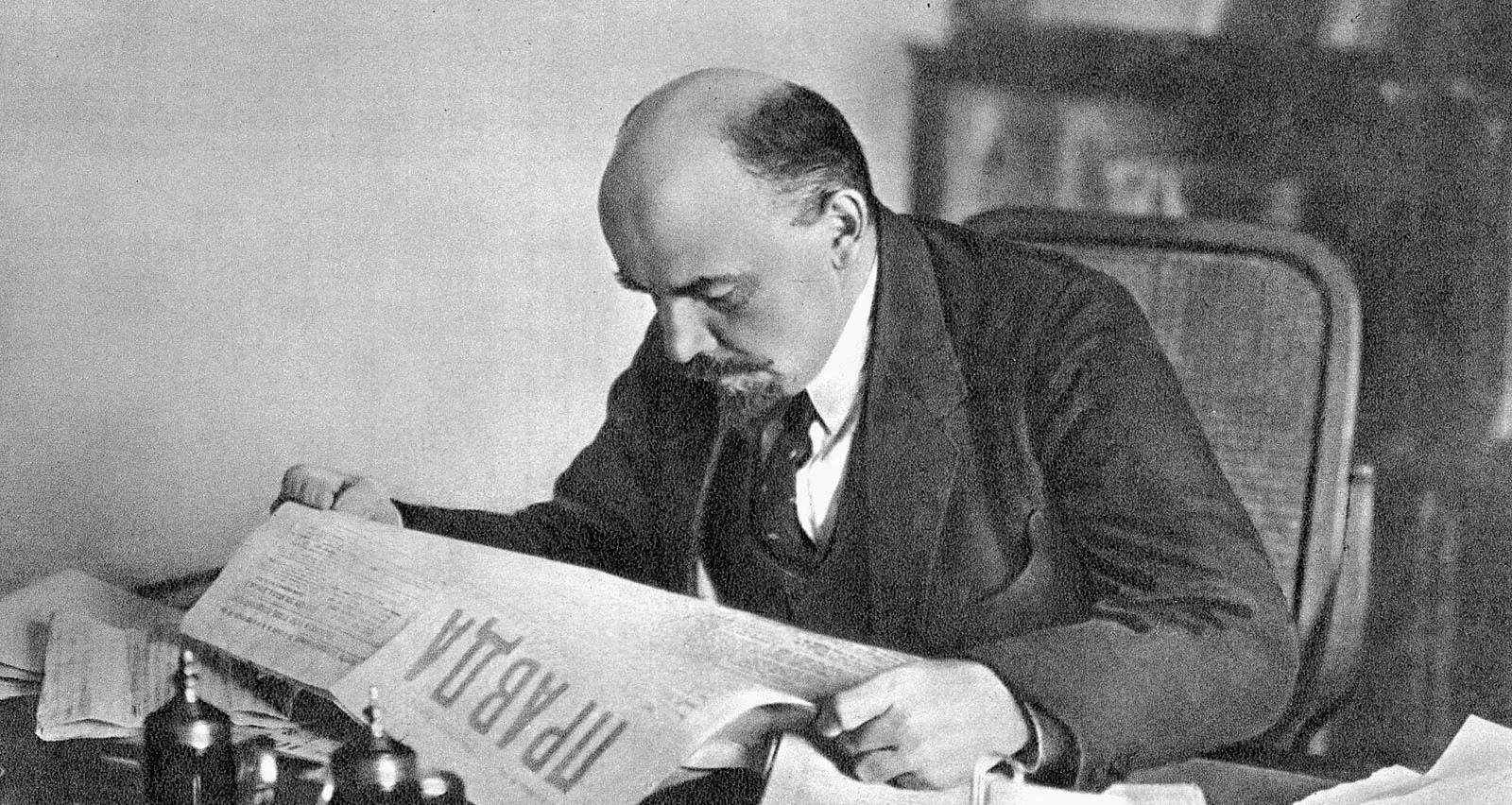
Under control of the Russia of the Tsars since it was taken from Sweden in 1809, the question of Finnish independence became again acute during the 1917 Revolution. First published in Pravda on May 15, 1917, Lenin makes clear that the Bolshevik position is for self-determination, including the right to separate. True to that position, the new Bolshevik-led government issued a Declaration of the Rights of the Peoples of Russia on November 2, 1917 enshrining that right. Shortly after, Finland–under a contested right-wing bourgeois government–declared independence with Soviet Russia the first country to recognise Finland’s new status on January 4, 1918. And then the Civil War…
‘Finland and Russia’ (1917) by V.I. Lenin from Collected Works, Vol. 20. International Publishers, New York. 1929.
The relation of Finland to Russia is the question of the hour. The Provisional Government has not been able to satisfy the Finnish people. The latter do not as yet demand separation, all they want is a wider autonomy.
Recently the Rabochaia Gazeta formulated and “defended” the undemocratic and annexationist policy of the Provisional Government. The defence was an unconscious condemnation of the defendant. The question is indeed fundamental, it is of importance to the state and deserves close scrutiny.
“The Organisation Committee supposes, writes the Rabochaia Gazeta in No. 42, “that the question of the mutual relations of Finland and the Russian state can be completely settled only by an agreement between the Finnish Diet and the Russian Constituent Assembly. Till then our Finnish comrades (the Organisation Committee was addressing the Finnish Social-Democrats) must remember that should the separation tendencies grow stronger in Finland, they might strengthen the centralist aspirations of the Russian bourgeoisie.”
This is the point of view of the capitalists, the bourgeoisie, the Cadets, but under no circumstances that of the proletariat. The Mensheviks have thrown overboard the programme of the Social-Democratic Party, particularly the ninth paragraph which acknowledges the right of self-determination for all nations included in the composition of a state. The Mensheviks have actually renounced that programme, they have gone over to the side of the bourgeoisie in this question, as well as in the question of substituting for the standing army a general arming of the people.
The capitalists, the bourgeoisie, including the Cadet Party, have never recognised the principle of political self-determination of nations, i.e., the freedom to separate from Russia.
The Social-Democratic Party, in the programme adopted in 1903, recognises this right in paragraph nine of the programme.
When the Organisation Committee “refers” the Finnish Social-Democrats to an “agreement” between the Finnish Diet and the Constituent Assembly, it is guilty of desertion to the bourgeoisie.
Fully to convince ourselves of this, all we need is to compare the attitude of all the principal classes and parties.
The Tsar, the Rights, the Monarchists, are against an agreement between the Diet and the Constituent Assembly, they want the subjection of Finland to the Russian people. The Republican bourgeoisie is for an agreement between the Finnish Diet and the Constituent Assembly. The class-conscious proletariat and the Social-Democrats, true to their programme, are for the freedom of Finland, as well as of other non-sovereign nationalities, to separate from Russia. Here we have an unambiguous, clear, and definite picture. Advancing the plan of an “agreement” that solves absolutely nothing—for what are they going to do if no agreement be reached?—the bourgeoisie is carrying on the same tsarist policy of subjection, the same tsarist policy of annexations.
For Finland was annexed by the Russian Tsars as a result of a deal with Napoleon, the strangler of the French Revolution. If we are really against annexations, we must come out openly for Finland’s freedom of separation! After we have said it and practiced it, then, and only then, will “agreement” with Finland have become a truly voluntary, free, and actual agreement, and not a deception.
Only equals can agree. For an agreement to be real and not merely a verbal cover of subjection, it is essential that both parties be given the same rights and privileges, that is to say, both Russia and Finland should have the right not to agree. This is as clear as day.
Only by “freedom to separate” can that right be expressed: only a Finland that is free to separate is really capable of entering into agreements with Russia concerning separation or non-separation. Without such a condition, without the recognition of the right of free separation, all phrases about “agreements” are deceptions.
The Organisation Committee should have told the Finns frankly whether it does or does not recognise the right of separation. Cadet-like it evaded the issue, and thus renounced the principle. It should have attacked the Russian bourgeoisie for the latter’s refusal to grant the oppressed nations the right of separation, such refusal being in fact equivalent to annexation. But, instead of doing that, the Organisation Committee attacked the Finns, warning them that “separation” (“separatist” would have been more correct) tendencies might strengthen the centralist aspirations of Russia!! In other words, the Organisation Committee threatens the Finns with the strengthening of the annexationist Great-Russian bourgeoisie,—this is exactly what the Cadets have always done, it is precisely under such a banner that the Rodichevs and Co. are carrying out their annexationism.
Here is an obvious practical elucidation of the question of annexations, a question that people fear to raise though it is in everybody’s mind. He who is against free separation is for annexations.
The Tsars were carrying out their policies of annexation rather crudely, exchanging one people for another by agreement with other monarchs (the partition of Poland, the deal with Napoleon concerning Finland, etc.), like serf-owners exchanging their serfs. The bourgeoisie, on becoming republican, is carrying out the same annexationist policy, only more subtly, more covertly. It promises “agreement,” but withholds the only real guarantee for actual equality of the parties entering into agreement, namely, the right of separation. The Organisation Committee is trailing after the bourgeoisie, and in reality takes sides with it. (The Birzhevkawas therefore quite right when it reprinted the salient points of the article published in the Rabochaia Gazeta and praised the Organisation Committee’s answer to the Finns, calling that answer “the lesson” that the Russian democracy taught the Finns. The Rabochaia Gazeta has fully deserved this kiss bestowed upon it by the Birzhevka.).
The party of the proletariat (the Bolsheviks) has once more passed a resolution relating to national problems, wherein it has affirmed the right of separation.
The grouping of classes and parties is obvious.
The petty bourgeoisie allows itself to be frightened by the phantom of a frightened bourgeoisie,—herein is the gist of the whole policy of the Social-Democratic Mensheviks and the Socialists-Revolutionists. They “fear” separation. Class-conscious proletarians do not fear it. Both Norway and Sweden were the gainers after Norway freely separated from Sweden in 1905. The gain was in the increased mutual confidence of the two nations, in their closer voluntary rapprochement, in the disappearance of absurd and harmful friction between them, in the strengthening of economic, political, and cultural attractions of the two nations for each other, in the consolidation of the fraternal union between the workers of the two countries.
Comrades, workers and peasants! Do not be carried away by the annexationist policy of the Russian capitalists, Guchkov, Miliukoy, and the Provisional Government, with regard to Finland, Courland, Ukraine, etc.!. Do not fear to recognise the right of these nations to separation. It is not by violence that we should draw these people into a union with the Great-Russians, but by a truly voluntary, truly free agreement which is impossible without freedom of separation.
The greater the freedom in Russia, the more decidedly our republic recognises the right of non-Great-Russian nations to separate, the more powerfully will other nations be drawn into a union with us, the less friction will there be, the more rarely will actual separation occur, the shorter the period of separation of some nations from us, the closer, the more permanent—in the long run—the brotherly union of the workers’ and peasants’ republic of Russia with the republic of any other nation.
International Publishers was formed in 1923 for the purpose of translating and disseminating international Marxist texts and headed by Alexander Trachtenberg. It quickly outgrew that mission to be the main book publisher, while Workers Library continued to be the pamphlet publisher of the Communist Party.
PDF of full book: https://archive.org/details/lenincollectedwo0000unse_p9m3/page/88/mode/1up
 Revolution's Newsstand