
Race, class, nativism, revolution and the Red Scare combine in 1919’s Steel Strike which saw hundreds of thousands of, majority foreign-born, unorganized workers strike against the country’s central industry. Olds with vignettes from across the field of conflict in one of the greatest class battles in U.S. history which saw dozens killed in what remains one of the largest strikes ever waged here.
‘Life, Liberty and Happiness in the Steel Towns’ by Leland Olds from The Worker (Boston). Vol. 1. Nos. 4 & 5. December 1 & 15, 1919.
IN THE steel towns which group themselves about Pittsburgh tens of thousands of men are on strike. And a strange strike it is, at least to the observer who comes down expecting to find dramatic excitement. The towns are silent. Few people are to be seen on the streets. It is hard to realize that so many men are idle on the streets. It is hard to realize that so many men are idle unless you go into some of the houses. There you will find the men, playing cards, talking quietly, or resting. Except for the dingy surroundings, you might take it for some cheap summer resort on a rainy day. There are hundred of those houses; and there is a general sense of restfulness, except where beds are supposed to work double shifts. There, with both shifts idle, the congestion is a bit uncomfortable. And restfulness is somewhat lacking where the troopers have just paid a visit, breaking trunks, knocking them about, ostensibly searching for arms. Yes, there is little that is dramatic, if you are looking for petty incidents. But as you get the whole silent district into your system, feel the pulsing energy and high tension which underlies that quiet, it will strike you as dramatic on a higher plane than you had dreamed. It is a magnificent example of passive resistance, of power with control.
It is extraordinary, this throbbing quiet extra ordinary when you come to know the extent of the provocation, even more extraordinary when you discover how few are the leaders, how small their opportunity to exercise discipline.
Stand in the Central Office of the Union any day. You need not wait long before some one comes in with a tale of new abuse, seeking assistance. First, two boys of twenty or thereabouts who went to visit a cousin in Woodlawn, arrested as they stepped from the train by the deputies who watch all trains–taken to the house of the Burgess, punched, kicked and abused just to bring the lesson home, kept all day, fined and driven out of town. Then a little housewife from up in the Monongahela Valley has made the trip to town in the early morning to get help. Her husband was arrested last night while standing on his own porch. He is now held on $1,000 bail. And she has children. Next, a young man from Duquesne; the “bulls” came to his house, said they were looking for him, and that when they got hold of him they’d fix him. His friend “put him wise” and he left the town. Now he does not dare go home. Of course the “bulls” showed no warrant. Warrants are an anachronism in the steel towns; they are needed neither for arrest nor search.
So one by one through the morning new cases come in. A fine of $50 and costs; $25 and costs for going to the grocery store. You protest that is no crime? Don’t forget, the prisoner is a striker. Mr. Rubin, lawyer for the Union, is in despair. He is overwhelmed with cases. “Get a New Castle lawyer to ask for a transcript in the New Castle cases,” he directs. “Can’t do it,” is the answer. “All the lawyers have been deputized and won’t handle the cases. And besides, we would all be arrested as we stepped off the car.” “Go down to McKeesport and get some affidavits.” “No use wasting the time, a lawyer who tried that yesterday was taken up by the police, told he couldn’t take depositions there and ordered out of town. His clients were arrested.” A thousand dollars bail, fifteen hundred dollars bail, three hundred dollars bail–are they trying to break the strike by confiscating all the workers’ money? What is their game?
These are the common incidents of the day.
One must expect arrest as a suspicious person if one goes on strike. In the steel country there is but one qualification which can free you from suspicion, regular twelve hour daily service to the kings of steel at a bare living wage without protest. Is not discontent a legitimate basis for arrest?
But there are other cases whose logic is less apparent. The police are guilty not simply of arrests but of the wanton use of unlimited power. They use their freedom from responsibility for the acts they commit in order to intimidate the strikers. A man on strike–yes, even his wife and children all are without the protection of the law. At Clairton, workers stopped to read a notice which the organizer was writing on a bulletin board. The state troopers rode up, ordered them to move, and then before they had time, clubs were swinging. Against those blows hats offer scant protection. You turned and looked to see blood running from under a worker’s hat. One broken head, you say. One broken head a day would be less than the truth. Those riot sticks have yet to be used in a riot. They are used daily on the streets to prod and goad, to clot and brise, to terrorize and provoke the strikers.
II.
To the Senate Committee came a veritable cloud of witnesses. And the appearance of these simple people, telling their story before the sleek, well groomed members of the highest legislative body of our government, had an emotional appeal which kept you on your toes straining to catch each word. And your breath came hot with resentment when, after a tale of outrage, a Senator would ask in cold even tones, “Do you speak English in your home? Have you ever suggested to the Town Council that they start night schools?” Night schools, forsooth, after a day varying from 11 to 13 hours, almost seven days a week!
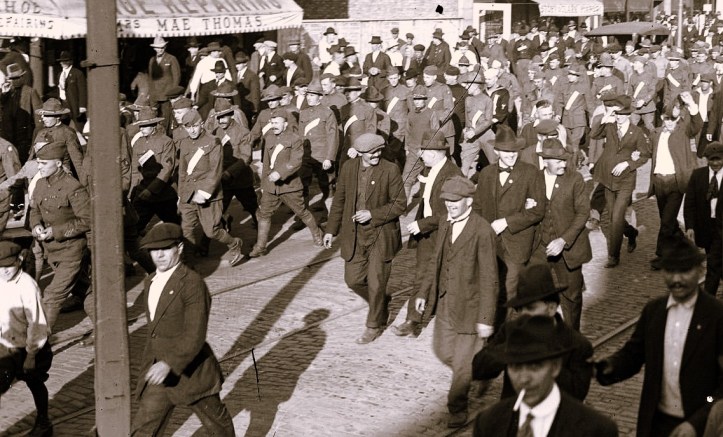
And as you watch the progress of the hearing, it is borne home upon you that this was not a movement of dramatic leaders, of fiery declamation, that you could not enliven your tale with descriptions of daring words of demagogues, that if you would give the great American public some understanding of the situation you must quote the simple stories of unknown people, of nameless members of the rank and file. They come out of the crowd to tell their story and then merge again with the hosts, neither greater nor less than themselves. The issue is theirs. And they understand it, and are smitten with the strange alternating sense of power and helplessness. Together, in the crowd, they feel they must win the right of human beings. Separated, the police, the “cossacks” reduce them to a state of helplessness. How can passive resistance win against brutal force? It is a question which even the idealist will often dodge. And still the counsel of the leaders is, “peace, peace, order, always order!” Out of the crowd came Mr. and Mrs. Banks, to tell their story for the Senators. For a moment they became the dramatic center of a strike involving millions. Together, wheeling their baby, they had gone to the store to make a purchase, cigarettes, I believe. She waited outside with the baby. As he came out, an officer was telling her roughly to move on. He took the baby and she took his arm and they started to walk on. Suddenly she was grabbed by a deputy who claimed that she had used foul language to him. The husband denied the accusation, was told in a stream of vulgarity that his brains would be beaten out if he did not hold his tongue. She was roughly dragged to an automobile while state troopers knocked him about and beat up his brother. The upshot was that he secured her release on $50 bail. An exception, you say? In one particular, that he was not arrested when he went down to offer hail. Mr. and Mrs. Banks told their story and were swallowed by the crowd.
A little woman, the strange repose of unspoiled peasantry in her face, took the stand. No leader, no agitator, just a wife and mother of three children. On October 8th, at 7 o’clock in the morning, she had come down to start breakfast. Her family were still half dressed. As she opened the door she saw deputies and state troopers scattering the men on the hillside. Suddenly one rode up and ordered her in. She replied that he could not boss her on her own property. He followed her into the house, kicking the panels out of the door despite the fact that it was open, and arrested the entire family, wife, husband, and three children. Half clothed, they were kept in jail six hours without food, although the mother offered to buy food for the children. Not police, but highway robbers, she called them. Her husband’s nose was bleeding from a blow from a state trooper’s pistol. She told her story and lost her identity in the crowd.
A room packed with witnesses to brutality, to intimidation, to sanctioned lawlessness, to denial of the ordinary rights of men. Calmly the Senators heard it with occasional remarks about the need of education. But we cannot ask all these men and women to tell their story. Much would sound like repetition. Several would tell how, at Monessen, the state police and deputies made occasional drives along the hillside, gathering as in a net all the men, herding them at last into the company gates. There they were given the choice arrest or “go to work.” Others would tell how they were locked in a cellar and threatened with hanging if they did not go to work. Upon one more individual, however, we will turn the light; for he shows a new spirit in the movement. A bullet had been presented as evidence. At Clairton, there had been firing in the night. A bullet had just grazed a housewife’s head, penetrated the house wall and the stove and lodged inside. This was the bullet. Senator Sterling picked it up with a bland smile. “You know,” he said in substance, “that story is rather far-fetched. In the first place, you have not shown who fired the shot. And in the second place this polished bullet hardly looks like one that had penetrated house and iron stove.” He tossed it to the other senators in half contemptuous dismissal of the case.
There stepped forward a square-shouldered, clean-cut fellow. In him you felt assurance equal to that of the worthy Senator. According to his story he had enlisted in the army in 1914, going to the Mexican border. In 1917 he went to France with the first unit of the Engineers, a non-commissioned officers corps, being one of the first 50 American soldiers to land. He served through the war, receiving his discharge in May, 1919. He returned to support his mother and was rebuffed by his old superintendent, despite the fact that he had been promised when he enlisted that he could have his job back again. After five months he got the dirtiest job in the place. Out of the crowd he stepped.
“May I look at that bullet?”
He examined it, turned a moment to a couple of his “buddies” for confirmation, and then said quietly:
“Senator, perhaps you do not know that that bullet was fired from the U.S. Army automatic.” He gave the exact bore and specifications. “That is a steel jacket bullet which will penetrate three inches of steel. And another thing, Senator, you cannot get one of those automatics unless the Government supplies it or you steal it. They are under Government patent and are not for sale.”
That was all he said, tossing the bullet into the middle of the table. But somehow, as this clean cut fellow talked, he appeared a very important member of the world which is to follow the war for democracy, and the Senator appeared a less significant figure in that new world.
III.
But to feel the fact of intimidation and provocation we must go out to the towns themselves, checking up the facts. So it will be necessary to pass over with a bare word the climax of the hearing when the counsel of the strikers offered as evidence the blood-stained clothes of Fannie Sellins, mother of children, organizer for the mine workers, killed in wanton shooting by deputies and a Company official at Breckenridge, August 26th. The clothes alone are ample refutation of the findings of the grand jury which refused to indict the deputies. There were moreover 40 affidavits showing that Mrs. Sellins was killed while trying to protect children after the shooting started. Before this awful exhibit the Senate Committee quailed, and fairly begged that these clothes be ruled out on the technical ground that the outrage had occurred before the steel strike had begun.
Yes, we must go into the field. At Braddock a strange thing has happened. The Town Council is trying unsuccessfully to discover who invited the state troopers to come to town. And what is more, so disgraceful has been the conduct of these troopers that the Town Council wants to get rid of them. Truly a new situation in a steel town!
On the 22nd of September two state troopers attacked a congregation, riding into them as they poured out of one of the large churches of the town. On the 12th of October, the state troopers rode into a flock of children as they were waiting for the school bell. Some of the parents were watching from the other side of the street, and the provocation was so great that a clash was averted with difficulty. The corporal of the squad of “cossacks” stationed in the town had already exposed the policy of the steel corporation before witnesses in Ward’s restaurant. “This is a hell of town,” he said. “You can’t get a fight if you are looking for one.”
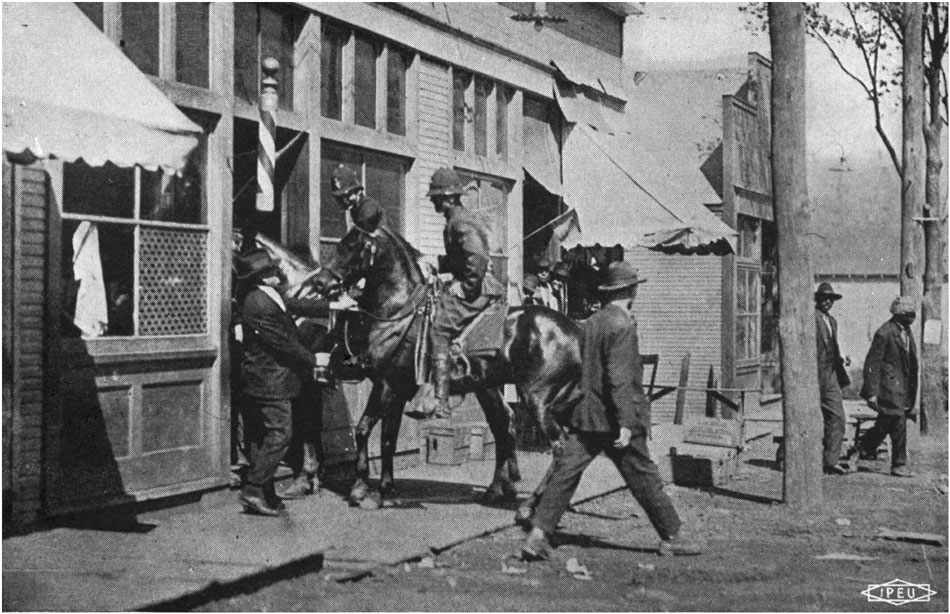
A man had been clubbed for walking slowly while counting the money which he had just received from a pay window. Two troopers on horseback went into a saloon after a man merely because when ordered to move on he had tried to excuse himself for standing on the sidewalk. A man chopping wood in his cellar for his wife’s breakfast, was arrested by state troopers without warrant, dragged out hatless, taken to the station, on the excuse that some one ten minutes previously had called “scab” to some workmen crossing the track. His wife, who was about to be confined, is now in bad condition as a result of the shock.
But the desire of the representatives of law and order, and of the steel authorities, to provoke retaliation which might be called a riot, was put into action in a most outrageous manner about a week ago. The “cossacks,” evidently looking for trouble rode slowly down the sidewalk along which the workers live, ordering the men who were on their porches into the house, and even riding up and slapping some of them. But the men bore it in silence. So the troopers got two mill officials, F.F. Slick (the man who turned the machine gun on workers at the Westinghouse plant some years ago) and a man named Sheppard, who drove down the same sidewalk in a big automobile, the troopers following. The very insolence which these officials showed the people would seem to have warranted vigorous protest. Witnesses say that a woman called out, “This is no thoroughfare,” that a man shouted, “Get out of the way, Slick is coming.” At any rate, Slick jumped out and shouted angrily at a man leaning against a fence, “Did you say that?” In broken English, the man denied saying anything. But the troopers went at him with clubs. He seized one club aimed at him and flung it away, but another trooper hit him from behind. The man somehow managed to escape into a house and the troopers were following with drawn guns, when they saw men, who were standing around, seize bricks. So they thought better of it and the whole troop of company brigands drove away. No wonder these brutal men, there to break the strike, claim that it is “a hell of a town, where you can’t start a fight when you want one.”
In the face of such provocation, I call the restraint of these unschooled steel workers extraordinary. Surely their leaders must have trained them long in peace. Where they are allowed to hold meetings the counsel of the leaders is “peace, peace, peace,” “conform in all things to the law.” “If they beat you, if they arrest you without cause, suffer it, do not resist.” “Keep the peace, stand firm, and we will win.” But there are few meetings which they are allowed to hold. And they are forbidden to speak to the men in their own language. One by one, even these meetings are being denied them. People do not understand how these tired, overworked organizers are a force for peace, restraining not men who are lusting for disorder and violence, but men who are suffering from the studied brutality of the “cossacks” and the “bulls.”
IV.
If these outrages can be counted by the score, so can the violation of rights of the strikers as members of the community be counted by the hundred. As workers they are not citizens but instruments of this great producing mechanism of society. Used and abused as instruments they are held responsible as members of the community. They have all the duties and none of the rights of responsible citizens. And when they take the one opportunity left them to be men, to meet as equals and to experience some of the real meaning of democracy in their organizations, when they seek the only road to freedom open to the worker, the strike which alone can save men from wage slavery, then indeed they cease to be instruments and become outlaws.
In Duquesne they have never been allowed to attempt to organize. Men have been arrested for attempting to hold meetings on vacant lots, for the use of which they had the owner’s permission. Crane men who attempted to bring a grievance to the attention of the management, were told they would be fired if they tried that again.
At McKeesport, three men cannot assemble at the Union headquarters. Once they could hold regular business meetings, with nearly all the company officials lined up on either side of the door watching the men go in. But when the superintendent saw the rapidity with which men were flocking to the meetings. When he saw gatherings of 1,200, the organizer was notified that there would be no more meetings. Organizers were arrested and fined for announcing to the men that the authorities had prohibited meetings. And in the face of this denial of fundamental rights, Senator Sterling can blandly answer, “But you tried to speak to the men when the constituted authorities had refused you a permit.” A permit, forsooth, when it is doubtful whether there is any law on the statute books which necessitates a permit for indoor meetings.
Broken heads at Glassport, when they tried to assemble in an open field; broken heads in Clairton when they assembled there with the permission of the Burgess–this is the answer given in Western Pennsylvania to the question of the right of assemblage. Arrests are made by the hundred; bail fixed at 1,000 more or less. It is not necessary to name the separate towns, Woodlawn, Monessen, Charleroi, Donora, Duquesne, Homestead, etc. Everywhere in the territory ruled by the steel corporation the story is the same. And the moral to the worker is this: “Accept slavery and live in peaceful poverty with just a bare subsistence. Strive to be a free man, protest ever so little, and you will be treated as an outlaw, as a runaway slave.”
Picketing is prohibited, that is, by the men. But missionaries of the corporation are by thousands working among the men in their homes, clubs, churches, and lodge rooms. Picketing by the corporation is a part of the daily routine of many towns. Men and women sent out to the homes, some armed, threaten and cajole the workers, intimidate the wives into urging a return to work. Is this peaceful picketing, such as the law allows? And still in tens of thousands the workers “stick,” although many who are fined are told that they will get it back when they return to work.
So we come to our conclusion. A strike in which the leaders are removed, are separated from the rank and file, in which organization has grown up almost spontaneously in the face of every obstacle which human ingenuity could devise. A strike which has persisted over weeks without the constant stimulated enthusiasm of the oratory of strike meetings, which has persisted despite company picketing, threats and violence. A strike in which all the participants know the purpose, a purpose so simple and fundamental that it appears no purpose to Senators. A strike based on the desire of hundreds of thousands to be recognized as human beings.
The Worker was published semi-monthly as the organ of the Boston Branch of the Communist Party of America, one of two Communist Parties at the time, beginning in 1919. The Worker was edited by John J. Ballam, former member of the Socialist Labor Party and the IWW, and run by Pascal Cosgrove. Thomas J O’Flaherty, Marion Sproule, Moissaye Joseph Olgin, and Antoinette Konikow were supporters. It was closed down, along with many publications, in the January 1920 Palmer Raids.
PDF of issue: https://www.marxists.org/history/usa/pubs/mass-worker/v1n4-dec-01-1919-ma-worker.pdf
PDF of issue 2: https://www.marxists.org/history/usa/pubs/mass-worker/v1n5-dec-15-1919-ma-worker.pdf
 Revolution's Newsstand