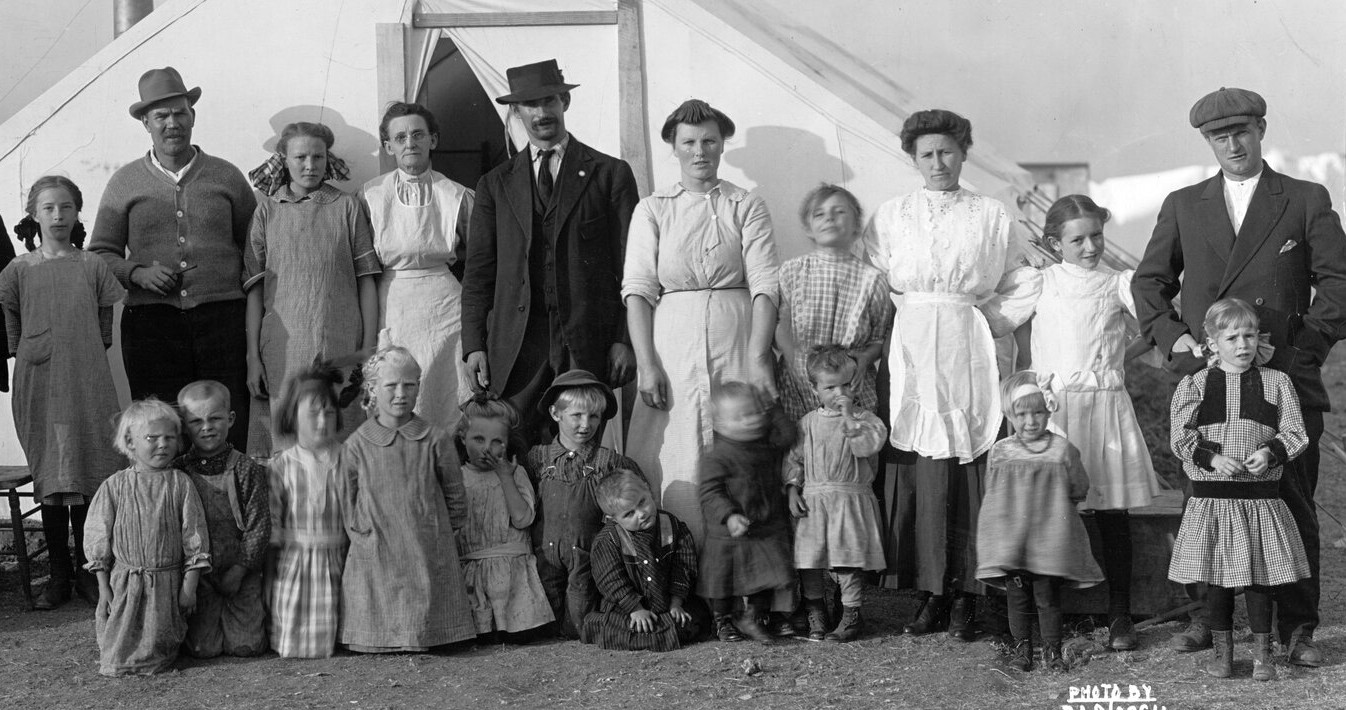
A wobbly critique of the U.M.W.A. leadership of the 1913-14 Colorado Coal Strike given one month before the Ludlow Massacre.
‘The Colorado Coal Strike’ by Pat Noonan from Solidarity. Vol. 5 No. 217. March 7, 1914.
Denver, Colo., Feb. 24. The situation in the coal strike as we can see it today, has again proven the fallacy of sectional unionism, otherwise known as craft unionism, industrial in form only. In this struggle, which has extended over five months and is still going on, there is one thing discernible to all thinking men and women–that is the lack of solidarity of supposedly organized labor.
The miners on strike here live under worse conditions than ever did the peon of darkest Mexico. Such vile abuses and indignations were these miners subjected to that as a last resort they organized under the banner of the U.M.W.A., and that organization declared a strike. This strike of the Colorado coal miners will soon be a forgotten episode in labor circles where class-conscious revolutionary tactics and direct, action methods without sanction of the legalized robbers are concerned.
A moment’s review of this organization, the U.M.W.A., as to its education, its methods and tactics: We were told in speeches, by manifestos and daily papers, by organizers and officials of the U.M.W.A., that this organization was strictly an industrial union, taking in all workers, and those connected with the mine who work on top. The membership consists of 435,000 dues-paying members; financial rating $14,000,000; all mines having agreements and obligations with mine operators; district contracts expiring at different times so as to prevent all the miners acting together. Education is mostly “respect for property rights and obedience to laws” made by their task masters. The ballot is the first of all their many useless weapons. They are told to vote for the enactment of laws to protect miners’ lives; send men to represent them in Congress and the state legislatures; pack every nook and corner with politicians and shysters who vow before election to save the poor miner.
Finally, the miners go out on strike of months’ duration, trying to enforce their demands in sections, like the coal strike here. Some of the miners of Colorado have been on strike for three years and all of that time have been trying to live on about $4.00 or $4.50 a week. The miners in Northern Colorado are getting damned tired of sectional unionism. But the machine of the U.M.W.A., as proven at the last convention, never tries any new tactics.
The 9,000 miners striking here are bound to meet defeat, for thousands of them have gone into other states where the union has agreements, and are flooding the blood-stained state of Colorado with mountains of coal. One would never know there was a strike of coal miners in this vicinity, except he heard it mentioned by some miner who can’t go elsewhere on account of his family and must subsist on $4 a week while waiting for the workers to unite so they can win. There is only one objection to this proceeding, and that comes from our old friend the petty trader, who wants the strike settled so bad that a Congressional investigation is now going on here. Of course the cockroaches are not interested whether or not the miners get their demands. But one thing is apparent to the most prejudiced commercial pirate–that is the exodus of the miners and families to Wyoming where union mines are working all the men procurable, and the consequent lack of the funds of these same miners which formerly were spent in Colorado trading dens. It is quite true that Colorado’s code of laws has many rules for better working conditions in mines and for protection of life in these hell holes. That is, these rules are on the statute books. It took years, of parliamentary and direct action, through former strikes and political buncomb, to place them there. And now it would take centuries to enforce them by sectional revolt.
So much for political action and sectional unionism. Why did the U.M.W.A. at the last convention refuse to donate to strikes or any other form of revolt against this system, no matter what phase it took? Why did the convention refuse to call a general strike of all the producers of fuel, when they passed resolutions to strike as an industry in case of war? If this present Colorado strike does not present at picture of war, what does? Not theoretic war, but actual warfare! Where high power rifles and high) fed generals are in actual service; where khaki-clad thugs, professional gunmen, and college pups rob, plunder, murder and revel in drunken debauchery, inflicting all their heinous crimes on defenseless miners’ homes and families in the name of the sovereign state of Colorado, the U.S.A. and the coal trust. You ask us to obey and respect that kind of law and order? We don’t, and any real man or woman would not. So miners, if in case of war you will call a general strike, for humanity’s sake if not for your own, get busy and stop producing coal. Strike as an industry the country over, and the master class, as well as the rest of the working class, will recognize the power of the General Strike.
The most widely read of I.W.W. newspapers, Solidarity was published by the Industrial Workers of the World from 1909 until 1917. First produced in New Castle, Pennsylvania, and born during the McKees Rocks strike, Solidarity later moved to Cleveland, Ohio until 1917 then spent its last months in Chicago. With a circulation of around 12,000 and a readership many times that, Solidarity was instrumental in defining the Wobbly world-view at the height of their influence in the working class. It was edited over its life by A.M. Stirton, H.A. Goff, Ben H. Williams, Ralph Chaplin who also provided much of the paper’s color, and others. Like nearly all the left press it fell victim to federal repression in 1917.
PDF of full issue: https://www.marxists.org/history/usa/pubs/solidarity-iww/1914/v05-w217-mar-07-1914-solidarity.pdf
 Revolution's Newsstand