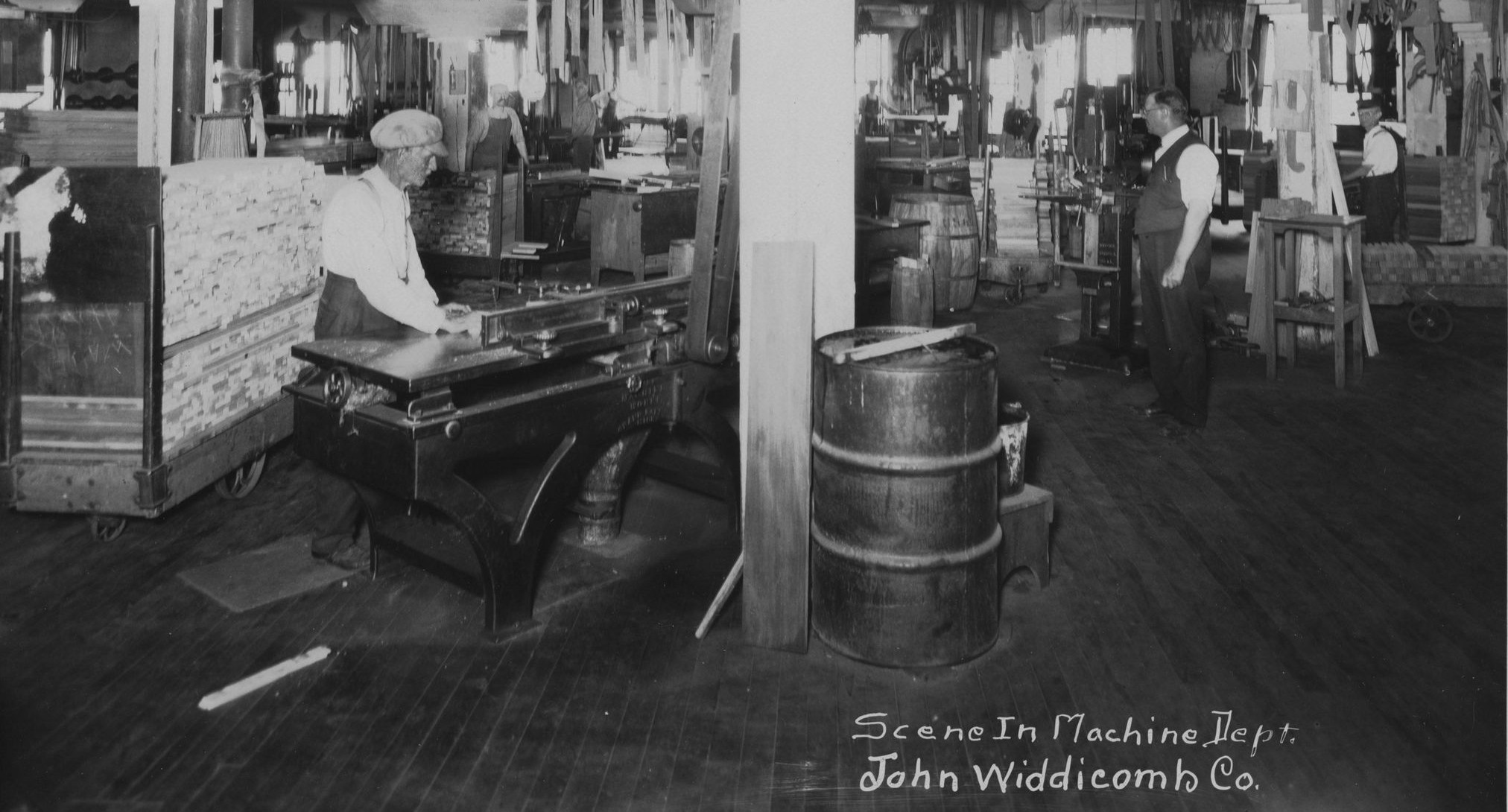
One of the delights of this work has been getting to know the militant minority of Furniture City–Grand Rapids, Michigan. Though fairly isolated, and in a largely conservative, craft-union, Dutch Calvinist city, they retained their radicalism and their humor with regular reports to the I.WW. press on life and politics in the city. Below, further news on what was a major class battle in the city as A.F.L. unions struck the furniture factories in 1911.
‘Another ‘Riot’ in Grand Rapids’ by O.L. Wakeup from Solidarity. Vol. 2 No. 29. July 11, 1911.
Grand Rapids, Mich., June 15. The most interesting incident in the furniture workers’ strike since my last report was the so called “riot” which occurred at the Widdicomb Furniture factories June 12. This outbreak was of a different character to that which took place a month ago.
The managers of these factories had announced their intentions to open the factories, and 106 “loyal” slaves reported for “duty.” When they were released from the slave pen about 6 o’clock in the evening the coast appeared to be clear, the only crowd about the factories being a squad of cops who had rushed thither on receipt, it is stated, of a telephone message from Organizer Macfarlane who it is alleged, reported that he had been informed that the word had been passed” that there was going to be “trouble.” So the squad, in response to peaceful Mac’s warning was on the job at the factories.
It so happens, however, that almost the entire district adjacent to these factories is populated by slaves who up to the time of the strike had been exploited by the Widdicomb’s. Many of these strikers own their homes, and they can assemble on their “own” property and jolly, the loyal, slaves who go and come “where duty calls them.” It may that these homes were sold on generous” terms by the Widdicombs to the slaves now in revolt. Tis the irony of fate if this is so.
Some of the loyal slaves, as a further protection against “attack” had their children meet them and accompany them from the pens, and the pen-pushing pin heads of the capitalist press played this up strong.
A squad of 30 scabs came out of the factories and marched down street in a body. They were unmolested, save for the jeers and cries (of “scab” from the wives and children of strikers who stood in their own yards. When the “Harvard heroes” turned the corner, presto, the scene was changed. The” air was rent” with loud cries mingled with curses and thuds and thumps. The “loyal” party of 30 had been attacked by those who apparently wished to keep the factories “tied up” in accordance with craft union tactics.
Isn’t that what craft union leaders loudly shout at all times in all craft strikes: “If we can keep the plant tied up we’ll win.” Well, I guess these lads who attacked the “heroes” thought that the best way to put this great craft motto into effect. Then they are bawled out and disowned by their “leaders” and everyone else for doing this. “Tis a great contradiction.”
Well, according to reports, quite a number of the 30 “loyal” slaves were handled pretty roughly, though no deaths have so far been reported. After the first 30 had gotten safely away from the factories another bunch of 12 was started out, and when these turned a corner they also, it is stated, “met theirs.” By this time the coppers got hip, called off the watch on the factories and proceeded to rescue the scabs. They were loudly jeered by men, women and children. When the coppers reached the scenes of the alleged attacks there was nothing doing; the “person or persons” responsible for same had not remained on the job. They had “flown,” they had.
Tuesday the factories were open for work, but only 26 loyal slaves reported for “duty.” They were permitted to leave the pen early in the afternoon, with a squad of cops, prepared for “trouble,” as an escort. On the following day the president of the company announced that the factory would be closed in answer to “the pleadings and prayers” of the wives and children of the “loyal” ones, so that the lives of their husbands and fathers might not be endangered. It was also. stated that the Widdicomb company was paying weekly “earnings” and “would continue these 106 loyal workers half their regular to do so as long as there was a cent left in the treasury.” It is also stated that some of the men who were attacked were old men, some of them being over 70 years. President Widdicomb stated that all the workers who had remained “loyal” had been employed by the firm for from 5 to 45 years.
The capitalist press played the sentimental strings bard in this affair–“boiling” with indignation at the thought that these citizens exercising their constitutional privilege and “Inalienable rights of life, liberty and pursuit of happiness” (a job) should be thus attacked in “free” America; and it was “cowardly that aged men should be so treated;” and their tears were shed over the “toilworn wives and mothers and little children who went to plead that the factories be closed that the lives of their dear ones be not endangered.” The strikers are warned in leading editorials that this will not be tolerated much longer; they will lose “the public sympathy” and without the support of the great mass of “independent citizens” the cause of the strikers will be hurt and the strike lost.
These same lackeys of capitalism shed no tears over the fact that these wives and mothers are toilworn and aged, because for from 5 to 45 years their husbands have been oppressed and robbed by the owners of these factories; that for all these years these slaves, young and old, have been creating vast masses of values that enable the Widdicombe et al. to live in luxury and ease, to enjoy life at the fullest, while the producers of these values receive back the pittance than will keep them in condition to produce more values and produce their kind so as to keep the labor power market well supplied, so that the price of labor will be kept well down. No teams are shed over the workers who have been crippled and maimed in the “discharge of their duty” of producing wealth for their masters. Their “blood does not boil with indignation” at the thought of the introduction of more and more human labor-displacing machinery.
How comes it that the slaves who have, according to the testimony of their masters, toiled “faithfully” for 45 years and in order to keep the wolf from their doors, in their old age are compelled to scab on their fellow workers? Is it because these slaves have spent their “substance” on riotous living, on automobiles, on wine and women, on trips to Europe, yachting and the thousand and one “little things of like nature that absorb “rewards of abstinence?” Answer, ye pusillanimous lick-spittles of capitalism, is it because of these things that these old slaves (these human labor commodities who are compelled to ascend the auction block in the human labor power market and sell themselves to the lowest bidder,) are forced in their old age to scab?
Another Strike in G.R.
June 12 about 900 workers employed at the Pere Marquette railroad shops went on strike. Machinists, carpenters, blacksmiths, boilermakers and their helpers were included in the walkout. These workers, together with the clerks and switchmen, are affiliated all over the P.M. system in what is known as a federation and for some time a committee composed of representatives from the different crafts in the federation has been negotiating with the officials of the company for an increase in wages. The officials of the road stated they were willing to treat with each individual organization, but would not do business with the federation. The workers would not accede to this, but said they wanted to do business as one body and could not enter into separate, agreements. Several conferences were had, and a big pow wow had been arranged to take place at Detroit the day the workers here went out. On the Saturday preceding the walkout 82 men were laid off at the shops here, the officials stating this was in line with the policy of “retrenchment” that had been decided on, and there was no possibility of increasing wages.
The headquarters of the different crafts were informed immediately concerning the walkout and several national officers were rushed here. It was given out that the men had gone on strike without the sanction (horrors) of their officers and in violation of all the rules of their various organizations. As soon as the leaders arrived Trump (good-name that), called meetings they got busy. They “interviewed” Supt. of “their” men and jawed them and ordered them back to work. The strikers were told they were “unreasonable,” “hasty,” that they had been misled by a bunch of dissatisfied “floaters” and “boomers”; the company had always been good to the individual unions; this should be appreciated, and no doubt with business conducted on “proper” lines satisfactory settlement would be made.
So the men went back to the job, including the 82 who were laid off–but they will only work seven hours a day and five days a week and will receive pay for 35 hours. However, they made the company take 82 workers off the labor power market; and if they would organize on correct lines and dump their “bleeders,” they’d have a seven hour day and put the price up. The switchmen did not go out, and possibly because it was a rainy day, neither did the clerks.
O.L. WAKEUP.
The most widely read of I.W.W. newspapers, Solidarity was published by the Industrial Workers of the World from 1909 until 1917. First produced in New Castle, Pennsylvania, and born during the McKees Rocks strike, Solidarity later moved to Cleveland, Ohio until 1917 then spent its last months in Chicago. With a circulation of around 12,000 and a readership many times that, Solidarity was instrumental in defining the Wobbly world-view at the height of their influence in the working class. It was edited over its life by A.M. Stirton, H.A. Goff, Ben H. Williams, Ralph Chaplin who also provided much of the paper’s color, and others. Like nearly all the left press it fell victim to federal repression in 1917.
PDF of full issue: https://www.marxists.org/history/usa/pubs/solidarity-iww/1911/v02n29-w081-jul-01-1911-Solidarity.pdf
 Revolution's Newsstand