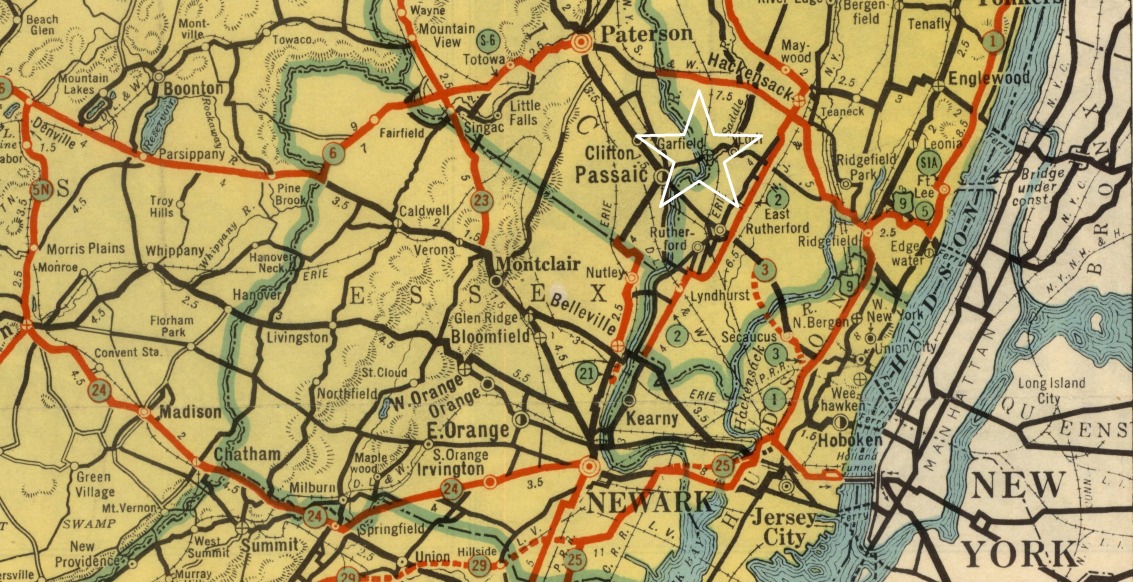
With struggle, new possibilities open. From leading Hungarian-American Communist Emil Gardos, a report on the impact of Passaic’s struggle on nearby Garfield, New Jersey as labor tries to break the capitalist party hold over the small industrial city.
‘Building the Labor Party in a Small Industrial Town’ by Emil Gardos from The Daily Worker. Vol. 4 No. 224. October 5, 1927.
The Garfield Labor Party
The building of a Labor Party in a small industrial town offers certain problems which we do not face in the larger cities. The lack of working class organizations, a militant spirit manifesting itself in spite of the political backwardness of the workers, the linking up of the Labor Party with the organization of the unorganized, necessitates a study of this question. For this reason the Labor Party ticket in Garfield, N.J., holds a special interest for all of us.
During the last Passaic strike, which was a splendid school for raising the political consciousness of the workers, Garfield, a city with a population of 27,000 was in the center of the struggle. This was due not only to the picket lines of the Forstmann-Huffmann and other mills in Garfield, but also to the fact that it is the residence of the great number of textile workers. Trying to escape the slums of the Passaic East Side, they settled down in this suburb, many of them living in their own little family houses secured through heavy mortgages. Of the 5,000 citizens entitled to vote, 80 percent at least are factory workers who are mostly engaged in the textile mills of Passaic and vicinity.
Interested In Politics.
The interest of these small-town workers in politics is much keener than in the larger cities. While the city worker, living in the tenement houses does not feel directly the burden of taxation, to the small-town worker who owns his own house, politics expresses itself in taxes, street paving, city improvements and other local issues, which become a part of his bread and butter problems. He is trying to find his political expression thru the participation in the republican and democratic parties where the different class interests manifest themselves in like issues. Although these parties are under the control of the bosses, their make-up presents a different picture from that of the same parties in the great cities. The membership of the Second Ward Hungarian republican club or the Italian democratic club consists of a great majority of workers with a few business men and foremen in the leadership. Most of these politicians are agents of the mill-owners, but there are some who unconsciously are trying to represent the interests of the workers.
Defeat Workers.
This is especially true during the primaries when there are sometimes workers fighting for nomination. Naturally, big business, with the help of the press and the party machine always puts up its own man. If a worker gets in by accident he is soon corrupted. This is known to many workers, but instead of their political passivity, as is the case in the larger cities, they remain within the folds of the capitalist parties in an effort to sway them in the interests of the poor people. Such expressions within the old parties must not be ignored, but to the contrary, we must utilize them when laying the basis for a Labor Party.
The present republican mayor of Garfield and the majority of the councilmen are directly or indirectly on the payroll of the mill-owners. Mayor Burke is the secretary of the Botany mills and we have a few foremen in the council, not speaking of the businessmen whose existence depends on the good will of the mighty corporations. During the strike they naturally rushed to the help of the mill owners. In spite of the fact that the vast majority of the voters were with the strikers, Burke immediately hired extra policemen, saving even the expense of the mill owners of hiring their own gunmen. This squandering of the strikers’ money to break the strike was done without practically any dissenting voice in the council.
Verge of Bankruptcy.
The city at the present time is on the verge of bankruptcy. Taxes are higher than anywhere else. A loan of $114,000 raised for building purposes was grafted by these strike-breakers. The payroll of the city employees was not paid this week because of lack of funds. Mass unemployment, pressing mortgages, high taxation this is the picture of Garfield today.
This indictment, however, did not prevent the republican party, controlling the majority of votes, from renominating Burke for mayor, and four similar lackeys for councilmen. The machine is so powerful that Councilman Quinlivan, who might be considered as a “progressive” republican, did not dare to oppose him at the primaries but nominated himself as an independent republican. The democratic candidate, Councilman Parrapato is more “friendly” to labor, due to the weakness of his party, but he offered no resistance to the present administration in the course of the strike.
Learned From Strike.
Under normal circumstances the election of Burke would be assured. But the workers have learned a great deal during the strike. This political education, and the successful campaign of the Passaic Communist ticket last May, convinced them of the necessity of organizing their class party.
Leading members of the textile union decided to put up a labor ticket for the coming city elections, headed by Gus Deak, the president of the union, Felix Panerisi, John Di Santo and others. The putting up of a labor ticket presented several difficulties. One was the lack of organizations and labor unions necessary to support such a ticket. The trade unions and the central body all meet in Passaic, and their active participation in a conference to put up the labor candidates was an impossibility. The few societies and clubs of Garfield are mostly vote catching organizations controlled by the capitalist politicians. The only move left was, first to get on the ballot, and then build up the necessary election machinery.
Organize Labor Clubs.
Utilizing the support of the most active union members and sympathizers, labor clubs were organized in every ward. These clubs with headquarters and regularly elected officials, form the backbone of the campaign in every ward. Funds are raised by the membership and meetings are held under their auspices. They are also trying to get the endorsement of other societies and thereby winning them away from the existing capitalist parties.
The labor clubs are not just election organizations. They will continue to exist after November 1, carrying on social and educational work, serving as a basis for a Labor Party, for the organization of the unorganized, and similar labor activities. This procedure, the building of labor clubs, will have to be followed in other cities as well.
Question of Candidate.
Another problem was the question of a candidate for mayor. The danger of electing Burke, who thanks to the machine, would certainly get enough votes to get himself elected while the four other candidates would split the rest of the votes between themselves, was a vital factor. The labor candidates therefore decided to enter into an alliance with the independent republican candidate for mayor, Mr. Quinlivan, on the condition that he drops the word republican and accepts a labor program. Mr. Quinlivan, a typical small town politician, is a worker himself, and coming from a purely working class district, seemed to be the most progressive with the least shady strike record. A supporter of LaFollette in 1924, he also has the support of the Passaic Central Labor Union and the organized workers in general. Mr. Quinlivan publicly accepted the labor program, endorsed Deak, Di Santo and Panerisi, who in turn did not nominate anybody for mayor and support the candidacy of Quinlivan. This labor ticket was endorsed by the Central Labor Union, through its “nonpartisan political expression”, the Good Government Association.
Mild Program.
The Platform of the United Labor Ticket is a very mild one. We can criticize them for their moderate immediate demands, which could be accepted even by many capitalist politicians, the insufficient emphasis on the Labor Party and many other points. But in spite of these short-comings, it is a real labor ticket, with three militant union men, having a broad popular support and the endorsement of the CLU which last May did not want to support any labor ticket and endorsed the manufacturer Cabell and the detective-chief Turner for commissioner. Vice-president Starr of the United Textile Workers who was campaigning last year for the Democrat Senator Wailh in Massachusetts, also spoke at their rally. It is the first step towards a labor party, towards splitting away the workers from capitalist political leadership and for this reason it must be supported by the Workers’ (Communist) Party.
Support With Criticism.
This means a qualified support with criticism. While helping these candidates, we have to show the workers that their program will never save them from capitalist exploitation. The sharp condemnation of the millowners and the capitalist parties, the constant advocating of a Labor Party must be demanded from these candidates.
We must also not forget that beside the three union men, whose political record is clean, Joseph F. Quinlivan is just coming over from the republican party (maybe because he was not nominated on its ticket) bringing over a past which is far from clean. He may even turn back into the folds of the republican party. Will this happen, will Quinlivan stick to the program all the time? Will he carry it out if he is elected? Here we cannot answer these questions.
We have no guarantee that Mr. Quinlivan or any other labor man will remain true to his class. There have been many betrayals in the past and we Communists know it.
For A Labor Party.
Our aim is to help every honest attempt to organize a Labor Tarty to tear the workers away from the capitalist parties, educating them at the same time so that even if some of the leaders may turn traitor, the political class organization remains.
This organization must be strong enough to give instructions to its representatives, to exert pressure upon them, to expose and not re-elect them if they become renegades. The Garfield labor campaign therefore deserves all our attention and support.
The lessons of this campaign, the correct estimation of capitalist parties and their followers in the small towns, the peculiar organizational methods, such as the building of labor clubs can be utilized elsewhere, when working towards the establishment of a Labor Party in the United States.
The Daily Worker began in 1924 and was published in New York City by the Communist Party US and its predecessor organizations. Among the most long-lasting and important left publications in US history, it had a circulation of 35,000 at its peak. The Daily Worker came from The Ohio Socialist, published by the Left Wing-dominated Socialist Party of Ohio in Cleveland from 1917 to November 1919, when it became became The Toiler, paper of the Communist Labor Party. In December 1921 the above-ground Workers Party of America merged the Toiler with the paper Workers Council to found The Worker, which became The Daily Worker beginning January 13, 1924.
PDF of full issue: https://www.marxists.org/history/usa/pubs/dailyworker/1927/1927-ny/v04-n226-not-224-NY-oct-05-1927-DW-LOC.pdf
 Revolution's Newsstand