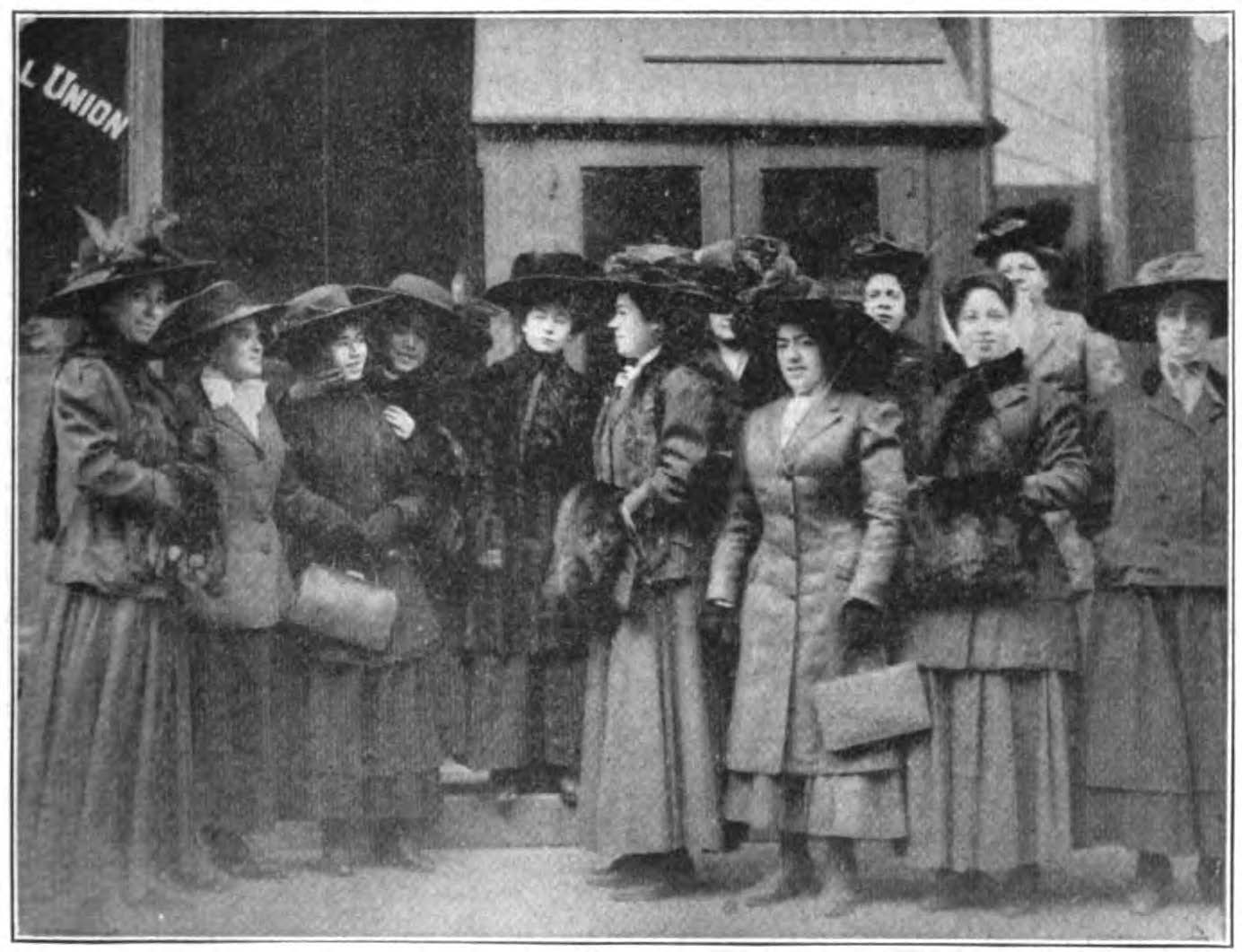
A fine piece of labor history in this look at the 1909-1910 textile strike in Philly.
‘Philadelphia Shirtwaist Strikers Fight to Live’ by Tom A. Price from The International Socialist Review. Vol. 10 No 8. February, 1910.
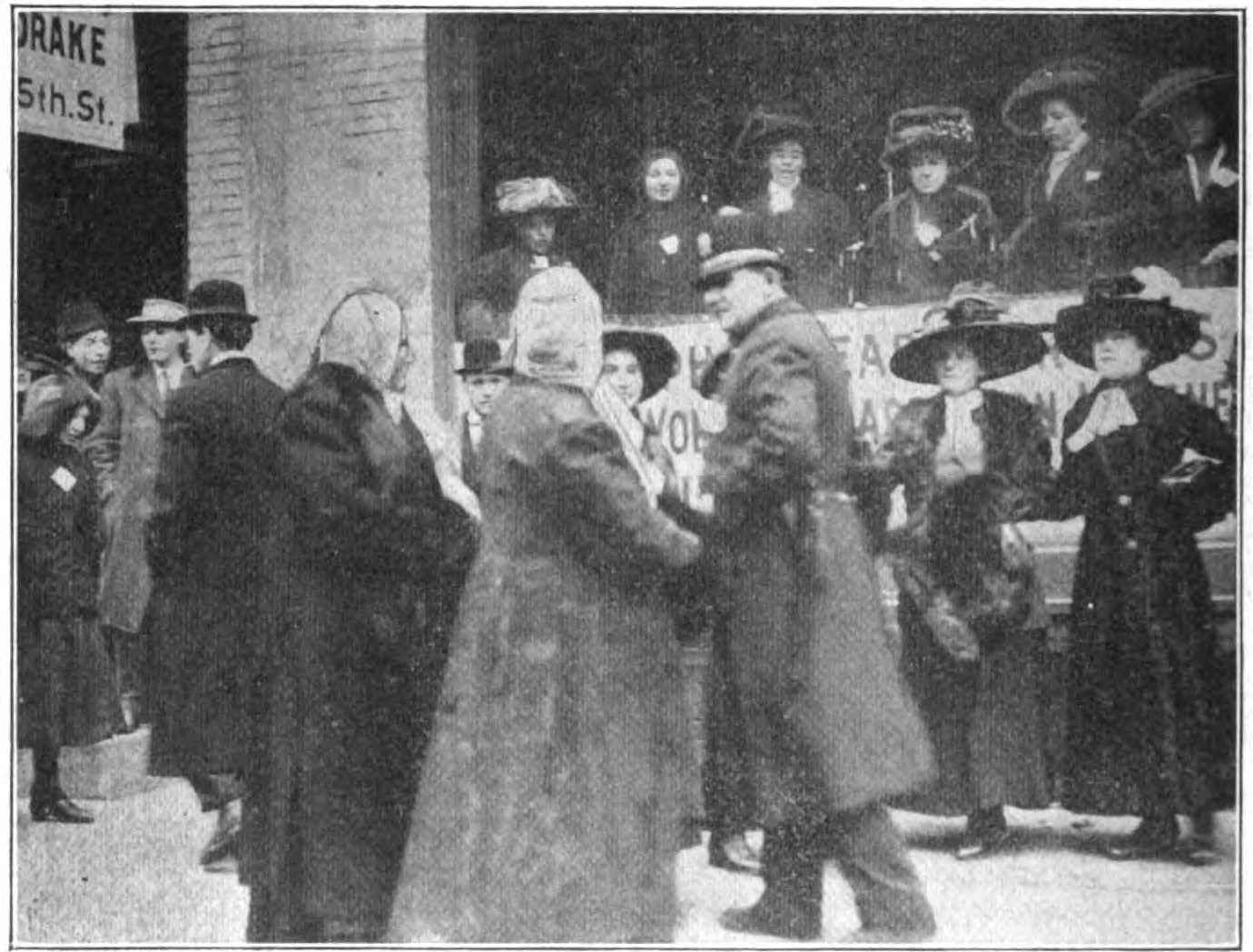
HARASSED by a subsidized police force which drives them from corner to corner at the behest of their employers, disputing their right to live and move and exercise free speech upon the streets once resonant with the peal of Liberty’s bell; lashed by the slave whip of necessity in the hands of manufacturers who grudge them a paltry dole sufficient to keep body and soul together, three thousand girls in Philadelphia are fighting against tremendous odds for the privileges which, according to the frequent boast of American orators, are elementary—the common heritage of all.
It is no longer a question of higher wages, important as that feature of the struggle is and has been from the beginning. It is a question of emancipation from something infinitely worse than hunger, a condition far more distressing than want.
Without sympathy save among those of their own order; without resources; without a knowledge in many cases of our language, much less our laws, these girls have shown a heroism, a devoted self-sacrifice, which should command the admiration of all men. With fear of neither confinement nor bodily harm in their minds they go forth every day to do picket duty under the very eyes of the police whom they know are against them, not only as a matter of policy but as a matter of absolute necessity.
They know that it is not possible for a “cop,” wearing the uniform of the great “City of Brotherly Love,” to permit them to claim a single right which is theirs under the law which no one violates oftener than the very men who are sworn in to uphold its provisions. They know they have no redress from the insults and the assaults of these blue-coated minions of wealth. They know they must risk violence at the hands of scabs and that they may not oppose force with force without running the risk of spending a night in a cell.
But no girl among the striking shirtwaist operators is daunted by these conditions. Every day deluded workers who have been listening to the insidious arguments of the manufacturers and have remained at their machines are won over to the cause by the cogent, vital arguments of these fearless pickets. It has been found that a plain statement of the facts will undeceive the most dyed-in-the-wool scab. Is it any wonder, then, that the employers have called upon the police for protection? They need it.
The action of these pickets is noted by the press of the city, with one exception, as brazen effrontery. By the general public—educated as it is by subsidized papers—their action is called a foolish defiance of that still more foolish economic law which would regulate wages rather than rewards by the exigencies of supply and demand.
The policeman at the crossing makes the girls move on. And they are moving on. Moving on in an ever-increasing army which will undoubtedly snatch the victory from a band of lawless, pitiless, ghoulish capitalists who try to insist that their’s is the right to amass money at the expense of a people whose country is called the mother of liberty and the greatest nation in the world.
Magistrates accept accusation as prima facie evidence of guilt. And the girls are guilty. They are guilty of thinking and feeling and fighting. They are guilty of demanding that intangible thing that our revolutionary army fought for and which colonial leaders handed down to a nation which has guarded it so loosely that a few men have been able to place it out of sight in a coffer of gold where the value of its chains make Liberty no less a prisoner.
Strikers here do not riot, although in any day’s papers accounts may be read of such occurrences. It is the employer who, in his hours of enforced idleness, incubates conspiracies in his counting rooms and hatches riots on the streets through his paid agents — cowards who would never brave a battle without the assurance that police were ready to protect them as soon as danger should appear.
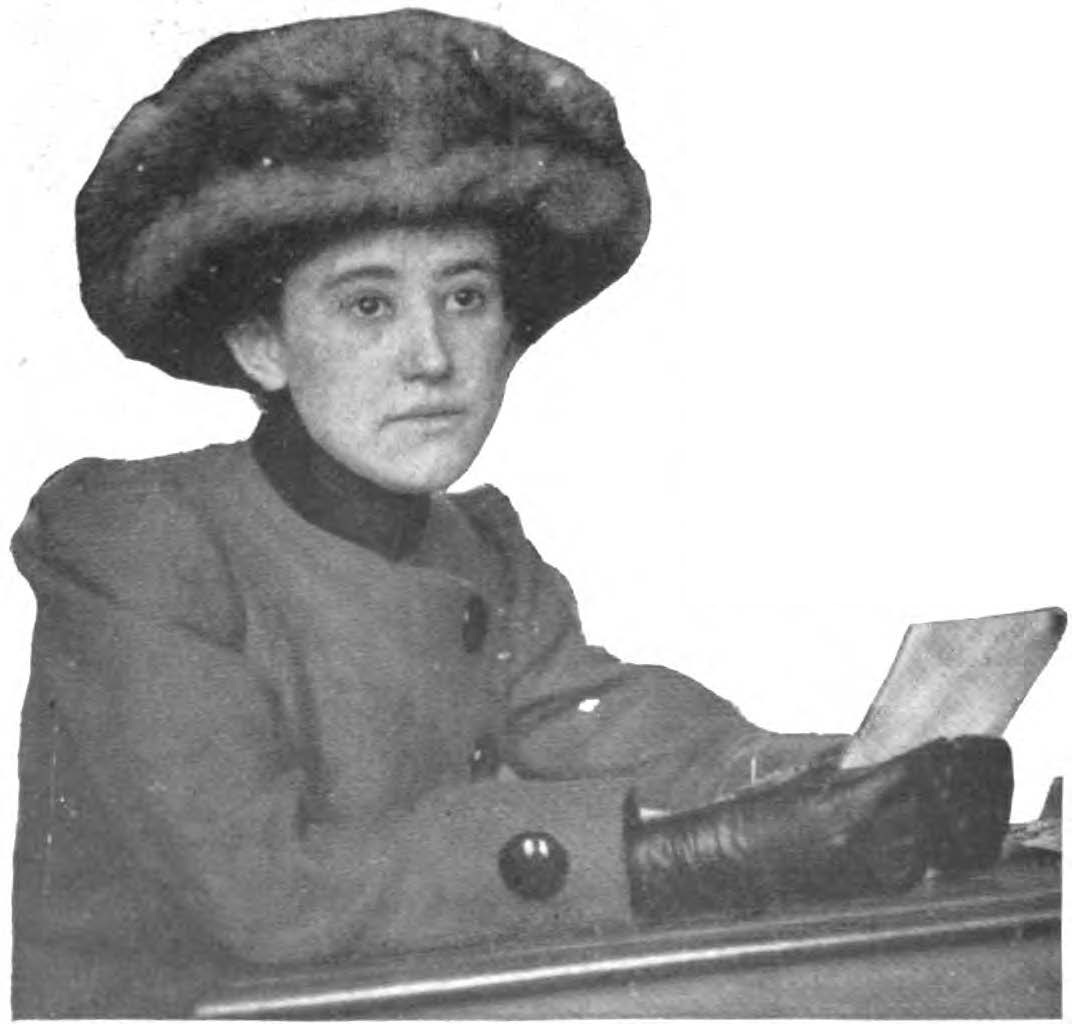
Under the leadership of heroines like Pauline Moscovitz; cheered in their struggle with want by the impassioned oratory of Mother Jones; urged to fight on by members of other labor unions which are helping them personally and with funds, the girls have become so imbued with the spirit of victory that it would be impossible to call the strike off now even should every leader advise such action. Promises will no longer attract these workers. Probabilities are rejected before they are offered. Nothing will be accepted but the right to live like human beings should live in a humane country.
Mother Jones. This little woman whose heart is as big as the nation and beats wholly for humanity, came to Philadelphia while the trumpet was still reverberating after the call to arms had been sounded. Under her bold leadership the fighters were organized before the manufacturers had fairly realized that their workers had at last been stung to revolt by the same lash which had so often driven them to slavery.
In impassioned speech after impassioned speech Mother Jones urged the girls on to battle. Shaking her gray locks in defiance she pictured the scab in such a light that workers still shudder when they think of what she would have considered them had they remained in the slave pens of the manufacturers. Every man and woman and child who heard her poignantly regrets the fact that her almost ceaseless labors at last drove her to her bed where she now lies ill.
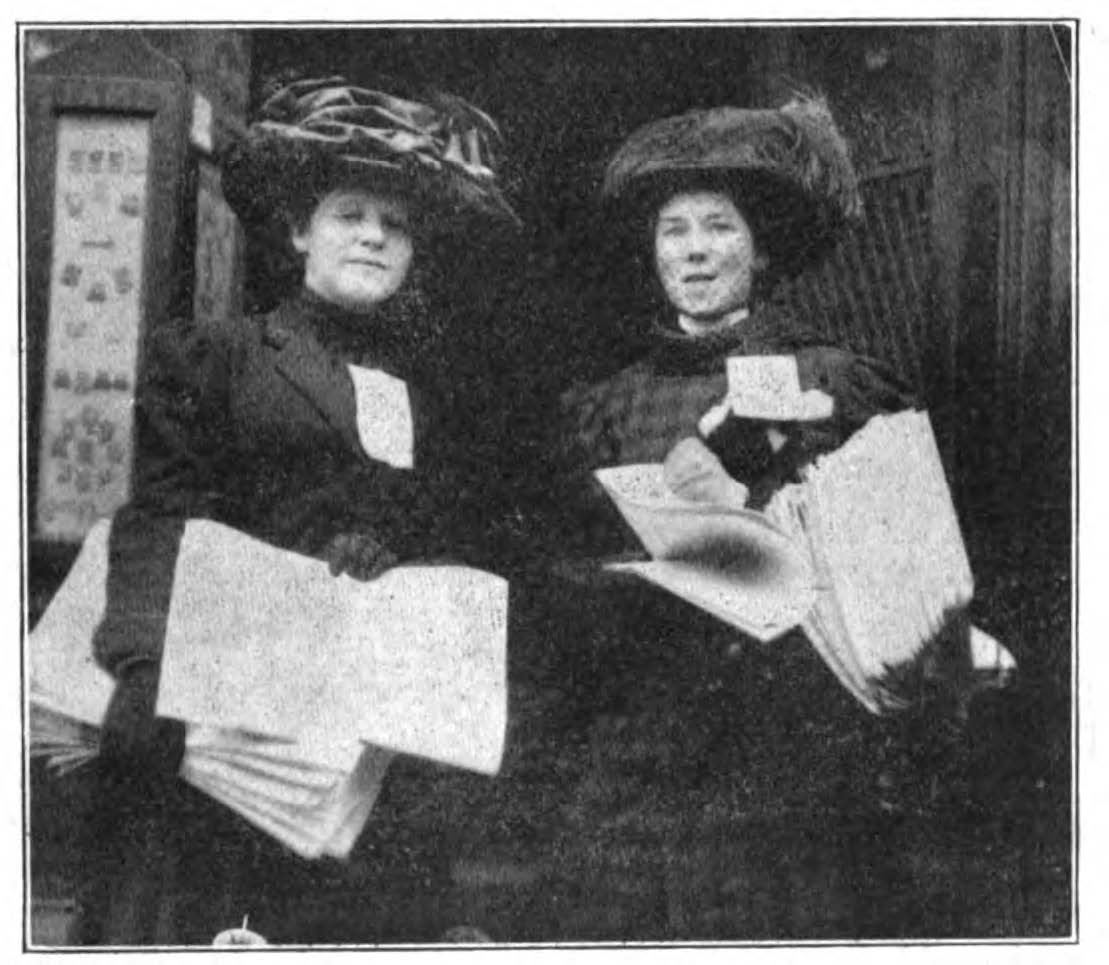
But she had instilled into the minds of her followers the spirit which prompted her to cross a continent to help them. That spirit remains and is holding in place the standard which she raised. It is leading the girls to every device possible to help the cause. Many of them are selling papers on the street that they may earn money to contribute to the union which they love.
Marie Comaford and Mary Miller, whose pictures accompany this article, have been on the streets constantly since December 22, selling papers every day. Their labor has been so generously rewarded by those who sympathize with the cause that they have been able to turn over to the union large sums every day.
During the first days of the strike those who had entered the battle fought silently, but when tales reflecting on their sincerity of purpose and veracity were scattered broadcast by the sneaking agents of the employers the strikers opened up their hearts to the writer and told him stories of slavery which were almost unimaginable in their horror. Their statements portray a scheme of things such as should bring the blush of shame to the face of every Philadelphian.
I learned that the reptilian employers here send agents to the immigrant ships before they are docked, there to shoot the venom of the sweatshop into the lives of innocent girls who know nothing of the deceit which these men cloak under fur overcoats and a benignant smile. The little hoards of these immigrants have been snatched from their hands and placed in the coffers of millionaires on the pretense that it is an equitable charge for “teaching them the business.”
Men as well as girls are mulcted of their all in the same manner. A. Goldfein is one of these. When he entered the “land of the free” six months ago he was accosted by a labor agent and told that he might learn to be a cutter and make big money if he would pay $25 for the privilege. He paid the money and was sent to the factory of Beyer, Frank & Company. Here he was assigned to a bench and told that to begin he would receive three dollars a week. He is a grown man, intelligent, and he has been working at that same bench during six months. He still draws three dollars every Saturday night, and no more. It took the man more than eight weeks to earn back the money which he had paid for his job.
And these toilers, after paying for their jobs, are assigned to work in filthy and ill-conditioned factories where the air is foul and there is no adequate sanitary equipment. It is on record that in one of these places there are 250 men and women employed. Two hundred of these are women. Yet there is but one toilet for each sex! And to cap the climax the place is on an upper floor and during the greater part of the day there is not enough pressure of water to carry it into the closets. The sinks are not flushed for hours at a time.
Out of this place workers have been ordered frequently by physicians who tell them remaining means certain death. They go if it is possible to obtain another job. Otherwise they stay, and finally die in their places. These men and women are as much murdered as were the miners who died in their pit at Cherry, Illinois, and the employer is as much a murderer as any other man who slays wantonly.
Health has been driven from the factories by pestilence using the whip of filth. Germs of disease fester and multiply in every crack. Yet the great State of Pennsylvania sits back complacently and sees its Bureau of Factory Inspection in the hands of a group of incompetent jobsters who hold their offices as payment for the crimes they have committed for the party in power. Manufacturers receive word long before hand when an inspection is to be made and the place is cleared up for the occasion. This happens only once or twice a year and in some instances the factories are never even swept at other times.
Child labor laws are laughed at. Children of any age may work if they will. Places are provided where they can stunt their growth and dwarf their minds by sitting at a bench all day for the purpose of earning the price of one lunch eaten by the manufacturer who washes down each mouthful of food with a gulp of the blood of his victims. Factories are inspected but the inspectors never see these children. Regular hiding places are maintained for the tots. Big packing cases are kept in the lofts. As soon as the word is passed up that an officer is on his way to go through a farcial travesty on an inspection the little ones are made to get into the packing cases, which are then turned so the open side will be towards the floor.
These little girls are among the most ardent of the workers for the cause. They do picket duty and are at all times ready to instill life and hope into the mind of any doubter who may have been induced by implied threats to remain at work. In winning to the cause the women of public note who have given their aid to these girls have played an important part. Speeches made by them at various meetings of women’s clubs have met with ready response in every instance.
If ever the competitive system was shown to be archaic, unscientific and utterly unequal to the demands made upon industrialism as it now exists in the world, we have a striking example of its futility in this city—a city of great private fortunes, immense enterprises and almost unprecedented productiveness.
Only last summer we were assured that as soon as the tariff question was settled by the “law-makers” at Washington—”law-makers” who devoted their efforts mainly to what we are told was the protection of home industries—an era of peace and plenty would dawn. Capital, assured of a reasonable profit, would strike hands with labor certain of an adequate wage.
The question was settled and we have been waiting for the dawn. We are still waiting. Labor was never before so restless or so poorly paid, the cost of living considered, and capital was never before so arrogant in its own conceit, so grudging of the dole it provides for the creators of wealth.
The striking shirt-waist girls are between the upper and the nether mill-stones. They must not only fight the wolf of hunger, forever nosing about their doors, but they must combat daily a subsidized police force which, fawning upon the man who has, browbeats and bullyrags, at al most every corner, the girl who has not.
As an observer on the ground I am not unduly impressed by the affected sympathy of certain society women for the toilers. I have seen these fads flare up and fade away before. I have studied the society woman somewhat on her native heath.
She figures more gracefully, to my mind, as center rush at a bargain counter onslaught than as a protagonist of labor. Like women of another class, whom we do not mention in the drawing rooms of society, she has a past which inspires little or no confidence in her professions. I speak of the professional society woman. Of course there are good women among the socially elect, just as there are bad women among the members of the workers’ army, but exceptions prove nothing, not even a rule.
Miss Anne Morgan, daughter of J. Pierpont Morgan, a most estimable spinster, I am informed and believe, seems to have received a faint glimmer of reason, a glimmer that may develop into a full flame later on. I hope so. She is credited with a resolve to start a shirt-waist factory with a million capital and run it on the profit-sharing basis. Miss Morgan with her father behind her might make a go of such an undertaking, but profit-sharing between a private capitalist and a retinue of employes is a half-way measure at best. It tends to breed condescension on the one hand and on the other it brings out the worst traits of human nature, sycophancy and dependence. It destroys initiative and promotes individual inertia.
Co-operation is better and is a decided step in advance, but the trouble is co-operation proves too much for the dilettante philanthropists. Their interests are centered in private graft, miscalled individualist, and they know that a real success along such lines is likely to provoke inquiry among the “proletariat.”
“If,” the man of common sense is apt to inquire, “co-operation is a success on a small community scale, why would not government co-operation be a good thing for the people as a whole?”
The International Socialist Review (ISR) was published monthly in Chicago from 1900 until 1918 by Charles H. Kerr and critically loyal to the Socialist Party of America. It is one of the essential publications in U.S. left history. During the editorship of A.M. Simons it was largely theoretical and moderate. In 1908, Charles H. Kerr took over as editor with strong influence from Mary E Marcy. The magazine became the foremost proponent of the SP’s left wing growing to tens of thousands of subscribers. It remained revolutionary in outlook and anti-militarist during World War One. It liberally used photographs and images, with news, theory, arts and organizing in its pages. It articles, reports and essays are an invaluable record of the U.S. class struggle and the development of Marxism in the decades before the Soviet experience. It was closed down in government repression in 1918.
PDF of issue: https://www.marxists.org/history/usa/pubs/isr/v10n08-feb-1910-ISR-gog.pdf
 Revolution's Newsstand