
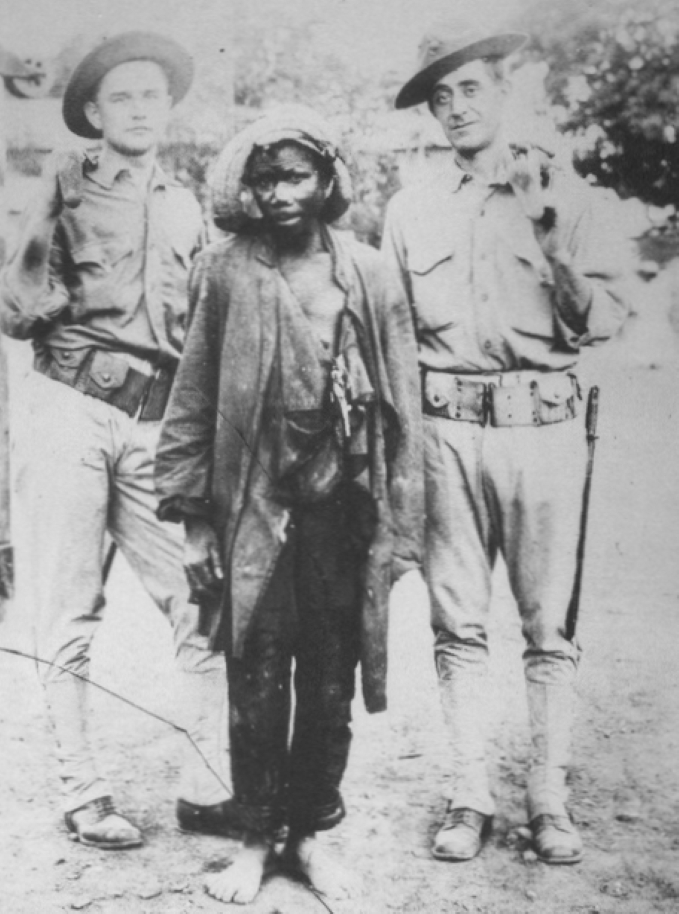
Increasing protests against U.S. occupation were met by the Les Cayes massacre of demonstrators by U.S. marines on December 6, 1929.
‘The Revolt in Haiti’ by William L. Patterson from International Press Correspondence. Vol. 9 No. 71. December 27, 1929.
Haiti with its enormous agricultural wealth, with great un-developed mineral resources, with an abundant supply of cheap labour, Haiti with immense strategical importance, lying as it does in close proximity to the Panama Canal and still closer to the proposed Nicaraguan Canal with harbours which can be readily converted into naval bases, offering another market for the expansion of American imperialism, was seized and became a part of the colonial empire which American imperialism is forming in the Caribbean Sea region.
The economic basis was laid when the national railroad of Haiti and the Banque Nationale de la Republique d’Haiti became the property of the National City Bank of New York. But politically, Haiti occupies a tremendously important position. Haiti lies in the centre of the Negro population of approximately 15 millions, the British West Indies, Cuba, the Central American States and Brazil. The position of these Negro peoples differs little if at all from the present position of the Haitian Republic, and the influence of the struggle there will undoubtedly play an important part in the further development of the struggles of these peoples against American imperialism.
The finances of the Haitian government were seized and withheld by the agents of American imperialism until the Haitian authorities agreed to the establishment of such a “constitutional government” as the government of the United States considered its duty to support. This “constitutional government” immediately accepted” a new constitution for Haiti drafted by the agents of American imperialism. This constitution made possible the “legal” control of the land by American imperialists through the abolition of the law prohibiting the ownership of land by foreigners. This “constitutional government” immediately entered into “treaty” relations with the United States under the terms of a treaty drafted by the officers of the National City Bank of New York. This treaty provided for a general receiver and officer of the National City Bank of New York to collect Customs duties on Haiti’s exports and imports. It provided for a tariff preferential to American imperialism. The agents of American imperialism took charge of all the departments of government and new taxes were imposed upon Haitian people to meet the costs of this administration. The American dollar became the country’s legal currency; English was substituted for French; the former language of the country, in the public schools; a loan. $22,000,000 of which has already been advanced, was “solicited” by the new Haitian Government. This loan was not to promote industrial development in the country generally, but only such developments as would enhance the imperialist exploitation of its raw materials.
A programme of road building with forced labour was introduced. The “corvee” or road law, provided that each citizen should work a certain number of days on the public roads to keep them in condition or pay a certain sum of money. Men are seized anywhere and everywhere and no able bodied Haitian is safe from such raids which resemble the African slave raids of past centuries. Those who protest or resist are beaten into submission, those who attempt to escape are killed.
A reign of white terror ensued. The Haitian press has been censored almost out of existence and all of those who have expressed any condemnation of the imperialist penetration of the country are now in jail or have been driven into exile. Leaders of the American fascists’ organisations, the Ku Klux Klan and American Legion hold a most responsible position in the departments of government. Mulattoes are pitted against blacks and given preference for those positions not in possession of the white agents of American imperialism.
Approximately 80% of the import trade is in the hands of American imperialism, and to increase its volume, the development of native industry is everywhere retarded. One-third of the import trade consists of cotton goods, while at the same time the second largest export is raw cotton. Resources of raw materials, coffee, tobacco, sugar, and cotton are almost all under the control of American imperialism. But no effort is being made to develop the mineral wealth of the country.
More and more rapidly the expropriation of the peasantry is effected. The hut tax has been introduced to accelerate the tempo of its separation from the land. Now a new law forcing the peasantry to prove ownership of the land by deed, has been passed. This is virtually impossible, as the peasantry for the greater part secured its land through the slave revolution of 1804. Thus, the driving of the peasants from the land will now be “legally” accomplished.
At the base of the present uprising lies the land question. The plantation system being introduced by American imperialism effects the destruction of peasant economy and adds to the misery and poverty of the countryside. The wages of the agricultural workers have been reduced to less than 20 cents a day. The price on the market for the products of the peasant now one-half of what it was before American intervened while the cost of living has doubled.
The driving of the peasants from the land has enormously increased the number of the unemployed. American imperialism has attempted to solve this question by supplying Haitian contract labour to the American imperialist forces exploiting Latin America. Last year 20,000 natives of Haiti were at work on a banana plantation of Columbia. The wages industrial workers have been reduced far below the actual cost of living.
Today’s struggle in Haiti is not against American imperialism alone, but also against its native agents. At the present time the Haitian Patriotic Union, an organisation of intellectuals, student organisations and bourgeois and petty bourgeois elements are leading the struggle against American imperialism. But the role always played by these elements must be fully shown to the Haitian workers and peasants. Already we are witnessing the organisation of independent workers’ and peasants defense organisations. The future of Haiti lies in the hands of these,
The Haitians have a revolutionary history and revolutionary traditions. A relentless struggle will be carried on against American imperialism, but the liberation movement needs organised leadership. Through the Anti-Imperialist League, the workers’ and peasants’ organisations must be linked up with the international struggle against imperialism. The time is ripe the formation of a Communist Party in Haiti, placing the hegemony of the movement in the hands of the Haitian proletariat. Only under the leadership of the Communist International can the workers and peasants of Haiti free themselves from Ame imperialism and establish a workers’ and peasants’ republic.
International Press Correspondence, widely known as”Inprecorr” was published by the Executive Committee of the Communist International (ECCI) regularly in German and English, occasionally in many other languages, beginning in 1921 and lasting in English until 1938. Inprecorr’s role was to supply translated articles to the English-speaking press of the International from the Comintern’s different sections, as well as news and statements from the ECCI. Many ‘Daily Worker’ and ‘Communist’ articles originated in Inprecorr, and it also published articles by American comrades for use in other countries. It was published at least weekly, and often thrice weekly.
PDF of full issue: https://www.marxists.org/history/international/comintern/inprecor/1929/v09n71-dec-27-1929-inprecor.pdf
 Revolution's Newsstand