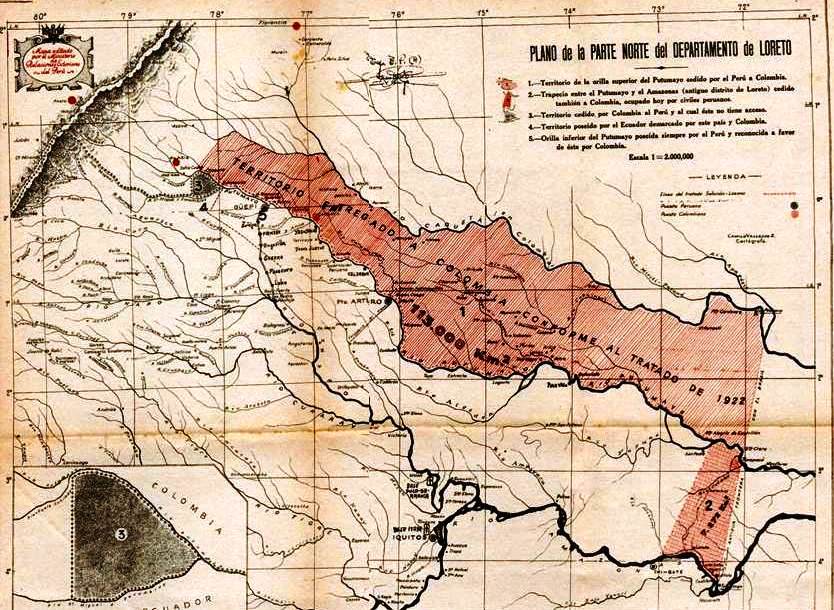
Readers will be shocked to learn that behind 1932’s Chaco War waged between Bolivia and Paraguay and the border war fought by Peru and Colombia were vast financial interests of U.S. banking firms.
‘Wall Street Loans Behind the War in Colombia and Bolivia’ Robert W. Dunn from The Daily Worker. Vol. 9 No. 257. October 27, 1932.
J.P. Morgan and Rockefeller Prime Movers
WALL STREET interest in the wars over “disputed areas” in South America is directly connected with American investment in the countries involved. Let us consider Colombia and Bolivia as examples of countries in which large Yankee interests are at stake.
Colombia: The president of Colombia, the pliant “Liberal” Olaya Herrera, is as subservient to the interests of U.S. imperialism as any ruler of a so-called “independent” country south of the Rio Grande. In March, 1931, he signed and submitted to the Colombia Congress a law which enables big American oil companies to enjoy fully the loot they had staked out for themselves in earlier years through the famous Barco Concession.
OIL COMPANIES INVOLVED
The oil companies involved in this historic concession are the South American Gulf Oil Co., a Mellon company, and the Carib Syndicate controlled by J.P. Morgan & Co. These companies in their sharp fight with the British companies—Royal Dutch Shell and Anglo-Persian—were compelled to resort to the usual imperialist methods of bribery and overpowering economic pressure. The way they did it in this case was to have Secretary Stimson at the U.S. State Department bring pressure to bear upon the National City Bank of New York to speed up the granting of a short term credit to the Colombian government.
When the Colombian Congress had validated the concession, June 19, 1931, ten days later $4,000,000 was paid over by the New York bankers at the behest of the State Department. Thus the State Department obligingly performed a service for the Mellon-Morgan oil company which clinched the claim of these companies to 500,000 acres of the richest oil land in the world.
There are dozens of other U.S. oil companies operating in Colombia, but this is the major oil investment, and the one involving the most political implications.
In addition to this major investment in oil, Wall Street has dug its way into the riches of Colombia in other ways. Up to the beginning of the world economic crisis, over $200,000,000 had been invested in foreign bonds of the central government, of the Agricultural Mortgage Bank, and of the various departments and municipalities. Together with the direct investment in mining and industry this brings a total Yankee investment in the country of over $300,000,000.
Other direct Investments in the industries of the country, other than those in government bonds, are to be found in minerals (the South American Gold & Platinum Co.—Lewisohn interests—Colombia International Corp., Colombia Emerald Development Corp. and others, in fruits (United Fruit Co. and Atlantic Fruit Co.) and public utilities (West Indies and Colombia Electric Co. and American, and Foreign Power Co.) in addition to coffee and sugar interests.
It was on behalf of the United Fruit Company’s investment in Colombia that Colombian troops killed at least 1,000 workers and wounded 3,000 in the strike on the banana plantations of Santa Marta in 1928. Similar strike-breaking services were performed by the Colombian government for the Tropical Oil Co. in 1927.
THE BANKERS CLAIM IN BOLIVIA
Bolivia: The chief American investments in Bolivia, which total at least $120,000,000, center around minerals such as tin, lead, copper, silver and oil. The chief American companies involved in the exploitation of the country are the Standard Oil Co. of New Jersey which has a concession for the exploitation of over 7,500,000 acres of oil land, near the border of Paraguay, the National Lead Co., which controls about 80 per cent of the tin production of the country, which ranks second only to the Straits Settlements In the production of tin.
There is also a Guggenheim-controlled tin company with a capital of $40,000,000, the International Mining Co., organized by W.R. Grace & Co., and several other Yankee mining investments. Light, power and construction companies also have large interests in the country.
BOLIVIA A U.S. COLONY
Bolivia has been practically a colony of the United States ever since 1922 when a loan for $29,000,000 was put through by the Equitable Trust Co., a Rockefeller bank, heading a syndicate of bankers. Under the terms of this loan the U.S. government has a mortgage on the chief taxes and income-bearing wealth of the nation. U.S. bankers dictate the raising and expenditure of Bolivian revenues. Since that time oil has become increasingly important and it is for this oil that the blood of Bolivian and Paraguayan workers is now being shed again.
* * *
THE very close relations of the bankers’ loans and the preparations for war comes out in the facts surrounding the $23,000,000 loan of 1928 floated by Dillon, Reed & Co., Wall Street bankers. Over $5,000,000 of this loan was used to pay Vickers Ltd., the leading British arms manufacturer.
Another $1,500,000 went for the building of military roads near the border of Paraguay in preparation for the Chaco war now in progress, which is fought in reality to advance the interests of the American oil companies in their conflict with British oil companies.
Bolivia wants to extend her territory down to the Paraguay river at the Paraguan capital, Asuncion. If this were done the Standard Oil could ship its products out more easily than at present thus making huge gains in “operating economies”.
Thus behind the Bolivian war and U.S. State Department aid to Bolivia stands clearly the form of Rockefeller and the Wall Street oil interests.
The Daily Worker began in 1924 and was published in New York City by the Communist Party US and its predecessor organizations. Among the most long-lasting and important left publications in US history, it had a circulation of 35,000 at its peak. The Daily Worker came from The Ohio Socialist, published by the Left Wing-dominated Socialist Party of Ohio in Cleveland from 1917 to November 1919, when it became became The Toiler, paper of the Communist Labor Party. In December 1921 the above-ground Workers Party of America merged the Toiler with the paper Workers Council to found The Worker, which became The Daily Worker beginning January 13, 1924.
PDF of full issue: https://www.marxists.org/history/usa/pubs/dailyworker/1932/v09-n257-NY-oct-27-1932-DW-LOC.pdf
 Revolution's Newsstand