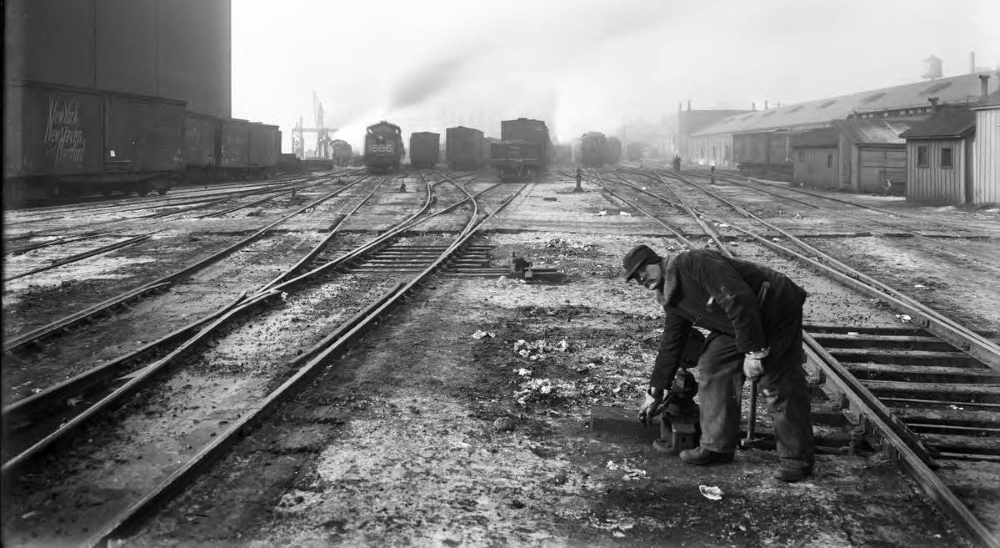
A post-war, insurgent railroad switchmen’s strike of the Yardmen’s Association goes down to defeat, but Cannon says this defeat also contain victories.
‘Long Live the Outlaw Switchmen!’ by James P. Cannon from The Toiler. No. 139. October 1, 1920.
After many months of hard battling against the combined forces of the railroad corporations, the Government and the craft union officialdom, the “outlaw” switchmen in several cities have voted to call off their strike and go back to work, forfeiting their seniority rights and failing to gain the formal recognition of their demands. At first view the result appears to be a victory for the railroads, their government and their “labor lieutenants”, and a defeat for the brave workers who defied them; but they who look beneath the surface and measure this great and heroic endeavor by the yardstick of revolutionary progress, will read a different story.
If we accept the view of the Gompers school of unionism that trade unions exist only for the purpose of holding the ground that has already been gained and that “collective bargaining” is the summit of our hopes, we must measure the success or failure of a strike by the definite and concrete results directly achieved. On the other hand, if we look upon the organized labor movement as machinery for revolution, strikes become to us as preliminary skirmishes wherein we try out our strength, lay bare to ourselves our own weakness and learn by the penalty suffered to throw them off. This latter is the view-point of labor’s vanguard all over the world and from this angle we can now calmly examine this strike of the switchmen; count up our gains and losses; take to heart the lessons driven home by it and prepare for another struggle on a larger scale.
The Curse Of Craft Unionism
The strike of the outlaw switchmen brought out in bold relief the curse of craft unionism. These strikers had not only to contend with the crooked and conservative officers of their own unions who shamelessly sold them out to the bosses, but they were hamstrung by the infamous practice which authorized other bodies of union men, whose interests and whose sympathies were one with theirs, to remain at work and thus become, in effect, strike breakers, Every worker on the railroads who stuck to the job during the period of this strike was acting as an ally of the bosses and an enemy of his own class. It does not remedy the situation to say that he had a union card in his pocket–that only made him a union scab. The man who is about to be hung will not be comforted by the knowledge that the rope bears the union label.
One result of this strike ought to be, and will be, a mighty stimulant to industrial unionism throughout the transportation industry. What better object lesson could be given for the need of one union on the railroads? To get the One Big Union idea planted in the minds of railroad men, and to see the beginning of organization on this line actually under way, is worth “losing” a dozen strikes. Such defeats will lead us on to victory,
The Government At Work
It is safe to say that the switchmen know a great deal more now about the nature of the government than they did at the outset of the revolt. Many of them had served it in the recent world slaughter engineered by the exploiters of labor; more of them helped it by “hitting the ball” a little harder on the job–all with the idea that the government really represented them; that it was their friend and protector. Consequently it scarcely occurred to them that when the time came for them to fight for bread they would find this powerful instrument of physical force arrayed against them. How quickly they were disillusioned! Arrests, indictments and intimidation confronted them at every turn. Their natural leaders–forceful, honest men who sprang up out of the ranks to place the criminals who betrayed them–were hounded and persecuted and denounced by Attorney-General Palmer and his army of bloodhounds. The wage commission, appointed by President Wilson under pressure of the strike, ignored the real union of the workers’ choice–The Yardmen’s Association–and negotiated exclusively with the traitor organizations, the Switchmen’s union and the Brotherhood of Railway Trainmen.
Experience is the best teacher, says the old proverb. Here is experience enough to teach at lesson about the government that should never be forgotten by those who came in direct conflict with it. They have seen it in action, stripped of all pretense, and openly serving the bosses against the workers. Is it not reasonable to assume that these workers will adopt the view that the government belongs to the bosses and not to them?
The two obvious lessons of the strike which have been here pointed out will be brought home not to the strikers alone, but to the other workers who have watched their struggle with sympathetic interest. This brings us to another aspect of the situation, perhaps the most important of all, the influence of their example on the working class as a whole. In the coming final show-down between capital and labor, toward which we are moving with the speed of a hurricane, we will have need of clear thinking; we will be foredoomed to failure unless, out of the experience gained in these preliminary skirmishes, we learn how to cast off the false ideas and self-deceptions with which we have fettered ourselves in the past.
Building Up Labor Morale.
But more than all we will have to build up within ourselves the fighting spirit, the morale of battle, that alone will bear us up through delays and disappointments and bitter defeats to the final victory. Herein lies the great service that these heroic yardmen have rendered. For by their long months of stubborn conflict, against insuperable odds, by their bold defiance of the master class and all of its agencies, they have inspired thousands outside their own ranks and have demonstrated once again the truth of the communist claim that the workers are the salt of the earth; the class that is destined to conquer. The working class of America, constantly being forced into action by the pressure of conditions imposed upon them and stimulated by such splendid precedents as the yardmen have set, will finally become impregnated with the same courage and solidarity. Then they will confront American capitalism with a battle line that will be invincible.
As the campaign of the revolting railroad workers now shifts from the open strike to the less dramatic, but equally important, task of quiet and persistent effort to build up an industrial union embracing all railroad workers, we can give expression here to the sentiment that lies deep in the hearts of all the workers who have drawn from their example a stronger courage and a higher inspiration:
The outlaw switchmen’s strike is dead! Long live the outlaw switchmen!
The Toiler was a significant regional, later national, newspaper of the early Communist movement published weekly between 1919 and 1921. It grew out of the Socialist Party’s ‘The Ohio Socialist’, leading paper of the Party’s left wing and northern Ohio’s militant IWW base and became the national voice of the forces that would become The Communist Labor Party. The Toiler was first published in Cleveland, Ohio, its volume number continuing on from The Ohio Socialist, in the fall of 1919 as the paper of the Communist Labor Party of Ohio. The Toiler moved to New York City in early 1920 and with its union focus served as the labor paper of the CLP and the legal Workers Party of America. Editors included Elmer Allison and James P Cannon. The original English language and/or US publication of key texts of the international revolutionary movement are prominent features of the Toiler. In January 1922, The Toiler merged with The Workers Council to form The Worker, becoming the Communist Party’s main paper continuing as The Daily Worker in January, 1924.
PDF of full issue: https://www.marxists.org/history/usa/pubs/thetoiler/n139-oct-01-1920-Toil-nyplmf.pdf
 Revolution's Newsstand