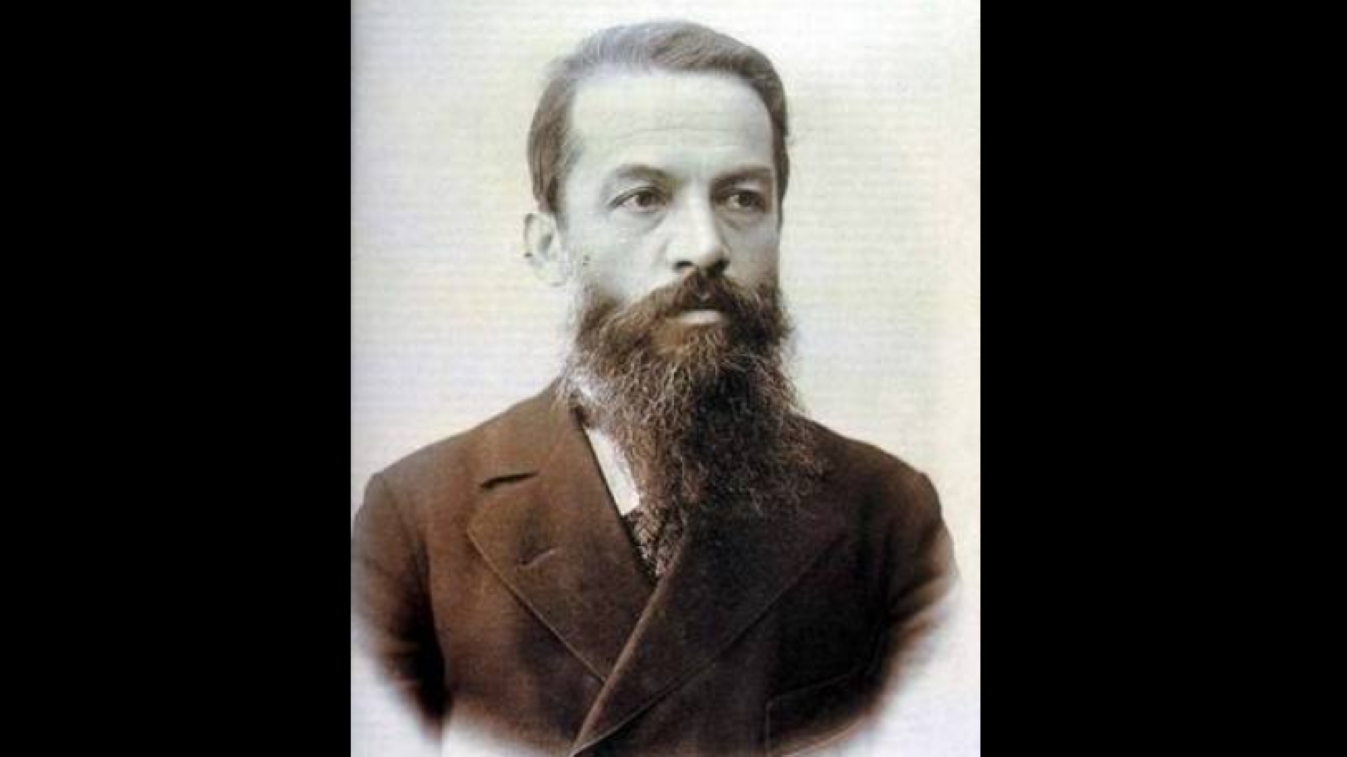
An outstanding figure in the Balkan workers’ movement dies.
‘Dimitri Blagoeff, Founder of Bulgarian Marxism’ from International Press Correspondence. Vol. 4 No. 30. May 22, 1924.
The founder of the Communist. Party of Bulgaria, the old teacher and leader of the Bulgarian proletariat, old “Dedo” (grandfather), beloved by all Bulgarian workers and peasants died in Sofia in the night of May 6th-7th. After forty years of unbroken, unresting devoted work for Communism Dimitri Blagoeff closed his eyes forever without having lived to see the final result of his great work: the victory of the working people and of Communism in Bulgaria.
Already as a student at the beginning of the eighties he took part in, the founding of the Russian Social Democratic Party (later the Bolshevist Party) in Leningrad. The history of his life and activity in Bulgaria is essentially the history of the Bulgarian revolutionary proletarian movement.
Dimitri Blagoeff was the first theorist of revolutionary Marxism in Bulgaria. To him the credit is due that the Bulgarian proletariat remained spared from the poisonous influence of reformism. Along with Kirkoff, who is also dead, he gave the political organization and the political struggle the correct direction right from the beginning. Under his clever leadership the small group of clean-cut Socialists (the real Marxists) developed in the course of the years 1900-1903 into the form of the Communist Party of Bulgaria, into the strongest and best organized political party in the country, to the real leader of the struggle for emancipation of the working people of Bulgaria.
His literary and theoretical activity is just as important. Already at the beginning of the nineties he defeated theoretically the numerous bourgeois critics of Marxism in Bulgaria. The reformist Sakasoff wing of the party which was endeavouring to change the party into a small bourgeois appendage of the bourgeoisie was theoretically liquidated in the year 1903, thanks to the relentless and splendidly argued campaign. After Lenin there was scarcely a second in the international labour movement who fought so relentlessly against reformism and against all diverting tendencies in the labour movement as did Dimitri Blagoeff.
In the Novo Vreme(The New Age), a theoretical periodical which was founded by him in the year 1897 Blagoeff illuminated the problem of the class struggle in Bulgaria for the course of 25 years. He was the first who, thirty years ago, placed the labour question upon a scientific basis in Bulgaria and in his book “The Labour Question” he showed the way for the emancipatory movement of labour. The first Bulgarian translation of “Capital” with commentary in popular language came from his hand. A large number of classical works of Marxist literature were translated by Blagoeff. He also wrote some valuable pamphlets and books to popularize Marxism and the Marxist interpretation of Bulgarian conditions. The only serious work upon the history of Socialism in Bulgaria came from his pen. It was under his intellectual leadership and under his influence that the greater part of the intellectuals of the Communist Party of Bulgaria received their Marxist schooling.
Blagoeff was, however, not only the first theoretician or Marxism. in Bulgaria, he was the real leader of the struggling Bulgarian proletariat. From the founding of the Party to his death he was always the first. member of the Central Committee of the Party elected unanimously in the conventions. Since 1913 he was a member of parliament, chairman, leader and soul of the Communist fraction in the parliament.
Blagoeff was also the founder of the Socialist (after the war, Communist) Balkan Federation in 1910; he interested himself extraordinarily in the revolutionary movement in the Balkan lands and took an active part in the work of the Communist Balkan Federation.
When the Second International committed the notorious betrayal of Socialism and the revolution at the beginning of the war, Blagoeff, along with Lenin, was the first who brand-marked this international as traitorous and who raised his voice for the founding of the Third Communist International. Blagoeff was irreconcilable and merciless towards all enemies of the proletariat, but he was still more merciless against the hidden enemies of the proletarian movement. He possessed the gift of being able to discover the reformist and other diverting tendencies in their veiled forms. He always called things by their right name, which caused many people to call him uncouth. All that he did was inspired by a boundless love for the cause of the proletariat. This, characteristic won him many friends but also made many enemies. He was boundlessly loved by one side and just as boundlessly hated by the other. There 1s perhaps no one person in the whole of Bulgaria who was so hated by the bourgeoisie as he but at the same time there is no one person who was so loved by the workers and peasants as he.
Right to the end Blagoeff remained true to himself and to Communism. The great defeats of the Communist Party of Bulgaria found him ill. They produced a great bitterness in him but they did not frighten him nor cause him to doubt. When the bourgeois press, during the September rising, spread the news that the old leader was against the rising, that he characterized the rising as an adventure and that he had cursed Kolarov and Dimitrov, the leaders of the rising, although he was in prison and sick, he denied these lies and fairy tales, which were invented by the bourgeoisie, and firmly defended the rising of the people.
Immediately before his death, when the high court was dealing with the question of formally dissolving the Communist Party of Bulgaria, Blagoeff summoned up his last strength to compose and publish a splendid defence of the Party. Blagoeff has died at a time when the blackest reaction has set up its reign in Bulgaria, but the Communist Party of Bulgaria which was founded by him will continue to live and will be led to victory.
The whole of the working class of Bulgaria, deeply touched by the heavy loss of the irreplaceable Dedo Blagoeff who was loved by. all, is raising higher and more daringly than ever, the revolutionary banner which he held so firmly in his hand for forty years, and is marching steadfastly towards its final victory over the bourgeoisie.
Dimitri Blagoeff was born in the village of Zagoritscheni (Macedonia) m the year 1855 (or 1859). At the age of ten he left the village to join his father in Constantinople. His mother wished that he should become a. scholar, but his father decided that he should learn shoemaking. However, he showed little enthusiasm for his trade and fortune favoured him to the extent that he was given a scholarship in a Bulgarian school in Constantinople where he held a first place. After finishing his school courses he yearned to go to Russia like the other Bulgarian students. With the help of Slavejkoff, one of the old revolutionaries whom he met in Bulgaria in 1877, he actually succeeded in proceeding to Russia. There he entered a theological college but soon forsook it for matriculation and philosophy in Leningrad. He took an active part in the student organizations where he become acquainted with Marx’s “Capital” and organized the first Marxist student group. He was expelled from Russia for revolutionary propaganda and thereupon returned to Bulgaria to devote the rest of his life to the labour movement.
International Press Correspondence, widely known as”Inprecor” was published by the Executive Committee of the Communist International (ECCI) regularly in German and English, occasionally in many other languages, beginning in 1921 and lasting in English until 1938. Inprecor’s role was to supply translated articles to the English-speaking press of the International from the Comintern’s different sections, as well as news and statements from the ECCI. Many ‘Daily Worker’ and ‘Communist’ articles originated in Inprecor, and it also published articles by American comrades for use in other countries. It was published at least weekly, and often thrice weekly. A major contributor to the Communist press in the U.S., Inprecor is an invaluable English-language source on the history of the Communist International and its sections.
PDF of full issue: https://www.marxists.org/history/international/comintern/inprecor/1924/v04n30-may-22-1924-inprecor.pdf
 Revolution's Newsstand