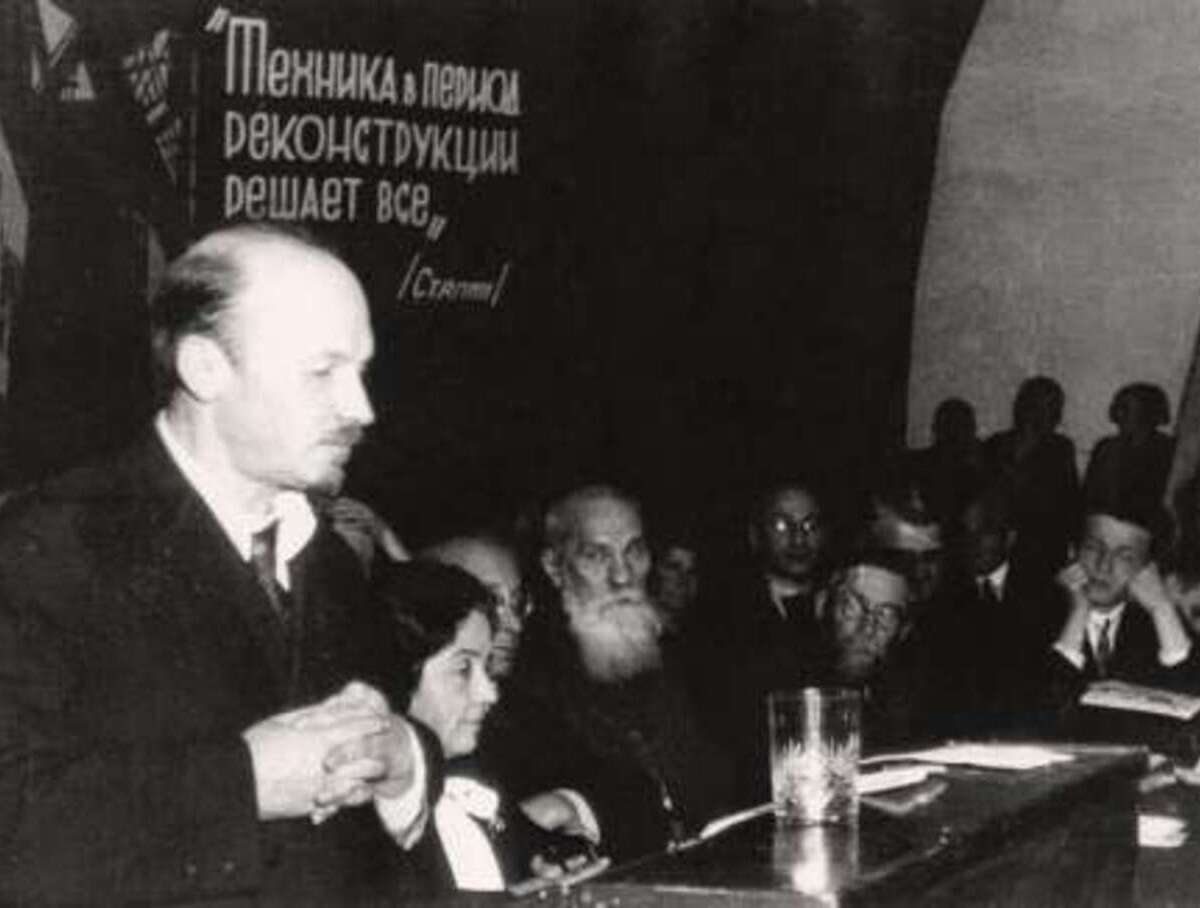
Given at the height of his authority in the Soviet Union and International, Bukharin’s speech on the Comintern’s program given to the Sixth World Congress in 1928 deals with a subject he spent nearly the entire 1920s working on without ever satisfactorily finishing. Bukharin, who wrote the Programme of the World Revolution in 1918 and, with Preobrazhensky, The ABC of Communism in 1920, and was tasked by the 4th Comintern Congress in 1922 to lead the elaboration of program for the International, of which this speech is part of that continuing process.
‘Report on the Programme of the Communist International’ by Nikolai Bukharin from International Press Correspondence. Vol. 8 No. 56. August 27, 1928.
Comrades, I have had occasion to speak on the programme question at two previous Congresses of the Comintern, and this is the third time. I mention this because in my report I will take it for granted that the comrades assembled here are acquainted with previous reports, co-reports and discussions on the Programme question and therefore, I will not repeat what has been said already on the subject. I will refrain from touching upon a number of material questions that have already been discussed on several occasions and concerning which there are no serious differences among us.
I. The Characteristic Features of the Draft Programme.
The Programme of the Comintern is the Programme of World Proletarian Dictatorship.
First of all I will deal with the specific features of the Draft Programme.
Our Programme is not the minimum Programme of the Proletarian Party, the core of the Draft Programme submitted to the Congress, its guiding principle, is the dictatorship of the proletariat. Our Programme is the Programme of the proletariat.
But it is not only the Programme of the dictatorship of the proletariat, it is the Programme of the world proletarian dictatorship.
This is the first time in history that so powerful a world organisation of the revolutionary proletariat as ours is, attempts to put forward its Programme. It is true that attempts have been made in the past to lay down a Programme for the dictatorship of the proletariat, but this is the first attempt concretely to formulate the task in connection with the establishment of the dictatorship of the proletariat on a world scale.
Our Programme is not merely the Programme of a single Section, of one part of the revolutionary proletariat; it is the Programme of the Communist International, i.e., the Programme of the world proletariat. Our programme is being drawn up in a special epoch, an epoch in which the problem of the dictatorship of the proletariat, the problem of revolution, the problem of capturing power no longer bears academic character, but bears a practical character. In this epoch these problems definitely and sharply confront us as the problems of the day. Born in an epoch of wars and revolutions, in an epoch when the dictatorship of the proletariat already exists on one sixth of the globe, our Programme is a militant document of the epoch, a document outlining the road leading directly to the revolutionary struggle of proletariat for itsworld dictatorship.
II. The Comintern Programme’s Place in History.
Its Peculiarities and Forms.
These features give our programme a very peculiar character. If we compare our Programme with the programmes of the parties affiliated to the Second International we will observe that a wide gulf separates them. The programmes of the parties affiliated to the Second International are merely national programmes. It is very doubtful whether the Second International would be able to draft an international programme. It is not altogether impossible for it to do so, but the parties affiliated to the Second International would find it extremely difficult to carry out such a programme because the differences among them are so great. Politically, and particularly in the sphere of foreign politics, the line of the Social Democratic parties so closely corresponds to the line of their respective bourgeoisie that the differences between these parties in the main reflect the antagonisms existing between the bourgeoisie of various countries, and this has its effect in critical periods in the life of bourgeois society. It is sufficient to recall the occupation of the Ruhr and the position taken up on this question by the various Social Democratic parties.
In analysing the programmes of the parties affiliated to the Second International, for example the draft programme e of the British Labour Party, the programme of the Austrian Social Democratic Party and the programme of the German Social Democratic Party adopted in Heidelberg, we will find that not only are these not programmes of the dictatorship of the proletariat, (not one of them pursues this aim), but that they are programmes for the building up of the capitalist State. There is not and there cannot be common language between us and these parties.
We will come to altogether different conclusions, however, if we compare our Programme with the earlier documents of revolutionary Marxism. However, in comparing our Draft with these most striking documents of the labour movement, with the most outstanding productions of revolutionary Marxism, we will find that our Programme differs from them in a number of specific features.
These specific features are dictated by the requirements of our time, requirements which did not exist at the time the previous documents mentioned were drafted. The outstanding Programme documents of revolutionary Marxism, the product of the pen of Marx himself, like the “Inaugural Address” to the First International and especially the “Communist Manifesto”, represented the guiding lines for a whole epoch in the history of humanity. The fundamental postulates laid down in the “Communist Manifesto” retain their force to this day. The Manifesto” is the authentic revolutionary programme of reason that contemporary, degenerate social-democracy fights so strenuously against the principles of the “Communist Manifesto”: sometimes openly and sometimes in a masked form, it conducts this fight along the whole line. In studying these documents, primarily, the “Communist Manifesto”, “Bible” of the “Fourth Estate”, we find that the Programme postulates are given in algebraic form. A concrete deciphering, a concrete analysis of these postulates, which our epoch demands, we will not find and cannot expect to find in the Communist Manifesto. At the time it was written the Communist movement bore primarily a propagandist character Communism had raised its standard, but the world army of the proletariat had not yet rallied to this standard.
A long period of history separates us from that time. After the collapse of the First International, the labour movement entered into a new period of development. During this period the Second International arose and large Social Democratic parties were formed. In the process of development of European and American capitalism these parties became “bourgeoisiefied” and ideologically degenerate. The Second International was consumed in the flames of the world war and Communist Parties arose which became organisationally crystalised in the Communist International. Then followed a return to revolutionary Marxism, but on a higher plane, on the plane of new experiences and of new requirements. Today, we are not merely the propagandists of Communism. Certainly, the Communist International carries on propaganda in favour of revolutionary Marxism, but this powerful organisation is mainly an organisation of action. This organisation bases itself on the dictatorship of the proletariat that now exists in former Czarist Russia, it relies on the cohorts of the fighting proletariat in other countries. It has already penetrated to all parts of the globe; it leads a grandiose struggle on the Continent of Asia in China. It represents so powerful a force that the organised world bourgeoisie is compelled to fight desperately to defend itself against the Communist danger. We are no longer a propagandist society, but a first-class factor in the struggle of the world proletariat, and a first-class factor in world politics generally. Consequently, problems that formerly confronted us as abstract problems now confront us as concrete and we must find concrete answers for them. The peculiar features of our epoch explain the specific features of the problems that confront us and the peculiar form of our Draft Programme. In the discussion that took place in the press, several comrades argued that the Programme is too long and too dry, that it does not correspond to the usual “conception” of a programme and for these reasons it does not achieve its purpose. Several comrades tried to prove their case by reference to Engels who insisted on a brief and concise (kurz und präzis) formulation of the programme. These comrades pointed out that the Draft Programme was more like a commentary to the Programme or material for the programme, than an actual programme. However, if all the suggestions made during the discussion in the press and at this Congress were adopted, the effect would be to make the Programme longer than it is.
I think that the arguments above-mentioned suffer from a methodological defect. The comrades who criticise our Programme are not guided in their criticism by the requirements of our epoch, but by the best examples of programmes in the past. This is clearly a one-sided way of presenting the question. Of course, it is quite possible to draft a much shorter programme consisting of an abstract analysis in algebraic form of capitalism, of the dictatorship of the proletariat, of the transitional period, of Communism, etc. But this is not what is required by our Parties at the present time.
We have Parties in South Africa, in China, in South America and in all parts of the globe. There is not a country where there is not at least a group of Communists. The great problems of our epoch–the programme problems, demand an analysis of the inter-relationships between these countries, they demand a basis for the general tactics and strategy of the Communist International, a linking up of the tactics of the Communist Parties in all countries. Marx did not have to solve these problems. When Marx wrote his celebrated Manifesto, problems like these, world-scale problems, did not exist. In the subsequent period, the period of the Second International there of highsounding words and phrases. A great lack in the Second International about the “brotherhood of nations”, about the need for uniting all proletarians, about the International, etc., etc. The Second International continues to talk about these things today, but see what is taking place at the Congress of the Second International now in session. The reports of the Congress show that the seats allocated for representatives of the colonial countries are empty. This is by no means an accident. At our gathering, however, we have genuine representatives of the varied colonial peoples and countries. The representatives of the Parties of the Communist International in the colonial countries, and in European, and in American countries do not confine themselves to platonic talk about “the brotherhood of nations”, but fight strenuously together and are organisationally linked up with each other. Our international work still suffers from numerous defects, but we can say without exaggeration that for the first time in history such proletarian co-operation has been established. We are, for the first time in the history of humanity, drawing up an international strategy and international tactics for the proletariat, and striving to coordinate and link up the tactics we are pursuing in various countries. We are striving to find the ideological expression of what is going on in reality. We do not flaunt phrases, but base ourselves on real facts. We can boldly say the Communist International is the only force which organises the masses of the proletariat on a world scale and lays down their general strategy and tactics. This is the first time that anything like this is being done, and it is quite understandable therefore, that our Programme should bear certain specific features which are lacking even in the most exemplary documents of previous epochs. These comrades who contrast our Draft with the brief programme of the national Sections or with the “Communist Manifesto” and who demand that the Programme of the Communist International shall not be longer than these, apply a wrong criterion. These demands are based on the incorrect postulate that our times do not in any way differ from previous times, that they have no specific features, specific requirements and specific demands.
The Factors Determining the Changes Introduced in Previous Draft Programmes.
At the last Congress of the Communist International a Draft Programme was discussed and adopted. A special Commission was appointed to make editorial amendments to this Draft to be discussed at the VI. Congress. But the Programme Commission of the Executive Committee of the Comintern did not confine itself to mere editorial amendments. The Draft Programme submitted to you now in the name of the Executive Committee of the Comintern differs very considerably from the previous draft. Four years have passed since the V. Congress. The objective conditions of historical development have considerably changed in this period and in many cases these changes are very important ones. These not only call for certain changes in tactics, they also call for other formulations of our Programme postulates. Of course this does not mean, that changes must be made in the fundamental principles of the previous Draft Programme.
The fundamental principle of our Programme is the principle of Marxism-Leninism. But it was necessary to make a number of changes in the concrete formulation of these principles in analysing capitalist society, in analysing the situation in the U.S.S.R., in defining the demands we must put forward and in laying down our line of tactics. I repeat, all this was determined by the objective changes in the real process of development. The form of the general crisis of capitalism has changed. I referred to this in my first report to this Congress and I will not dwell upon it again now. A grouping has taken place in the fundamental forces of imperialism. The Continent of Asia has been subjected to a number of serves shocks. The great Chinese Revolution was of tremendous significance, and we hope that it will have still greater significance in the future. In the land of the proletarian dictatorship, in the U.S.S.R., great successes have been achieved, enormous experience has been accumulated; the road before us has become ever so much more distinct than it was four years ago. The specific features of the development of the U.S.S.R. and all international phenomena stand out more distinctly than they did at the time of the preceding Congress.
A change has taken place in the economic structure of modern capitalism, the regroupings that have taken place in the political super-structure of capitalism are accompanied by new social phenomena. At the time of the V. Congress Fascism was as yet only in its first stage of development. Now we not only have the classical form of Fascism, but also a number of transitional stages to it; Fascism is striving to entrench itself as a special system, as a save the mark “philosophy” of a new “cultural ideal”.
Our principal enemy in the labour movement has entered into a new stage of development, I speak of the Social Democratic parties, the parties affiliated to the Second International. Corresponding to this a change is taking place in the internal structure and functional role of the reformist trade unions and in their approach to both programme and tactical questions. Hence, the problem of our united front tactics, for example, presents itself to us somewhat differently today than it presented itself to us four years ago. In connection with the new phenomena that have appeared in the labour movement the Executive Committee of the Communist International laid down and carried out a tactical change to the Left for the British Party, the French Party, etc.
The great changes that have taken place in the form of the general crisis which capitalism is now experiencing and the changes that have taken place in a number of other spheres to which I have already referred, compelled the Programme Commission of the E.C.C.I. to widen its task, to go beyond the limits of merely technical and editorial amendments. From the formal point of view of course, the Programme Commission had no right to do this and in fact has exceeded its competence. But we hope that the VI. Congress will not censure the Commission for this, as in my opinion, the Commission had sufficiently important grounds for acting in the way it did. My first duty is to show that the changes, or at all events, the principal changes that have been introduced by the Programme Commission are fully justified and determined by the whole world situation.
III. Our Philosophy–Dialectical Materialism.
Comrades, one of the principal features of our Draft Programme is that it openly declares that the Communist International accepts, champions and carries on propaganda in favour of the revolutionary method of the dialectical materialism of Marx and Engels. The fundamental basis of our Programme consists of a concrete analysis made on the basis of dialectical materialism as a method and as a definite philosophy advanced by Marx and Engels. In the Draft before you we have still more sharply stressed our adherence to revolutionary Marxism. In the epoch in which we are now living it is necessary to emphasise this ideological basis of our Programme. I have said already that the Social Democratic parties are undergoing a process of profound ideological degeneration and “bourgeoisification”. There cannot be slightest doubt about this. The German Social Democracy, this classical model of a Social Democratic party, hitherto flirted with Marxian phraseology, although a considerable section of this Social Democracy has definitely abandoned this phraseology, German Social Democracy, which in pre-war times was the herald of scientific Socialism and which emphasised that Socialism followed “with iron necessity” from the capitalist system of society and that our ideals and our aims were deeply rooted in the objective development of capitalist society, has now completely broken with scientific traditions of Socialism. It now no longer argues that Socialism emerges from the objective process of development of capitalist society. Entirely different ideological tendencies now predominate in the German Social Democratic party, various off-shoots of British eclectic pseudo-Socialism, which, in its philosophies, lays most stress on ethics. The greatest theoreticians of Social Democracy are striving to reconcile Marx with the old Hegelianist philosophy, with Kant, with Bergson and other idealist philosophers, and even with religion. In its capitulation before the bourgeoisie, Social Democracy is more and more frequently openly attacking the alleged “fatalism” of scientific Socialism, in other words, it is attacking orthodox Marxism and bases its theories on an ethical and sometimes even on a religious basis. In this epoch we must particularly emphasise that we stand on the basis of orthodox Marxism-Leninism. We must openly declare,–and we do so in our programme that we prove the inevitability of Socialism by scientific facts and that our tactics correspond to this objectively scientific analysis. In our analysis we establish the historical inevitability of the transition from capitalism to Socialism and at the same time we convert our analysis into practice, into living reality. Simultaneously, and in close connection with the above-mentioned postulates, we openly preach our Marxian theory of the collapse of capitalism, etc., our theory of revolution.
I will observe, in parenthesis, that Social Democracy has not only obliterated the term “dictatorship of the proletariat” from its lexicon, but it has ceased to speak of revolution altogether. If it does mention the word “revolution”, as for example in the Programme of the British Labour Party, it is merely in order to say that revolution must be combated. The Programme of the German Social Democratic party speaks of “capturing political power”, but the word “revolution” has been obliterated from it. The notorious renegade of Communism, Paul Levi, modestly and somewhat shyly stated at the Heidelberg Congress: “Gentlemen, you have obliterated revolution altogether, you are talking vulgarly about evolution”. To this Rudolph Hilferding, in his closing speech, replied approximately as follows: “What do we understand by revolution? The greatest revolutionary is capitalism. Capitalism exists, ergo, revolution exists!”
Thus, the method of dialectical materialism, the historical revolutionary basis of Socialism, the doctrine of revolution, the doctrine of the dictatorship of the proletariat, all these are closely linked up with each other and represent the ideological basis of our Draft Programme.
IV. The World Keynote of the Programme of the III. Communist International.
An Abstract Analysis is Now Inadequate.
The Draft Programme submitted to the VI. Congress differs in yet another specific feature from previous drafts. In this draft we have laid stress on the world keynote which determines the whole architecture of the Programme and which runs like a thread through all its chapters. This world keynote leaves its impress also on the analysis of the general crisis of capitalism, on the strategy and tactics we have outlined and on our Programme demands. We did this, comrades, because our movement and the requirements of our Party have now increased. The methods we previously adopted in drafting our Programme are no longer adequate. Formerly, this was typical of all Draft Programmes of all Parties, including also the Programme of the C.P.S.U., the Programme commenced with an analysis of abstract capitalism, with a description of the laws of motion of abstract capitalist society. We think that the requirements of our epoch demand some change from this type of programme. The most acute problems of our epoch, as everyone understands, is connected with the problem of imperialism. The problem of imperialism alone prevents us from confining ourselves solely to the description of abstract capitalism. Abstract capitalism is something that is isolated and complete in itself, a society without external contacts, without foreign trade, without the export of capital, etc. Everyone who is in the least acquainted with the theoretical discussions that take place in the ranks of Marxists knows for example, that when we analyse the problem of crises, of reproduction, etc., we must, as has been done since the time of Marx abstract these problems from foreign trade and a number of other conditions. As you all know, this is how Marx developed his analysis in “Capital”. When, however, we analyse the problem of imperialism we can no longer utilise the concept of abstract capitalism alone. The premises for an analysis of imperialism are an analysis of the relations between the various parts comprising the capitalist system. An analysis of imperialism is impossible without an analysis of foreign trade, of the export of capital, and of the relations existing within capitalist world economy. Thus, we have something that is different from simple and abstract capitalism. One of the premises of the problem of imperialism is the direct analysis of world economy and world economic relationships. For that reason, the laws of motion of abstract capitalism may be taken only as a starting point for further analysis. We must start out from this point, but we cannot now be satisfied solely with an analysis of abstract capitalist society. Insofar as the requirements of our epoch, the requirements of the world labour movement and of the various Communist Parties compel us to present this question in the most concrete manner possible, we are compelled to make a concrete analysis. This does not mean that we must burden our programme with concrete details. We must however, in our programme bring out the typical features in the relationship between the various component parts.
Why We Emphasised the Analysis of World Economy.
I will try to explain this question in another way. One of the Social Democratic theories directed against us is the theory of so-called “ultra-imperialism”. Should we in our Programme put forward a counter-argument to this theory? I think we should. The question of “ultra-imperialism” is one on which the greatest theoretical divergencies exist, divergencies which lead to most important political discussions. But try and treat the problem of “ultra-imperialism” from the point of view of abstract capitalism. You will find it to be utterly impossible. No matter from what angle you approach it, you will have to emphasise the world keynote. This is not a drawback; on the contrary, it is a step forward in the development of the ideology of Communism. You see how widely our movement has expanded. At the V. Congress we did not see this so clearly as we do now. Take, for example, the fact that at this Congress we for the first time, have such a strong representation from the South-American and colonial countries. This is an index of our growth and this growth must find its reflection in the Programme. All these considerations caused us, in starting out from the analysis of abstract capitalism, to emphasise the analysis of world capitalist economy. We speak of a concrete system of world society, of a system of world economic relationships; we speak of a world imperialism. We analyse the internal contradictions of this world imperialism and trace the problem of the general crisis of capitalism not only in the abstract formulas of the “cataclysmic theory”, but we decipher this theory, we disintegrate its various processes, we picture it to ourselves more concretely as a process of world revolution, a process consisting of various component parts. Suppose we had taken the process of the crisis of capitalism in its absolutely abstract form. We would not have received any reply to questions like that of the role of national rebellions, of the role of colonial wars, of agrarian revolutions in backward countries, etc. Must these questions be replied to in the Programme? I think that it is absolutely necessary to reply to them. I want to remind you of the brilliant, controversy conducted by Comrade Lenin against the pamphlet by Junius, Rosa Luxemburg, and his article in reply to P. Kievsky. One of the most brilliant features of Lenin’s genius was that, already in the period of the world war, at the very beginning of it, he excellently understood the multifarious and multiform character of the world revolutionary process, which many of us did not understand at the time. Already at that time he understood that this process would not take place in the “pure” forms of “pure” proletarian uprisings, but that in this process proletarian revolutions will be accompanied by national wars against imperialist rulers and by colonial rebellions. Already at the time of the world war Lenin pointed out that the world revolution will not come about at one stroke, that it must not be regarded as an absolutely single whole, but that it is made up of a number of various parts of a varying social character and that it will take place in the course of a long process which will develop unevenly. The hegemony of the proletariat in revolution means precisely that the proletariat leads this chain of world revolutionary processes. The task that confronts the world proletariat is not only to bring about “pure” proletarian revolutions, but also to take the lead of the peasantry and of colonial peoples. For example, it must support national, and nationalist rebellions and even rebellions directly led by the bourgeois revolutionaries, as for example the Irish rebellion against British imperialism during the war. This we did not understand at that time. Many of the best revolutionary minds of the labour movement, like Rosa Luxemburg for example, failed to understand this. Seeing that this theme, i.e., the concrete deciphering of the world revolutionary process is so exceptionally important for our immediate practical work, can we afford to ignore it? No, of course we cannot; we cannot afford to leave it out of our Programme. We cannot speak merely of abstract revolutions in abstract capitalist society. We must speak of world revolution not of world revolution in the abstract, but of world revolution from the point of view of its inherent multifarious character, from the point of view of the variety of its forms which, only when taken together, represent the general process of world revolution. And we must speak of the process of world revolution far more concretely than we have done, emphasise its inherent multiform character. Thus, our analysis must bear a more concrete character and at the same time it must harmonise with the world keynote. That is why it was necessary so thoroughly to re-draft the chapter on Communism, the chapter on our ultimate aims. In this new draft we speak of the world system of Communism. To speak boldly, we are presenting the question of our world plans for the future. We quite openly say: We no longer speak of Communism as an abstract thing. We now strive to subordinate the whole world to our influence and to lead it towards our ultimate aim; and this ultimate aim now presents itself to us in a more concrete form. We declare that in reply to the utopian plans of imperialism to build up a world Trust cemented with blood and iron, we will, by means of proletarian revolutions, by means of world revolution, take command over the whole world and distribute the productive forces of the whole world in such a way as to enable them to develop at a much more rapid rate. That is why in the chapter on world Communism we bring out more concretely the special features of our ultimate aim, which again compelled us to emphasise the world keynote. We do the same thing when we describe the transition period, when we speak of the various “transition periods” corresponding to the various types of countries.
The Core of our Analysis of Strategy and Tactics.

We do the same thing also in the chapter on the strategy and tactics of our Parties. The question of strategy and tactics is a very important one, and is organically linked up with our current tactical tasks. When we discussed the theses on the first point of the agenda we pointed out that defects were revealed in the work of all our Parties in carrying out international campaigns and especially in the campaigns in support of the Chinese Revolution. This very fact shows that we have already taken up the question of coordinating our struggle in various parts of the world as a practical task. What is the significance of a demonstration in Berlin in support of the Chinese workers? Its significance is the coordination of the struggle of the Chinese workers with that of the Berlin proletariat, and the more we grow, the wider this task will become. What is the significance of the slogan “defend the U.S.S.R.”? Nothing more nor less than the working out of the International strategy and tactics of the various Parties affiliated to the Communist International. In this, of course, we are confronted by great difficulties. How is it possible to coordinate such divergent tasks, how can they be embodied in a programme formula? How can we find the fundamental line that will enable us to regard all these various forms of tactics and strategy from the point of view of our general strategy? I think you have all noticed the way in which we tried to solve this problem. We placed the struggle for the world dictatorship of the proletariat as the corner-stone of our postulate and regarded the struggle of the working class in the various countries as stages in the development of the international struggle for the world dictatorship of the proletariat. Hence, in our Draft Programme we describe three types of countries: highly developed capitalist countries, countries of medium development, I may say that this is a conventional and inexact term and finally, the colonial and semi-colonial countries. We have tried to describe the specific features of each of these groups of countries and correspondingly to each we have tried to describe the specific tasks in the struggle for the Proletarian dictatorship, and in the struggle for the dictatorship of the proletariat and the Peasantry which represents a stage on the road towards the dictatorship of the proletariat. Then follows a description of the development of the struggle for the dictatorship of the working class and the peasantry and its “merging” into a struggle for the proletarian dictatorship. This is the core of our analysis of our strategy and tactics. The general aim, the struggle for the dictatorship of the world proletariat, is placed in the forefront. The developed capitalist countries occupy first place in the direct struggle for the proletarian dictatorship. Otherwise countries carry on the struggle for the dictatorship of the proletariat and the peasantry, which is described merely as a preliminary stage in the struggle for the dictatorship of the proletariat. The same thing applies to the colonial countries. Hence, the general all-embracing aim is the struggle for the world dictatorship of the proletariat. And it is precisely along these lines that we regard the Programme demands in our draft. What do the demands of the Communist Parties in the more developed capitalist countries, in the imperialist countries, represent? The are transitional demands of a period of direct struggle for and the consolidation of the proletarian dictatorship. What is the character of the demands which we advance as the specific demands for the colonial countries? In regard to typical cases, these demands correspond to the preliminary stage of the struggle for the proletarian dictatorship, i.e., the struggle for the dictatorship of the proletariat and the peasantry. Thus, we combine in one whole, all these multiform and multifarious parts of the process and in this way obtain a general picture of the development of the struggle for the proletarian dictatorship.
V. The Multiform Process of the World Revolution.
The Experience of the U.S.S.R.
Thus, in our draft we strongly emphasised the problem of the multiform character of the world revolutionary process, but at the same time we try to show the arguments proving this. We advance the thesis that the relative unity of world economy is the cause of the world character of revolution and that the uneven development of capitalism is the cause of the uneven development of the world revolutionary process. On the basis of this thesis we describe the various types of countries. In this connection, we had on the one hand to emphasise the role of the U.S.S.R. and on the other, the role of the colonies. Our present draft differs from the previous draft by the fact that a special section deals with the U.S.S.R. and also by the fact that it lays greater emphasis on the colonial problem. These two questions alone, even from the point of view of the architecture of the Programme, creates an impassable gulf between our Programme and the programmes of Social Democracy; for in the programmes of the Social Democratic parties no mention whatever is made of the U.S.S.R., of course, while the colonial question is treated in a manner as to make it difficult to see any difference between it and the imperialist manner of treating it. Several comrades think it is inexpedient to have a special section of the Programme dealing with the U.S.S.R., because they allege this gives the Draft Programme a too specifically Russian character. Several of our Russian comrades have expressed the same point of view in our press. I do not share this point of view. I think that we must deal separately with the U.S.S.R. What does it mean to deal separately with the U.S.S.R.? It does not mean that we isolate the U.S.S.R. from the general contacts of world phenomena and of world development. On the contrary, we regard this problem from the point of view of the inter-relationships of world economy as a whole, and from the point of view of the international labour movement. When I speak of discussing the U.S.S.R. “separately”, I mean that we have given prominent place to this subject in our Draft Programme. This is absolutely correct, especially in the present situation. The present situation must not be regarded as a “conjuncture” in the narrow sense of the word. The question of the war danger, for example, is not something that is connected with the economic situation (conjuncture), it is not identical with the question of depression or boom in this country or that. It is something different. The war danger will occupy a very prominent place in the development of the general crisis of the capitalist system and, as I said in my first report, this question is the pivot of the development of events in the immediate future. On the other hand, the rather considerable experience in constructive work that our Party has accumulated must be utilised by the other Parties. It has been said: Our experience is of international importance; utilise it in the chapter on “War Communism” and on “The New Economic Policy”. This is exactly what we have done. And on the basis of the experience in Soviet Russia we discuss in detail, and also very cautiously, a number of problems like the problem of the New Economic Policy, of “War Communism”, etc.
But there are various specific problems and specific experiences which we can under no circumstances apply directly to other countries. It is absolutely necessary to place at the disposal of the revolutionary working class of the whole world the experience of our country as a whole in a generalised and condensed form, quite apart from the direct application of this experience to this country or another. It is absolutely necessary to introduce clarity in the question of the role of the U.S.S.R. in the present general situation, in the question of the obligations of the U.S.S.R. towards the proletariat of other countries and towards the colonial movements, and of the obligations of the proletariat in other countries towards the U.S.S.R. How can we obscure this question and treat it in a diplomatic manner when it demands, first and foremost, the greatest possible clarity.
All these considerations compel us to devote a special section to the problem of the U.S.S.R.
The Role of the Colonies.
The strong emphasis that is laid on the colonial problem, a far stronger emphasis than is laid on this problem in previous drafts, was also dictated by necessity. In regard to this I would like to say the following. In our draft Programme we tried to picture the role of the colonial movements, not only from the point of view of the world revolutionary process, but also in the light of our future work of construction. The Draft contains several generalisations, for example, the colonies are described as the world rural district compared with the industrial countries which are described as the world city. What countries we speak of the hegemony of the proletariat. Nevertheless, the inherent strength of the proletariat in these countries is not sufficiently developed to enable them to direct the subsequent development of society along Socialist lines without outside aid. It does not follow simply that because we argued with Trotzkyism about the possibility of building up Socialism in a single country that every country possesses all that is necessary for the building up of Socialism. This would be a clumsy and stupid interpretation of our point of view. Of course, it is not possible in every country to build up Socialism entirely with the resources of that country; a certain degree of development of productive forces, of concentration of industry, etc., are required. Without these premises it is useless to dream of the development of Socialism in the countries where they are lacking. Take the Chinese Revolution, for example. We have talked of the bourgeois-democratic revolution inevitably growing into the proletarian revolution. But does that mean that the Chinese proletariat will be able, unaided, separately, so to speak, to build up Socialism? I think not. The situation in China is different from what it is in Russia. The economic structure of that country is different. It means that from the point of view of the possibility of building up Socialism we must link up the Chinese Revolution with the world revolution. In China we already have capitalism to a certain extent, there is a working class which is able to take the hegemony of the revolution, but it is unable as yet, unaided from outside, successfully to build up the Socialist system. Here we raise the question of the aid proletarian dictatorships can render to the proletariat in certain countries in the work of building up Socialism. This applies to economically backward countries, where capitalism already exists, where there is a proletariat, but where the prerequisites for building up Socialism are still inadequate.
The Possibility of Non-Capitalist Development.
It is a different question, however, in regard to those countries where capitalism is really in an embryonic stage, where pre-capitalist forms still exist and where capitalism has not greatly penetrated social and economic life. In such countries the question as to the possibility of “skipping” the capitalist result will we get if we examine the general picture of world stands out more prominently. What does the theses say about economy from the point of view of our future? We have mighty industrial countries, which, from the class point of view, represent industrial proletarian centres. These, so to speak, are great cities in world economy, whereas the colonial periphery, or the ex-colonies, represent a sort of gigantic village, the rural periphery of these industrial centres. Speaking on the Programme Commission, Comrade Defrieze referred to the fears prevailing among various sections of the proletariat; the British proletariat, for example, is disturbed by the fear that in the event of a wide and profound development of the revolutionary process in the British colonies or in Great Britain itself, the British proletariat will be unable to feed itself without the aid of the ex-colonies, unless food is imported from these colonies. All these fears and problems demand that complete clarity be introduced into the question of the future relations between the industrial centres and the ex-colonies. From the economic point of view also our fraternal relations with the colonial peoples are determined by the iron necessity of maintaining economic ties between the mighty industrial centres and the gigantic village. From the class point of view this gives rise to the problem of maintaining relations between the world industrial proletariat, and if one may so express it, the world colonial peasantry.
Thus, all the specific, Leninist problems, about which we have argued for a long time now confront us on a world scale. And if we are “bold” enough to speak of world Communism, of the world dictatorship of the proletariat, of world plans of activity, then of course, the problem of the economic relationships between industry and the proletariat on the one hand, and the peasantry on the other, is the most important problem both from the economic and the class point of view.
In our Programme we must take up the question of the possibility of non-capitalist, i.e., of directly Socialist development in the colonies. This is a question that Lenin raised at the Second Congress. I think that in this connection we have to discuss two problems. On the one hand, we have colonies in which capitalism is sufficiently develop, and in regard to these outside aid signify as far as these countries are concerned? In regard to these countries it is not a matter of one working class aiding another working class that has already achieved a certain stage of development. It is a matter of the relations between the working class in industrial centres and the peasantry. Take for example the question of the relations between the proletarian dictatorships in industrial countries and the Chinese workers. The proletariat in industrial centres, where the proletarian dictatorship already exists stands in certain relationship to the Chinese proletariat which is leading the peasantry. Here we have an intermediary link in the shape of the Chinese proletariat, which plays an independent and leading role. But in countries where the proletariat represents an insignificant section of the population, or does not exist at all, the situation is altogether different. The proletarian dictatorship in the industrial countries has no intermediary link in the shape of the proletariat and therefore, the process of development in those countries will be different. In China the situation is as follows: from the internal Chinese point of view we speak of the bourgeois-democratic revolution growing into the social-revolution. But we cannot speak in this way of countries with a nomadic population, or with a purely peasant population. From the world historical point of view, we may discuss the question of the bourgeois democratic revolution growing into social-revolution in regard to these countries also, but the question will present itself to us differently. Why? From the point of view of the internal conditions of such countries there cannot be such a transformation of the revolution because there is no proletariat in such countries, the internal prerequisites for it are lacking. In such countries there is no one that could make history turn in this direction. Nevertheless, it is possible to speak of the revolution becoming transformed into a social-revolution, but only conventionally, in a altogether different sense, namely, that in the final analysis the industrial centres of other countries will draw the peasant periphery into the orbit of its influence. I will quote the example of the U.S.S.R. The Soviet Union is a very large agricultural country, but it also has industrial cities. Take a village Soviet, for example, on which there are no workers. If these village soviets were isolated from the urban soviets we would have a soviet peasant democracy in our country and nothing more. However, definite contacts exist between the soviets in the villages and the proletarian soviets in the towns. The structure of the Soviet system is so built up that these subordinate units represent minor parts in the general organism of the Soviet state in which the urban workers’ soviets play the leading part and the higher one goes the more powerful is the influence of the proletariat, so that if there are any differences it is the proletariat that decides. Owing to these factors the peasant units become transformed into parts of the proletarian dictatorship. And it is only these contacts that enable us to draw the peasantry into the work of building up Socialism that is guided by the proletariat. Let us apply this example on a world scale. I think we can draw an analogy between what has just been said and the world industrial city, or industrial proletarian dictatorship, and the peasant colonial village. After the Revolution, in conditions of developing proletarian dictatorship, we will unite all these territories into a single federation, or some other form of combination and these purely peasant districts, i.e., the ex-colonies, will play in the world system of proletarian dictatorship approximately the same role that our village soviets, for example, play in the soviet system in our country. As these rural parts become drawn into the general process of development here, too, a process of development in the direction of social-revolution will take place not because there are active groups of the proletariat in this peasant periphery, but because the proletariat of other countries will be drawing the peasant periphery into the orbit of its influence and creating the conditions for the direct transition to Socialism, avoiding the capitalist phase of development. You may say that this is “music of the future”, that such a situation does not exist yet, but I think that we must think of the future.
The World Town and the World Village.
I will try to trace the further process of development after the world victory of the proletariat and expand somewhat the thesis to which Lenin refers, namely, that the Comintern must prove the possibility of non-capitalist, i.e., socialist development of the so-called “uncivilised” peoples. The term “uncivilised” peoples is not our term. Our task is to develop the backward peoples in such colonies and draw them into the general movement. In this connection, we must have a clearer idea of the situation than we had previously. If in our programme we are to speak of the world dictatorship of the proletariat we must deal with the relationships between the world city and the world village, in other words, of the relationships between the world proletariat and the world peasantry. I refrain from dealing especially with the differentiation among the peasantry at this point, not because I think the subject unimportant, but because it is a special subject in itself which has been frequently discussed in resolutions and is also dealt with in our Draft Programme. But the theses which I have just tried to expound have not been so extensively discussed up till now, and we must give it greater prominence in our Draft Programme.
The analysis of the theses on the possibility of non-capitalist development in the colonies has close connection with the fact that we are presenting the colonial problem much more sharply now than we have done hitherto, and this fact in its turn is closely connected with what Lenin has written, namely, the victorious outcome of the age-long world struggle between the proletariat against international capital is determined by the process of attracting hundreds of millions of the colonial population into this struggle. This gigantic mass force, these colossal reserves of the proletariat and partly also of the peasantry, from the world historical point of view, represent the decisive force. If we are to speak of the proletariat leading the world revolution, then one of the most important and fundamental tasks is the solution of the problem of the leadership of the world peasantry by the world proletariat. That is why the colonial problem is such an acute one and that is why we must emphasise so strongly. We must lay special stress on the fact that in the process of world revolution the combination of rebellions of the world proletariat with the agrarian revolutions of the colonial countries represents a most important factor and a guarantee of our victory.
VI. Some Economic Problems.
The Cataclysmic Theory.
A few words on the law of capitalist dynamics and on the question of the general crisis of the capitalist system. I will deal with this briefly. I have already emphasised the fact that we regard Socialism as an inevitable and natural phenomenon in complete harmony with the fundamental views of Marx, Engels, and Lenin. The description of the laws of the dynamics of capitalism constitutes the most important element in the fundamental part of our draft programme. We base our “cataclysmic theory” on an analysis of the process of reproduction of the contradictions within the capitalist system. In our Draft we do not say that capitalism is growing constantly weaker and weaker and the proletariat stronger and stronger. Although the last phase of capitalism, the imperialist phase, reveals growing symptoms of internal decay, although the parasitic tendencies become constantly more outstanding within the framework of the capitalist system, powerful productive forces are nevertheless developing and technique is being further improved in a number of capitalist countries at the present time. We are convinced that capitalism will meet with disaster all along the line, not because it is steadily becoming weaker in all its parts, but because the great contradictions both internal and external interlocked and generated by capitalism in the course of its development will lead to increasingly powerful clashes and conflicts. During these clashes of the antagonistic forces, the capitalist form of society will burst asunder and be destroyed.
The Controversy Over Finance Capital.
In connection with this general outline of the theory of the cataclysmic collapse of capitalism coming as a result of the perpetual reproduction of its inherent contradictions itself, stands the analysis of the present situation and also the analysis of the general crisis of the capitalist system. There is no need for me to deal with this subject as it has already been thoroughly dealt with in connection with the first point of the agenda. Nevertheless, I would like to touch upon one or two of the controversial points connected with the laws of development of the capitalist system. In the discussion on the programme, the first attack was made on the term “finance capital”. Some comrades declared that we have borrowed this theory from Hilferding and that for this reason the draft acquired a social democratic, “Hilferding” tinge. I think that these arguments are wrong. Formally speaking, it does not follow that because Hilferding speaks of finance capital nothing he says about it is true. Even Socialist authors, especially before the war, have said some things that are true. Everyone knows how highly Lenin appreciated Kautsky’s “Road to Power”, although that pamphlet was not free from defects. Lenin’s opinion of Hilferding’s “Finance Capital” is also well-known. In Germany it used to be said in the past that Hilferding lives on his finance capital. Many a true word is spoken in jest and it may be taken as being true now in the sense that the author of “Finance Capital” is subsidised by the magnates of finance capital. It must not be forgotten that at the end of his “Finance Capital” Hilferding speaks of the proletarian dictatorship. As far as the arguments advanced by the comrades mentioned are concerned they can be reduced to this, that the term finance capital means nothing more than the domination of the banks over industry. Thus, by “Finance Capital” these comrades mean, not the combination of bank capital with industrial capital, but the domination of bank capital over industrial capital. This is wrong. Finance capital is the form of capital in which bank capital is merged with industrial capital. It is from this conception of finance capital, and no other, that we started out in our analysis.
A second argument, related to the first is: Marx, particularly in his second volume of Capital, has clearly shown that the basis of the entire process of circulation of capital is production, therefore, the basic form of capital is, industrial capital. To speak of the hegemony of the banks, they say, means to deny that production is the basis of the entire process of circulation.
This argumentation is wrong firstly, because it is based on a wrong conception of finance capital. The most vital element is torn out of the definition of finance capital, namely the merging of bank capital with industrial capital. But even if we agreed to the wrong definition of finance capital, the arguments used by our opponents would not become more convincing. I have already shown on the Programme Commission, that if we examine the State of the proletarian dictatorship or the system of State capitalism in bourgeois society, we will find that although the State is a super-structure, it also regulates the process of production. To say: how can the State regulate production if it is a super-structure means to put the question in a non-Marxian fashion. This argument leads to the following one: Since the State is a super-structure and production is the basis, then State capitalism is impossible. This argument is obviously absurd. Production is the basis, but there is a specific form in which the State super-structure becomes merged with the economic organisations. Such a peculiar form exists. It exists under the proletarian dictatorship. What is the characteristic feature of the proletarian dictatorship? It is that the State organisation is directly attached to the basis of society, to production, in which connection the economic organisations are a constituent part of the State apparatus. Thus, the “secondary” (the super-structure) regulates the “primary” (the basis), and there is nothing terrible about it. Hence, the argument that it is impossible for the banks to regulate falls to the ground.
Now as to the third argument. It is said that the situation now is such that the trusts, or industrial enterprises in general, frequently finance each other and have their own banks. But this is an argument in our favour and not against us. The fact that the trusts mutually finance each other and have their own banks shows precisely that bank capital has merged with industrial capital. It shows that the trusts partly perform the functions of banks, and this only serves to emphasise the objective necessity for “merging” and not the contrary. It is ridiculous to say that finance capital plays “no role whatever”. Why, we have the living example of Germany which is living at the expense of American capital and seems to thrive on it. All the facts go to confirm our arguments.
The Theory of Crises.
Now a few words on the theory of crises. In our literary controversies and in various amendments, for example those of Comrade Thalheimer, it is suggested that we substitute another description of the general crises of capitalism for the one given in the programme. These suggestions may be reduced to the following, that it is necessary to modify or entirely eliminate the term “disproportion” and to speak of “over production”. A few words on this point. Comrade Thalheimer suggests that reference be made to over production as the chief expression of capitalist crises. He says that nothing is said about this in the programme. This is not true. The capitalist contradiction which finds expression in over-production is referred to in our programme in that part where we speak of the contradictions between consuming capacity and the growth of productive forces.
The contradiction between consuming capacity and productive forces cannot be interpreted in any other way except as over production. When we speak of the contradiction between the growth of the productive forces and the capacity of the market we speak of over production. Perhaps we have not used this term but the idea is obviously there. I have no objection to inserting this term in the programme, but I must object to the suggestion that the idea is not expressed. The comrades who criticised our formula reveal a tendency to ignore the question of disproportion between the different branches of industry and the mutual connection that exists between purchasing power and the growth of productive forces.
I cannot go into this question in detail; I dealt with it in detail on the programme commission and I would ask the comrades to read the records of the commission, but just a word or two more on this question. I think the two contradictions: disproportion between the various branches of industry and disproportion between purchasing power and production forces, should be taken together. As a matter of fact the disproportion between purchasing power and the growth of the productive forces and the disproportion between the various branches of industry merely serve as an expression of the absence of plan in capitalist economy. Under State capitalism in the West European sense of the term, crises would be impossible, although the “share” of the workers may steadily decline. This diminishing share would be taken into account in the plan. In anarchic capitalist society we have the elements of buying and selling, of money and the market. That is why the contradiction between the growth of the productive forces and purchasing power leads to crises. The disproportion in capitalist society in its present form consists precisely in the discrepancy between the consuming capacity of the masses and the growth of the productive forces, in which connection the disproportion between the various branches of industry must also be taken into account. Taken by itself, the idea of the disproportion between the various branches of industry, would be absurd. If the problem of the correlation between the purchasing power of the population and the productive forces is discarded the idea of proportion or disproportion between the various branches of industry becomes meaningless. Take coal, iron, and textiles, for example. What regulates the quantity of these commodities? How can one speak of proportion or disproportion between the textile and iron industries without knowing what quantity of textile commodities have been produced? It is impossible, for it is the latter that is connected with effective consumers’ demands. All these arguments go to prove that it is possible to speak of disproportion between various branches of industry only in connection with the correlation between purchasing power and the growth of the productive forces. The latter discrepancy serves merely as a partial expression of the general absence of a plan in capitalist society. That is how the question should be regarded. Lenin already in the ’90’s raised briefly but correctly touched upon this problem and pointed out that the discrepancy between purchasing power and productive forces is merely a partial expression of the general disproportion existing in capitalist society. He said:
“The consuming capacity of society and proportion between the various branches of industry are by no means separate, independent and disconnected conditions. On the contrary consumption is one of the factors that determine proportion. In fact an analysis of sales shows that the capitalist home market is formed, not so much of articles of consumption as of means of production. From this it follows that the first subdivision of social production (production of means of production) must develop more rapidly than the second (production of means of consumption). This of course does not mean that the production of means of production can develop absolutely independently and without any connection with the production of the means of consumption.” (Lenin, Vol. XI. Russian edition. “Note on the Theory of the Market.”).
I will add that one of the elements in the process of reproduction is the production of labour-power. The production of labour-power is a process of consumption, or to speak more correctly, the process of consumption is a process of the production of labour power. Hence, the contradiction between production and consumption is a contradiction between the production of commodities and the production of a particular commodity labour power.
I now come to another question that we have discussed among ourselves.
VII. The Problem of the New Economic Policy and War Communism.
The Substance of our Disagreements.
In speaking of the further phases of development and particularly of the transition period in our Draft, we had to deal in detail with the problem of the New Economic Policy and War Communism: The term “New Economic Policy” is not used in the Draft. We did not consider it advisable to employ this term because we thought: what sense is there in speaking of a new economic policy, say, in Australia? This is a specifically Russian term and cannot be applied to other countries. But we must deal with the problem itself. Certain differences among us were revealed in the press and oral discussions that took place prior to the Congress. These difference arose on the following partial problems:
1. The universal necessity for N.E.P., or a policy permitting market relations, etc.
2. The substance of N.E.P.
3. The relations between N.E.P. and War Communism.
4. The substance of War Communism as such. Permit me to deal briefly with all these points.
First of all as to the possibility of N.E.P. in other countries. Some comrades believe that N.E.P. will be totally unnecessary in the highly developed countries. These comrades argue in this way: In countries with highly developed industry, the proletarian governments will occupy strong economic key positions. The power of the proletariat will be enormous and will have wide possibilities for organising the economic periphery. It will thus be possible to adopt a policy fundamentally different from N.E.P. What that policy will be like cannot be foretold exactly. Let us hope it will not be the policy of War Communism…
Market Relations–The Determining Element of N.E.P.
Before answering this question it is first necessary to clear up the question, what New Economic Policy is. What is the “quintessence” of the New Economic Policy? What is its basis? This question was the subject of a hot discussion at the plenum of the C.C. of the Russian Party. In my opinion, the quintessence of N.E.P. is the existence of market relations in one degree or another. This is the most vital criterion of the New Economic Policy. On this question arguments have been brought forward against us which recall the arguments used in the discussion on finance capital. We were told: according to Marxian doctrine, market relations are not primary but derivative. Therefore, market relations cannot be regarded as the basis, because they are merely the outward expression of the process of production. Therefore, production is the basis and not the market, not exchange. I think that this formulation of the question is wrong. There is no such thing as production in the abstract. There is commodity production or production of some other type. Production, which is neither self-sufficing production nor commodity production but production “in the abstract” does not exist. Market relations are the reverse side of a definite mode of production, namely, commodity production. Can you have commodity production without commodities, or commodity production without a market? No, of course not. If we are dealing with commodity production then, clearly, the most vital element is market-relations. What are market relations? Market relations are nothing but the expression of specific relations of production, the characteristic feature of which is the scattered labour of small, individual and formally, independent producers. Thus, in those countries where there are no small producers you can safely oppose N.E.P., oppose market relations and the like. It was stated that a characteristic feature of N.E.P. is the fact that the workers receive their “income” in the form of wages, and the question was asked: What has this got to do with the market? Let us examine this question. Wages in the strict sense of the term is a category of capitalist economy (it is nothing else than the opposite pole of capitalist profit). The Soviet State pays the worker what they earn in the form of wages. However, the wage a worker in the Soviet State gets, strictly speaking, are not wages; they are an irrational and fictious form of wages, the class substance of which is totally different from that of what are commonly called wages. What is the origin of this form of wages? Its origin is perfectly clear. Its origin lies in the money system that exists in the Soviet Union. But why does the money system exist? Because we still have market relations. Why do we still have market relations? Because our economy is scattered, we have an enormous number of small producers whom we are unable to organise on the lines of a trust. The existence of small producers who cannot be organised at one stroke and who no doubt will continue to exist for an entire historical period, finds its expression in the market relations, the market relations find their expression in money relations, the money relations find their expression in wages.

From this viewpoint any phenomenon can be separated from the main fact, namely the existence of market relations, which are nothing else than the outward expression of the existence of small producers. This is the quintessence of the problem. From the class aspect, this is a problem of inter-relations between the proletariat and the peasantry, a problem of the method of drawing the small producers into the orbit of socialist economy. It is a problem that must invariably arise, and will require a whole epoch for its solution not only in Soviet Russia but also in other countries. Can you name a country where there are no small producers or where their specific gravity is absolutely insignificant? You cannot. Lenin said that perhaps England is such a country, but even that is doubtful. The reason for this is clear. Firstly, even Great Britain has her farmers. Secondly, Great Britain is not an isolated island. Were she isolated she would be unable to exist. Look at the question from the world point of view and ask yourselves: is the peasant periphery of the world revolutionary proletariat smaller than that of the proletariat of Soviet Russia? There is a vast army of small producers in the world and the problem of our attitude towards them has to be solved on a world scale. Furthermore, let us isolatedy take even an “advanced” country like the United States of America, where there is a vast army of farmers. It is difficult to believe that these farmers, these small producers, could be organised at one stroke. Thus, in the United States also the problem will arise of preserving market relations, or money relations, or to speak more correctly, of preserving the market form of contacts between industry and small production.
But does this mean that the scope and scale of the market relations will remain the same as in the U.S.S.R.? The answer to this question must be in the negative. It is not N.E.P. as such that represents the specific feature of the Soviet Union, but its dimensions, the extent of the market relations. In a country where the specific gravity of the small producers is not so great the scope of the market relations will be smaller than that of the U.S.S.R. The more highly developed a country is industrially, the smaller will be the part market relations will play after the proletariat captures power, and the sooner will it be possible to overcome N.E.P. i.e. to overcome market relations by these very market relations. On the background of market relations development will be accompanied by the growth of the entire economic mechanism; the scope of the market relations will diminish, their disappearance will tend to become more rapid, as will also the rate of socialist development from the embryonic form to the complete form of socialist economy, representing a single homogenous organism. This, in my opinion, solves the problem of the quintessence and “universality” of the New Economic Policy.
War Communism.
The question of the relations between War Communism and N.E.P. still remains to be answered. On this point various tendencies were expressed. Some comrades held that War Communism must be placed in the forefront, because it is the first and essential phase of development of the period of civil war. Other comrades maintained that in many countries and particularly in Europe the proletariat will have to fight severe and decisive battles before it will succeed in capturing power. That being the case, since the decisive battles will take place before the capture of power there will be no need for War Communism after power will have been taken. Both arguments are groundless. We must not tie our hands with one-sided formulas, because we do not know with absolute certainty how circumstances will really shape themselves. War Communism may have to be introduced at the beginning or at a later stage of development, we cannot be certain about it now. Why? Because this depends not only on the internal conditions, but also on external conditions. Foreign intervention may play a decisive role in determining this. The combination of these two factors internal and external may assume quite different forms. In Russia we started not with War Communism, but with the so-called New Economic Policy. This was followed by intervention, by an extreme colossal intensification of the class struggle, which assumed the form of civil war. This gave rise to War Communism. Then followed a return to N.E.P. Lenin has written on this subject and I think these problems should be clear to everyone.
But intervention may start from the very outset. In that case it will be necessary from the very beginning to resort to the methods known as War Communism. This does not mean that every measure adopted in the U.S.S.R. in the period of War Communism will be copied in Western Europe and America. We committed obvious follies which cannot in the least be justified by the fact that we were engaged in civil war. Certain measurers, however, characteristic of War Communism may have to be applied from the very start. The factors and conditions may assume entirely different forms and they cannot be foreseen beforehand. We cannot develop the revolution according to a rigid plan. Events of such magnitude cannot be squeezed into a rigid “plan”.
That is why the question of War Communism in our draft must be formulated in this way: under such and such conditions it may be necessary to adopt the method of War Communism; That is all we can say. We may say that this system is probable under such and such conditions, but we cannot lay it down as a rigid rule that all parties must adopt War Communism from the outset or at any other particular period. That is why I believe that we must retain the formula as it is given in the draft programme.
Perhaps, the probability of this form being adopted under certain conditions should be emphasised. There is no need to tie our hands without knowing exactly what awaits us in the future.
VII. Social Democracy and Fascism.
Differences of opinion arose on the question of Social Democracy and Fascism. (I do not speak on the work of the Programme Commission, that should be dealt with in a special report, but of the preliminary stages of our discussion and I refer merely to certain points touched on by the Programme Commission.)
One of the features that distinguish the present draft programme from the previous one is that we deal more in detail with the role of the Social Democratic parties. The reason why we have done so should be clear to you. Social Democracy has undergone a process of evolution both in politics and theory. A great change has taken place within the ranks of Social Democracy. Commencing with the betrayal of Socialism in 1914, Social Democracy has sunk to such a degree of treachery that we deemed it essential to describe this process in more or less detail. Social Democracy has degenerated in the sphere of theory. It has lost all traces of Marxism. People like Ramsay MacDonald play the leading part in it. The Social Democrats now obtain their intellectual pabulum from the purely bourgeois economists. In the German Section of the II. International this mental food is seasoned with Marxian phraseology and in this form is handed out to the masses. In the Anglo-Saxon countries they swallow this fodder in its raw state without turning it into a finished article. (Laughter). All these circumstances had to be mentioned in our Draft, and special attention had to be paid to the role of the “Left” Social Democrats. We had to summarise the work of Social Democracy during the revolution in Germany in 1923, during the Vienna insurrection and in the period of the general strike in Great Britain. The labour movement has acquired colossal experiences in all these events; they light up the road the so-called “Left” wing of reformism has travelled. All this had to be linked up, generalised, analysed and properly classified. That is why this type of phenomena has been elucidated in the draft.
Now as to Fascism. I will make a detailed analysis of the specific problem of Fascism and Social Democracy and their interrelations in my concluding speech or in the report of the Commission. In the Programme Commission we had a very detailed and in my opinion a highly interesting discussion on this question and I will endeavour to elucidate it in my next speech. Here I only want to point out that in the present draft we tried to deal with this problem more widely and to solve it more completely than was done in the previous draft.
The concluding part of the Draft Programme, which deals with strategy and tactics has been considerably changed. A new section has been introduced devoted to diverse ideological tendencies in the labour movement. We describe the tendencies hostile to us among the colonial proletariat, the so-called “revolutionary” syndicalism and certain forms of British reformism which has very considerable influence on European reformism (guild Socialism, for example). It has been said that this is a mere trifle that could have been ignored. But I want to say that this “trifle” is being resuscitated in the works of the German Social Democrats. The same may be said also about the piffle, of which Ramsay MacDonald is the “author”, namely “Constructive Socialism”. We had to speak also of Ghandism and of Sun Yat-senism. But it will be more advisable to speak in greater detail about this at the end of our discussion.
Thus, the effort to describe the various tendencies in the reformist movement is something new, it is, so to speak, something new in “principle”. I believe that this attempt, not very brilliant, perhaps, must be accepted in principle. Here and there corrections may have to be made, but this is a different matter.
Such are my principal remarks on the programme. I repeat, I refrained from touching a whole series of vital and cardinal questions because they have been elucidated in the previous reports.
IX. The Adoption of a Programme is the Chief Task of the Congress.
In conclusion I should like to say a few words concerning the general spirit of our Programme. This is the third time that we are discussing our programme and think that a final effort should be made at this Congress to adopt it.
Of course we cannot claim that our Programme is 100% perfect. Naturally, if we keep on polishing it up during the next few years it will be greatly improved. But we cannot afford in these times to have the skilled forces of the Comintern sitting in their studies for years polishing up the Programme. Moreover, I would like to ask, has there been much discussion on the Programme in our Parties since the V. Congress? No, not much. Everyone is too deeply engrossed in their daily work, events develop at too rapid a rate, new events arise in such breathless succession, history moves at such break-neck speed that we cannot afford ourselves the luxury of sitting down quietly to study every term and every word in the Programme. To postpone the matter again and again means ultimately to shelve it. At other Congresses and other Plenums the situation will be the same as it is at this one. It is better to linger here a little longer and to adopt the text of a Programme with various stylistic, editorial and practical improvements. We cannot make any further progress without a Programme. All Parties feel that our productivity in the ideological domain is inadequate.
It is very difficult to work out a document that would deal in proper proportion with all the fundamental problems of the international movement. But after a threefold discussion of the subject (at the IV., V., and VI. Congresses of the Comintern) it is time at last to adopt a Programme.
In our great struggle that embraces millions of the people, in the struggle of the industrial proletariat of Europe and America, of the proletariat of the Soviet Union, of the colonial workers and of the colonial peasants who follow them, our programme will be a banner, a Communist banner, a battle cry, a reliable guiding star.
The situation is becoming more and more acute. The war danger is not a hollow phrase but a terrible reality. Verily we have millions on our side. The Programme will be our beacon, the faithful guide of all our Sections.
We will march in serried ranks under the banner of Communism hurling forth our old battle cry; and our Programme will be our strongest weapon in the fight for world revolution, for the victory of the world proletariat, for the world proletarian dictatorship, for world Communism.
Long live world Communism! (Loud and prolonged cheers.)
International Press Correspondence, widely known as”Inprecorr” was published by the Executive Committee of the Communist International (ECCI) regularly in German and English, occasionally in many other languages, beginning in 1921 and lasting in English until 1938. Inprecorr’s role was to supply translated articles to the English-speaking press of the International from the Comintern’s different sections, as well as news and statements from the ECCI. Many ‘Daily Worker’ and ‘Communist’ articles originated in Inprecorr, and it also published articles by American comrades for use in other countries. It was published at least weekly, and often thrice weekly.
PDF of full issue: https://www.marxists.org/history/international/comintern/inprecor/1928/v08n56-aug-27-1928-inprecor-op.pdf
 Revolution's Newsstand